SUBSCRIBE TO OUR FREE NEWSLETTER
Daily news & progressive opinion—funded by the people, not the corporations—delivered straight to your inbox.
5
#000000
#FFFFFF
To donate by check, phone, or other method, see our More Ways to Give page.
Daily news & progressive opinion—funded by the people, not the corporations—delivered straight to your inbox.
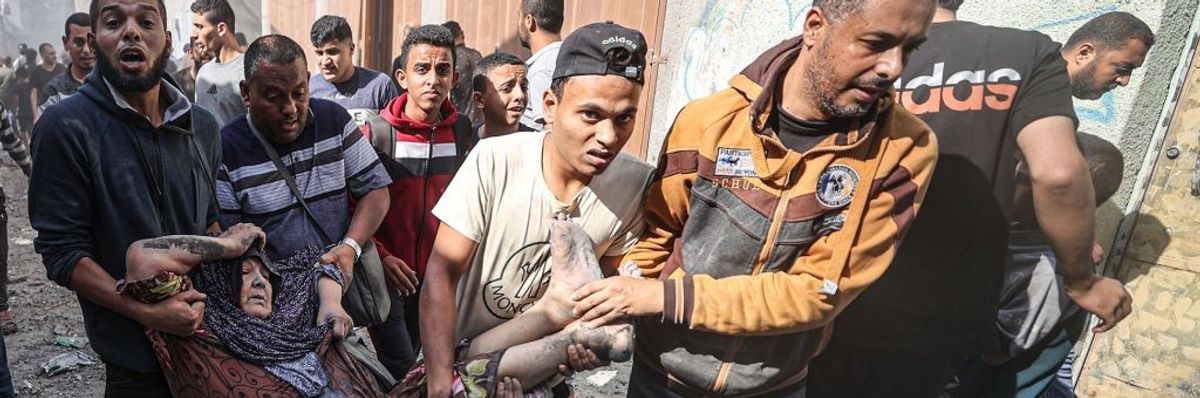
A woman covered in blood and dust being taken to a hospital amid destruction caused by Israeli attacks at Al Bureij Refugee Camp as Israeli attacks continue on the 27th day in Gaza City, Gaza on November 02, 2023.
War is both just and unjust simultaneously, and it will never end.
We—by which I mean most of humanity—are still playing with the so-called “just war theory,” the intellectual justification for war dating back to St. Augustine and the early centuries of the Common Era.
You know, violence is morally neutral—and thus, when the cause is just and sacred, go for it! Kill the non-believers. Make the world a better place.
Just war theory makes the world numb to human slaughter. Dead children, and all other innocent victims, become abstractions, collateral damage. It’s almost as though the role of lone-nut mass murderers—killers who clearly have no moral justification to walk into a shopping mall or school classroom or bowling alley and start shooting—is to remind the world that lives are precious and murders equal hell. Thus the recent mass shooting in Lewiston, Maine (apparently the 565th mass shooting in the U.S. this year) generated painful eulogies of the victims in the media, cutting open the national soul. Yes, their deaths are unspeakable tragedies!
But the thousands of dead in Gaza and every other war don’t get such public eulogies—because, of course, there are far too many of them to write about, but also . . . well, because the war may be just (and the U.S. is either waging it or supplying the weapons) and humanizing the collateral damage could make the good guys look bad.
Is the winner of a violent conflict, ipso facto, the one who’s right? Humanity is stuck with an enormous paradox.
So war is neutral. Killing children (and/or their parents) is neutral and sometimes necessary, for self-defense and other God-sanctioned reasons that make the world a better place. I can see St. Augustine’s point. The defense of what we value is necessary, and defense means fighting back.
But as I wrote a year ago: A serious, unaddressed problem comes along with this. “What if we value . . . oh, let’s say, whiteness? And along comes a nonwhite teenager who (allegedly) looks inappropriately at a white lady. Shouldn’t we lynch him? What’s to stop us? Violence is morally neutral.”
In other words, the neutrality of violence can be used by anyone in a position of power. Is the winner of a violent conflict, ipso facto, the one who’s right? Humanity is stuck with an enormous paradox. If war is morally neutral, anyone, including those whose values are morally questionable (or simply wrong), can resort to it. Thus we must never stop preparing for it. War is both just and unjust simultaneously, and it will never end.
And here’s the thing. War is not just. Indeed, it’s humanity’s cancer. It can’t happen without first obliterating our primary value: the sanctity of life. As Kelly Denton-Borhaug points out, citing the research of John Dower: “Dehumanization always precedes and paves the way for the horrors of war. Human beings won’t kill other humans if they truly believe their lives are as worthy as their own.”
Or as Israeli Defense Minister Yoav Gallant declared last month, as Israel’s “just war” got underway: “We are fighting human animals.”
And that makes any and every action possible. Denton-Borhaug goes on to note that “dehumanization does more than just enable war. It also generates an annihilating energy all its own through which the atrocity-laden destruction of war multiplies exponentially.”
Believing in the just-war theory means believing in—valuing—dehumanization.
In other words, during the course of war, the violence keeps intensifying. Why shouldn’t it? War’s entire point is winning, and when the enemy refuses to give up, the violence must increase. But her point transcends mere strategic necessity. The limitless expansion of violence takes on a life of its own. As she points out, during World War II, when the Japanese turned to kamikaze fighting, “the Americans abandoned precision bombing and initiated the full-scale firebombing of Japanese cities. The firebombing of Tokyo in March 1945 burned to death more than 100,000 civilians in a single night. More than 60 cities were similarly targeted, killing hundreds of thousands of Japanese in a final paroxysm of violence.”
And then, of course, came Hiroshima and Nagasaki.
And this is where the human race now finds itself. Just war theory, after several millennia of justified dehumanization, has led us to the brink of Armageddon. And we’re geopolitically fine with that! Powerful nations not only possess nukes, they — at least some of them, such as the U.S.—continue to modernize them, as though . . . my God, I can’t even complete this sentence. We’re living on a planet with two possibilities: no future without nuclear weapons, or no future at all.
Believing in the just-war theory means believing in—valuing—dehumanization. Not of all of us, as the defenders say. Only some of us. But to dehumanize part of the human race, part of who we are — so much so that we are prepared to turn them into ashes and dust — has consequences far beyond the simplistic mindset of winning or losing. This is poison. War will always come home, whether as loners with AK-47s or as nuclear winter.
Indeed, war doesn’t simply “come home,” a metaphor that implies a separated humanity—separated by invisible lines called national borders. Yes, conflict is part of who we are; we are a complex entity. But war drives a spike into our collective soul. We are one. When we prepare for and ultimately wage war, rather than reach for understanding, we are killing ourselves: our precious children, our fragile planet.
And we know this — every time we look into a child’s eyes. This is where our future pulsates.
This country and this world are at a monumental crossroads. US voters have an opportunity to beat back the forces of fascism and confront the billionaires who are rigging the economy, our media system, and our democracy, making it increasingly impossible for ordinary people to get by. We’re not just talking about the election. We’re talking about what must be done once these fascist elements are vanquished from power. We need a bolder set of solutions than what either major party has so far been willing to offer and a working-class movement ready to fight like hell for it. Trump didn't emerge from nowhere. The conditions that fueled MAGA authoritarianism were created by decades of radical neoliberal economic policies and a corrupt political system dominated by corporate interests. They slashed taxes on the super-rich, promising that the benefits would trickle down. They said giveaways to the corporate titans would make life more affordable for the rest of us. It was all bullshit. And when a bitter, betrayed populace searches for someone to blame, right-wing demagogues have little trouble finding scapegoats. People know when they're being lied to, but you won't hear any of this from the corporate media. Only independent journalism—powered and funded by people who believe in building a better world—can deliver truly trustworthy daily news. If you share our vision, please contribute whatever you can to sustain our work. |
We—by which I mean most of humanity—are still playing with the so-called “just war theory,” the intellectual justification for war dating back to St. Augustine and the early centuries of the Common Era.
You know, violence is morally neutral—and thus, when the cause is just and sacred, go for it! Kill the non-believers. Make the world a better place.
Just war theory makes the world numb to human slaughter. Dead children, and all other innocent victims, become abstractions, collateral damage. It’s almost as though the role of lone-nut mass murderers—killers who clearly have no moral justification to walk into a shopping mall or school classroom or bowling alley and start shooting—is to remind the world that lives are precious and murders equal hell. Thus the recent mass shooting in Lewiston, Maine (apparently the 565th mass shooting in the U.S. this year) generated painful eulogies of the victims in the media, cutting open the national soul. Yes, their deaths are unspeakable tragedies!
But the thousands of dead in Gaza and every other war don’t get such public eulogies—because, of course, there are far too many of them to write about, but also . . . well, because the war may be just (and the U.S. is either waging it or supplying the weapons) and humanizing the collateral damage could make the good guys look bad.
Is the winner of a violent conflict, ipso facto, the one who’s right? Humanity is stuck with an enormous paradox.
So war is neutral. Killing children (and/or their parents) is neutral and sometimes necessary, for self-defense and other God-sanctioned reasons that make the world a better place. I can see St. Augustine’s point. The defense of what we value is necessary, and defense means fighting back.
But as I wrote a year ago: A serious, unaddressed problem comes along with this. “What if we value . . . oh, let’s say, whiteness? And along comes a nonwhite teenager who (allegedly) looks inappropriately at a white lady. Shouldn’t we lynch him? What’s to stop us? Violence is morally neutral.”
In other words, the neutrality of violence can be used by anyone in a position of power. Is the winner of a violent conflict, ipso facto, the one who’s right? Humanity is stuck with an enormous paradox. If war is morally neutral, anyone, including those whose values are morally questionable (or simply wrong), can resort to it. Thus we must never stop preparing for it. War is both just and unjust simultaneously, and it will never end.
And here’s the thing. War is not just. Indeed, it’s humanity’s cancer. It can’t happen without first obliterating our primary value: the sanctity of life. As Kelly Denton-Borhaug points out, citing the research of John Dower: “Dehumanization always precedes and paves the way for the horrors of war. Human beings won’t kill other humans if they truly believe their lives are as worthy as their own.”
Or as Israeli Defense Minister Yoav Gallant declared last month, as Israel’s “just war” got underway: “We are fighting human animals.”
And that makes any and every action possible. Denton-Borhaug goes on to note that “dehumanization does more than just enable war. It also generates an annihilating energy all its own through which the atrocity-laden destruction of war multiplies exponentially.”
Believing in the just-war theory means believing in—valuing—dehumanization.
In other words, during the course of war, the violence keeps intensifying. Why shouldn’t it? War’s entire point is winning, and when the enemy refuses to give up, the violence must increase. But her point transcends mere strategic necessity. The limitless expansion of violence takes on a life of its own. As she points out, during World War II, when the Japanese turned to kamikaze fighting, “the Americans abandoned precision bombing and initiated the full-scale firebombing of Japanese cities. The firebombing of Tokyo in March 1945 burned to death more than 100,000 civilians in a single night. More than 60 cities were similarly targeted, killing hundreds of thousands of Japanese in a final paroxysm of violence.”
And then, of course, came Hiroshima and Nagasaki.
And this is where the human race now finds itself. Just war theory, after several millennia of justified dehumanization, has led us to the brink of Armageddon. And we’re geopolitically fine with that! Powerful nations not only possess nukes, they — at least some of them, such as the U.S.—continue to modernize them, as though . . . my God, I can’t even complete this sentence. We’re living on a planet with two possibilities: no future without nuclear weapons, or no future at all.
Believing in the just-war theory means believing in—valuing—dehumanization. Not of all of us, as the defenders say. Only some of us. But to dehumanize part of the human race, part of who we are — so much so that we are prepared to turn them into ashes and dust — has consequences far beyond the simplistic mindset of winning or losing. This is poison. War will always come home, whether as loners with AK-47s or as nuclear winter.
Indeed, war doesn’t simply “come home,” a metaphor that implies a separated humanity—separated by invisible lines called national borders. Yes, conflict is part of who we are; we are a complex entity. But war drives a spike into our collective soul. We are one. When we prepare for and ultimately wage war, rather than reach for understanding, we are killing ourselves: our precious children, our fragile planet.
And we know this — every time we look into a child’s eyes. This is where our future pulsates.