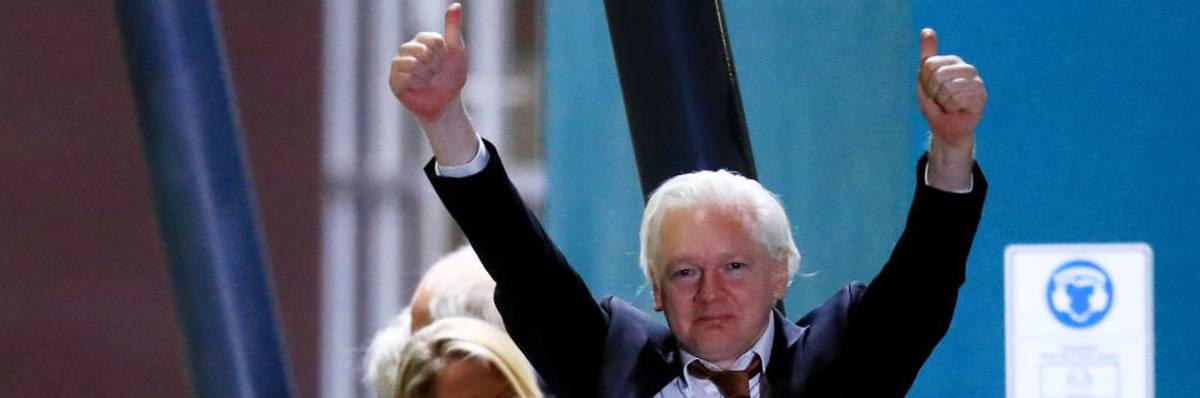
WikiLeaks founder Julian Assange gestures as he arrives at Canberra Airport on June 26, 2024 in Canberra, Australia. Julian Assange, the WikiLeaks founder, returned to his native Australia as a free man, after attending the U.S. District Court for the Northern Mariana Islands in Saipan on Wednesday.
Sick of Julian Assange? Fine. Just Don't Miss The Message.
The end of the legal saga for the Wikileaks' founder should not be seen as the end. It should be seen as a warning.
CD editor's note: The original Swedish language version of this op-ed first appeared in Sweden's Dagens Nyheter newspaper and this English translation is provided by the author.
After fifteen years, it appears that the Julian Assange case has reached a conclusion. But, as with almost everything to do with Assange, that conclusion may end up creating more problems than it solves, and raising more questions than it answers.
This was man who, on the back of material leaked by whistleblower Chelsea Manning, and by leveraging the possibilities presented by rapidly-evolving digital technologies, challenged the might of the U.S. military and the authority of the U.S. government. And, he did so through an innovative collaboration between WikiLeaks and major European and U.S. news outlets that for a brief period suggested the possibility of a new model for whistleblowing, data-gathering, and journalism.
The conclusion to the Assange case sends a clear and chilling message to journalists around the world... that you challenge U.S. power at your own peril.
WikiLeaks released the Collateral Murder video, showing a U.S. attack helicopter killing people in Baghdad, including two Reuters journalists. Some of those killed were blown to pieces as they lay injured on the ground. U.S. politicians and commentators, Democrats and Republicans alike, saw Assange and WikiLeaks as the enemy and as people who should, at best, be tried for espionage or treason or, at worst, assassinated. In 2010, none other than Donald Trump said there should be the “death penalty” for what WikiLeaks had done.
Then, the tide turned. In multiple directions. Because, after all, this was Assange.
The allegations of sexual assault made in Sweden in 2010 marked the start of a period where the support Assange and WikiLeaks had developed among some progressives rapidly began to fade. No charges were ever leveled against Assange for sexual assault or rape, but the fallout from the incident was stark. Assange called Sweden “the Saudi Arabia of feminism,” and his followers smeared his accusers as being lying tools of the U.S. government who had set Assange up. The misogyny was obvious and aggressive.
Assange sought asylum in the Ecuadorian embassy in London, and the Ecuadorian embassy years saw WikiLeaks rapidly disintegrate into a farcical side-show, marked by an increasingly close relationship between the Trump administration, a clear opposition to Hillary Clinton, the amplification of right-wing conspiracy theories and potentially dangerous acts such as linking to unredacted emails revealing private information about female voters in Turkey.
Assange, once considered by many to be a symbol of transparency, anti-Americanism and anti-militarism was now seen as doing the bidding of elites on the U.S. political right. He was hailed by right-wing politicians and commentators such as Tucker Carlson. In 2016, Trump, who just six years earlier said Assange and Manning should be put to death, now said, “I love WikiLeaks.”
The WikiLeaks account on Twitter became a steady mix of opinion, hyperbole, half-truths, and disinformation. The lifeblood of organizations that work with whistleblowers is a combination of trust, competence, and solidity. But, just the few short years after the leak of material from Chelsea Manning that shook the U.S. establishment and led to thousands of news articles across the globe, it was impossible to imagine any serious whistleblower deciding to work with WikiLeaks.
So, when Assange faced extradition to the U.S. to stand trial for his role in obtaining and publishing the material from Chelsea Manning, many shrugged their shoulders. The Assange/WikiLeaks image had been permanently tarnished. If he wasn’t guilty of espionage, the reasoning went, then the sexual assault allegations, the suggested support for Trump and the disintegration of WikiLeaks into amplifying right-wing conspiracy theories clearly made him unworthy of sympathy or attention.
And yet.
All of the distaste for Assange the person, and for what WikiLeaks had become in the years after the Manning leaks, overshadowed a fundamental yet powerful truth. The Assange case was, and is, absolutely fundamental to the working of critical investigative journalism in the U.S. and globally. Whatever dislike one may have for Assange or WikiLeaks, the fact remains that his pleading guilty to one felony count of "conspiring to unlawfully obtain and disseminate classified information relating to the national defense of the U.S." might enable Assange to leave prison, but is nevertheless a victory for the United States government and military, and a loss for freedom of information and the critical examination of power.
The conclusion to the Assange case sends a clear and chilling message to journalists around the world—Assange isn’t American, remember—that you challenge U.S. power at your own peril. This, in turn, sends a message to citizens that they are not worthy of knowing what the state does in their name. Which is pretty ironic, given that democracy is supposed to be about the rule of the people.
So, the end of the Assange case has given us one final twist, namely that the end is not the end.
It’s a warning.
We are at a crossroads
This country and this world are at a monumental crossroads. In a few short weeks, US voters will have an opportunity to beat back the forces of fascism and confront the billionaires who are rigging the economy, our media system, and our democracy, making it increasingly impossible for ordinary people to get by. We’re not just talking about the election. We’re talking about what must be done once these fascist elements are vanquished from power. We need a bolder set of solutions than what either major party has so far been willing to offer and a working-class movement ready to fight like hell for it. Trump didn't emerge from nowhere. The conditions that fueled MAGA authoritarianism were created by decades of radical neoliberal economic policies and a corrupt political system dominated by corporate interests. They slashed taxes on the super-rich, promising that the benefits would trickle down. They said giveaways to the corporate titans would make life more affordable for the rest of us. It was all bullshit. And when a bitter, betrayed populace searches for someone to blame, right-wing demagogues have little trouble finding scapegoats. People know when they're being lied to, but you won't hear any of this from the corporate media. Only independent journalism—powered and funded by people who believe in building a better world—can deliver truly trustworthy daily news. Our Fall Campaign is underway, and we need your help. To power our newsroom through the rest of the year, we need to raise $125,000 by midnight on October 31. So if you share our vision, please contribute whatever you can to sustain our work. |
CD editor's note: The original Swedish language version of this op-ed first appeared in Sweden's Dagens Nyheter newspaper and this English translation is provided by the author.
After fifteen years, it appears that the Julian Assange case has reached a conclusion. But, as with almost everything to do with Assange, that conclusion may end up creating more problems than it solves, and raising more questions than it answers.
This was man who, on the back of material leaked by whistleblower Chelsea Manning, and by leveraging the possibilities presented by rapidly-evolving digital technologies, challenged the might of the U.S. military and the authority of the U.S. government. And, he did so through an innovative collaboration between WikiLeaks and major European and U.S. news outlets that for a brief period suggested the possibility of a new model for whistleblowing, data-gathering, and journalism.
The conclusion to the Assange case sends a clear and chilling message to journalists around the world... that you challenge U.S. power at your own peril.
WikiLeaks released the Collateral Murder video, showing a U.S. attack helicopter killing people in Baghdad, including two Reuters journalists. Some of those killed were blown to pieces as they lay injured on the ground. U.S. politicians and commentators, Democrats and Republicans alike, saw Assange and WikiLeaks as the enemy and as people who should, at best, be tried for espionage or treason or, at worst, assassinated. In 2010, none other than Donald Trump said there should be the “death penalty” for what WikiLeaks had done.
Then, the tide turned. In multiple directions. Because, after all, this was Assange.
The allegations of sexual assault made in Sweden in 2010 marked the start of a period where the support Assange and WikiLeaks had developed among some progressives rapidly began to fade. No charges were ever leveled against Assange for sexual assault or rape, but the fallout from the incident was stark. Assange called Sweden “the Saudi Arabia of feminism,” and his followers smeared his accusers as being lying tools of the U.S. government who had set Assange up. The misogyny was obvious and aggressive.
Assange sought asylum in the Ecuadorian embassy in London, and the Ecuadorian embassy years saw WikiLeaks rapidly disintegrate into a farcical side-show, marked by an increasingly close relationship between the Trump administration, a clear opposition to Hillary Clinton, the amplification of right-wing conspiracy theories and potentially dangerous acts such as linking to unredacted emails revealing private information about female voters in Turkey.
Assange, once considered by many to be a symbol of transparency, anti-Americanism and anti-militarism was now seen as doing the bidding of elites on the U.S. political right. He was hailed by right-wing politicians and commentators such as Tucker Carlson. In 2016, Trump, who just six years earlier said Assange and Manning should be put to death, now said, “I love WikiLeaks.”
The WikiLeaks account on Twitter became a steady mix of opinion, hyperbole, half-truths, and disinformation. The lifeblood of organizations that work with whistleblowers is a combination of trust, competence, and solidity. But, just the few short years after the leak of material from Chelsea Manning that shook the U.S. establishment and led to thousands of news articles across the globe, it was impossible to imagine any serious whistleblower deciding to work with WikiLeaks.
So, when Assange faced extradition to the U.S. to stand trial for his role in obtaining and publishing the material from Chelsea Manning, many shrugged their shoulders. The Assange/WikiLeaks image had been permanently tarnished. If he wasn’t guilty of espionage, the reasoning went, then the sexual assault allegations, the suggested support for Trump and the disintegration of WikiLeaks into amplifying right-wing conspiracy theories clearly made him unworthy of sympathy or attention.
And yet.
All of the distaste for Assange the person, and for what WikiLeaks had become in the years after the Manning leaks, overshadowed a fundamental yet powerful truth. The Assange case was, and is, absolutely fundamental to the working of critical investigative journalism in the U.S. and globally. Whatever dislike one may have for Assange or WikiLeaks, the fact remains that his pleading guilty to one felony count of "conspiring to unlawfully obtain and disseminate classified information relating to the national defense of the U.S." might enable Assange to leave prison, but is nevertheless a victory for the United States government and military, and a loss for freedom of information and the critical examination of power.
The conclusion to the Assange case sends a clear and chilling message to journalists around the world—Assange isn’t American, remember—that you challenge U.S. power at your own peril. This, in turn, sends a message to citizens that they are not worthy of knowing what the state does in their name. Which is pretty ironic, given that democracy is supposed to be about the rule of the people.
So, the end of the Assange case has given us one final twist, namely that the end is not the end.
It’s a warning.
- WikiLeaks Founder Julian Assange 'Dragged Out' of Ecuadorian Embassy, Arrested By UK Police ›
- 'Julian Assange Is Free': WikiLeaks Founder Strikes Plea Deal With US ›
- Collateral Murder and the Persecution of Julian Assange ›
- Even as Julian Assange's Release Celebrated, Deep Worries Remain for Press Freedom ›
CD editor's note: The original Swedish language version of this op-ed first appeared in Sweden's Dagens Nyheter newspaper and this English translation is provided by the author.
After fifteen years, it appears that the Julian Assange case has reached a conclusion. But, as with almost everything to do with Assange, that conclusion may end up creating more problems than it solves, and raising more questions than it answers.
This was man who, on the back of material leaked by whistleblower Chelsea Manning, and by leveraging the possibilities presented by rapidly-evolving digital technologies, challenged the might of the U.S. military and the authority of the U.S. government. And, he did so through an innovative collaboration between WikiLeaks and major European and U.S. news outlets that for a brief period suggested the possibility of a new model for whistleblowing, data-gathering, and journalism.
The conclusion to the Assange case sends a clear and chilling message to journalists around the world... that you challenge U.S. power at your own peril.
WikiLeaks released the Collateral Murder video, showing a U.S. attack helicopter killing people in Baghdad, including two Reuters journalists. Some of those killed were blown to pieces as they lay injured on the ground. U.S. politicians and commentators, Democrats and Republicans alike, saw Assange and WikiLeaks as the enemy and as people who should, at best, be tried for espionage or treason or, at worst, assassinated. In 2010, none other than Donald Trump said there should be the “death penalty” for what WikiLeaks had done.
Then, the tide turned. In multiple directions. Because, after all, this was Assange.
The allegations of sexual assault made in Sweden in 2010 marked the start of a period where the support Assange and WikiLeaks had developed among some progressives rapidly began to fade. No charges were ever leveled against Assange for sexual assault or rape, but the fallout from the incident was stark. Assange called Sweden “the Saudi Arabia of feminism,” and his followers smeared his accusers as being lying tools of the U.S. government who had set Assange up. The misogyny was obvious and aggressive.
Assange sought asylum in the Ecuadorian embassy in London, and the Ecuadorian embassy years saw WikiLeaks rapidly disintegrate into a farcical side-show, marked by an increasingly close relationship between the Trump administration, a clear opposition to Hillary Clinton, the amplification of right-wing conspiracy theories and potentially dangerous acts such as linking to unredacted emails revealing private information about female voters in Turkey.
Assange, once considered by many to be a symbol of transparency, anti-Americanism and anti-militarism was now seen as doing the bidding of elites on the U.S. political right. He was hailed by right-wing politicians and commentators such as Tucker Carlson. In 2016, Trump, who just six years earlier said Assange and Manning should be put to death, now said, “I love WikiLeaks.”
The WikiLeaks account on Twitter became a steady mix of opinion, hyperbole, half-truths, and disinformation. The lifeblood of organizations that work with whistleblowers is a combination of trust, competence, and solidity. But, just the few short years after the leak of material from Chelsea Manning that shook the U.S. establishment and led to thousands of news articles across the globe, it was impossible to imagine any serious whistleblower deciding to work with WikiLeaks.
So, when Assange faced extradition to the U.S. to stand trial for his role in obtaining and publishing the material from Chelsea Manning, many shrugged their shoulders. The Assange/WikiLeaks image had been permanently tarnished. If he wasn’t guilty of espionage, the reasoning went, then the sexual assault allegations, the suggested support for Trump and the disintegration of WikiLeaks into amplifying right-wing conspiracy theories clearly made him unworthy of sympathy or attention.
And yet.
All of the distaste for Assange the person, and for what WikiLeaks had become in the years after the Manning leaks, overshadowed a fundamental yet powerful truth. The Assange case was, and is, absolutely fundamental to the working of critical investigative journalism in the U.S. and globally. Whatever dislike one may have for Assange or WikiLeaks, the fact remains that his pleading guilty to one felony count of "conspiring to unlawfully obtain and disseminate classified information relating to the national defense of the U.S." might enable Assange to leave prison, but is nevertheless a victory for the United States government and military, and a loss for freedom of information and the critical examination of power.
The conclusion to the Assange case sends a clear and chilling message to journalists around the world—Assange isn’t American, remember—that you challenge U.S. power at your own peril. This, in turn, sends a message to citizens that they are not worthy of knowing what the state does in their name. Which is pretty ironic, given that democracy is supposed to be about the rule of the people.
So, the end of the Assange case has given us one final twist, namely that the end is not the end.
It’s a warning.
- WikiLeaks Founder Julian Assange 'Dragged Out' of Ecuadorian Embassy, Arrested By UK Police ›
- 'Julian Assange Is Free': WikiLeaks Founder Strikes Plea Deal With US ›
- Collateral Murder and the Persecution of Julian Assange ›
- Even as Julian Assange's Release Celebrated, Deep Worries Remain for Press Freedom ›