SUBSCRIBE TO OUR FREE NEWSLETTER
Daily news & progressive opinion—funded by the people, not the corporations—delivered straight to your inbox.
5
#000000
#FFFFFF
To donate by check, phone, or other method, see our More Ways to Give page.
Daily news & progressive opinion—funded by the people, not the corporations—delivered straight to your inbox.
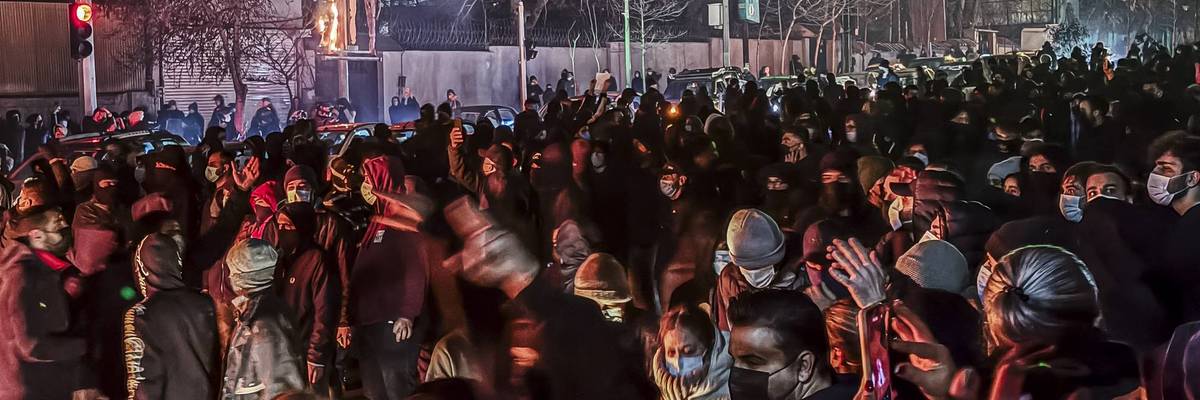
Iranians gather while blocking a street during a protest in Tehran, Iran on January 9, 2026.
I sit with the reality that I have no idea what Iranians really want. I don’t know what they go through day to day. I haven’t been on the ground. I haven’t spoken to them.
My Mamanbozorg, or maternal grandmother, died on Monday, January 5, 2026 in Iran.
My family and I hadn’t seen her in roughly four years. We didn’t get to care for her or help with her adjusting to life in a nursing home. We didn’t witness her dementia in person. We said our goodbyes from afar. We watched her burial over video footage and photos. We grieved as a family together on FaceTime.
This is not unusual for Iranian families outside of Iran, to not feel safe to return to their birth country, not even during times of grief. The Iranian government is unpredictable. They may hold passports under false accusations of espionage.
This is a layer of grief of being an immigrant that no one really talks about. To be an immigrant, especially one in exile, is to grieve not just the loss of homeland, but the loss of loved ones. Some believe that seeing the body after death helps the living with the grief process. What about the immigrant mother who doesn’t get to hold her dying mother’s hand on her death bed?
Iranians, like any other nation, deserve full human rights. They deserve dignity and freedom, and the right to choose their government. What they don’t need is a Western savior.
As I write this, Iran is once again in the headlines. Mainstream headlines are calling out the number of protester deaths. A hypocrite media is the perfect match for a hypocrite government. They assume the position of caring for the Iranian people and their human rights. When it comes to Iran, democracy and freedom matter to American media and politicians. Meanwhile, they have no problem with the slaughter of Palestinians. Palestinians’ freedom and democracy are never considered.
Everyone on the internet has an opinion on Iran. Leftists, conservatives, monarchists, liberals, Zionists: a collision of beliefs on what’s right for the future of Iranians and Iran.
I was born and raised in Iran and lived there for 11 years. I moved to the US in 1999. My family has suffered and endured unimaginable grief and cruelty under both governments: the Pahlavi Kingdom and the current Islamic Republic. No version of the Iranian flag resonates with me. I can sit here on my comfortable couch in suburban America and write about my dreams and visions for the Iranian people.
Instead, I sit with the reality that I have no idea what Iranians really want. I don’t know what they go through day to day. I haven’t been on the ground. I haven’t spoken to them. I have a general sense from reports from friends and family and the diaspora, but I don’t know. I don’t have the right to pretend that I do. I don’t have the right to dictate to my Western audience that I am writing on behalf of all Iranian people.
I write from the position of being an Iranian immigrant woman in my late 30s, grieving the loss of my beloved Mamanbozorg, calling my mother daily to hold her grief and to fill the gaping hole in her heart with love. I am heartbroken to see Iranians dying on the streets, their voices yet again repressed. I am angry at Western politicians who pretend to care about Iranian life for their own interests and agendas in the region. I am angry at the Iranian government who continues to kill, repress, and quash dissent. It feels isolating to want to speak on this grief, but knowing that I must do so carefully or my words will be taken out of context.
Iranians, like any other nation, deserve full human rights. They deserve dignity and freedom, and the right to choose their government. What they don’t need is a Western savior.
Dear Common Dreams reader, It’s been nearly 30 years since I co-founded Common Dreams with my late wife, Lina Newhouser. We had the radical notion that journalism should serve the public good, not corporate profits. It was clear to us from the outset what it would take to build such a project. No paid advertisements. No corporate sponsors. No millionaire publisher telling us what to think or do. Many people said we wouldn't last a year, but we proved those doubters wrong. Together with a tremendous team of journalists and dedicated staff, we built an independent media outlet free from the constraints of profits and corporate control. Our mission has always been simple: To inform. To inspire. To ignite change for the common good. Building Common Dreams was not easy. Our survival was never guaranteed. When you take on the most powerful forces—Wall Street greed, fossil fuel industry destruction, Big Tech lobbyists, and uber-rich oligarchs who have spent billions upon billions rigging the economy and democracy in their favor—the only bulwark you have is supporters who believe in your work. But here’s the urgent message from me today. It's never been this bad out there. And it's never been this hard to keep us going. At the very moment Common Dreams is most needed, the threats we face are intensifying. We need your support now more than ever. We don't accept corporate advertising and never will. We don't have a paywall because we don't think people should be blocked from critical news based on their ability to pay. Everything we do is funded by the donations of readers like you. When everyone does the little they can afford, we are strong. But if that support retreats or dries up, so do we. Will you donate now to make sure Common Dreams not only survives but thrives? —Craig Brown, Co-founder |
My Mamanbozorg, or maternal grandmother, died on Monday, January 5, 2026 in Iran.
My family and I hadn’t seen her in roughly four years. We didn’t get to care for her or help with her adjusting to life in a nursing home. We didn’t witness her dementia in person. We said our goodbyes from afar. We watched her burial over video footage and photos. We grieved as a family together on FaceTime.
This is not unusual for Iranian families outside of Iran, to not feel safe to return to their birth country, not even during times of grief. The Iranian government is unpredictable. They may hold passports under false accusations of espionage.
This is a layer of grief of being an immigrant that no one really talks about. To be an immigrant, especially one in exile, is to grieve not just the loss of homeland, but the loss of loved ones. Some believe that seeing the body after death helps the living with the grief process. What about the immigrant mother who doesn’t get to hold her dying mother’s hand on her death bed?
Iranians, like any other nation, deserve full human rights. They deserve dignity and freedom, and the right to choose their government. What they don’t need is a Western savior.
As I write this, Iran is once again in the headlines. Mainstream headlines are calling out the number of protester deaths. A hypocrite media is the perfect match for a hypocrite government. They assume the position of caring for the Iranian people and their human rights. When it comes to Iran, democracy and freedom matter to American media and politicians. Meanwhile, they have no problem with the slaughter of Palestinians. Palestinians’ freedom and democracy are never considered.
Everyone on the internet has an opinion on Iran. Leftists, conservatives, monarchists, liberals, Zionists: a collision of beliefs on what’s right for the future of Iranians and Iran.
I was born and raised in Iran and lived there for 11 years. I moved to the US in 1999. My family has suffered and endured unimaginable grief and cruelty under both governments: the Pahlavi Kingdom and the current Islamic Republic. No version of the Iranian flag resonates with me. I can sit here on my comfortable couch in suburban America and write about my dreams and visions for the Iranian people.
Instead, I sit with the reality that I have no idea what Iranians really want. I don’t know what they go through day to day. I haven’t been on the ground. I haven’t spoken to them. I have a general sense from reports from friends and family and the diaspora, but I don’t know. I don’t have the right to pretend that I do. I don’t have the right to dictate to my Western audience that I am writing on behalf of all Iranian people.
I write from the position of being an Iranian immigrant woman in my late 30s, grieving the loss of my beloved Mamanbozorg, calling my mother daily to hold her grief and to fill the gaping hole in her heart with love. I am heartbroken to see Iranians dying on the streets, their voices yet again repressed. I am angry at Western politicians who pretend to care about Iranian life for their own interests and agendas in the region. I am angry at the Iranian government who continues to kill, repress, and quash dissent. It feels isolating to want to speak on this grief, but knowing that I must do so carefully or my words will be taken out of context.
Iranians, like any other nation, deserve full human rights. They deserve dignity and freedom, and the right to choose their government. What they don’t need is a Western savior.
My Mamanbozorg, or maternal grandmother, died on Monday, January 5, 2026 in Iran.
My family and I hadn’t seen her in roughly four years. We didn’t get to care for her or help with her adjusting to life in a nursing home. We didn’t witness her dementia in person. We said our goodbyes from afar. We watched her burial over video footage and photos. We grieved as a family together on FaceTime.
This is not unusual for Iranian families outside of Iran, to not feel safe to return to their birth country, not even during times of grief. The Iranian government is unpredictable. They may hold passports under false accusations of espionage.
This is a layer of grief of being an immigrant that no one really talks about. To be an immigrant, especially one in exile, is to grieve not just the loss of homeland, but the loss of loved ones. Some believe that seeing the body after death helps the living with the grief process. What about the immigrant mother who doesn’t get to hold her dying mother’s hand on her death bed?
Iranians, like any other nation, deserve full human rights. They deserve dignity and freedom, and the right to choose their government. What they don’t need is a Western savior.
As I write this, Iran is once again in the headlines. Mainstream headlines are calling out the number of protester deaths. A hypocrite media is the perfect match for a hypocrite government. They assume the position of caring for the Iranian people and their human rights. When it comes to Iran, democracy and freedom matter to American media and politicians. Meanwhile, they have no problem with the slaughter of Palestinians. Palestinians’ freedom and democracy are never considered.
Everyone on the internet has an opinion on Iran. Leftists, conservatives, monarchists, liberals, Zionists: a collision of beliefs on what’s right for the future of Iranians and Iran.
I was born and raised in Iran and lived there for 11 years. I moved to the US in 1999. My family has suffered and endured unimaginable grief and cruelty under both governments: the Pahlavi Kingdom and the current Islamic Republic. No version of the Iranian flag resonates with me. I can sit here on my comfortable couch in suburban America and write about my dreams and visions for the Iranian people.
Instead, I sit with the reality that I have no idea what Iranians really want. I don’t know what they go through day to day. I haven’t been on the ground. I haven’t spoken to them. I have a general sense from reports from friends and family and the diaspora, but I don’t know. I don’t have the right to pretend that I do. I don’t have the right to dictate to my Western audience that I am writing on behalf of all Iranian people.
I write from the position of being an Iranian immigrant woman in my late 30s, grieving the loss of my beloved Mamanbozorg, calling my mother daily to hold her grief and to fill the gaping hole in her heart with love. I am heartbroken to see Iranians dying on the streets, their voices yet again repressed. I am angry at Western politicians who pretend to care about Iranian life for their own interests and agendas in the region. I am angry at the Iranian government who continues to kill, repress, and quash dissent. It feels isolating to want to speak on this grief, but knowing that I must do so carefully or my words will be taken out of context.
Iranians, like any other nation, deserve full human rights. They deserve dignity and freedom, and the right to choose their government. What they don’t need is a Western savior.