SUBSCRIBE TO OUR FREE NEWSLETTER
Daily news & progressive opinion—funded by the people, not the corporations—delivered straight to your inbox.
5
#000000
#FFFFFF
To donate by check, phone, or other method, see our More Ways to Give page.
Daily news & progressive opinion—funded by the people, not the corporations—delivered straight to your inbox.
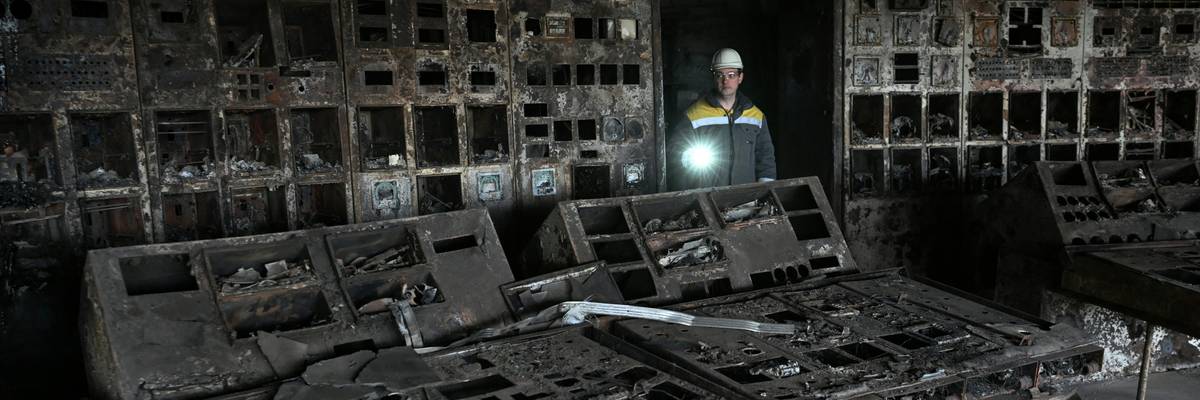
A worker walks through a burned out control room at a power plant of energy provider DTEK, destroyed after an attack, in an undisclosed location in Ukraine on April 19, 2024, amid the Russian invasion of Ukraine.
Russia aims not only to destroy Ukraine's physical infrastructure but also to erode confidence in its government, undermine international support, and exploit the world's dependence on fossil fuels.
In 2022, Russian propagandists spread fear across Europe, playing on the "fear of the cold" by pushing narratives like "Europe will freeze without Russian gas." Now, in 2024, we are still witnessing the devastating effects of this hybrid warfare, with energy playing a central role in Russia's aggression against Ukraine.
Hybrid warfare is more than just conventional military aggression. It involves a strategic blend of economic, informational, and cyber tactics designed to disrupt societies and weaken the Kremlin's targets. Russia's hybrid warfare against Ukraine, particularly in the energy sector, illustrates this perfectly. By combining direct military assaults with cyberattacks, energy blockades, and unprecedented widespread disinformation campaigns, Russia aims not only to destroy Ukraine's physical infrastructure but also to erode confidence in its government, undermine international support, and exploit the world's dependence on fossil fuels.
Russia has weaponized energy exports as a critical element in its war on Ukraine. Today, Ukraine's energy infrastructure is under relentless attack, with over 50% damaged, often leaving millions of Ukrainians without reliable power. While missiles and drones visibly ravage Ukrainian cities, another, less visible battle rages in cyberspace and through the media, targeting the energy sector.
Renewable energy is the path to a safer, more just world in the battle against Russian aggression and climate change
In 2024 alone, the Kremlin-backed hacker group Sandworm launched numerous cyberattacks on Ukrainian energy facilities. These assaults, timed to coincide with Russian missile strikes, are part of a broader campaign to cripple Ukraine's ability to generate and distribute energy. A report from Ukraine's computer emergency response team (CERT-UA) confirmed that Sandworm infected energy, water, and heating suppliers in at least 10 regions of Ukraine this year. Cyberattacks like these are designed to paralyze Ukraine's recovery, create chaos, and force the government to divert critical resources away from the front lines.
In parallel, Russia's disinformation campaigns have relentlessly targeted Ukraine's energy independence. False narratives about new power projects, like the construction of additional reactors at the Khmelnytskyi Nuclear Power Plant (KhNPP), are intended to spread fear and uncertainty. Russian propagandists claim that the project will lead to a "nuclear disaster, comparable to Chernobyl" and that Ukraine is incapable of safely managing its nuclear energy sector. These lies are designed to erode public trust and cast doubt on the country's capacity to modernize its energy infrastructure.
Disinformation spreads through pro-Kremlin Telegram channels and foreign media outlets, suggesting that Ukraine is unprepared for the responsibilities of managing its energy sector. The goal is to sow doubt among Ukraine's international allies, reduce foreign investment in critical energy projects, and delay Ukraine's shift toward renewable energy.
Such disinformation campaigns do not stop at Ukraine's door. Russia has also employed similar tactics in Western nations, influencing public discourse and policy on energy. In 2024, the U.S. Department of Justice uncovered a large-scale Russian disinformation campaign designed to interfere in the U.S. presidential race. These operations use unsuspecting PR firms and social media channels to spread narratives beneficial to Russia, further demonstrating the global reach of Russia's hybrid warfare strategy.
The consequences of these campaigns are far-reaching. Disinformation can:
To counter Russia's hybrid warfare, Ukraine and its allies must not only defend against missile strikes and cyberattacks but also combat the disinformation campaigns that erode public trust and international support. The best response to Russia's weaponization of energy is to weaken its dominance in the sector altogether.
Ukraine's shift toward cheaper renewable energy offers a clear path to energy security and independence. Renewables—wind, solar, and hydropower—are not only crucial for Ukraine's recovery and economic security but also harder to target, making them more resilient to future threats. Ukraine's shift to renewables is pivotal for its security, global energy stability, and the fight against climate change.
Ukraine's future—and indeed the future of global security—depends on breaking free from the grip of fossil fuels that fuel both war and disinformation. Russia's energy dominance has not only bankrolled its military but has also been a tool of manipulation, distorting public perception and sowing distrust. Ukraine can secure its independence by accelerating the transition to renewable energy while setting an example for the world. Global support for Ukraine's energy revolution is not just a step toward rebuilding the country—it is a decisive blow against the disinformation networks and economic strangleholds that empower petro-dictatorships.
Renewable energy is the path to a safer, more just world in the battle against Russian aggression and climate change. The time to act is now.
Dear Common Dreams reader, It’s been nearly 30 years since I co-founded Common Dreams with my late wife, Lina Newhouser. We had the radical notion that journalism should serve the public good, not corporate profits. It was clear to us from the outset what it would take to build such a project. No paid advertisements. No corporate sponsors. No millionaire publisher telling us what to think or do. Many people said we wouldn't last a year, but we proved those doubters wrong. Together with a tremendous team of journalists and dedicated staff, we built an independent media outlet free from the constraints of profits and corporate control. Our mission has always been simple: To inform. To inspire. To ignite change for the common good. Building Common Dreams was not easy. Our survival was never guaranteed. When you take on the most powerful forces—Wall Street greed, fossil fuel industry destruction, Big Tech lobbyists, and uber-rich oligarchs who have spent billions upon billions rigging the economy and democracy in their favor—the only bulwark you have is supporters who believe in your work. But here’s the urgent message from me today. It's never been this bad out there. And it's never been this hard to keep us going. At the very moment Common Dreams is most needed, the threats we face are intensifying. We need your support now more than ever. We don't accept corporate advertising and never will. We don't have a paywall because we don't think people should be blocked from critical news based on their ability to pay. Everything we do is funded by the donations of readers like you. When everyone does the little they can afford, we are strong. But if that support retreats or dries up, so do we. Will you donate now to make sure Common Dreams not only survives but thrives? —Craig Brown, Co-founder |
In 2022, Russian propagandists spread fear across Europe, playing on the "fear of the cold" by pushing narratives like "Europe will freeze without Russian gas." Now, in 2024, we are still witnessing the devastating effects of this hybrid warfare, with energy playing a central role in Russia's aggression against Ukraine.
Hybrid warfare is more than just conventional military aggression. It involves a strategic blend of economic, informational, and cyber tactics designed to disrupt societies and weaken the Kremlin's targets. Russia's hybrid warfare against Ukraine, particularly in the energy sector, illustrates this perfectly. By combining direct military assaults with cyberattacks, energy blockades, and unprecedented widespread disinformation campaigns, Russia aims not only to destroy Ukraine's physical infrastructure but also to erode confidence in its government, undermine international support, and exploit the world's dependence on fossil fuels.
Russia has weaponized energy exports as a critical element in its war on Ukraine. Today, Ukraine's energy infrastructure is under relentless attack, with over 50% damaged, often leaving millions of Ukrainians without reliable power. While missiles and drones visibly ravage Ukrainian cities, another, less visible battle rages in cyberspace and through the media, targeting the energy sector.
Renewable energy is the path to a safer, more just world in the battle against Russian aggression and climate change
In 2024 alone, the Kremlin-backed hacker group Sandworm launched numerous cyberattacks on Ukrainian energy facilities. These assaults, timed to coincide with Russian missile strikes, are part of a broader campaign to cripple Ukraine's ability to generate and distribute energy. A report from Ukraine's computer emergency response team (CERT-UA) confirmed that Sandworm infected energy, water, and heating suppliers in at least 10 regions of Ukraine this year. Cyberattacks like these are designed to paralyze Ukraine's recovery, create chaos, and force the government to divert critical resources away from the front lines.
In parallel, Russia's disinformation campaigns have relentlessly targeted Ukraine's energy independence. False narratives about new power projects, like the construction of additional reactors at the Khmelnytskyi Nuclear Power Plant (KhNPP), are intended to spread fear and uncertainty. Russian propagandists claim that the project will lead to a "nuclear disaster, comparable to Chernobyl" and that Ukraine is incapable of safely managing its nuclear energy sector. These lies are designed to erode public trust and cast doubt on the country's capacity to modernize its energy infrastructure.
Disinformation spreads through pro-Kremlin Telegram channels and foreign media outlets, suggesting that Ukraine is unprepared for the responsibilities of managing its energy sector. The goal is to sow doubt among Ukraine's international allies, reduce foreign investment in critical energy projects, and delay Ukraine's shift toward renewable energy.
Such disinformation campaigns do not stop at Ukraine's door. Russia has also employed similar tactics in Western nations, influencing public discourse and policy on energy. In 2024, the U.S. Department of Justice uncovered a large-scale Russian disinformation campaign designed to interfere in the U.S. presidential race. These operations use unsuspecting PR firms and social media channels to spread narratives beneficial to Russia, further demonstrating the global reach of Russia's hybrid warfare strategy.
The consequences of these campaigns are far-reaching. Disinformation can:
To counter Russia's hybrid warfare, Ukraine and its allies must not only defend against missile strikes and cyberattacks but also combat the disinformation campaigns that erode public trust and international support. The best response to Russia's weaponization of energy is to weaken its dominance in the sector altogether.
Ukraine's shift toward cheaper renewable energy offers a clear path to energy security and independence. Renewables—wind, solar, and hydropower—are not only crucial for Ukraine's recovery and economic security but also harder to target, making them more resilient to future threats. Ukraine's shift to renewables is pivotal for its security, global energy stability, and the fight against climate change.
Ukraine's future—and indeed the future of global security—depends on breaking free from the grip of fossil fuels that fuel both war and disinformation. Russia's energy dominance has not only bankrolled its military but has also been a tool of manipulation, distorting public perception and sowing distrust. Ukraine can secure its independence by accelerating the transition to renewable energy while setting an example for the world. Global support for Ukraine's energy revolution is not just a step toward rebuilding the country—it is a decisive blow against the disinformation networks and economic strangleholds that empower petro-dictatorships.
Renewable energy is the path to a safer, more just world in the battle against Russian aggression and climate change. The time to act is now.
In 2022, Russian propagandists spread fear across Europe, playing on the "fear of the cold" by pushing narratives like "Europe will freeze without Russian gas." Now, in 2024, we are still witnessing the devastating effects of this hybrid warfare, with energy playing a central role in Russia's aggression against Ukraine.
Hybrid warfare is more than just conventional military aggression. It involves a strategic blend of economic, informational, and cyber tactics designed to disrupt societies and weaken the Kremlin's targets. Russia's hybrid warfare against Ukraine, particularly in the energy sector, illustrates this perfectly. By combining direct military assaults with cyberattacks, energy blockades, and unprecedented widespread disinformation campaigns, Russia aims not only to destroy Ukraine's physical infrastructure but also to erode confidence in its government, undermine international support, and exploit the world's dependence on fossil fuels.
Russia has weaponized energy exports as a critical element in its war on Ukraine. Today, Ukraine's energy infrastructure is under relentless attack, with over 50% damaged, often leaving millions of Ukrainians without reliable power. While missiles and drones visibly ravage Ukrainian cities, another, less visible battle rages in cyberspace and through the media, targeting the energy sector.
Renewable energy is the path to a safer, more just world in the battle against Russian aggression and climate change
In 2024 alone, the Kremlin-backed hacker group Sandworm launched numerous cyberattacks on Ukrainian energy facilities. These assaults, timed to coincide with Russian missile strikes, are part of a broader campaign to cripple Ukraine's ability to generate and distribute energy. A report from Ukraine's computer emergency response team (CERT-UA) confirmed that Sandworm infected energy, water, and heating suppliers in at least 10 regions of Ukraine this year. Cyberattacks like these are designed to paralyze Ukraine's recovery, create chaos, and force the government to divert critical resources away from the front lines.
In parallel, Russia's disinformation campaigns have relentlessly targeted Ukraine's energy independence. False narratives about new power projects, like the construction of additional reactors at the Khmelnytskyi Nuclear Power Plant (KhNPP), are intended to spread fear and uncertainty. Russian propagandists claim that the project will lead to a "nuclear disaster, comparable to Chernobyl" and that Ukraine is incapable of safely managing its nuclear energy sector. These lies are designed to erode public trust and cast doubt on the country's capacity to modernize its energy infrastructure.
Disinformation spreads through pro-Kremlin Telegram channels and foreign media outlets, suggesting that Ukraine is unprepared for the responsibilities of managing its energy sector. The goal is to sow doubt among Ukraine's international allies, reduce foreign investment in critical energy projects, and delay Ukraine's shift toward renewable energy.
Such disinformation campaigns do not stop at Ukraine's door. Russia has also employed similar tactics in Western nations, influencing public discourse and policy on energy. In 2024, the U.S. Department of Justice uncovered a large-scale Russian disinformation campaign designed to interfere in the U.S. presidential race. These operations use unsuspecting PR firms and social media channels to spread narratives beneficial to Russia, further demonstrating the global reach of Russia's hybrid warfare strategy.
The consequences of these campaigns are far-reaching. Disinformation can:
To counter Russia's hybrid warfare, Ukraine and its allies must not only defend against missile strikes and cyberattacks but also combat the disinformation campaigns that erode public trust and international support. The best response to Russia's weaponization of energy is to weaken its dominance in the sector altogether.
Ukraine's shift toward cheaper renewable energy offers a clear path to energy security and independence. Renewables—wind, solar, and hydropower—are not only crucial for Ukraine's recovery and economic security but also harder to target, making them more resilient to future threats. Ukraine's shift to renewables is pivotal for its security, global energy stability, and the fight against climate change.
Ukraine's future—and indeed the future of global security—depends on breaking free from the grip of fossil fuels that fuel both war and disinformation. Russia's energy dominance has not only bankrolled its military but has also been a tool of manipulation, distorting public perception and sowing distrust. Ukraine can secure its independence by accelerating the transition to renewable energy while setting an example for the world. Global support for Ukraine's energy revolution is not just a step toward rebuilding the country—it is a decisive blow against the disinformation networks and economic strangleholds that empower petro-dictatorships.
Renewable energy is the path to a safer, more just world in the battle against Russian aggression and climate change. The time to act is now.