SUBSCRIBE TO OUR FREE NEWSLETTER
Daily news & progressive opinion—funded by the people, not the corporations—delivered straight to your inbox.
5
#000000
#FFFFFF
To donate by check, phone, or other method, see our More Ways to Give page.
Daily news & progressive opinion—funded by the people, not the corporations—delivered straight to your inbox.
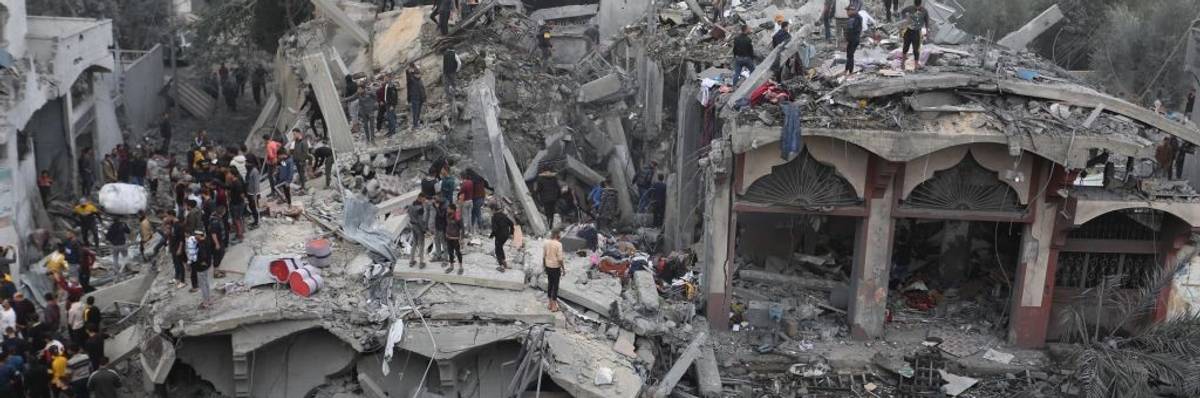
People conduct rescue work among the rubble of buildings destroyed in Israeli airstrikes in the southern Gaza Strip city of Rafah, on Nov. 22, 2023.
With Palestinians, UN officials, humanitarian experts and internationally known genocide scholars naming Israel’s bombardment and blockade as genocide, the violence simply must stop. That is only possible through a mutual, binding agreement to ceasefire.
The pause in the fighting in Gaza — with some humanitarian aid allowed in and exchange of some Israeli and Palestinian captives — is important, but not nearly enough. We need to fight for a permanent ceasefire.
In the current deal between Israel and Hamas — brokered by Qatar, Egypt, and the United States — all parties agree to stop fighting for four days. Hamas will release 50 women and children it took captive on October 7, and Israel will release 150 women and children who are among the 10,000 or so Palestinians it holds in Israeli military prisons.
There is the possibility of extending the pause — and exchanging more captives — for up to five more days after the initial agreement is implemented, potentially leading to a pause of as many as nine days.
The most obvious significance of this deal is humanitarian. Captives will be freed from Gaza and from Israel, and Israel’s massive bombardment of Gaza will pause, as will Palestinian fighters’ firing of rockets into Israel. Desperately needed humanitarian aid convoys and fuel will be allowed into Gaza.
This agreement is the product of a negotiation between the parties involved, and it extends across the whole Gaza Strip. But it is explicitly temporary.
This is also important because it proves that diplomacy can work.
Ending the continuing deaths under Israeli bombs, and securing the release of captives is happening not because of fighting, but because of negotiations. And that means more diplomacy can work too — perhaps leading to a full ceasefire, an exchange of all captives, full humanitarian access into Gaza, and ultimately an end to the siege of the Gaza Strip.
No, this is not the permanent ceasefire that UN agencies, activists, and many others have been — and still are — calling for. It is an agreement to pause the fighting for a few days, release some of the captives, and allow some aid into Gaza. It is different from Israel’s previous pauses in fighting, which were unilateral — without any conversation with or agreement from Palestinian forces — and limited to small individual parts of Gaza and short, finite time periods. This agreement is the product of a negotiation between the parties involved, and it extends across the whole Gaza Strip.
But it is explicitly temporary. Israel has said that it will only pause fighting for a maximum of nine days. In the past few days, Israeli forces have surrounded the city and refugee camp of Jabaliya and begun new attacks there. They are preparing to resume the kind of very intensive assault there that we have seen throughout the siege as soon as the temporary truce is over.
A permanent ceasefire calls for an end of all military operations on all sides. It will inevitably require the release of more captives being held in Gaza and Israel. It will have to involve urgently needed humanitarian relief on a massive scale getting into Gaza. And, as Palestinians are demanding, it must affirm the right of Palestinians who live in Gaza to stay there, as Israel has discussed permanently displacing Palestinians from Gaza in this moment.
The human toll of this fighting has been catastrophic. More than 14,000 people in Gaza and 1,200 in Israel have been killed, with untold numbers wounded. A much wider disaster is unfolding in Gaza after weeks of Israel depriving the Strip of clean water, electricity, fuel, and food, with waterborne disease spreading. Over one and a half million people have been displaced from their homes. With hospitals having run out of fuel for their generators, and Israel carrying out military assaults in and around hospitals, the health system in Gaza has largely collapsed.
With Palestinians, UN officials, humanitarian experts and internationally known genocide scholars naming Israel’s bombardment and blockade as genocide, the violence simply must stop. That is only possible through a mutual, binding agreement to ceasefire.
Keep reaching out to members of Congress and other elected officials and demand that they work to stop the killing — and call for a permanent ceasefire. Urge support for continuing diplomacy, instead of sending more weapons and warplanes and cash for the military.
There is no military solution — we need to convince Washington that we need negotiation, not war!
Dear Common Dreams reader, It’s been nearly 30 years since I co-founded Common Dreams with my late wife, Lina Newhouser. We had the radical notion that journalism should serve the public good, not corporate profits. It was clear to us from the outset what it would take to build such a project. No paid advertisements. No corporate sponsors. No millionaire publisher telling us what to think or do. Many people said we wouldn't last a year, but we proved those doubters wrong. Together with a tremendous team of journalists and dedicated staff, we built an independent media outlet free from the constraints of profits and corporate control. Our mission has always been simple: To inform. To inspire. To ignite change for the common good. Building Common Dreams was not easy. Our survival was never guaranteed. When you take on the most powerful forces—Wall Street greed, fossil fuel industry destruction, Big Tech lobbyists, and uber-rich oligarchs who have spent billions upon billions rigging the economy and democracy in their favor—the only bulwark you have is supporters who believe in your work. But here’s the urgent message from me today. It's never been this bad out there. And it's never been this hard to keep us going. At the very moment Common Dreams is most needed, the threats we face are intensifying. We need your support now more than ever. We don't accept corporate advertising and never will. We don't have a paywall because we don't think people should be blocked from critical news based on their ability to pay. Everything we do is funded by the donations of readers like you. When everyone does the little they can afford, we are strong. But if that support retreats or dries up, so do we. Will you donate now to make sure Common Dreams not only survives but thrives? —Craig Brown, Co-founder |
The pause in the fighting in Gaza — with some humanitarian aid allowed in and exchange of some Israeli and Palestinian captives — is important, but not nearly enough. We need to fight for a permanent ceasefire.
In the current deal between Israel and Hamas — brokered by Qatar, Egypt, and the United States — all parties agree to stop fighting for four days. Hamas will release 50 women and children it took captive on October 7, and Israel will release 150 women and children who are among the 10,000 or so Palestinians it holds in Israeli military prisons.
There is the possibility of extending the pause — and exchanging more captives — for up to five more days after the initial agreement is implemented, potentially leading to a pause of as many as nine days.
The most obvious significance of this deal is humanitarian. Captives will be freed from Gaza and from Israel, and Israel’s massive bombardment of Gaza will pause, as will Palestinian fighters’ firing of rockets into Israel. Desperately needed humanitarian aid convoys and fuel will be allowed into Gaza.
This agreement is the product of a negotiation between the parties involved, and it extends across the whole Gaza Strip. But it is explicitly temporary.
This is also important because it proves that diplomacy can work.
Ending the continuing deaths under Israeli bombs, and securing the release of captives is happening not because of fighting, but because of negotiations. And that means more diplomacy can work too — perhaps leading to a full ceasefire, an exchange of all captives, full humanitarian access into Gaza, and ultimately an end to the siege of the Gaza Strip.
No, this is not the permanent ceasefire that UN agencies, activists, and many others have been — and still are — calling for. It is an agreement to pause the fighting for a few days, release some of the captives, and allow some aid into Gaza. It is different from Israel’s previous pauses in fighting, which were unilateral — without any conversation with or agreement from Palestinian forces — and limited to small individual parts of Gaza and short, finite time periods. This agreement is the product of a negotiation between the parties involved, and it extends across the whole Gaza Strip.
But it is explicitly temporary. Israel has said that it will only pause fighting for a maximum of nine days. In the past few days, Israeli forces have surrounded the city and refugee camp of Jabaliya and begun new attacks there. They are preparing to resume the kind of very intensive assault there that we have seen throughout the siege as soon as the temporary truce is over.
A permanent ceasefire calls for an end of all military operations on all sides. It will inevitably require the release of more captives being held in Gaza and Israel. It will have to involve urgently needed humanitarian relief on a massive scale getting into Gaza. And, as Palestinians are demanding, it must affirm the right of Palestinians who live in Gaza to stay there, as Israel has discussed permanently displacing Palestinians from Gaza in this moment.
The human toll of this fighting has been catastrophic. More than 14,000 people in Gaza and 1,200 in Israel have been killed, with untold numbers wounded. A much wider disaster is unfolding in Gaza after weeks of Israel depriving the Strip of clean water, electricity, fuel, and food, with waterborne disease spreading. Over one and a half million people have been displaced from their homes. With hospitals having run out of fuel for their generators, and Israel carrying out military assaults in and around hospitals, the health system in Gaza has largely collapsed.
With Palestinians, UN officials, humanitarian experts and internationally known genocide scholars naming Israel’s bombardment and blockade as genocide, the violence simply must stop. That is only possible through a mutual, binding agreement to ceasefire.
Keep reaching out to members of Congress and other elected officials and demand that they work to stop the killing — and call for a permanent ceasefire. Urge support for continuing diplomacy, instead of sending more weapons and warplanes and cash for the military.
There is no military solution — we need to convince Washington that we need negotiation, not war!
The pause in the fighting in Gaza — with some humanitarian aid allowed in and exchange of some Israeli and Palestinian captives — is important, but not nearly enough. We need to fight for a permanent ceasefire.
In the current deal between Israel and Hamas — brokered by Qatar, Egypt, and the United States — all parties agree to stop fighting for four days. Hamas will release 50 women and children it took captive on October 7, and Israel will release 150 women and children who are among the 10,000 or so Palestinians it holds in Israeli military prisons.
There is the possibility of extending the pause — and exchanging more captives — for up to five more days after the initial agreement is implemented, potentially leading to a pause of as many as nine days.
The most obvious significance of this deal is humanitarian. Captives will be freed from Gaza and from Israel, and Israel’s massive bombardment of Gaza will pause, as will Palestinian fighters’ firing of rockets into Israel. Desperately needed humanitarian aid convoys and fuel will be allowed into Gaza.
This agreement is the product of a negotiation between the parties involved, and it extends across the whole Gaza Strip. But it is explicitly temporary.
This is also important because it proves that diplomacy can work.
Ending the continuing deaths under Israeli bombs, and securing the release of captives is happening not because of fighting, but because of negotiations. And that means more diplomacy can work too — perhaps leading to a full ceasefire, an exchange of all captives, full humanitarian access into Gaza, and ultimately an end to the siege of the Gaza Strip.
No, this is not the permanent ceasefire that UN agencies, activists, and many others have been — and still are — calling for. It is an agreement to pause the fighting for a few days, release some of the captives, and allow some aid into Gaza. It is different from Israel’s previous pauses in fighting, which were unilateral — without any conversation with or agreement from Palestinian forces — and limited to small individual parts of Gaza and short, finite time periods. This agreement is the product of a negotiation between the parties involved, and it extends across the whole Gaza Strip.
But it is explicitly temporary. Israel has said that it will only pause fighting for a maximum of nine days. In the past few days, Israeli forces have surrounded the city and refugee camp of Jabaliya and begun new attacks there. They are preparing to resume the kind of very intensive assault there that we have seen throughout the siege as soon as the temporary truce is over.
A permanent ceasefire calls for an end of all military operations on all sides. It will inevitably require the release of more captives being held in Gaza and Israel. It will have to involve urgently needed humanitarian relief on a massive scale getting into Gaza. And, as Palestinians are demanding, it must affirm the right of Palestinians who live in Gaza to stay there, as Israel has discussed permanently displacing Palestinians from Gaza in this moment.
The human toll of this fighting has been catastrophic. More than 14,000 people in Gaza and 1,200 in Israel have been killed, with untold numbers wounded. A much wider disaster is unfolding in Gaza after weeks of Israel depriving the Strip of clean water, electricity, fuel, and food, with waterborne disease spreading. Over one and a half million people have been displaced from their homes. With hospitals having run out of fuel for their generators, and Israel carrying out military assaults in and around hospitals, the health system in Gaza has largely collapsed.
With Palestinians, UN officials, humanitarian experts and internationally known genocide scholars naming Israel’s bombardment and blockade as genocide, the violence simply must stop. That is only possible through a mutual, binding agreement to ceasefire.
Keep reaching out to members of Congress and other elected officials and demand that they work to stop the killing — and call for a permanent ceasefire. Urge support for continuing diplomacy, instead of sending more weapons and warplanes and cash for the military.
There is no military solution — we need to convince Washington that we need negotiation, not war!