SUBSCRIBE TO OUR FREE NEWSLETTER
Daily news & progressive opinion—funded by the people, not the corporations—delivered straight to your inbox.
5
#000000
#FFFFFF
To donate by check, phone, or other method, see our More Ways to Give page.
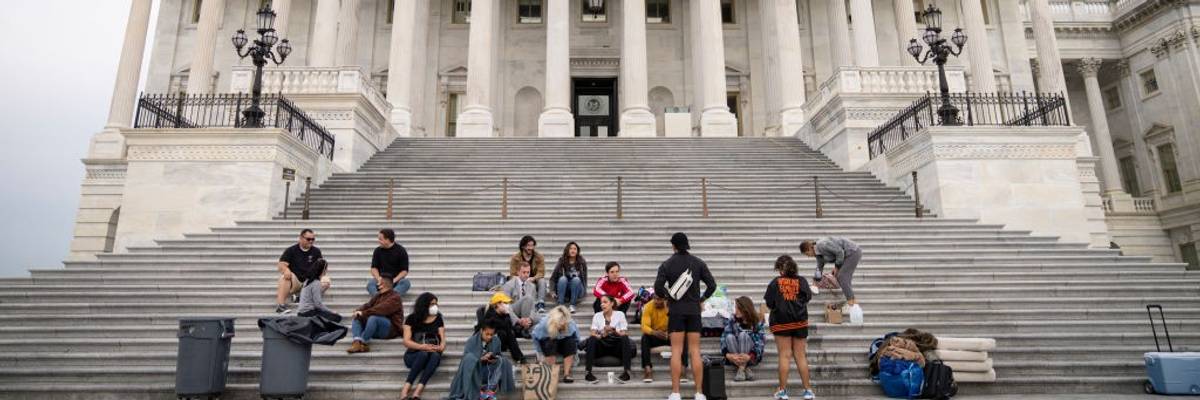
Randall Irvin has been waiting for public housing in Chicago for six years, and his situation is not that unusual. For example, there are over 100,000 families on San Antonio’s waitlist for public housing. In Chicago, there were more than 200,000 families on the waitlist in 2023. Public housing waiting lists are extremely long because there is an inadequate supply—and a 1998 amendment to federal housing law is a significant barrier to building new housing.
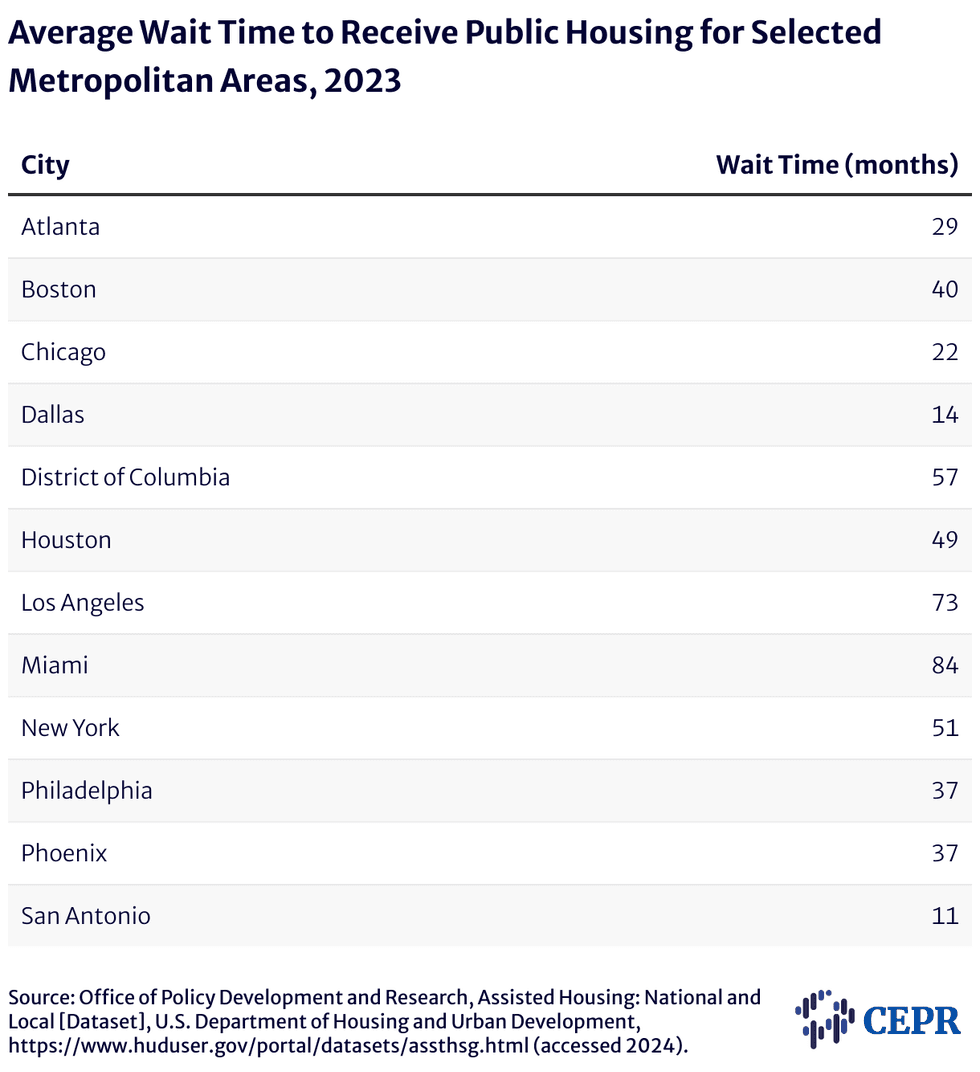
Table 1 lists the average number of months households waited before they were able to receive public housing in selected metropolitan areas according to the U.S. Department of Housing and Urban Development. It ranges from a low of 11 months in San Antonio to a high of 84 months (seven years) in Miami. These numbers hide the wide range of variation around the average. In the city of Chicago, families can wait for as few as six months or as long as 25 years depending on the specifics of their situation and their family size. Households that are still waiting for housing or that never receive housing are not included in the calculation of the averages, so these average wait times do not fully capture the difficulty of obtaining public housing.
The families remaining on public housing waitlists for housing for years are in desperate situations. They are people who are homeless, who are living in unsafe and unsanitary conditions, and who are struggling to afford their housing. In Washington, D.C., Rosalynn Talley, who waited 14 years for public housing, described her overcrowded housing situation as being “smashed up like sardines.” Her neighborhood was also unsafe, and there was mold in the house.
Congress is to blame for the low supply of public housing. In 1998, Congress passed the Faircloth Amendment which put a cap on the number of public housing units. The cap and the consistent underfunding of public housing has caused the number of public housing units to decline 40% from 1.4 million in 1994 to 835,000 in 2022 while the need for affordable housing has steadily increased.
Public housing is one of the most affordable forms of housing, but affordable housing policy has shifted to relying on the Low-Income Housing Tax Credit (LIHTC). LIHTC goes to private developers and investors and creates “affordable” housing that is often more expensive to renters than public housing. The Joint Center for Housing Studies reports that “LIHTC [housing] does not necessarily protect a renter from [housing] cost burdens.” While the Faircloth Amendment has been a benefit to the for-profit real estate industry, it has hurt low-income renters.
Thankfully, there are some in Congress working to undo this bad law. The Homes Act, introduced by Sen. Tina Smith (D-Minn.) and Rep. Alexandria Ocasio-Cortez (D-N.Y.), if passed, would repeal the Faircloth Amendment and provide the funding needed to address the maintenance and repair backlog in public housing. Currently, the bill has 40 supporters in the House of Representatives and two supporters in the Senate. Repealing the Faircloth Amendment would open another channel to address the affordable housing crisis.
Randall Irvin has been waiting for public housing in Chicago for six years, and his situation is not that unusual. For example, there are over 100,000 families on San Antonio’s waitlist for public housing. In Chicago, there were more than 200,000 families on the waitlist in 2023. Public housing waiting lists are extremely long because there is an inadequate supply—and a 1998 amendment to federal housing law is a significant barrier to building new housing.
Table 1 lists the average number of months households waited before they were able to receive public housing in selected metropolitan areas according to the U.S. Department of Housing and Urban Development. It ranges from a low of 11 months in San Antonio to a high of 84 months (seven years) in Miami. These numbers hide the wide range of variation around the average. In the city of Chicago, families can wait for as few as six months or as long as 25 years depending on the specifics of their situation and their family size. Households that are still waiting for housing or that never receive housing are not included in the calculation of the averages, so these average wait times do not fully capture the difficulty of obtaining public housing.
The families remaining on public housing waitlists for housing for years are in desperate situations. They are people who are homeless, who are living in unsafe and unsanitary conditions, and who are struggling to afford their housing. In Washington, D.C., Rosalynn Talley, who waited 14 years for public housing, described her overcrowded housing situation as being “smashed up like sardines.” Her neighborhood was also unsafe, and there was mold in the house.
Congress is to blame for the low supply of public housing. In 1998, Congress passed the Faircloth Amendment which put a cap on the number of public housing units. The cap and the consistent underfunding of public housing has caused the number of public housing units to decline 40% from 1.4 million in 1994 to 835,000 in 2022 while the need for affordable housing has steadily increased.
Public housing is one of the most affordable forms of housing, but affordable housing policy has shifted to relying on the Low-Income Housing Tax Credit (LIHTC). LIHTC goes to private developers and investors and creates “affordable” housing that is often more expensive to renters than public housing. The Joint Center for Housing Studies reports that “LIHTC [housing] does not necessarily protect a renter from [housing] cost burdens.” While the Faircloth Amendment has been a benefit to the for-profit real estate industry, it has hurt low-income renters.
Thankfully, there are some in Congress working to undo this bad law. The Homes Act, introduced by Sen. Tina Smith (D-Minn.) and Rep. Alexandria Ocasio-Cortez (D-N.Y.), if passed, would repeal the Faircloth Amendment and provide the funding needed to address the maintenance and repair backlog in public housing. Currently, the bill has 40 supporters in the House of Representatives and two supporters in the Senate. Repealing the Faircloth Amendment would open another channel to address the affordable housing crisis.
Randall Irvin has been waiting for public housing in Chicago for six years, and his situation is not that unusual. For example, there are over 100,000 families on San Antonio’s waitlist for public housing. In Chicago, there were more than 200,000 families on the waitlist in 2023. Public housing waiting lists are extremely long because there is an inadequate supply—and a 1998 amendment to federal housing law is a significant barrier to building new housing.
Table 1 lists the average number of months households waited before they were able to receive public housing in selected metropolitan areas according to the U.S. Department of Housing and Urban Development. It ranges from a low of 11 months in San Antonio to a high of 84 months (seven years) in Miami. These numbers hide the wide range of variation around the average. In the city of Chicago, families can wait for as few as six months or as long as 25 years depending on the specifics of their situation and their family size. Households that are still waiting for housing or that never receive housing are not included in the calculation of the averages, so these average wait times do not fully capture the difficulty of obtaining public housing.
The families remaining on public housing waitlists for housing for years are in desperate situations. They are people who are homeless, who are living in unsafe and unsanitary conditions, and who are struggling to afford their housing. In Washington, D.C., Rosalynn Talley, who waited 14 years for public housing, described her overcrowded housing situation as being “smashed up like sardines.” Her neighborhood was also unsafe, and there was mold in the house.
Congress is to blame for the low supply of public housing. In 1998, Congress passed the Faircloth Amendment which put a cap on the number of public housing units. The cap and the consistent underfunding of public housing has caused the number of public housing units to decline 40% from 1.4 million in 1994 to 835,000 in 2022 while the need for affordable housing has steadily increased.
Public housing is one of the most affordable forms of housing, but affordable housing policy has shifted to relying on the Low-Income Housing Tax Credit (LIHTC). LIHTC goes to private developers and investors and creates “affordable” housing that is often more expensive to renters than public housing. The Joint Center for Housing Studies reports that “LIHTC [housing] does not necessarily protect a renter from [housing] cost burdens.” While the Faircloth Amendment has been a benefit to the for-profit real estate industry, it has hurt low-income renters.
Thankfully, there are some in Congress working to undo this bad law. The Homes Act, introduced by Sen. Tina Smith (D-Minn.) and Rep. Alexandria Ocasio-Cortez (D-N.Y.), if passed, would repeal the Faircloth Amendment and provide the funding needed to address the maintenance and repair backlog in public housing. Currently, the bill has 40 supporters in the House of Representatives and two supporters in the Senate. Repealing the Faircloth Amendment would open another channel to address the affordable housing crisis.