SUBSCRIBE TO OUR FREE NEWSLETTER
Daily news & progressive opinion—funded by the people, not the corporations—delivered straight to your inbox.
5
#000000
#FFFFFF
To donate by check, phone, or other method, see our More Ways to Give page.
Daily news & progressive opinion—funded by the people, not the corporations—delivered straight to your inbox.
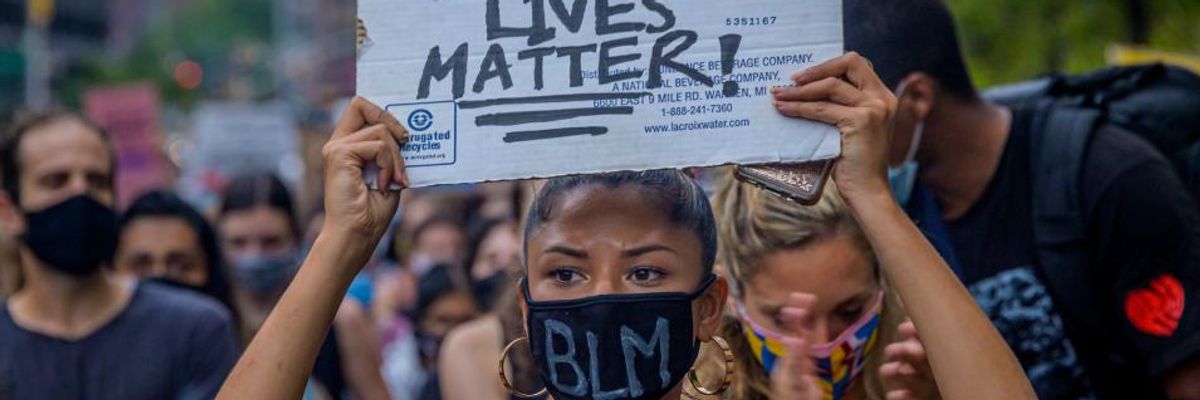
A participant holding a Black Lives Matter sign at a protest on August 28, 2020.
I am an elected representative of my community, and I have been removed from an office I was duly elected into, because of a prior conviction.
One thing I know: Corruption only withers under the sunlight.
In Illinois, 3.3 million adults have been arrested or convicted of a crime since 1979. Right now, there are 1,189 permanent punishment laws and regulations in Illinois that restrict people with records. Often these restrictions are permanent punishments. I am an elected representative of my community, and I have been removed from an office I was duly elected into, because of such permanent punishments.
“How did this happen?” you might be asking. I’m sharing my experience, because it is indicative of a much larger problem of corruption in Joliet Township and it exposes a longstanding injustice in our state. Let’s start at the beginning though.
In a state where many of our elected officials, including governors, have prior convictions, this is a clear double standard. It also means that, even after serving time and being released, we are not fully free.
I began community engagement and organizing in 2020. That year, alongside other dedicated community members, I co-founded Will County Democratic Black Caucus and BLM Will County. In April of 2021, after many years as an activist and community leader, I was elected as Trustee of Joliet Township. It was a day of celebration and community pride. Soon after the election, we got to work.
In the face of police violence and impunity, we called for a citizens oversight board. We were engaging the community and responding to their calls for more accountability from law enforcement. We started a gun violence prevention program. Of course, responding to the needs of the community is the job of a duly elected trustee.
When Eric Lurry needed care and support, officers who took oaths to protect and serve their community instead hastened his death. Mr. Lurry, suffering an accidental overdose, was treated with such blatant disregard and violence by police that the city launched an investigation into their behavior. How can this kind of racist and inhumane behavior go unaddressed, or worse, defended? Joliet police not only refused accountability in the role they played in the death of Eric Lurry, they withheld information from the community. Without the vigilance of Nicole Lurry (Eric’s widow), they would have swept his death under the rug. I began working with organizers to call for real accountability.
It is the job I was elected to do—to make sure that people with power do not harm the people they are there to serve. I helped to found the Black Caucus, knowing that in order to achieve the change we want we must be strong.
On July 18, the Illinois Supreme Court upheld the SAFE-T Act. The court rejected the “uneven reasoning” and reversed Judge Thomas Cunnington’s earlier ruling in the 12th Judicial Circuit Court. Cash bail will be abolished on September 18 of this year. This law will make our community safer, and lower the rate of recidivism. Ultimately, it intervenes in a profoundly unjust system, which allows people with money to walk free, and keeps poor people behind bars.
We need people in politics to pass this kind of legislation, we need changes in our economic policies, we need social programs that care for all of us. We need political, social, and economic change, at the core of all our structures. And we each have a role to play in this work. As a trustee, I was playing my part alongside others who share a vision for racial justice in our community.
Doing this work made me a target of those who want to protect the racist status quo. James Glasow, the longest sitting state’s attorney in the country, threatened by our growing people power, started a campaign to remove me from office due to a prior conviction. In a state where many of our elected officials, including governors, have prior convictions, this is a clear double standard. It also means that, even after serving time and being released, we are not fully free.
But we keep working for freedom.
The criminal legal system targets and oppresses Black, Indigenous, queer folks, and people of color—especially those who are poor—at every turn. Poor people of color are often sentenced the longest and the worst. Then, if we are able to return to our families, communities, and lives, we are faced with laws that create barriers for us at every turn.
Recently, I spoke at a press conference about the PIECE Act at the Joliet Township Government Building, where I was once elected to represent my community. I also joined the township meeting at the Joliet Township Government Building to help our community know what is at stake. Because corruption only withers under the sunlight.
Many have worked tirelessly to prevent me from fighting for my community in the halls of power. But I refuse to concede the fight, and want to tell my story, in hopes that others will join in the fight against corruption, no matter where it happens.
Dear Common Dreams reader, It’s been nearly 30 years since I co-founded Common Dreams with my late wife, Lina Newhouser. We had the radical notion that journalism should serve the public good, not corporate profits. It was clear to us from the outset what it would take to build such a project. No paid advertisements. No corporate sponsors. No millionaire publisher telling us what to think or do. Many people said we wouldn't last a year, but we proved those doubters wrong. Together with a tremendous team of journalists and dedicated staff, we built an independent media outlet free from the constraints of profits and corporate control. Our mission has always been simple: To inform. To inspire. To ignite change for the common good. Building Common Dreams was not easy. Our survival was never guaranteed. When you take on the most powerful forces—Wall Street greed, fossil fuel industry destruction, Big Tech lobbyists, and uber-rich oligarchs who have spent billions upon billions rigging the economy and democracy in their favor—the only bulwark you have is supporters who believe in your work. But here’s the urgent message from me today. It's never been this bad out there. And it's never been this hard to keep us going. At the very moment Common Dreams is most needed, the threats we face are intensifying. We need your support now more than ever. We don't accept corporate advertising and never will. We don't have a paywall because we don't think people should be blocked from critical news based on their ability to pay. Everything we do is funded by the donations of readers like you. When everyone does the little they can afford, we are strong. But if that support retreats or dries up, so do we. Will you donate now to make sure Common Dreams not only survives but thrives? —Craig Brown, Co-founder |
One thing I know: Corruption only withers under the sunlight.
In Illinois, 3.3 million adults have been arrested or convicted of a crime since 1979. Right now, there are 1,189 permanent punishment laws and regulations in Illinois that restrict people with records. Often these restrictions are permanent punishments. I am an elected representative of my community, and I have been removed from an office I was duly elected into, because of such permanent punishments.
“How did this happen?” you might be asking. I’m sharing my experience, because it is indicative of a much larger problem of corruption in Joliet Township and it exposes a longstanding injustice in our state. Let’s start at the beginning though.
In a state where many of our elected officials, including governors, have prior convictions, this is a clear double standard. It also means that, even after serving time and being released, we are not fully free.
I began community engagement and organizing in 2020. That year, alongside other dedicated community members, I co-founded Will County Democratic Black Caucus and BLM Will County. In April of 2021, after many years as an activist and community leader, I was elected as Trustee of Joliet Township. It was a day of celebration and community pride. Soon after the election, we got to work.
In the face of police violence and impunity, we called for a citizens oversight board. We were engaging the community and responding to their calls for more accountability from law enforcement. We started a gun violence prevention program. Of course, responding to the needs of the community is the job of a duly elected trustee.
When Eric Lurry needed care and support, officers who took oaths to protect and serve their community instead hastened his death. Mr. Lurry, suffering an accidental overdose, was treated with such blatant disregard and violence by police that the city launched an investigation into their behavior. How can this kind of racist and inhumane behavior go unaddressed, or worse, defended? Joliet police not only refused accountability in the role they played in the death of Eric Lurry, they withheld information from the community. Without the vigilance of Nicole Lurry (Eric’s widow), they would have swept his death under the rug. I began working with organizers to call for real accountability.
It is the job I was elected to do—to make sure that people with power do not harm the people they are there to serve. I helped to found the Black Caucus, knowing that in order to achieve the change we want we must be strong.
On July 18, the Illinois Supreme Court upheld the SAFE-T Act. The court rejected the “uneven reasoning” and reversed Judge Thomas Cunnington’s earlier ruling in the 12th Judicial Circuit Court. Cash bail will be abolished on September 18 of this year. This law will make our community safer, and lower the rate of recidivism. Ultimately, it intervenes in a profoundly unjust system, which allows people with money to walk free, and keeps poor people behind bars.
We need people in politics to pass this kind of legislation, we need changes in our economic policies, we need social programs that care for all of us. We need political, social, and economic change, at the core of all our structures. And we each have a role to play in this work. As a trustee, I was playing my part alongside others who share a vision for racial justice in our community.
Doing this work made me a target of those who want to protect the racist status quo. James Glasow, the longest sitting state’s attorney in the country, threatened by our growing people power, started a campaign to remove me from office due to a prior conviction. In a state where many of our elected officials, including governors, have prior convictions, this is a clear double standard. It also means that, even after serving time and being released, we are not fully free.
But we keep working for freedom.
The criminal legal system targets and oppresses Black, Indigenous, queer folks, and people of color—especially those who are poor—at every turn. Poor people of color are often sentenced the longest and the worst. Then, if we are able to return to our families, communities, and lives, we are faced with laws that create barriers for us at every turn.
Recently, I spoke at a press conference about the PIECE Act at the Joliet Township Government Building, where I was once elected to represent my community. I also joined the township meeting at the Joliet Township Government Building to help our community know what is at stake. Because corruption only withers under the sunlight.
Many have worked tirelessly to prevent me from fighting for my community in the halls of power. But I refuse to concede the fight, and want to tell my story, in hopes that others will join in the fight against corruption, no matter where it happens.
One thing I know: Corruption only withers under the sunlight.
In Illinois, 3.3 million adults have been arrested or convicted of a crime since 1979. Right now, there are 1,189 permanent punishment laws and regulations in Illinois that restrict people with records. Often these restrictions are permanent punishments. I am an elected representative of my community, and I have been removed from an office I was duly elected into, because of such permanent punishments.
“How did this happen?” you might be asking. I’m sharing my experience, because it is indicative of a much larger problem of corruption in Joliet Township and it exposes a longstanding injustice in our state. Let’s start at the beginning though.
In a state where many of our elected officials, including governors, have prior convictions, this is a clear double standard. It also means that, even after serving time and being released, we are not fully free.
I began community engagement and organizing in 2020. That year, alongside other dedicated community members, I co-founded Will County Democratic Black Caucus and BLM Will County. In April of 2021, after many years as an activist and community leader, I was elected as Trustee of Joliet Township. It was a day of celebration and community pride. Soon after the election, we got to work.
In the face of police violence and impunity, we called for a citizens oversight board. We were engaging the community and responding to their calls for more accountability from law enforcement. We started a gun violence prevention program. Of course, responding to the needs of the community is the job of a duly elected trustee.
When Eric Lurry needed care and support, officers who took oaths to protect and serve their community instead hastened his death. Mr. Lurry, suffering an accidental overdose, was treated with such blatant disregard and violence by police that the city launched an investigation into their behavior. How can this kind of racist and inhumane behavior go unaddressed, or worse, defended? Joliet police not only refused accountability in the role they played in the death of Eric Lurry, they withheld information from the community. Without the vigilance of Nicole Lurry (Eric’s widow), they would have swept his death under the rug. I began working with organizers to call for real accountability.
It is the job I was elected to do—to make sure that people with power do not harm the people they are there to serve. I helped to found the Black Caucus, knowing that in order to achieve the change we want we must be strong.
On July 18, the Illinois Supreme Court upheld the SAFE-T Act. The court rejected the “uneven reasoning” and reversed Judge Thomas Cunnington’s earlier ruling in the 12th Judicial Circuit Court. Cash bail will be abolished on September 18 of this year. This law will make our community safer, and lower the rate of recidivism. Ultimately, it intervenes in a profoundly unjust system, which allows people with money to walk free, and keeps poor people behind bars.
We need people in politics to pass this kind of legislation, we need changes in our economic policies, we need social programs that care for all of us. We need political, social, and economic change, at the core of all our structures. And we each have a role to play in this work. As a trustee, I was playing my part alongside others who share a vision for racial justice in our community.
Doing this work made me a target of those who want to protect the racist status quo. James Glasow, the longest sitting state’s attorney in the country, threatened by our growing people power, started a campaign to remove me from office due to a prior conviction. In a state where many of our elected officials, including governors, have prior convictions, this is a clear double standard. It also means that, even after serving time and being released, we are not fully free.
But we keep working for freedom.
The criminal legal system targets and oppresses Black, Indigenous, queer folks, and people of color—especially those who are poor—at every turn. Poor people of color are often sentenced the longest and the worst. Then, if we are able to return to our families, communities, and lives, we are faced with laws that create barriers for us at every turn.
Recently, I spoke at a press conference about the PIECE Act at the Joliet Township Government Building, where I was once elected to represent my community. I also joined the township meeting at the Joliet Township Government Building to help our community know what is at stake. Because corruption only withers under the sunlight.
Many have worked tirelessly to prevent me from fighting for my community in the halls of power. But I refuse to concede the fight, and want to tell my story, in hopes that others will join in the fight against corruption, no matter where it happens.