SUBSCRIBE TO OUR FREE NEWSLETTER
Daily news & progressive opinion—funded by the people, not the corporations—delivered straight to your inbox.
5
#000000
#FFFFFF
To donate by check, phone, or other method, see our More Ways to Give page.
Daily news & progressive opinion—funded by the people, not the corporations—delivered straight to your inbox.
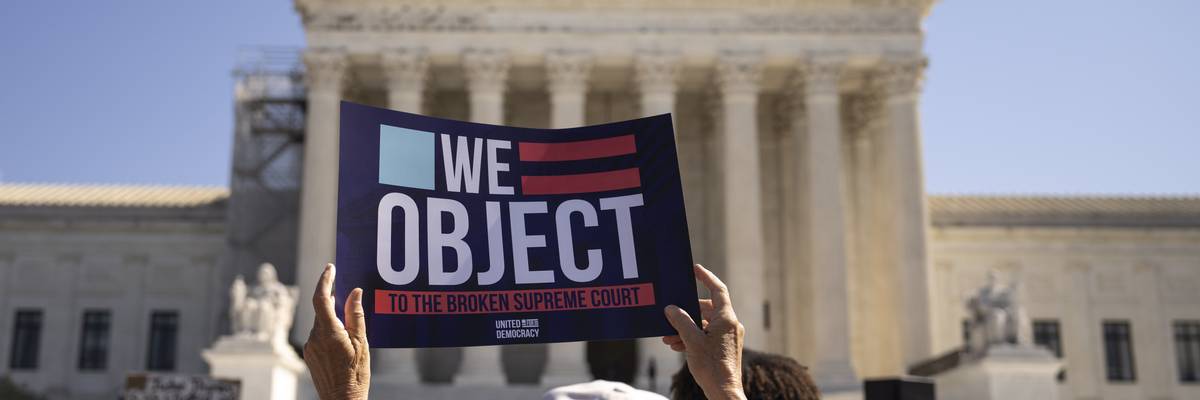
Demonstrators rally against the right-wing majority of the U.S. Supreme Court on October 2, 2023 in Washington, D.C.
When they have the political power to do so, progressives must immediately expand the court to reflect the diverse backgrounds, experiences, and viewpoints of the nation, and impose term limits on justices.
As the dust continues to settle on the Supreme Court’s 2023-2024 term, the conservative majority’s existential threat to our democracy (and, in particular, our multiracial democracy) could not be clearer. But progressives have also enabled this threat by refusing to embrace the democratic reforms necessary to bring the court to heel.
Beyond the widely panned decision granting former U.S. President Donald Trump unprecedented immunity from prosecution, the court’s decisions have followed a clear trend of expanding power for the rich and connected (who will have new tools to challenge environmental and consumer protections), and diminishing it for people of color (who will have fewer tools to challenge racist gerrymanders), and the poor (who can now be incarcerated for sleeping outside even when no shelter is available).
Even in supposed bright spots, such as Rahimi, in which the court declined to overrule a federal law that bars anyone under a domestic violence restraining order from having a gun, its rulings have reified white supremacy. The court did not refrain from imposing its “history and tradition” test for gun laws, which Justice Sonia Sotomayor acknowledged privileges an era “predating the inclusion of women and people of color as full members of the polity.” The court also conspicuously declined to address whether its vision of originalism includes the history of Reconstruction, which fundamentally transformed race relations and laid the foundation for multiracial democracy in the United States.
Lasting protections for the most vulnerable must be won and defended through power building at all levels of society—not in the courts alone.
In the face of the court’s sustained attack on multiracial democracy, progressive responses have so far been ineffective. Progressives arguing before the court have relied on precedent only to see those precedents tossed away in cases ending the right to abortion and outlawing affirmative action. They have grounded their arguments in history only to see the court cherry-pick research to achieve its desired results in cases diminishing the power of federal agencies. And, outside the courtroom, progressives have shone spotlights on Justices Samuel Alito’s and Clarence Thomas’ numerous conflicts of interest, only to have calls for the pair’s recusal fall on deaf ears in cases related to the January 6 insurrection.
Yet in the wake of another devastating term, President Joe Biden has announced no plan for Supreme Court reform. Instead, he seems content to patiently await a vacancy that may never arise to make his next appointment.
Let’s be honest with ourselves—efforts to influence or reshape the court short of structural reform are doomed to fail. Because justices currently have lifetime tenure, and experience has demonstrated that they will time their departures to coincide with ideologically sympathetic presidential administrations, there is no guarantee that another progressive presidency will result in any shift in the court’s ideology.
Meanwhile, as the Court places its thumb on the scale in elections, whether directly, as in Bush v. Gore, or more indirectly by diluting the Voting Rights Act, and unleashing unlimited corporate spending in campaigns, democracy may continue to erode.
When they have the political power to do so, progressives must immediately expand the court to reflect the diverse backgrounds, experiences, and viewpoints of the nation, and impose term limits on justices (in line with other Western democracies).
Opposition to these straightforward ways to restore democratic accountability have laid bare progressive ambivalences about democracy itself. Some progressive elites, and particularly legal elites, who are wary of reigning in the court point to (supposedly) counter-majoritarian decisions like Brown, Roe, and Obergefell, which expanded rights for people of color, women, and LGBT people, as reasons to preserve the court’s power.
But an overly romantic view of the court risks breezing past the Supreme Court’s efforts to disempower vulnerable groups throughout its history in cases like Dred Scott, which held that Black people were not and could not be citizens, Plessy, which enshrined “separate but equal” for more than half a century, and Korematsu, which denied the constitutional rights of Japanese Americans interned during World War II, and throughout the anti-regulatory Lochner era. And it risks empowering a handful of unaccountable decision-makers above the true levers of social change—the people.
While the Supreme Court was a sometime ally to the movements of the 1950s, 60s, and 70s, the true heroes of change were civil rights organizers and feminist activists who dared to imagine a brighter future. They pushed the nation (kicking and screaming) closer toward equity as reflected in the enactment of landmark legislation like the Civil Rights Act of 1964 and the Voting Rights Act of 1965.
Meanwhile, as the demise of Roe and its aftermath has made clear, victories that rely on the Supreme Court alone are fragile. Lasting protections for the most vulnerable must be won and defended through power building at all levels of society—not in the courts alone. Continued progress is possible, but only if we restrain a court that is all too happy to defang or dismantle popularly enacted legislation.
We must continue to call out the court’s insidious efforts to undermine democracy. We must also hold progressive leaders, and especially the progressive bar, accountable for their role in enabling this erosion. And we must demand that the president and Congress take action to expand the court and impose term limits. If they do not, it’s difficult to see how the court’s future terms won’t be darker mirrors of this one.
Dear Common Dreams reader, It’s been nearly 30 years since I co-founded Common Dreams with my late wife, Lina Newhouser. We had the radical notion that journalism should serve the public good, not corporate profits. It was clear to us from the outset what it would take to build such a project. No paid advertisements. No corporate sponsors. No millionaire publisher telling us what to think or do. Many people said we wouldn't last a year, but we proved those doubters wrong. Together with a tremendous team of journalists and dedicated staff, we built an independent media outlet free from the constraints of profits and corporate control. Our mission has always been simple: To inform. To inspire. To ignite change for the common good. Building Common Dreams was not easy. Our survival was never guaranteed. When you take on the most powerful forces—Wall Street greed, fossil fuel industry destruction, Big Tech lobbyists, and uber-rich oligarchs who have spent billions upon billions rigging the economy and democracy in their favor—the only bulwark you have is supporters who believe in your work. But here’s the urgent message from me today. It's never been this bad out there. And it's never been this hard to keep us going. At the very moment Common Dreams is most needed, the threats we face are intensifying. We need your support now more than ever. We don't accept corporate advertising and never will. We don't have a paywall because we don't think people should be blocked from critical news based on their ability to pay. Everything we do is funded by the donations of readers like you. When everyone does the little they can afford, we are strong. But if that support retreats or dries up, so do we. Will you donate now to make sure Common Dreams not only survives but thrives? —Craig Brown, Co-founder |
As the dust continues to settle on the Supreme Court’s 2023-2024 term, the conservative majority’s existential threat to our democracy (and, in particular, our multiracial democracy) could not be clearer. But progressives have also enabled this threat by refusing to embrace the democratic reforms necessary to bring the court to heel.
Beyond the widely panned decision granting former U.S. President Donald Trump unprecedented immunity from prosecution, the court’s decisions have followed a clear trend of expanding power for the rich and connected (who will have new tools to challenge environmental and consumer protections), and diminishing it for people of color (who will have fewer tools to challenge racist gerrymanders), and the poor (who can now be incarcerated for sleeping outside even when no shelter is available).
Even in supposed bright spots, such as Rahimi, in which the court declined to overrule a federal law that bars anyone under a domestic violence restraining order from having a gun, its rulings have reified white supremacy. The court did not refrain from imposing its “history and tradition” test for gun laws, which Justice Sonia Sotomayor acknowledged privileges an era “predating the inclusion of women and people of color as full members of the polity.” The court also conspicuously declined to address whether its vision of originalism includes the history of Reconstruction, which fundamentally transformed race relations and laid the foundation for multiracial democracy in the United States.
Lasting protections for the most vulnerable must be won and defended through power building at all levels of society—not in the courts alone.
In the face of the court’s sustained attack on multiracial democracy, progressive responses have so far been ineffective. Progressives arguing before the court have relied on precedent only to see those precedents tossed away in cases ending the right to abortion and outlawing affirmative action. They have grounded their arguments in history only to see the court cherry-pick research to achieve its desired results in cases diminishing the power of federal agencies. And, outside the courtroom, progressives have shone spotlights on Justices Samuel Alito’s and Clarence Thomas’ numerous conflicts of interest, only to have calls for the pair’s recusal fall on deaf ears in cases related to the January 6 insurrection.
Yet in the wake of another devastating term, President Joe Biden has announced no plan for Supreme Court reform. Instead, he seems content to patiently await a vacancy that may never arise to make his next appointment.
Let’s be honest with ourselves—efforts to influence or reshape the court short of structural reform are doomed to fail. Because justices currently have lifetime tenure, and experience has demonstrated that they will time their departures to coincide with ideologically sympathetic presidential administrations, there is no guarantee that another progressive presidency will result in any shift in the court’s ideology.
Meanwhile, as the Court places its thumb on the scale in elections, whether directly, as in Bush v. Gore, or more indirectly by diluting the Voting Rights Act, and unleashing unlimited corporate spending in campaigns, democracy may continue to erode.
When they have the political power to do so, progressives must immediately expand the court to reflect the diverse backgrounds, experiences, and viewpoints of the nation, and impose term limits on justices (in line with other Western democracies).
Opposition to these straightforward ways to restore democratic accountability have laid bare progressive ambivalences about democracy itself. Some progressive elites, and particularly legal elites, who are wary of reigning in the court point to (supposedly) counter-majoritarian decisions like Brown, Roe, and Obergefell, which expanded rights for people of color, women, and LGBT people, as reasons to preserve the court’s power.
But an overly romantic view of the court risks breezing past the Supreme Court’s efforts to disempower vulnerable groups throughout its history in cases like Dred Scott, which held that Black people were not and could not be citizens, Plessy, which enshrined “separate but equal” for more than half a century, and Korematsu, which denied the constitutional rights of Japanese Americans interned during World War II, and throughout the anti-regulatory Lochner era. And it risks empowering a handful of unaccountable decision-makers above the true levers of social change—the people.
While the Supreme Court was a sometime ally to the movements of the 1950s, 60s, and 70s, the true heroes of change were civil rights organizers and feminist activists who dared to imagine a brighter future. They pushed the nation (kicking and screaming) closer toward equity as reflected in the enactment of landmark legislation like the Civil Rights Act of 1964 and the Voting Rights Act of 1965.
Meanwhile, as the demise of Roe and its aftermath has made clear, victories that rely on the Supreme Court alone are fragile. Lasting protections for the most vulnerable must be won and defended through power building at all levels of society—not in the courts alone. Continued progress is possible, but only if we restrain a court that is all too happy to defang or dismantle popularly enacted legislation.
We must continue to call out the court’s insidious efforts to undermine democracy. We must also hold progressive leaders, and especially the progressive bar, accountable for their role in enabling this erosion. And we must demand that the president and Congress take action to expand the court and impose term limits. If they do not, it’s difficult to see how the court’s future terms won’t be darker mirrors of this one.
As the dust continues to settle on the Supreme Court’s 2023-2024 term, the conservative majority’s existential threat to our democracy (and, in particular, our multiracial democracy) could not be clearer. But progressives have also enabled this threat by refusing to embrace the democratic reforms necessary to bring the court to heel.
Beyond the widely panned decision granting former U.S. President Donald Trump unprecedented immunity from prosecution, the court’s decisions have followed a clear trend of expanding power for the rich and connected (who will have new tools to challenge environmental and consumer protections), and diminishing it for people of color (who will have fewer tools to challenge racist gerrymanders), and the poor (who can now be incarcerated for sleeping outside even when no shelter is available).
Even in supposed bright spots, such as Rahimi, in which the court declined to overrule a federal law that bars anyone under a domestic violence restraining order from having a gun, its rulings have reified white supremacy. The court did not refrain from imposing its “history and tradition” test for gun laws, which Justice Sonia Sotomayor acknowledged privileges an era “predating the inclusion of women and people of color as full members of the polity.” The court also conspicuously declined to address whether its vision of originalism includes the history of Reconstruction, which fundamentally transformed race relations and laid the foundation for multiracial democracy in the United States.
Lasting protections for the most vulnerable must be won and defended through power building at all levels of society—not in the courts alone.
In the face of the court’s sustained attack on multiracial democracy, progressive responses have so far been ineffective. Progressives arguing before the court have relied on precedent only to see those precedents tossed away in cases ending the right to abortion and outlawing affirmative action. They have grounded their arguments in history only to see the court cherry-pick research to achieve its desired results in cases diminishing the power of federal agencies. And, outside the courtroom, progressives have shone spotlights on Justices Samuel Alito’s and Clarence Thomas’ numerous conflicts of interest, only to have calls for the pair’s recusal fall on deaf ears in cases related to the January 6 insurrection.
Yet in the wake of another devastating term, President Joe Biden has announced no plan for Supreme Court reform. Instead, he seems content to patiently await a vacancy that may never arise to make his next appointment.
Let’s be honest with ourselves—efforts to influence or reshape the court short of structural reform are doomed to fail. Because justices currently have lifetime tenure, and experience has demonstrated that they will time their departures to coincide with ideologically sympathetic presidential administrations, there is no guarantee that another progressive presidency will result in any shift in the court’s ideology.
Meanwhile, as the Court places its thumb on the scale in elections, whether directly, as in Bush v. Gore, or more indirectly by diluting the Voting Rights Act, and unleashing unlimited corporate spending in campaigns, democracy may continue to erode.
When they have the political power to do so, progressives must immediately expand the court to reflect the diverse backgrounds, experiences, and viewpoints of the nation, and impose term limits on justices (in line with other Western democracies).
Opposition to these straightforward ways to restore democratic accountability have laid bare progressive ambivalences about democracy itself. Some progressive elites, and particularly legal elites, who are wary of reigning in the court point to (supposedly) counter-majoritarian decisions like Brown, Roe, and Obergefell, which expanded rights for people of color, women, and LGBT people, as reasons to preserve the court’s power.
But an overly romantic view of the court risks breezing past the Supreme Court’s efforts to disempower vulnerable groups throughout its history in cases like Dred Scott, which held that Black people were not and could not be citizens, Plessy, which enshrined “separate but equal” for more than half a century, and Korematsu, which denied the constitutional rights of Japanese Americans interned during World War II, and throughout the anti-regulatory Lochner era. And it risks empowering a handful of unaccountable decision-makers above the true levers of social change—the people.
While the Supreme Court was a sometime ally to the movements of the 1950s, 60s, and 70s, the true heroes of change were civil rights organizers and feminist activists who dared to imagine a brighter future. They pushed the nation (kicking and screaming) closer toward equity as reflected in the enactment of landmark legislation like the Civil Rights Act of 1964 and the Voting Rights Act of 1965.
Meanwhile, as the demise of Roe and its aftermath has made clear, victories that rely on the Supreme Court alone are fragile. Lasting protections for the most vulnerable must be won and defended through power building at all levels of society—not in the courts alone. Continued progress is possible, but only if we restrain a court that is all too happy to defang or dismantle popularly enacted legislation.
We must continue to call out the court’s insidious efforts to undermine democracy. We must also hold progressive leaders, and especially the progressive bar, accountable for their role in enabling this erosion. And we must demand that the president and Congress take action to expand the court and impose term limits. If they do not, it’s difficult to see how the court’s future terms won’t be darker mirrors of this one.