

SUBSCRIBE TO OUR FREE NEWSLETTER
Daily news & progressive opinion—funded by the people, not the corporations—delivered straight to your inbox.
5
#000000
#FFFFFF
To donate by check, phone, or other method, see our More Ways to Give page.
Daily news & progressive opinion—funded by the people, not the corporations—delivered straight to your inbox.
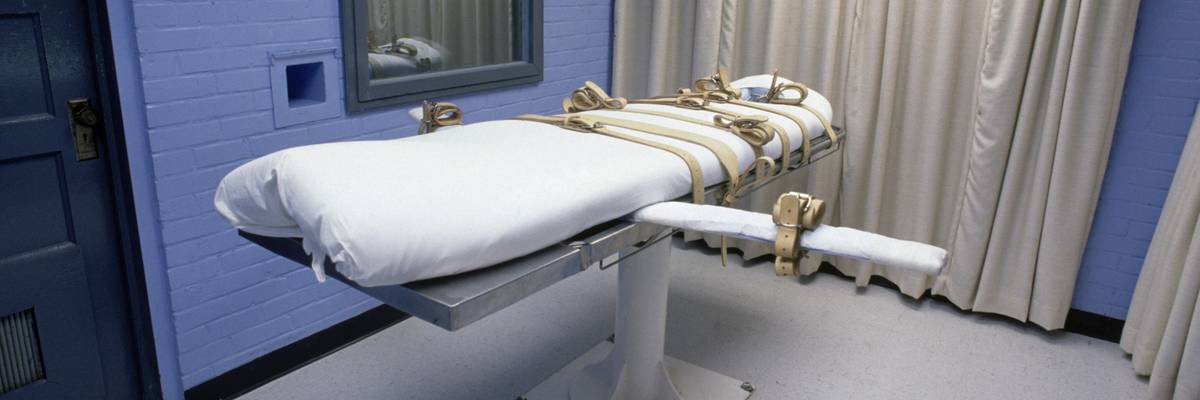
A table fitted with restraints holds down death row prisoners while they are given a lethal injection at Huntsville Unit (Walls Unit) in Huntsville, Texas.
My opposition to this execution is not a betrayal of my father. It is an affirmation of the values he lived by, and that I have tried to instill in my children.
At the tender age of 9, I lost my father, Doug Battle, when he was killed during a robbery. Like many children faced with sudden violence, I asked a simple question with no answer: Why did you have to kill him?
Today, I am asking a different question… one that should concern all of us.
Why is the state preparing to execute Charles Burton, a man who did not kill my father?
In 1991, six men robbed an AutoZone store in Alabama. Mr. Burton had already left the store with the money. Derrick DeBruce remained inside and made his own decision, in accordance with no one, to shoot my father as he lay face-down on the floor alongside employees and customers. There is no evidence that Mr. Burton knew, or had any intent, that a shooting would occur.
Executing a man who did not commit the killing does not heal wounds or strengthen public trust. It weakens it.
Both men were initially sentenced to death. Later, DeBruce, the shooter, had his sentence overturned and the state agreed to resentence him to life without parole. Mr. Burton, the non-shooter, remains on death row.
If this is allowed to stand, this would represent a fundamental flaw in how capital punishment is applied in America.
Mr. Burton is now 75 years old, wheelchair-bound, and suffering from severe rheumatoid arthritis. He is frail, in declining health, and poses no threat to public safety. Yet the state plans to execute him using nitrogen hypoxia, a method that raises serious ethical and constitutional concerns.
As a child, I believed justice meant punishment. I thought executions would bring closure. Over time, I learned that justice cannot be reduced to finality. A system that values procedural rigidity over truth demonstrates to me that it does not revere justice.
Mr. Burton’s continued presence on death row does not reflect a moral judgment. From what I understand, it has persisted in part because technical rules prevent courts from correcting past errors. When a legal system allows a man who did not commit the killing to die because the process itself blocks reconsideration, it reveals how fragile justice can be.
Earlier this year, I was informed that the state intended to move forward with Mr. Burton’s execution. When I was contacted by the Attorney General's Victims' Assistance Office and said I opposed the execution, I was told my opinion did not matter. As the victim’s child, I was not consulted about mercy, only about logistics.
My opposition to this execution is not a betrayal of my father. It is an affirmation of the values he lived by, and that I have tried to instill in my children. Justice can be measured by our commitment to truth and our willingness to show mercy.
Executing a man who did not commit the killing does not heal wounds or strengthen public trust. It weakens it.
I wrestle with my feelings on whether capital punishment should exist at all, but if it must be applied, it should be done so with restraint, proportionality, and humility. This case fails on all three counts.
I lost my father to violence. Another death will not bring him back. It will only deepen my trauma and the moral cost we all share.
Dear Common Dreams reader, It’s been nearly 30 years since I co-founded Common Dreams with my late wife, Lina Newhouser. We had the radical notion that journalism should serve the public good, not corporate profits. It was clear to us from the outset what it would take to build such a project. No paid advertisements. No corporate sponsors. No millionaire publisher telling us what to think or do. Many people said we wouldn't last a year, but we proved those doubters wrong. Together with a tremendous team of journalists and dedicated staff, we built an independent media outlet free from the constraints of profits and corporate control. Our mission has always been simple: To inform. To inspire. To ignite change for the common good. Building Common Dreams was not easy. Our survival was never guaranteed. When you take on the most powerful forces—Wall Street greed, fossil fuel industry destruction, Big Tech lobbyists, and uber-rich oligarchs who have spent billions upon billions rigging the economy and democracy in their favor—the only bulwark you have is supporters who believe in your work. But here’s the urgent message from me today. It's never been this bad out there. And it's never been this hard to keep us going. At the very moment Common Dreams is most needed, the threats we face are intensifying. We need your support now more than ever. We don't accept corporate advertising and never will. We don't have a paywall because we don't think people should be blocked from critical news based on their ability to pay. Everything we do is funded by the donations of readers like you. When everyone does the little they can afford, we are strong. But if that support retreats or dries up, so do we. Will you donate now to make sure Common Dreams not only survives but thrives? —Craig Brown, Co-founder |
At the tender age of 9, I lost my father, Doug Battle, when he was killed during a robbery. Like many children faced with sudden violence, I asked a simple question with no answer: Why did you have to kill him?
Today, I am asking a different question… one that should concern all of us.
Why is the state preparing to execute Charles Burton, a man who did not kill my father?
In 1991, six men robbed an AutoZone store in Alabama. Mr. Burton had already left the store with the money. Derrick DeBruce remained inside and made his own decision, in accordance with no one, to shoot my father as he lay face-down on the floor alongside employees and customers. There is no evidence that Mr. Burton knew, or had any intent, that a shooting would occur.
Executing a man who did not commit the killing does not heal wounds or strengthen public trust. It weakens it.
Both men were initially sentenced to death. Later, DeBruce, the shooter, had his sentence overturned and the state agreed to resentence him to life without parole. Mr. Burton, the non-shooter, remains on death row.
If this is allowed to stand, this would represent a fundamental flaw in how capital punishment is applied in America.
Mr. Burton is now 75 years old, wheelchair-bound, and suffering from severe rheumatoid arthritis. He is frail, in declining health, and poses no threat to public safety. Yet the state plans to execute him using nitrogen hypoxia, a method that raises serious ethical and constitutional concerns.
As a child, I believed justice meant punishment. I thought executions would bring closure. Over time, I learned that justice cannot be reduced to finality. A system that values procedural rigidity over truth demonstrates to me that it does not revere justice.
Mr. Burton’s continued presence on death row does not reflect a moral judgment. From what I understand, it has persisted in part because technical rules prevent courts from correcting past errors. When a legal system allows a man who did not commit the killing to die because the process itself blocks reconsideration, it reveals how fragile justice can be.
Earlier this year, I was informed that the state intended to move forward with Mr. Burton’s execution. When I was contacted by the Attorney General's Victims' Assistance Office and said I opposed the execution, I was told my opinion did not matter. As the victim’s child, I was not consulted about mercy, only about logistics.
My opposition to this execution is not a betrayal of my father. It is an affirmation of the values he lived by, and that I have tried to instill in my children. Justice can be measured by our commitment to truth and our willingness to show mercy.
Executing a man who did not commit the killing does not heal wounds or strengthen public trust. It weakens it.
I wrestle with my feelings on whether capital punishment should exist at all, but if it must be applied, it should be done so with restraint, proportionality, and humility. This case fails on all three counts.
I lost my father to violence. Another death will not bring him back. It will only deepen my trauma and the moral cost we all share.
At the tender age of 9, I lost my father, Doug Battle, when he was killed during a robbery. Like many children faced with sudden violence, I asked a simple question with no answer: Why did you have to kill him?
Today, I am asking a different question… one that should concern all of us.
Why is the state preparing to execute Charles Burton, a man who did not kill my father?
In 1991, six men robbed an AutoZone store in Alabama. Mr. Burton had already left the store with the money. Derrick DeBruce remained inside and made his own decision, in accordance with no one, to shoot my father as he lay face-down on the floor alongside employees and customers. There is no evidence that Mr. Burton knew, or had any intent, that a shooting would occur.
Executing a man who did not commit the killing does not heal wounds or strengthen public trust. It weakens it.
Both men were initially sentenced to death. Later, DeBruce, the shooter, had his sentence overturned and the state agreed to resentence him to life without parole. Mr. Burton, the non-shooter, remains on death row.
If this is allowed to stand, this would represent a fundamental flaw in how capital punishment is applied in America.
Mr. Burton is now 75 years old, wheelchair-bound, and suffering from severe rheumatoid arthritis. He is frail, in declining health, and poses no threat to public safety. Yet the state plans to execute him using nitrogen hypoxia, a method that raises serious ethical and constitutional concerns.
As a child, I believed justice meant punishment. I thought executions would bring closure. Over time, I learned that justice cannot be reduced to finality. A system that values procedural rigidity over truth demonstrates to me that it does not revere justice.
Mr. Burton’s continued presence on death row does not reflect a moral judgment. From what I understand, it has persisted in part because technical rules prevent courts from correcting past errors. When a legal system allows a man who did not commit the killing to die because the process itself blocks reconsideration, it reveals how fragile justice can be.
Earlier this year, I was informed that the state intended to move forward with Mr. Burton’s execution. When I was contacted by the Attorney General's Victims' Assistance Office and said I opposed the execution, I was told my opinion did not matter. As the victim’s child, I was not consulted about mercy, only about logistics.
My opposition to this execution is not a betrayal of my father. It is an affirmation of the values he lived by, and that I have tried to instill in my children. Justice can be measured by our commitment to truth and our willingness to show mercy.
Executing a man who did not commit the killing does not heal wounds or strengthen public trust. It weakens it.
I wrestle with my feelings on whether capital punishment should exist at all, but if it must be applied, it should be done so with restraint, proportionality, and humility. This case fails on all three counts.
I lost my father to violence. Another death will not bring him back. It will only deepen my trauma and the moral cost we all share.

