SUBSCRIBE TO OUR FREE NEWSLETTER
Daily news & progressive opinion—funded by the people, not the corporations—delivered straight to your inbox.
5
#000000
#FFFFFF
To donate by check, phone, or other method, see our More Ways to Give page.
Daily news & progressive opinion—funded by the people, not the corporations—delivered straight to your inbox.
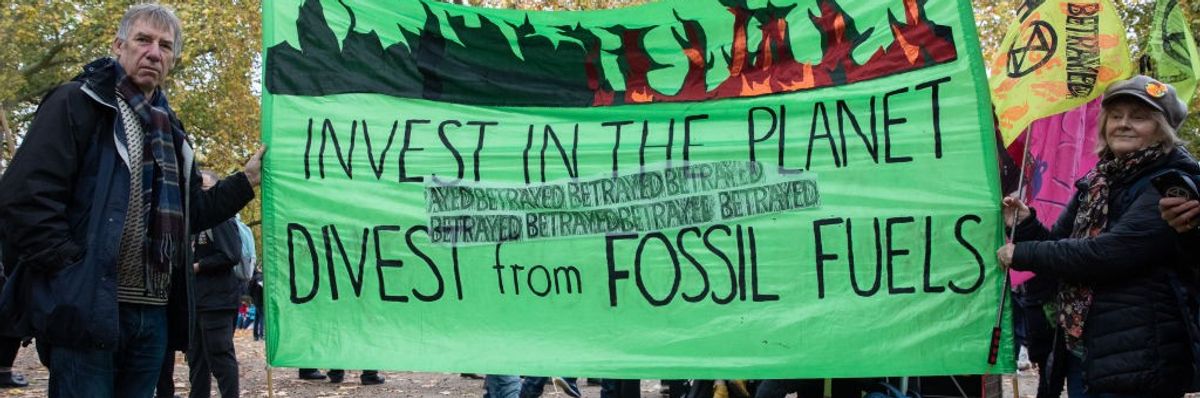
Extinction Rebellion climate activists hold a banner in Lincoln's Inn Fields before a march on November 13, 2021 in London, United Kingdom.
Over 1,600 institutions, including hundreds of faith-based organizations, have now joined the fight to move money away from polluting fossil fuels and toward clean energy solutions—yours should be next.
Last month saw an historic, albeit altogether insufficient, step forward to avoid climate catastrophe.
At the annual global UN-backed climate change conference in Dubai, known as COP28, countries for the first time unanimously acknowledged the necessity of “transitioning away from fossil fuels”: coal, oil, and gas. While short of an endorsement of a full fossil fuel phaseout—what scientists tell us is needed to avert the worst impacts of the climate crisis—it is a milestone, decades in the making.
Yet even this tepid sign of progress faced pushback from fossil fuel executives and the politicians who do their bidding.
The story of COP28 is one of the power and perniciousness of the fossil fuel industry. The CEO of the United Arab Emirates’ oil company (the 12th largest in the world) served as conference chair, and industry lobbyists outnumbered delegates from nearly every country. The final text is full of industry-friendly loopholes, giving fossil fuel corporations leeway to continue to profit off dirty energy.
Trying to address the climate crisis while expanding drilling, mining, and fracking operations is like offering chemotherapy to a lung cancer patient while handing them pack after pack of Marlboro Reds.
It’s clear we are at the end of the fossil fuel era. Solar and wind energy are the cheapest forms of energy to build.
Like tobacco companies before them, fossil fuel corporations have known for years (with shocking accuracy) about the science: their products, when used as directed, would harm the health of the planet and cause widespread devastation. But the industry has time and again blocked significant action or sought to delay it through false promises. They did so again at COP28.
As the future is at stake, it falls to the rest of us to take urgent action. Indeed, civil society institutions are not waiting. Last week marked a major achievement: 1600 institutions across the world representing more than $40 trillion (with a “T”) have now pledged to move money away from fossil fuels and toward clean energy.
Finance represents a critical lever for climate action. Fossil fuel corporations rely on an open spigot of funds – project finance through underwriting and loans from major banks, plus investment capital and approval for continued fossil fuel expansion from investors, including the world’s largest firms, BlackRock and Vanguard.
When investors move their money en masse, fossil fuel corporations face reputational and brand risk that can have knock-on effects, including lower credit ratings and challenges with securing financing for projects and operations. Crucially, doing so also erodes fossil fuel corporations’ social license to expand their operations.
The 1600 institutions that have committed to move their money include groups like the National Academy of Medicine, because profiting from burning fossil fuels violates the medical ethic of “first, do no harm.” They include universities like Brandeis, rooted in Jewish history, experience, and values, whose students and administration recognize the climate crisis as an existential threat to their future.
It’s clear we are at the end of the fossil fuel era. Solar and wind energy are the cheapest forms of energy to build. The market itself is acting on this imperative. Fossil fuels as a sector have performed worse financially over the past decade than the rest of the market. Over the last 30 years, they have shrunk from a quarter of the market to around 5%. According to a recent report, six public pensions could be $21 billion richer if they had ditched investments in coal, oil, and gas a decade ago.
As the future is at stake, it falls to the rest of us to take urgent action.
Faith-based institutions, representing more than a third of the commitments, are at the forefront of this movement for change. As Pope Francis has encouraged, we “must listen to science and institute a rapid and equitable transition to end the era of fossil fuel.”
One year ago, my organization, Dayenu: A Jewish Call to Climate Action, released a report about the investment capital of major Jewish institutions. The report found that these institutions had a substantial opportunity to move more than $3 billion in capital out of fossil fuels and into clean energy, and offered a roadmap to achieve this goal. Since last year, the climate crisis has grown more urgent, and so has the power of our faith and moral voice.
Faith groups are leading. They are making prudent, long-term decisions that will protect their communities. Join us before it is too late.
Dear Common Dreams reader, It’s been nearly 30 years since I co-founded Common Dreams with my late wife, Lina Newhouser. We had the radical notion that journalism should serve the public good, not corporate profits. It was clear to us from the outset what it would take to build such a project. No paid advertisements. No corporate sponsors. No millionaire publisher telling us what to think or do. Many people said we wouldn't last a year, but we proved those doubters wrong. Together with a tremendous team of journalists and dedicated staff, we built an independent media outlet free from the constraints of profits and corporate control. Our mission has always been simple: To inform. To inspire. To ignite change for the common good. Building Common Dreams was not easy. Our survival was never guaranteed. When you take on the most powerful forces—Wall Street greed, fossil fuel industry destruction, Big Tech lobbyists, and uber-rich oligarchs who have spent billions upon billions rigging the economy and democracy in their favor—the only bulwark you have is supporters who believe in your work. But here’s the urgent message from me today. It's never been this bad out there. And it's never been this hard to keep us going. At the very moment Common Dreams is most needed, the threats we face are intensifying. We need your support now more than ever. We don't accept corporate advertising and never will. We don't have a paywall because we don't think people should be blocked from critical news based on their ability to pay. Everything we do is funded by the donations of readers like you. When everyone does the little they can afford, we are strong. But if that support retreats or dries up, so do we. Will you donate now to make sure Common Dreams not only survives but thrives? —Craig Brown, Co-founder |
Last month saw an historic, albeit altogether insufficient, step forward to avoid climate catastrophe.
At the annual global UN-backed climate change conference in Dubai, known as COP28, countries for the first time unanimously acknowledged the necessity of “transitioning away from fossil fuels”: coal, oil, and gas. While short of an endorsement of a full fossil fuel phaseout—what scientists tell us is needed to avert the worst impacts of the climate crisis—it is a milestone, decades in the making.
Yet even this tepid sign of progress faced pushback from fossil fuel executives and the politicians who do their bidding.
The story of COP28 is one of the power and perniciousness of the fossil fuel industry. The CEO of the United Arab Emirates’ oil company (the 12th largest in the world) served as conference chair, and industry lobbyists outnumbered delegates from nearly every country. The final text is full of industry-friendly loopholes, giving fossil fuel corporations leeway to continue to profit off dirty energy.
Trying to address the climate crisis while expanding drilling, mining, and fracking operations is like offering chemotherapy to a lung cancer patient while handing them pack after pack of Marlboro Reds.
It’s clear we are at the end of the fossil fuel era. Solar and wind energy are the cheapest forms of energy to build.
Like tobacco companies before them, fossil fuel corporations have known for years (with shocking accuracy) about the science: their products, when used as directed, would harm the health of the planet and cause widespread devastation. But the industry has time and again blocked significant action or sought to delay it through false promises. They did so again at COP28.
As the future is at stake, it falls to the rest of us to take urgent action. Indeed, civil society institutions are not waiting. Last week marked a major achievement: 1600 institutions across the world representing more than $40 trillion (with a “T”) have now pledged to move money away from fossil fuels and toward clean energy.
Finance represents a critical lever for climate action. Fossil fuel corporations rely on an open spigot of funds – project finance through underwriting and loans from major banks, plus investment capital and approval for continued fossil fuel expansion from investors, including the world’s largest firms, BlackRock and Vanguard.
When investors move their money en masse, fossil fuel corporations face reputational and brand risk that can have knock-on effects, including lower credit ratings and challenges with securing financing for projects and operations. Crucially, doing so also erodes fossil fuel corporations’ social license to expand their operations.
The 1600 institutions that have committed to move their money include groups like the National Academy of Medicine, because profiting from burning fossil fuels violates the medical ethic of “first, do no harm.” They include universities like Brandeis, rooted in Jewish history, experience, and values, whose students and administration recognize the climate crisis as an existential threat to their future.
It’s clear we are at the end of the fossil fuel era. Solar and wind energy are the cheapest forms of energy to build. The market itself is acting on this imperative. Fossil fuels as a sector have performed worse financially over the past decade than the rest of the market. Over the last 30 years, they have shrunk from a quarter of the market to around 5%. According to a recent report, six public pensions could be $21 billion richer if they had ditched investments in coal, oil, and gas a decade ago.
As the future is at stake, it falls to the rest of us to take urgent action.
Faith-based institutions, representing more than a third of the commitments, are at the forefront of this movement for change. As Pope Francis has encouraged, we “must listen to science and institute a rapid and equitable transition to end the era of fossil fuel.”
One year ago, my organization, Dayenu: A Jewish Call to Climate Action, released a report about the investment capital of major Jewish institutions. The report found that these institutions had a substantial opportunity to move more than $3 billion in capital out of fossil fuels and into clean energy, and offered a roadmap to achieve this goal. Since last year, the climate crisis has grown more urgent, and so has the power of our faith and moral voice.
Faith groups are leading. They are making prudent, long-term decisions that will protect their communities. Join us before it is too late.
Last month saw an historic, albeit altogether insufficient, step forward to avoid climate catastrophe.
At the annual global UN-backed climate change conference in Dubai, known as COP28, countries for the first time unanimously acknowledged the necessity of “transitioning away from fossil fuels”: coal, oil, and gas. While short of an endorsement of a full fossil fuel phaseout—what scientists tell us is needed to avert the worst impacts of the climate crisis—it is a milestone, decades in the making.
Yet even this tepid sign of progress faced pushback from fossil fuel executives and the politicians who do their bidding.
The story of COP28 is one of the power and perniciousness of the fossil fuel industry. The CEO of the United Arab Emirates’ oil company (the 12th largest in the world) served as conference chair, and industry lobbyists outnumbered delegates from nearly every country. The final text is full of industry-friendly loopholes, giving fossil fuel corporations leeway to continue to profit off dirty energy.
Trying to address the climate crisis while expanding drilling, mining, and fracking operations is like offering chemotherapy to a lung cancer patient while handing them pack after pack of Marlboro Reds.
It’s clear we are at the end of the fossil fuel era. Solar and wind energy are the cheapest forms of energy to build.
Like tobacco companies before them, fossil fuel corporations have known for years (with shocking accuracy) about the science: their products, when used as directed, would harm the health of the planet and cause widespread devastation. But the industry has time and again blocked significant action or sought to delay it through false promises. They did so again at COP28.
As the future is at stake, it falls to the rest of us to take urgent action. Indeed, civil society institutions are not waiting. Last week marked a major achievement: 1600 institutions across the world representing more than $40 trillion (with a “T”) have now pledged to move money away from fossil fuels and toward clean energy.
Finance represents a critical lever for climate action. Fossil fuel corporations rely on an open spigot of funds – project finance through underwriting and loans from major banks, plus investment capital and approval for continued fossil fuel expansion from investors, including the world’s largest firms, BlackRock and Vanguard.
When investors move their money en masse, fossil fuel corporations face reputational and brand risk that can have knock-on effects, including lower credit ratings and challenges with securing financing for projects and operations. Crucially, doing so also erodes fossil fuel corporations’ social license to expand their operations.
The 1600 institutions that have committed to move their money include groups like the National Academy of Medicine, because profiting from burning fossil fuels violates the medical ethic of “first, do no harm.” They include universities like Brandeis, rooted in Jewish history, experience, and values, whose students and administration recognize the climate crisis as an existential threat to their future.
It’s clear we are at the end of the fossil fuel era. Solar and wind energy are the cheapest forms of energy to build. The market itself is acting on this imperative. Fossil fuels as a sector have performed worse financially over the past decade than the rest of the market. Over the last 30 years, they have shrunk from a quarter of the market to around 5%. According to a recent report, six public pensions could be $21 billion richer if they had ditched investments in coal, oil, and gas a decade ago.
As the future is at stake, it falls to the rest of us to take urgent action.
Faith-based institutions, representing more than a third of the commitments, are at the forefront of this movement for change. As Pope Francis has encouraged, we “must listen to science and institute a rapid and equitable transition to end the era of fossil fuel.”
One year ago, my organization, Dayenu: A Jewish Call to Climate Action, released a report about the investment capital of major Jewish institutions. The report found that these institutions had a substantial opportunity to move more than $3 billion in capital out of fossil fuels and into clean energy, and offered a roadmap to achieve this goal. Since last year, the climate crisis has grown more urgent, and so has the power of our faith and moral voice.
Faith groups are leading. They are making prudent, long-term decisions that will protect their communities. Join us before it is too late.