SUBSCRIBE TO OUR FREE NEWSLETTER
Daily news & progressive opinion—funded by the people, not the corporations—delivered straight to your inbox.
5
#000000
#FFFFFF
To donate by check, phone, or other method, see our More Ways to Give page.
Daily news & progressive opinion—funded by the people, not the corporations—delivered straight to your inbox.
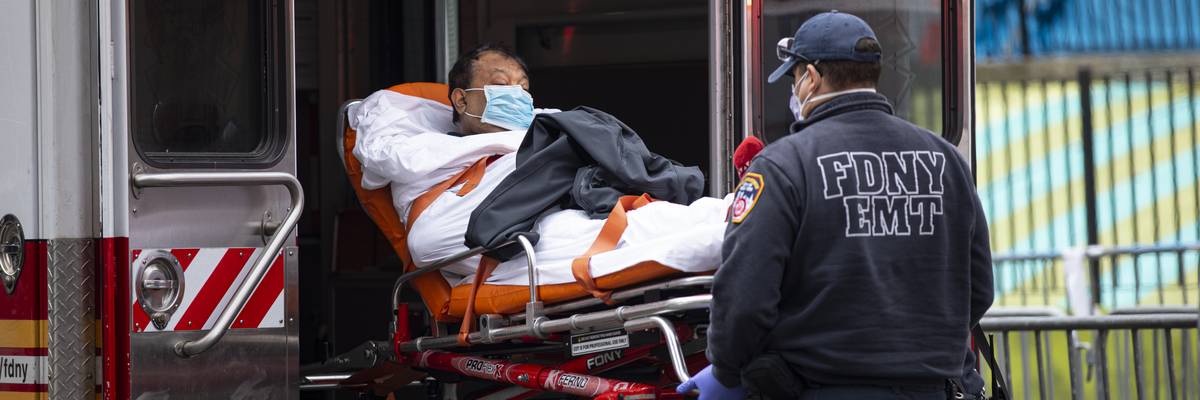
Two members of the Fire Department of New York's Emergency Medical Team wheel in a patient with potentially fatal coronavirus to the Elmhurst Hospital Center in the Queens borough of New York City on March 30, 2020.
In a world where the avian flu hovers near us, measles is reemerging, and viruses are mutating daily, we need the example of essential workers’ courage and solidarity to strengthen us for the next public health emergency.
Just five years after Covid-19 struck New York City, we’ve almost forgotten the early days of the pandemic in the spring of 2020, when refrigerator trucks were filled with dead bodies and 800 people a day were dying from Covid-19. We may remember the lockdowns and disputes over masking and vaccines that persist to this day, but we fail to remember what actually kept the city running and helped it survive: the labor of essential workers in our hospitals, grocery stores, transit system, police precincts, and firehouses.
The desire to forget the traumas of the pandemic is perfectly human, but forgetting the labor that saved the city would be a dangerous mistake. In a world where the avian flu hovers near us, measles is reemerging, and viruses are mutating daily, we need the example of essential workers’ courage and solidarity to strengthen us for the next public health emergency.
When then-Gov. Andrew Cuomo’s ”New York On Pause” plan took effect on March 22 of 2020, it divided the state’s workforce into essential workers (who were expected to go out to do their jobs) and the rest of us who could labor from home.
Maintaining public health requires setting aside private interest to serve the public good. When a communicable disease attacks, it becomes clear that the health of each of us is bound up with the health of all of us.
Essential workers drew strength from many sources—from socially conscious professionalism to ideals of courage to the support of workmates to the knowledge that their families needed their paycheck to survive.
For some essential workers—above all police and firefighters—facing danger is part of the job. And transit workers toil in a system of buses, subways, and repair shops where hazards are common.
Others faced danger on their jobs for the first time. Healthcare professionals expect to confront dangerous illnesses, but the communicability of Covid-19 was unusual. Cashiers in supermarkets and drug stores were surprised to find themselves facing a deadly disease transmitted by customers and coworkers.
It was a scary time. Police officers, firefighters, paramedics, and emergency medical technicians went into the homes of the sick to provide support, care, and—when all else failed—transportation to a hospital. Nurses learned new skills overnight to meet the demands of Covid-19, then held cellphones next to their dying patients so they could hear the voices of their loved ones. Doctors improvised new forms of communication and treatment. Cashiers and food service workers provided meals and emotional support for customers.
For all their bravery, many essential workers faced terrible working conditions. Bicycle couriers who delivered meals for restaurants confronted poor pay, bad weather, and the galling fact that the restaurants they served would not let them use their toilets. Health care professionals grappled with shortages of protective gear and medical supplies.
Transit workers had to deal with passengers who ignored rules on social distancing. One bus driver was knocked unconscious by a passenger after he asked him to put on a mask to cover his chronic cough.
Still, for a brief time, the city seemed united. Every night at 7:00 pm, New Yorkers learned from their windows or stood on the sidewalk to cheer their essential workers. For precious minutes we broke out of our isolation, saluted the best in us, and strengthened each other. Working together, putting the common good first, the city managed to “bend the curve.” Stay-at-home orders, social distancing, and masking brought the number of infections down.
By June, the Covid-19 surge of spring 2020 was over and deaths were down to a much-reduced level of less than 50 a day.
But the spirit of solidarity proved to be short-lived. Ironically, after vaccines against Covid-19 were introduced in December 2020 and danger eased, the city was gripped by a sour mood, starting with negative reactions to a computerized system of registration for vaccines that was glitchy and inefficient. Restaurant operators had to contend with both changing municipal guidelines and customers who flouted masking requirements. Old currents of hatred, especially antisemitism and racism against Asians, gained new strength. Over time, the value of the vaccines themselves became a subject of debate and disinformation.
One of the great lessons of the pandemic is that solidarity is hard to maintain. When the interest of public health and personal interest aligned, as they did in the spring of 2020, people were willing to wear masks and engage in social distancing to save themselves. Once the vaccines made them feel safe, they were reluctant to accept limitations on their individual lives.
Maintaining public health requires setting aside private interest to serve the public good. When a communicable disease attacks, it becomes clear that the health of each of us is bound up with the health of all of us.
In the grim days of the pandemic, essential workers were their brothers and sisters’ keepers. For all the divisions in our city and country over the pandemic and so much else, the courage of essential workers is something we all can admire. We need to learn from it if we are to build a better future.
Dear Common Dreams reader, It’s been nearly 30 years since I co-founded Common Dreams with my late wife, Lina Newhouser. We had the radical notion that journalism should serve the public good, not corporate profits. It was clear to us from the outset what it would take to build such a project. No paid advertisements. No corporate sponsors. No millionaire publisher telling us what to think or do. Many people said we wouldn't last a year, but we proved those doubters wrong. Together with a tremendous team of journalists and dedicated staff, we built an independent media outlet free from the constraints of profits and corporate control. Our mission has always been simple: To inform. To inspire. To ignite change for the common good. Building Common Dreams was not easy. Our survival was never guaranteed. When you take on the most powerful forces—Wall Street greed, fossil fuel industry destruction, Big Tech lobbyists, and uber-rich oligarchs who have spent billions upon billions rigging the economy and democracy in their favor—the only bulwark you have is supporters who believe in your work. But here’s the urgent message from me today. It's never been this bad out there. And it's never been this hard to keep us going. At the very moment Common Dreams is most needed, the threats we face are intensifying. We need your support now more than ever. We don't accept corporate advertising and never will. We don't have a paywall because we don't think people should be blocked from critical news based on their ability to pay. Everything we do is funded by the donations of readers like you. When everyone does the little they can afford, we are strong. But if that support retreats or dries up, so do we. Will you donate now to make sure Common Dreams not only survives but thrives? —Craig Brown, Co-founder |
Just five years after Covid-19 struck New York City, we’ve almost forgotten the early days of the pandemic in the spring of 2020, when refrigerator trucks were filled with dead bodies and 800 people a day were dying from Covid-19. We may remember the lockdowns and disputes over masking and vaccines that persist to this day, but we fail to remember what actually kept the city running and helped it survive: the labor of essential workers in our hospitals, grocery stores, transit system, police precincts, and firehouses.
The desire to forget the traumas of the pandemic is perfectly human, but forgetting the labor that saved the city would be a dangerous mistake. In a world where the avian flu hovers near us, measles is reemerging, and viruses are mutating daily, we need the example of essential workers’ courage and solidarity to strengthen us for the next public health emergency.
When then-Gov. Andrew Cuomo’s ”New York On Pause” plan took effect on March 22 of 2020, it divided the state’s workforce into essential workers (who were expected to go out to do their jobs) and the rest of us who could labor from home.
Maintaining public health requires setting aside private interest to serve the public good. When a communicable disease attacks, it becomes clear that the health of each of us is bound up with the health of all of us.
Essential workers drew strength from many sources—from socially conscious professionalism to ideals of courage to the support of workmates to the knowledge that their families needed their paycheck to survive.
For some essential workers—above all police and firefighters—facing danger is part of the job. And transit workers toil in a system of buses, subways, and repair shops where hazards are common.
Others faced danger on their jobs for the first time. Healthcare professionals expect to confront dangerous illnesses, but the communicability of Covid-19 was unusual. Cashiers in supermarkets and drug stores were surprised to find themselves facing a deadly disease transmitted by customers and coworkers.
It was a scary time. Police officers, firefighters, paramedics, and emergency medical technicians went into the homes of the sick to provide support, care, and—when all else failed—transportation to a hospital. Nurses learned new skills overnight to meet the demands of Covid-19, then held cellphones next to their dying patients so they could hear the voices of their loved ones. Doctors improvised new forms of communication and treatment. Cashiers and food service workers provided meals and emotional support for customers.
For all their bravery, many essential workers faced terrible working conditions. Bicycle couriers who delivered meals for restaurants confronted poor pay, bad weather, and the galling fact that the restaurants they served would not let them use their toilets. Health care professionals grappled with shortages of protective gear and medical supplies.
Transit workers had to deal with passengers who ignored rules on social distancing. One bus driver was knocked unconscious by a passenger after he asked him to put on a mask to cover his chronic cough.
Still, for a brief time, the city seemed united. Every night at 7:00 pm, New Yorkers learned from their windows or stood on the sidewalk to cheer their essential workers. For precious minutes we broke out of our isolation, saluted the best in us, and strengthened each other. Working together, putting the common good first, the city managed to “bend the curve.” Stay-at-home orders, social distancing, and masking brought the number of infections down.
By June, the Covid-19 surge of spring 2020 was over and deaths were down to a much-reduced level of less than 50 a day.
But the spirit of solidarity proved to be short-lived. Ironically, after vaccines against Covid-19 were introduced in December 2020 and danger eased, the city was gripped by a sour mood, starting with negative reactions to a computerized system of registration for vaccines that was glitchy and inefficient. Restaurant operators had to contend with both changing municipal guidelines and customers who flouted masking requirements. Old currents of hatred, especially antisemitism and racism against Asians, gained new strength. Over time, the value of the vaccines themselves became a subject of debate and disinformation.
One of the great lessons of the pandemic is that solidarity is hard to maintain. When the interest of public health and personal interest aligned, as they did in the spring of 2020, people were willing to wear masks and engage in social distancing to save themselves. Once the vaccines made them feel safe, they were reluctant to accept limitations on their individual lives.
Maintaining public health requires setting aside private interest to serve the public good. When a communicable disease attacks, it becomes clear that the health of each of us is bound up with the health of all of us.
In the grim days of the pandemic, essential workers were their brothers and sisters’ keepers. For all the divisions in our city and country over the pandemic and so much else, the courage of essential workers is something we all can admire. We need to learn from it if we are to build a better future.
Just five years after Covid-19 struck New York City, we’ve almost forgotten the early days of the pandemic in the spring of 2020, when refrigerator trucks were filled with dead bodies and 800 people a day were dying from Covid-19. We may remember the lockdowns and disputes over masking and vaccines that persist to this day, but we fail to remember what actually kept the city running and helped it survive: the labor of essential workers in our hospitals, grocery stores, transit system, police precincts, and firehouses.
The desire to forget the traumas of the pandemic is perfectly human, but forgetting the labor that saved the city would be a dangerous mistake. In a world where the avian flu hovers near us, measles is reemerging, and viruses are mutating daily, we need the example of essential workers’ courage and solidarity to strengthen us for the next public health emergency.
When then-Gov. Andrew Cuomo’s ”New York On Pause” plan took effect on March 22 of 2020, it divided the state’s workforce into essential workers (who were expected to go out to do their jobs) and the rest of us who could labor from home.
Maintaining public health requires setting aside private interest to serve the public good. When a communicable disease attacks, it becomes clear that the health of each of us is bound up with the health of all of us.
Essential workers drew strength from many sources—from socially conscious professionalism to ideals of courage to the support of workmates to the knowledge that their families needed their paycheck to survive.
For some essential workers—above all police and firefighters—facing danger is part of the job. And transit workers toil in a system of buses, subways, and repair shops where hazards are common.
Others faced danger on their jobs for the first time. Healthcare professionals expect to confront dangerous illnesses, but the communicability of Covid-19 was unusual. Cashiers in supermarkets and drug stores were surprised to find themselves facing a deadly disease transmitted by customers and coworkers.
It was a scary time. Police officers, firefighters, paramedics, and emergency medical technicians went into the homes of the sick to provide support, care, and—when all else failed—transportation to a hospital. Nurses learned new skills overnight to meet the demands of Covid-19, then held cellphones next to their dying patients so they could hear the voices of their loved ones. Doctors improvised new forms of communication and treatment. Cashiers and food service workers provided meals and emotional support for customers.
For all their bravery, many essential workers faced terrible working conditions. Bicycle couriers who delivered meals for restaurants confronted poor pay, bad weather, and the galling fact that the restaurants they served would not let them use their toilets. Health care professionals grappled with shortages of protective gear and medical supplies.
Transit workers had to deal with passengers who ignored rules on social distancing. One bus driver was knocked unconscious by a passenger after he asked him to put on a mask to cover his chronic cough.
Still, for a brief time, the city seemed united. Every night at 7:00 pm, New Yorkers learned from their windows or stood on the sidewalk to cheer their essential workers. For precious minutes we broke out of our isolation, saluted the best in us, and strengthened each other. Working together, putting the common good first, the city managed to “bend the curve.” Stay-at-home orders, social distancing, and masking brought the number of infections down.
By June, the Covid-19 surge of spring 2020 was over and deaths were down to a much-reduced level of less than 50 a day.
But the spirit of solidarity proved to be short-lived. Ironically, after vaccines against Covid-19 were introduced in December 2020 and danger eased, the city was gripped by a sour mood, starting with negative reactions to a computerized system of registration for vaccines that was glitchy and inefficient. Restaurant operators had to contend with both changing municipal guidelines and customers who flouted masking requirements. Old currents of hatred, especially antisemitism and racism against Asians, gained new strength. Over time, the value of the vaccines themselves became a subject of debate and disinformation.
One of the great lessons of the pandemic is that solidarity is hard to maintain. When the interest of public health and personal interest aligned, as they did in the spring of 2020, people were willing to wear masks and engage in social distancing to save themselves. Once the vaccines made them feel safe, they were reluctant to accept limitations on their individual lives.
Maintaining public health requires setting aside private interest to serve the public good. When a communicable disease attacks, it becomes clear that the health of each of us is bound up with the health of all of us.
In the grim days of the pandemic, essential workers were their brothers and sisters’ keepers. For all the divisions in our city and country over the pandemic and so much else, the courage of essential workers is something we all can admire. We need to learn from it if we are to build a better future.