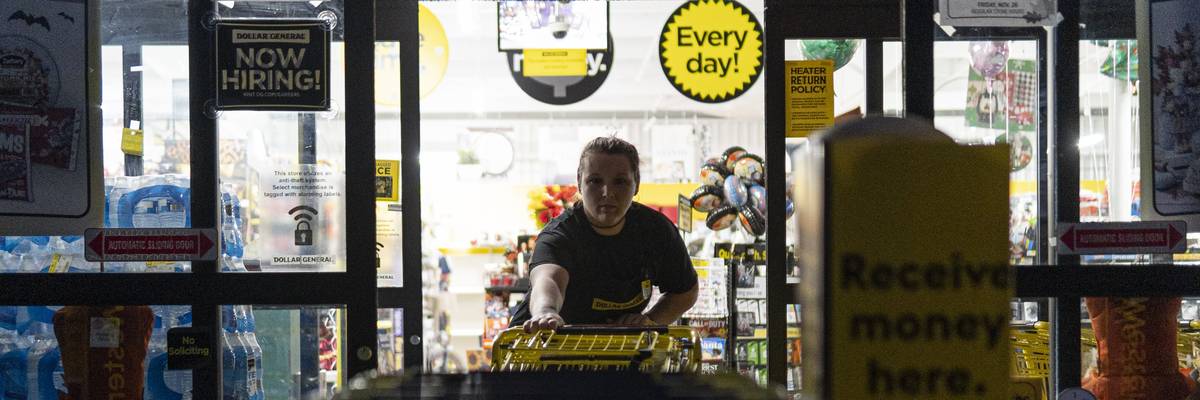
A worker pushes shopping carts out of the front doors of a Dollar General in Barkhamsted, Connecticut on November 18, 2021.
How Corporate Greed Hurts Workers and Customers at Places Like Dollar General
At many big stores, workers are short-handed and face difficult working conditions—even when their companies are highly profitable.
I’ve always felt that working in customer-facing jobs is my calling. I’m passionate about making people feel comfortable when they enter a business, be it a retail store or a restaurant.
But it was hard to keep that passion when I worked at Dollar General. Like workers at many other big retailers, we were so short-staffed and poorly trained that it was next to impossible to give good customer service.
My interview and first day on the job went well. Managers, co-workers, and customers all seemed pretty happy. The second day was a complete 180. All of a sudden I was thrown into my duties with zero training. They even scheduled me to close out the store that day without instructions.
Dollar General has also been taking profits that could go toward worker pay or fixing up their stores and spending them instead on stock buybacks.
Quickly I had shifts where I was the only worker for hours at a time, dealing with long lines of impatient customers, tons of merchandise to stock, and frustrated vendors subject to long wait times.
I frequently had to get overstock items from unstable top shelves and constantly worried I’d fall. The back door also wouldn’t close correctly—and even though I brought it up to management several times, it remained an easy way for anyone to sneak in.
I didn’t know it then, but Dollar General has repeatedly faced huge penalties for workplace safety violations.
Once I was called out to help with a truck delivery of refrigerated and frozen products. I went to grab a tote bag full and had to do a triple take because it was full of black mold. Another afternoon, I picked up a bag of potting soil to stock and realized it was covered with dead insects, which got all over the floor and other products.
When I had problems like these with merchandise, I was expected to contact the warehouse myself. But that was hard to do, given how understaffed we were.
Dollar General isn’t the only tough place for retail employees. At many big stores, workers are short-handed and face difficult working conditions—even when their companies are highly profitable.
Where is all the money going? Well, I can tell you not much went to me.
I made $14.75 an hour for part-time hours, even though I often wound up working full-time. After the first few weeks, my schedule became so unpredictable that I sometimes worked only a few hours a week. Eventually it just wasn’t worth all the hard work and stress, so I quit.
By contrast, Dollar General CEO Todd Vasos made nearly $10 million last year—521 times as much as a typical worker at his company, the Institute for Policy Studies reported recently.
Dollar General has also been taking profits that could go toward worker pay or fixing up their stores and spending them instead on stock buybacks. That’s when a company repurchases its own shares to inflate the value of its stock and make CEOs even richer. Between 2019 and 2023, the company spent $9 billion on this financial scam.
I also learned from the Institute’s report that 88% of Dollar General workers who are eligible to participate in the company 401(k) plan don’t have one dime in their accounts. Low-wage workers like me just don’t earn enough to be able to save for our retirement.
I saw up close how a business that’s focused on exploiting employees to make those at the top even richer isn’t just bad for workers like me, but for customers as well. And anyone who’s worked for one of these low-wage companies can tell you Dollar General is hardly unique.
If we want a strong economy, we need to do more to make sure all workers can make a decent living and feel safe and respected in their workplace.
An Urgent Message From Our Co-Founder
Dear Common Dreams reader, It’s been nearly 30 years since I co-founded Common Dreams with my late wife, Lina Newhouser. We had the radical notion that journalism should serve the public good, not corporate profits. It was clear to us from the outset what it would take to build such a project. No paid advertisements. No corporate sponsors. No millionaire publisher telling us what to think or do. Many people said we wouldn't last a year, but we proved those doubters wrong. Together with a tremendous team of journalists and dedicated staff, we built an independent media outlet free from the constraints of profits and corporate control. Our mission has always been simple: To inform. To inspire. To ignite change for the common good. Building Common Dreams was not easy. Our survival was never guaranteed. When you take on the most powerful forces—Wall Street greed, fossil fuel industry destruction, Big Tech lobbyists, and uber-rich oligarchs who have spent billions upon billions rigging the economy and democracy in their favor—the only bulwark you have is supporters who believe in your work. But here’s the urgent message from me today. It's never been this bad out there. And it's never been this hard to keep us going. At the very moment Common Dreams is most needed, the threats we face are intensifying. We need your support now more than ever. We don't accept corporate advertising and never will. We don't have a paywall because we don't think people should be blocked from critical news based on their ability to pay. Everything we do is funded by the donations of readers like you. When everyone does the little they can afford, we are strong. But if that support retreats or dries up, so do we. Will you donate now to make sure Common Dreams not only survives but thrives? —Craig Brown, Co-founder |
I’ve always felt that working in customer-facing jobs is my calling. I’m passionate about making people feel comfortable when they enter a business, be it a retail store or a restaurant.
But it was hard to keep that passion when I worked at Dollar General. Like workers at many other big retailers, we were so short-staffed and poorly trained that it was next to impossible to give good customer service.
My interview and first day on the job went well. Managers, co-workers, and customers all seemed pretty happy. The second day was a complete 180. All of a sudden I was thrown into my duties with zero training. They even scheduled me to close out the store that day without instructions.
Dollar General has also been taking profits that could go toward worker pay or fixing up their stores and spending them instead on stock buybacks.
Quickly I had shifts where I was the only worker for hours at a time, dealing with long lines of impatient customers, tons of merchandise to stock, and frustrated vendors subject to long wait times.
I frequently had to get overstock items from unstable top shelves and constantly worried I’d fall. The back door also wouldn’t close correctly—and even though I brought it up to management several times, it remained an easy way for anyone to sneak in.
I didn’t know it then, but Dollar General has repeatedly faced huge penalties for workplace safety violations.
Once I was called out to help with a truck delivery of refrigerated and frozen products. I went to grab a tote bag full and had to do a triple take because it was full of black mold. Another afternoon, I picked up a bag of potting soil to stock and realized it was covered with dead insects, which got all over the floor and other products.
When I had problems like these with merchandise, I was expected to contact the warehouse myself. But that was hard to do, given how understaffed we were.
Dollar General isn’t the only tough place for retail employees. At many big stores, workers are short-handed and face difficult working conditions—even when their companies are highly profitable.
Where is all the money going? Well, I can tell you not much went to me.
I made $14.75 an hour for part-time hours, even though I often wound up working full-time. After the first few weeks, my schedule became so unpredictable that I sometimes worked only a few hours a week. Eventually it just wasn’t worth all the hard work and stress, so I quit.
By contrast, Dollar General CEO Todd Vasos made nearly $10 million last year—521 times as much as a typical worker at his company, the Institute for Policy Studies reported recently.
Dollar General has also been taking profits that could go toward worker pay or fixing up their stores and spending them instead on stock buybacks. That’s when a company repurchases its own shares to inflate the value of its stock and make CEOs even richer. Between 2019 and 2023, the company spent $9 billion on this financial scam.
I also learned from the Institute’s report that 88% of Dollar General workers who are eligible to participate in the company 401(k) plan don’t have one dime in their accounts. Low-wage workers like me just don’t earn enough to be able to save for our retirement.
I saw up close how a business that’s focused on exploiting employees to make those at the top even richer isn’t just bad for workers like me, but for customers as well. And anyone who’s worked for one of these low-wage companies can tell you Dollar General is hardly unique.
If we want a strong economy, we need to do more to make sure all workers can make a decent living and feel safe and respected in their workplace.
- 'Illegal Corporate Price-Fixing' Is Rampant in US Economy: Report ›
- Rare Unionizing Opportunity in Big Box and Retail Chains ›
- Dollar Tree CEO--Who Made Over $10 Million Last Year--Blames Inflation for Price Hike to $1.25 ›
- Report Exposes How Chains Like Dollar General Prey on the Poor With Cash-Back Fees ›
I’ve always felt that working in customer-facing jobs is my calling. I’m passionate about making people feel comfortable when they enter a business, be it a retail store or a restaurant.
But it was hard to keep that passion when I worked at Dollar General. Like workers at many other big retailers, we were so short-staffed and poorly trained that it was next to impossible to give good customer service.
My interview and first day on the job went well. Managers, co-workers, and customers all seemed pretty happy. The second day was a complete 180. All of a sudden I was thrown into my duties with zero training. They even scheduled me to close out the store that day without instructions.
Dollar General has also been taking profits that could go toward worker pay or fixing up their stores and spending them instead on stock buybacks.
Quickly I had shifts where I was the only worker for hours at a time, dealing with long lines of impatient customers, tons of merchandise to stock, and frustrated vendors subject to long wait times.
I frequently had to get overstock items from unstable top shelves and constantly worried I’d fall. The back door also wouldn’t close correctly—and even though I brought it up to management several times, it remained an easy way for anyone to sneak in.
I didn’t know it then, but Dollar General has repeatedly faced huge penalties for workplace safety violations.
Once I was called out to help with a truck delivery of refrigerated and frozen products. I went to grab a tote bag full and had to do a triple take because it was full of black mold. Another afternoon, I picked up a bag of potting soil to stock and realized it was covered with dead insects, which got all over the floor and other products.
When I had problems like these with merchandise, I was expected to contact the warehouse myself. But that was hard to do, given how understaffed we were.
Dollar General isn’t the only tough place for retail employees. At many big stores, workers are short-handed and face difficult working conditions—even when their companies are highly profitable.
Where is all the money going? Well, I can tell you not much went to me.
I made $14.75 an hour for part-time hours, even though I often wound up working full-time. After the first few weeks, my schedule became so unpredictable that I sometimes worked only a few hours a week. Eventually it just wasn’t worth all the hard work and stress, so I quit.
By contrast, Dollar General CEO Todd Vasos made nearly $10 million last year—521 times as much as a typical worker at his company, the Institute for Policy Studies reported recently.
Dollar General has also been taking profits that could go toward worker pay or fixing up their stores and spending them instead on stock buybacks. That’s when a company repurchases its own shares to inflate the value of its stock and make CEOs even richer. Between 2019 and 2023, the company spent $9 billion on this financial scam.
I also learned from the Institute’s report that 88% of Dollar General workers who are eligible to participate in the company 401(k) plan don’t have one dime in their accounts. Low-wage workers like me just don’t earn enough to be able to save for our retirement.
I saw up close how a business that’s focused on exploiting employees to make those at the top even richer isn’t just bad for workers like me, but for customers as well. And anyone who’s worked for one of these low-wage companies can tell you Dollar General is hardly unique.
If we want a strong economy, we need to do more to make sure all workers can make a decent living and feel safe and respected in their workplace.
- 'Illegal Corporate Price-Fixing' Is Rampant in US Economy: Report ›
- Rare Unionizing Opportunity in Big Box and Retail Chains ›
- Dollar Tree CEO--Who Made Over $10 Million Last Year--Blames Inflation for Price Hike to $1.25 ›
- Report Exposes How Chains Like Dollar General Prey on the Poor With Cash-Back Fees ›