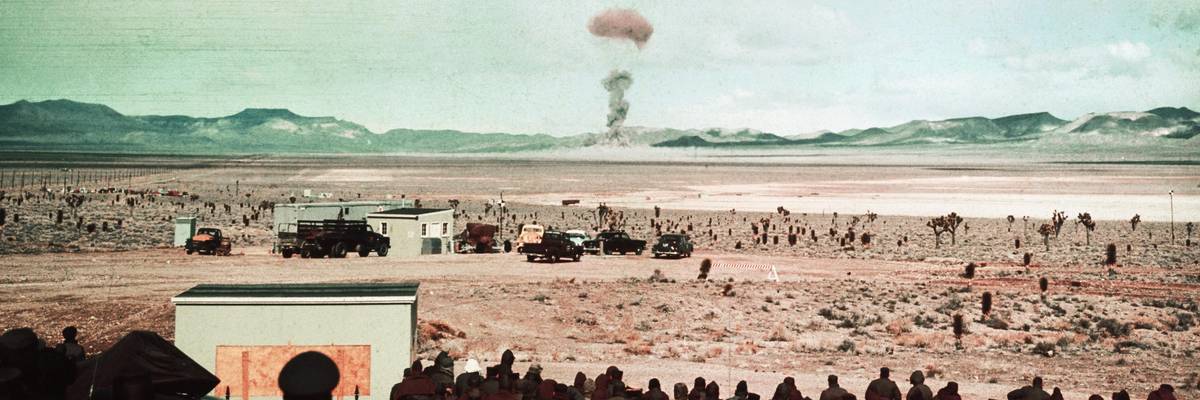
Soldiers watching the effects of the deadly Atomic Bomb during a nuclear test in Yucca Flat, Nevada on February 18, 1955.
Congress Must Renew and Expand Compensation for Nuclear Downwinders
The U.S. is projected to spend over $750 billion on nuclear weapons over the next decade—a fact it feels impossible to reconcile with the abandonment of the people affected by that spending.
It’s been nearly 80 years since the first atomic bomb was tested in New Mexico. Communities have been reeling ever since.
For generations, Americans who live “downwind” of nuclear testing and development sites have suffered deadly health complications. And this summer, funding for the Radiation Exposure Compensation Act (RECA) expired, putting their hard-earned compensation at risk.
Coming alongside sky-high spending on nuclear weapons development, this lapse is an outrage. Funding for these communities, which span much of the country, should be not only restored but expanded.
To protect future generations—and our own—the ultimate goal should be an end to all nuclear weapons development.
Alongside New Mexicans, people in Nevada, Idaho, Arizona, Utah, and beyond have suffered health complications from nuclear testing in Nevada. And fallout from decades of tests ravaged the Marshall Islands, which were occupied by the U.S. after World War II.
Communities in Colorado were exposed to radiation from the Rocky Flats weapons plant. And people living near Missouri’s Coldwater Creek were exposed when World War II-era nuclear waste was buried there.
Over the generations since, tens of thousands of people have been affected. Health impacts include respiratory illnesses, cardiovascular diseases, birth defects, and elevated rates of cancer.
We’re from New Mexico, the only “cradle-to-grave” state in which all steps of the nuclear production process—mining, testing, and disposal—occur together. We’ve lived near impacted communities our entire lives.
Tina Cordova, co-founder of New Mexico’s Tularosa Basin Downwinders Consortium, says five generations of her family have suffered health and economic impacts from nuclear testing. “We are forced to bury our loved ones on a regular basis,” she said.
Uranium mining in the Navajo Nation has also taken a terrible toll. Between 1944 and 1986, 30 million tons of uranium ore were extracted from Navajo land. Indigenous miners were exposed to radiation without proper safety protocols, resulting in aggressive cancers, miscarriages, lung diseases, and other illnesses.
After decades of struggle to get compensation, communities impacted by nuclear weapons development finally won passage of RECA in 1990—45 years after the first atomic bomb was dropped.
The initial law provided $2.6 billion to around 41,000 individuals, limiting coverage to onsite participants and downwinders within designated areas of the Nevada Test Site. The bill was amended in 2000 to include those who contracted cancer or other specific diseases from working as uranium miners between 1942 and 1971.
Since then, there have been bipartisan efforts to expand the bill’s narrow scope to other impacted communities. In response to years of advocacy, an extended and expanded version of RECA successfully passed the Senate this spring with 69-30 in favor—and President Joe Biden’s backing.
The bill would have expanded RECA eligibility to all downwinders in Idaho, Montana, Colorado, New Mexico, and Guam, along with previously excluded areas of Nevada, Arizona, and Utah. And it would have included miners exposed to radiation until 1990.
But Republican House Speaker Mike Johnson blocked a vote in the House, abandoning the unseen victims of the U.S. nuclear arms race. Now RECA has expired altogether.
It’s not for lack of money. The U.S. is projected to spend over $750 billion on nuclear weapons over the next decade—a fact it feels impossible to reconcile with the abandonment of the people affected by that spending.
Meanwhile, people are still being exposed to radiation.
Even now, 523 abandoned uranium mines containing waste piles remain on Navajo territory—and companies continue to haul uranium through Navajo land, despite a nearly two-decade old ban on uranium mining there.
Mismanagement of nuclear waste is another ongoing concern. In 2019, 250 barrels of waste were lost en route to the Waste Isolation Pilot Plant in New Mexico.
To protect future generations—and our own—the ultimate goal should be an end to all nuclear weapons development. But as we work toward that goal, repairing the harm to impacted communities—by renewing and expanding RECA—is a necessary next step.
We are at a crossroads
This country and this world are at a monumental crossroads. In a few short weeks, US voters will have an opportunity to beat back the forces of fascism and confront the billionaires who are rigging the economy, our media system, and our democracy, making it increasingly impossible for ordinary people to get by. We’re not just talking about the election. We’re talking about what must be done once these fascist elements are vanquished from power. We need a bolder set of solutions than what either major party has so far been willing to offer and a working-class movement ready to fight like hell for it. Trump didn't emerge from nowhere. The conditions that fueled MAGA authoritarianism were created by decades of radical neoliberal economic policies and a corrupt political system dominated by corporate interests. They slashed taxes on the super-rich, promising that the benefits would trickle down. They said giveaways to the corporate titans would make life more affordable for the rest of us. It was all bullshit. And when a bitter, betrayed populace searches for someone to blame, right-wing demagogues have little trouble finding scapegoats. People know when they're being lied to, but you won't hear any of this from the corporate media. Only independent journalism—powered and funded by people who believe in building a better world—can deliver truly trustworthy daily news. Our Fall Campaign is underway, and we need your help. To power our newsroom through the rest of the year, we need to raise $125,000 by midnight on October 31. So if you share our vision, please contribute whatever you can to sustain our work. |
It’s been nearly 80 years since the first atomic bomb was tested in New Mexico. Communities have been reeling ever since.
For generations, Americans who live “downwind” of nuclear testing and development sites have suffered deadly health complications. And this summer, funding for the Radiation Exposure Compensation Act (RECA) expired, putting their hard-earned compensation at risk.
Coming alongside sky-high spending on nuclear weapons development, this lapse is an outrage. Funding for these communities, which span much of the country, should be not only restored but expanded.
To protect future generations—and our own—the ultimate goal should be an end to all nuclear weapons development.
Alongside New Mexicans, people in Nevada, Idaho, Arizona, Utah, and beyond have suffered health complications from nuclear testing in Nevada. And fallout from decades of tests ravaged the Marshall Islands, which were occupied by the U.S. after World War II.
Communities in Colorado were exposed to radiation from the Rocky Flats weapons plant. And people living near Missouri’s Coldwater Creek were exposed when World War II-era nuclear waste was buried there.
Over the generations since, tens of thousands of people have been affected. Health impacts include respiratory illnesses, cardiovascular diseases, birth defects, and elevated rates of cancer.
We’re from New Mexico, the only “cradle-to-grave” state in which all steps of the nuclear production process—mining, testing, and disposal—occur together. We’ve lived near impacted communities our entire lives.
Tina Cordova, co-founder of New Mexico’s Tularosa Basin Downwinders Consortium, says five generations of her family have suffered health and economic impacts from nuclear testing. “We are forced to bury our loved ones on a regular basis,” she said.
Uranium mining in the Navajo Nation has also taken a terrible toll. Between 1944 and 1986, 30 million tons of uranium ore were extracted from Navajo land. Indigenous miners were exposed to radiation without proper safety protocols, resulting in aggressive cancers, miscarriages, lung diseases, and other illnesses.
After decades of struggle to get compensation, communities impacted by nuclear weapons development finally won passage of RECA in 1990—45 years after the first atomic bomb was dropped.
The initial law provided $2.6 billion to around 41,000 individuals, limiting coverage to onsite participants and downwinders within designated areas of the Nevada Test Site. The bill was amended in 2000 to include those who contracted cancer or other specific diseases from working as uranium miners between 1942 and 1971.
Since then, there have been bipartisan efforts to expand the bill’s narrow scope to other impacted communities. In response to years of advocacy, an extended and expanded version of RECA successfully passed the Senate this spring with 69-30 in favor—and President Joe Biden’s backing.
The bill would have expanded RECA eligibility to all downwinders in Idaho, Montana, Colorado, New Mexico, and Guam, along with previously excluded areas of Nevada, Arizona, and Utah. And it would have included miners exposed to radiation until 1990.
But Republican House Speaker Mike Johnson blocked a vote in the House, abandoning the unseen victims of the U.S. nuclear arms race. Now RECA has expired altogether.
It’s not for lack of money. The U.S. is projected to spend over $750 billion on nuclear weapons over the next decade—a fact it feels impossible to reconcile with the abandonment of the people affected by that spending.
Meanwhile, people are still being exposed to radiation.
Even now, 523 abandoned uranium mines containing waste piles remain on Navajo territory—and companies continue to haul uranium through Navajo land, despite a nearly two-decade old ban on uranium mining there.
Mismanagement of nuclear waste is another ongoing concern. In 2019, 250 barrels of waste were lost en route to the Waste Isolation Pilot Plant in New Mexico.
To protect future generations—and our own—the ultimate goal should be an end to all nuclear weapons development. But as we work toward that goal, repairing the harm to impacted communities—by renewing and expanding RECA—is a necessary next step.
It’s been nearly 80 years since the first atomic bomb was tested in New Mexico. Communities have been reeling ever since.
For generations, Americans who live “downwind” of nuclear testing and development sites have suffered deadly health complications. And this summer, funding for the Radiation Exposure Compensation Act (RECA) expired, putting their hard-earned compensation at risk.
Coming alongside sky-high spending on nuclear weapons development, this lapse is an outrage. Funding for these communities, which span much of the country, should be not only restored but expanded.
To protect future generations—and our own—the ultimate goal should be an end to all nuclear weapons development.
Alongside New Mexicans, people in Nevada, Idaho, Arizona, Utah, and beyond have suffered health complications from nuclear testing in Nevada. And fallout from decades of tests ravaged the Marshall Islands, which were occupied by the U.S. after World War II.
Communities in Colorado were exposed to radiation from the Rocky Flats weapons plant. And people living near Missouri’s Coldwater Creek were exposed when World War II-era nuclear waste was buried there.
Over the generations since, tens of thousands of people have been affected. Health impacts include respiratory illnesses, cardiovascular diseases, birth defects, and elevated rates of cancer.
We’re from New Mexico, the only “cradle-to-grave” state in which all steps of the nuclear production process—mining, testing, and disposal—occur together. We’ve lived near impacted communities our entire lives.
Tina Cordova, co-founder of New Mexico’s Tularosa Basin Downwinders Consortium, says five generations of her family have suffered health and economic impacts from nuclear testing. “We are forced to bury our loved ones on a regular basis,” she said.
Uranium mining in the Navajo Nation has also taken a terrible toll. Between 1944 and 1986, 30 million tons of uranium ore were extracted from Navajo land. Indigenous miners were exposed to radiation without proper safety protocols, resulting in aggressive cancers, miscarriages, lung diseases, and other illnesses.
After decades of struggle to get compensation, communities impacted by nuclear weapons development finally won passage of RECA in 1990—45 years after the first atomic bomb was dropped.
The initial law provided $2.6 billion to around 41,000 individuals, limiting coverage to onsite participants and downwinders within designated areas of the Nevada Test Site. The bill was amended in 2000 to include those who contracted cancer or other specific diseases from working as uranium miners between 1942 and 1971.
Since then, there have been bipartisan efforts to expand the bill’s narrow scope to other impacted communities. In response to years of advocacy, an extended and expanded version of RECA successfully passed the Senate this spring with 69-30 in favor—and President Joe Biden’s backing.
The bill would have expanded RECA eligibility to all downwinders in Idaho, Montana, Colorado, New Mexico, and Guam, along with previously excluded areas of Nevada, Arizona, and Utah. And it would have included miners exposed to radiation until 1990.
But Republican House Speaker Mike Johnson blocked a vote in the House, abandoning the unseen victims of the U.S. nuclear arms race. Now RECA has expired altogether.
It’s not for lack of money. The U.S. is projected to spend over $750 billion on nuclear weapons over the next decade—a fact it feels impossible to reconcile with the abandonment of the people affected by that spending.
Meanwhile, people are still being exposed to radiation.
Even now, 523 abandoned uranium mines containing waste piles remain on Navajo territory—and companies continue to haul uranium through Navajo land, despite a nearly two-decade old ban on uranium mining there.
Mismanagement of nuclear waste is another ongoing concern. In 2019, 250 barrels of waste were lost en route to the Waste Isolation Pilot Plant in New Mexico.
To protect future generations—and our own—the ultimate goal should be an end to all nuclear weapons development. But as we work toward that goal, repairing the harm to impacted communities—by renewing and expanding RECA—is a necessary next step.