SUBSCRIBE TO OUR FREE NEWSLETTER
Daily news & progressive opinion—funded by the people, not the corporations—delivered straight to your inbox.
5
#000000
#FFFFFF
To donate by check, phone, or other method, see our More Ways to Give page.
Daily news & progressive opinion—funded by the people, not the corporations—delivered straight to your inbox.
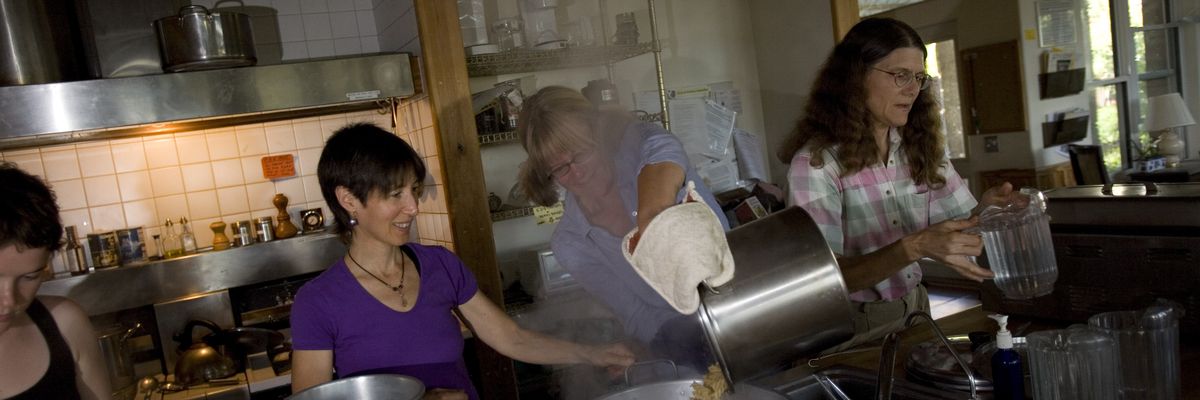
Residents help out with cooking for the weekly community dinner in EcoVillage at Ithaca (EVI) during an informal meeting in Ithaca , New York, on August 26, 2007.
As disasters become more frequent and politics destabilizes, it feels more important than ever to live connected to other people.
This spring my husband and I are moving three tenths of a mile and 200 years back in time.
We are moving from our super-energy-efficient, passive solar home built in 2001 to a farmhouse built in 1800. (And looking for someone to buy the cozy green home we raised our family in. Check it out here and spread the word!) We are excited to have more space to share with extended family. And, we will have a project on our hands! Regaining some of the features we are leaving behind—heat pumps, PV, a composting toilet, and more—will take time. A fun and satisfying challenge we hope!
The great news is that we will still be part of the experiment we have participated in for almost 30 years: Cobb Hill Cohousing, a multi-generational community of 23 families in Vermont’s Connecticut River Valley. The house we are moving to is located within Cobb Hill, just a bit further from the cluster of houses we’ve called home.
We will still share 280 acres of farm and forest and participate in community celebrations and decision-making. We’ll still have neighbors to help and to rely on. We’ll still have maple syrup, eggs, flowers, herbs, vegetables, milk, and cheese all produced by our neighbors on our shared land. We’ll have learning companions to navigate alongside in an increasingly destabilized world.
No one knows how to live sustainably and equitably in our current society or how to prepare for coming climate shocks. So we need to learn. And learning is faster with more minds in the mix.
A big move like ours prompts reflection. We had to move, but we didn’t want to go anywhere else. Here are six reasons that came to mind when we paused to ask ourselves why.
Cobb Hill isn’t the only way to find these six things, thank goodness. You’ll find them in smaller groups and larger ones, in cities, in the tropics, on the coast. In this time of transition and reflection in my own family, I hope that knowing they exist in one place might make it easier for you to imagine (or create) them elsewhere, too.
Dear Common Dreams reader, It’s been nearly 30 years since I co-founded Common Dreams with my late wife, Lina Newhouser. We had the radical notion that journalism should serve the public good, not corporate profits. It was clear to us from the outset what it would take to build such a project. No paid advertisements. No corporate sponsors. No millionaire publisher telling us what to think or do. Many people said we wouldn't last a year, but we proved those doubters wrong. Together with a tremendous team of journalists and dedicated staff, we built an independent media outlet free from the constraints of profits and corporate control. Our mission has always been simple: To inform. To inspire. To ignite change for the common good. Building Common Dreams was not easy. Our survival was never guaranteed. When you take on the most powerful forces—Wall Street greed, fossil fuel industry destruction, Big Tech lobbyists, and uber-rich oligarchs who have spent billions upon billions rigging the economy and democracy in their favor—the only bulwark you have is supporters who believe in your work. But here’s the urgent message from me today. It's never been this bad out there. And it's never been this hard to keep us going. At the very moment Common Dreams is most needed, the threats we face are intensifying. We need your support now more than ever. We don't accept corporate advertising and never will. We don't have a paywall because we don't think people should be blocked from critical news based on their ability to pay. Everything we do is funded by the donations of readers like you. When everyone does the little they can afford, we are strong. But if that support retreats or dries up, so do we. Will you donate now to make sure Common Dreams not only survives but thrives? —Craig Brown, Co-founder |
This spring my husband and I are moving three tenths of a mile and 200 years back in time.
We are moving from our super-energy-efficient, passive solar home built in 2001 to a farmhouse built in 1800. (And looking for someone to buy the cozy green home we raised our family in. Check it out here and spread the word!) We are excited to have more space to share with extended family. And, we will have a project on our hands! Regaining some of the features we are leaving behind—heat pumps, PV, a composting toilet, and more—will take time. A fun and satisfying challenge we hope!
The great news is that we will still be part of the experiment we have participated in for almost 30 years: Cobb Hill Cohousing, a multi-generational community of 23 families in Vermont’s Connecticut River Valley. The house we are moving to is located within Cobb Hill, just a bit further from the cluster of houses we’ve called home.
We will still share 280 acres of farm and forest and participate in community celebrations and decision-making. We’ll still have neighbors to help and to rely on. We’ll still have maple syrup, eggs, flowers, herbs, vegetables, milk, and cheese all produced by our neighbors on our shared land. We’ll have learning companions to navigate alongside in an increasingly destabilized world.
No one knows how to live sustainably and equitably in our current society or how to prepare for coming climate shocks. So we need to learn. And learning is faster with more minds in the mix.
A big move like ours prompts reflection. We had to move, but we didn’t want to go anywhere else. Here are six reasons that came to mind when we paused to ask ourselves why.
Cobb Hill isn’t the only way to find these six things, thank goodness. You’ll find them in smaller groups and larger ones, in cities, in the tropics, on the coast. In this time of transition and reflection in my own family, I hope that knowing they exist in one place might make it easier for you to imagine (or create) them elsewhere, too.
This spring my husband and I are moving three tenths of a mile and 200 years back in time.
We are moving from our super-energy-efficient, passive solar home built in 2001 to a farmhouse built in 1800. (And looking for someone to buy the cozy green home we raised our family in. Check it out here and spread the word!) We are excited to have more space to share with extended family. And, we will have a project on our hands! Regaining some of the features we are leaving behind—heat pumps, PV, a composting toilet, and more—will take time. A fun and satisfying challenge we hope!
The great news is that we will still be part of the experiment we have participated in for almost 30 years: Cobb Hill Cohousing, a multi-generational community of 23 families in Vermont’s Connecticut River Valley. The house we are moving to is located within Cobb Hill, just a bit further from the cluster of houses we’ve called home.
We will still share 280 acres of farm and forest and participate in community celebrations and decision-making. We’ll still have neighbors to help and to rely on. We’ll still have maple syrup, eggs, flowers, herbs, vegetables, milk, and cheese all produced by our neighbors on our shared land. We’ll have learning companions to navigate alongside in an increasingly destabilized world.
No one knows how to live sustainably and equitably in our current society or how to prepare for coming climate shocks. So we need to learn. And learning is faster with more minds in the mix.
A big move like ours prompts reflection. We had to move, but we didn’t want to go anywhere else. Here are six reasons that came to mind when we paused to ask ourselves why.
Cobb Hill isn’t the only way to find these six things, thank goodness. You’ll find them in smaller groups and larger ones, in cities, in the tropics, on the coast. In this time of transition and reflection in my own family, I hope that knowing they exist in one place might make it easier for you to imagine (or create) them elsewhere, too.