
SUBSCRIBE TO OUR FREE NEWSLETTER
Daily news & progressive opinion—funded by the people, not the corporations—delivered straight to your inbox.
5
#000000
#FFFFFF
To donate by check, phone, or other method, see our More Ways to Give page.
Daily news & progressive opinion—funded by the people, not the corporations—delivered straight to your inbox.
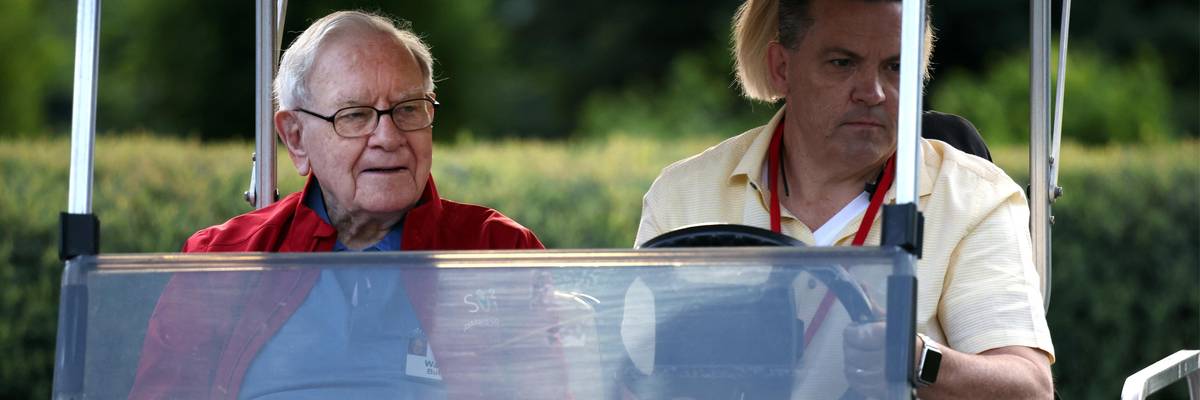
Warren Buffett, the chairman and CEO of Berkshire Hathaway, rides in a golf cart at the Allen & Company Sun Valley Conference on July 07, 2021 in Sun Valley, Idaho. (Photo: Kevin Dietsch/Getty Images)
Companies don't get better because of buybacks. Shareholders only get richer.
Warren Buffett, one of the richest people in America, defended stock buybacks in his highly anticipated annual letter to Berkshire Hathaway shareholders, released a few days ago.
“When you are told that all repurchases are harmful to shareholders or to the country, or particularly beneficial to CEOs, you are listening to either an economic illiterate or a silver-tongued demagogue (characters that are not mutually exclusive).”
Buffett may be correct about buybacks being good for shareholders, for the simple reason that each remaining outstanding share has more corporate profit behind it.
But the Oracle of Omaha is dead wrong about buybacks being good for the country. They merely enrich people who own shares of stock (the richest 10 percent of Americans own 92 percent of the stock market) rather than add to the productive capacity of America.
Many pundits (including Andrew Ross Sorkin of The New York Times’s DealBook) are failing to draw the distinction — assuming that if stock buybacks are good for corporations and their shareholders, they must be good for America.
Rubbish.
To take but one recent example: Last year, the Norfolk Southern Railway enjoyed record revenue and operating income — $3.2 billion in the fourth quarter alone, a remarkable 13 percent year-over-year increase.
How did the railroad accomplish this? By cutting nearly 10,000 jobs — reducing its workforce by a third while running fewer, longer trains. Some trains now stretch longer than 2 miles. It made these changes despite warnings that they worsened safety risks.
The corporation also refused to provide its remaining workers with sick leave. And it failed to invest in improved safety equipment. (As I noted last week, the railroad mounted a major lobbying blitz against stronger safety regulations.)
And what did Norfolk Southern do with all the money it saved from cutting its workforce, running longer trains, refusing sick leave, and scrimping on safety?
Over the past two decades, it has boosted shareholder payouts by 4,500 percent (along the way enriching Warren Buffett and other investors).
Specifically, it has spent billions on stock buybacks — hitting a record $4.7 billion in buybacks and dividends last year.
Then it went off the rails, literally, releasing a toxic plume over East Palestine, Ohio.
On Saturday it went off the rails again, near Springfield, Ohio, although thankfully this Norfolk Southern train wasn’t carrying hazardous materials.
Companies don’t get better because of buybacks. Shareholders only get richer. While railroads spent more on stock buybacks than rail safety, Warren Buffett’s wealth increased by $42 billion.
Researchers at Deloitte point out that buybacks and dividends have soared as a share of GDP, while corporate investments in equipment and infrastructure have stagnated. Many of the social costs of this failure to invest have been shifted to the public-at-large, as we saw in East Palestine.
Stock buybacks don’t create more jobs. They don’t increase wages. They don’t grow the economy.
Before 1982, it was illegal for corporations to purchase their own stock to artificially prop up share prices. Then Ronald Reagan’s SEC adopted a rule protecting corporations from being charged for this kind of stock manipulation.
Jump ahead to 2017 and the Trump-GOP tax cuts added fuel to the fire. Since then, stock buybacks have more than doubled, reaching a record high $1.2 trillion in 2022 alone.
That’s $1.2 trillion that did not go into improving quality of life for American workers or building the American economy. It just went straight into the pockets of already-wealthy shareholders and CEOs.
Once again, Wall Street gains at the expense of working families.
Which is why the Inflation Reduction Act imposes a 1 percent tax on buybacks. And why Biden wants to raise it to 4 percent. The Stock Buyback Accountability Act of 2023, introduced by Senators Sherrod Brown and Ron Wyden, would do just this.
From the standpoint of America as a whole, Biden is exactly right about stock buybacks. Buffett is utterly wrong.
This country and this world are at a monumental crossroads. US voters have an opportunity to beat back the forces of fascism and confront the billionaires who are rigging the economy, our media system, and our democracy, making it increasingly impossible for ordinary people to get by. We’re not just talking about the election. We’re talking about what must be done once these fascist elements are vanquished from power. We need a bolder set of solutions than what either major party has so far been willing to offer and a working-class movement ready to fight like hell for it. Trump didn't emerge from nowhere. The conditions that fueled MAGA authoritarianism were created by decades of radical neoliberal economic policies and a corrupt political system dominated by corporate interests. They slashed taxes on the super-rich, promising that the benefits would trickle down. They said giveaways to the corporate titans would make life more affordable for the rest of us. It was all bullshit. And when a bitter, betrayed populace searches for someone to blame, right-wing demagogues have little trouble finding scapegoats. People know when they're being lied to, but you won't hear any of this from the corporate media. Only independent journalism—powered and funded by people who believe in building a better world—can deliver truly trustworthy daily news. If you share our vision, please contribute whatever you can to sustain our work. |
Warren Buffett, one of the richest people in America, defended stock buybacks in his highly anticipated annual letter to Berkshire Hathaway shareholders, released a few days ago.
“When you are told that all repurchases are harmful to shareholders or to the country, or particularly beneficial to CEOs, you are listening to either an economic illiterate or a silver-tongued demagogue (characters that are not mutually exclusive).”
Buffett may be correct about buybacks being good for shareholders, for the simple reason that each remaining outstanding share has more corporate profit behind it.
But the Oracle of Omaha is dead wrong about buybacks being good for the country. They merely enrich people who own shares of stock (the richest 10 percent of Americans own 92 percent of the stock market) rather than add to the productive capacity of America.
Many pundits (including Andrew Ross Sorkin of The New York Times’s DealBook) are failing to draw the distinction — assuming that if stock buybacks are good for corporations and their shareholders, they must be good for America.
Rubbish.
To take but one recent example: Last year, the Norfolk Southern Railway enjoyed record revenue and operating income — $3.2 billion in the fourth quarter alone, a remarkable 13 percent year-over-year increase.
How did the railroad accomplish this? By cutting nearly 10,000 jobs — reducing its workforce by a third while running fewer, longer trains. Some trains now stretch longer than 2 miles. It made these changes despite warnings that they worsened safety risks.
The corporation also refused to provide its remaining workers with sick leave. And it failed to invest in improved safety equipment. (As I noted last week, the railroad mounted a major lobbying blitz against stronger safety regulations.)
And what did Norfolk Southern do with all the money it saved from cutting its workforce, running longer trains, refusing sick leave, and scrimping on safety?
Over the past two decades, it has boosted shareholder payouts by 4,500 percent (along the way enriching Warren Buffett and other investors).
Specifically, it has spent billions on stock buybacks — hitting a record $4.7 billion in buybacks and dividends last year.
Then it went off the rails, literally, releasing a toxic plume over East Palestine, Ohio.
On Saturday it went off the rails again, near Springfield, Ohio, although thankfully this Norfolk Southern train wasn’t carrying hazardous materials.
Companies don’t get better because of buybacks. Shareholders only get richer. While railroads spent more on stock buybacks than rail safety, Warren Buffett’s wealth increased by $42 billion.
Researchers at Deloitte point out that buybacks and dividends have soared as a share of GDP, while corporate investments in equipment and infrastructure have stagnated. Many of the social costs of this failure to invest have been shifted to the public-at-large, as we saw in East Palestine.
Stock buybacks don’t create more jobs. They don’t increase wages. They don’t grow the economy.
Before 1982, it was illegal for corporations to purchase their own stock to artificially prop up share prices. Then Ronald Reagan’s SEC adopted a rule protecting corporations from being charged for this kind of stock manipulation.
Jump ahead to 2017 and the Trump-GOP tax cuts added fuel to the fire. Since then, stock buybacks have more than doubled, reaching a record high $1.2 trillion in 2022 alone.
That’s $1.2 trillion that did not go into improving quality of life for American workers or building the American economy. It just went straight into the pockets of already-wealthy shareholders and CEOs.
Once again, Wall Street gains at the expense of working families.
Which is why the Inflation Reduction Act imposes a 1 percent tax on buybacks. And why Biden wants to raise it to 4 percent. The Stock Buyback Accountability Act of 2023, introduced by Senators Sherrod Brown and Ron Wyden, would do just this.
From the standpoint of America as a whole, Biden is exactly right about stock buybacks. Buffett is utterly wrong.
Warren Buffett, one of the richest people in America, defended stock buybacks in his highly anticipated annual letter to Berkshire Hathaway shareholders, released a few days ago.
“When you are told that all repurchases are harmful to shareholders or to the country, or particularly beneficial to CEOs, you are listening to either an economic illiterate or a silver-tongued demagogue (characters that are not mutually exclusive).”
Buffett may be correct about buybacks being good for shareholders, for the simple reason that each remaining outstanding share has more corporate profit behind it.
But the Oracle of Omaha is dead wrong about buybacks being good for the country. They merely enrich people who own shares of stock (the richest 10 percent of Americans own 92 percent of the stock market) rather than add to the productive capacity of America.
Many pundits (including Andrew Ross Sorkin of The New York Times’s DealBook) are failing to draw the distinction — assuming that if stock buybacks are good for corporations and their shareholders, they must be good for America.
Rubbish.
To take but one recent example: Last year, the Norfolk Southern Railway enjoyed record revenue and operating income — $3.2 billion in the fourth quarter alone, a remarkable 13 percent year-over-year increase.
How did the railroad accomplish this? By cutting nearly 10,000 jobs — reducing its workforce by a third while running fewer, longer trains. Some trains now stretch longer than 2 miles. It made these changes despite warnings that they worsened safety risks.
The corporation also refused to provide its remaining workers with sick leave. And it failed to invest in improved safety equipment. (As I noted last week, the railroad mounted a major lobbying blitz against stronger safety regulations.)
And what did Norfolk Southern do with all the money it saved from cutting its workforce, running longer trains, refusing sick leave, and scrimping on safety?
Over the past two decades, it has boosted shareholder payouts by 4,500 percent (along the way enriching Warren Buffett and other investors).
Specifically, it has spent billions on stock buybacks — hitting a record $4.7 billion in buybacks and dividends last year.
Then it went off the rails, literally, releasing a toxic plume over East Palestine, Ohio.
On Saturday it went off the rails again, near Springfield, Ohio, although thankfully this Norfolk Southern train wasn’t carrying hazardous materials.
Companies don’t get better because of buybacks. Shareholders only get richer. While railroads spent more on stock buybacks than rail safety, Warren Buffett’s wealth increased by $42 billion.
Researchers at Deloitte point out that buybacks and dividends have soared as a share of GDP, while corporate investments in equipment and infrastructure have stagnated. Many of the social costs of this failure to invest have been shifted to the public-at-large, as we saw in East Palestine.
Stock buybacks don’t create more jobs. They don’t increase wages. They don’t grow the economy.
Before 1982, it was illegal for corporations to purchase their own stock to artificially prop up share prices. Then Ronald Reagan’s SEC adopted a rule protecting corporations from being charged for this kind of stock manipulation.
Jump ahead to 2017 and the Trump-GOP tax cuts added fuel to the fire. Since then, stock buybacks have more than doubled, reaching a record high $1.2 trillion in 2022 alone.
That’s $1.2 trillion that did not go into improving quality of life for American workers or building the American economy. It just went straight into the pockets of already-wealthy shareholders and CEOs.
Once again, Wall Street gains at the expense of working families.
Which is why the Inflation Reduction Act imposes a 1 percent tax on buybacks. And why Biden wants to raise it to 4 percent. The Stock Buyback Accountability Act of 2023, introduced by Senators Sherrod Brown and Ron Wyden, would do just this.
From the standpoint of America as a whole, Biden is exactly right about stock buybacks. Buffett is utterly wrong.