SUBSCRIBE TO OUR FREE NEWSLETTER
Daily news & progressive opinion—funded by the people, not the corporations—delivered straight to your inbox.
5
#000000
#FFFFFF
To donate by check, phone, or other method, see our More Ways to Give page.
Daily news & progressive opinion—funded by the people, not the corporations—delivered straight to your inbox.
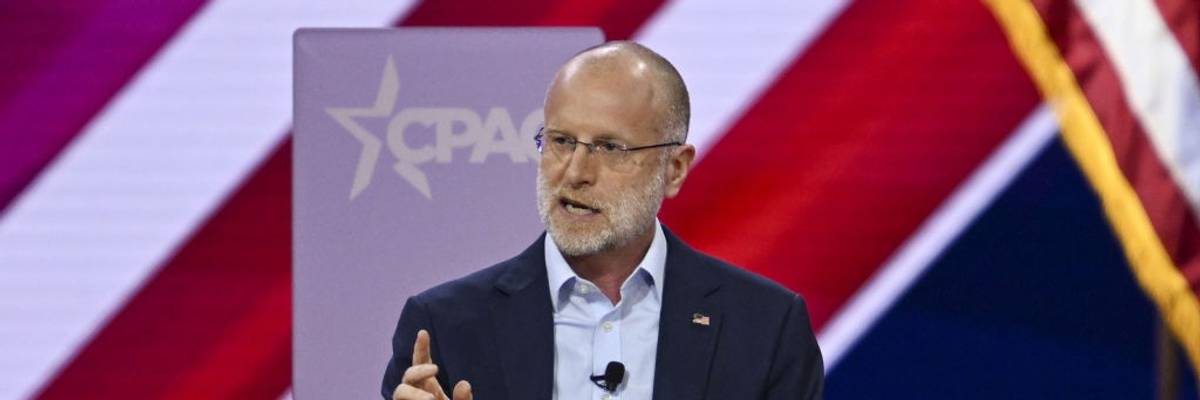
Brendan Carr, Trump's pick to be the next FCC chair, speaks during the 2024 Conservative Political Action Conference (CPAC) in National Harbor, Maryland, United States on February 24, 2024.
Brendan Carr pretends to be a defender of free-speech rights when it suits his right-wing agenda but disappears into the ether when he should be protecting expression that doesn’t align with Trump’s authoritarian aims.
President-Elect Donald Trump’s pick to head the Federal Communications Commission has an on-again/off-again relationship with the First Amendment.
Brendan Carr pretends to be a defender of free-speech rights when it suits his right-wing agenda but disappears into the ether when he should be protecting expression that doesn’t align with Trump’s authoritarian aims.
His mind-bending inconsistencies on free-speech rights would sound alarms under normal circumstances, especially for someone tapped to lead the federal agency that oversees the media sector. But these aren’t normal times. And Carr’s dodgy doublespeak on government censorship seems designed to please an incoming president who’s intent on undermining the essential freedoms that flow from the First Amendment.
During a September hearing before the House of Representatives, Carr refused to speak out against Trump’s suggestion that ABC should lose its broadcast licenses because two of its journalists had fact checked the former president during his debate with Vice President Kamala Harris. Instead he told members of the House Commerce Committee that the law and the First Amendment guide all of his decisions — an assertion that doesn’t withstand even the slightest scrutiny.
Carr has already weaponized his future role as the government’s top media regulator by threatening to shut down the speech of anyone who questions Trump’s leadership.
In an October Fox News interview, Carr came after CBS for airing an edited interview with Harris during 60 Minutes. Editing interviews is a standard practice of television journalism, but Carr suggested that CBS violated the FCC’s seldom-invoked news-distortion policy, adding that the government could punish the network. In particular, he said that the 60 Minutes interview could factor into the agency’s review of the Skydance-Paramount merger (Paramount is CBS’ parent company).
Carr then took to Twitter to attack NBC after Kamala Harris appeared on Saturday Night Live, wrongly calling it “a clear and blatant effort to evade the equal time rule” — even though NBC did provide Trump equal time later that same weekend. Carr suggested on a subsequent Fox News appearance that the FCC should “keep every remedy on the table,” including revoking the broadcast licenses of local television stations owned by NBC and Telemundo, subsidiaries of Comcast.
“The FCC traditionally avoids regulating broadcast radio and television content except in extremely narrow circumstances, such as indecency,” Free Press Co-CEO Jessica J. González wrote in a commentary for The Hill. “ … Carr has shown that he is willing to break with [this] longstanding and bipartisan FCC precedent to punish Trump’s detractors.”
In November, Carr went on the attack again. In a letter addressed to the CEOs of the world’s largest technology platforms, he argues that they are facilitating “censorship” by allowing fact checking on their sites — something they as private companies have an unambiguous First Amendment right to do. In Carr’s distorted view, however, such fact checking violated Americans’ right to be misinformed.
Carr is “rushing to be America’s top censor,” Mike Masnick, a widely read champion of the First Amendment, wrote at Techdirt. “Threatening to revoke broadcast licenses over unfavorable coverage is a blatant First Amendment violation. The government cannot use its licensing power to control or punish the speech of private actors. Carr surely knows this but doesn’t seem to care.”
It’s hard to comprehend how anyone who’s read the 45 words of the First Amendment could come away with such a blatant misunderstanding of its intent. Carr’s recent actions have made it necessary to repeat the obvious: The First Amendment protects people from government censorship; it does not protect government actors like Trump and Carr from criticism and fact checking.
Carr has already weaponized his future role as the government’s top media regulator by threatening to shut down the speech of anyone who questions Trump’s leadership.
But it wasn’t long ago that Carr was preaching from a different pulpit, although with the same aim: to silence opposing views and advance his highly partisan agenda.
In March 2020 — as the global pandemic set in — Free Press called on the FCC to offer guidance on its interpretation of the agency’s “broadcast-hoax rule.” At the time a number of licensed broadcasters had aired false and misleading information about the COVID-19 crisis without providing the kinds of context or disclaimers the rule suggests.
Rather than take up Free Press’ good-faith suggestion, Carr went on the attack, making the false claim that our media-democracy organization “want[ed] to turn the FCC into a roving speech police empowered to go after the left’s political opponents” (emphasis added).
In actuality, the Free Press petition merely asks the FCC to issue guidance on the broadcasting of disinformation about COVID-19 at a time when thousands of Americans had already succumbed to the disease.
Carr auditioned for the lead part at the FCC by repeatedly threatening to do what he once falsely accused Free Press of doing: turning the agency into the “roving speech police.” And his anti-free-speech stridency has captured the attention of Elon Musk, who has leveraged his control of X’s algorithms to amplify Carr’s tweets — while positioning his broadband access company Starlink to benefit from potentially hundreds of millions of dollars in government grants that flow through the FCC.
As Masnick wrote: “Carr is smart and he knows exactly what he’s doing here. He is couching his extreme censorial desires in the language of free speech, knowing that most people won’t know enough or understand the details and nuances to recognize what he’s doing.”
Free Press is tracking Carr’s First-Amendment flip flops very closely, and exercising our right to call out Trump’s pick to chair the FCC whenever he fails to honor his sworn oath “to support and defend the Constitution of the United States.”
Carr is duty bound to ensure that government forces don’t restrict the speech of private individuals and entities. As the recent past shows, however, he routinely fails to protect free speech with any consistency, preferring to wrap himself in dishonest rhetoric about the First Amendment as he pursues his — and Trump’s — desire to censor others.
Dear Common Dreams reader, It’s been nearly 30 years since I co-founded Common Dreams with my late wife, Lina Newhouser. We had the radical notion that journalism should serve the public good, not corporate profits. It was clear to us from the outset what it would take to build such a project. No paid advertisements. No corporate sponsors. No millionaire publisher telling us what to think or do. Many people said we wouldn't last a year, but we proved those doubters wrong. Together with a tremendous team of journalists and dedicated staff, we built an independent media outlet free from the constraints of profits and corporate control. Our mission has always been simple: To inform. To inspire. To ignite change for the common good. Building Common Dreams was not easy. Our survival was never guaranteed. When you take on the most powerful forces—Wall Street greed, fossil fuel industry destruction, Big Tech lobbyists, and uber-rich oligarchs who have spent billions upon billions rigging the economy and democracy in their favor—the only bulwark you have is supporters who believe in your work. But here’s the urgent message from me today. It's never been this bad out there. And it's never been this hard to keep us going. At the very moment Common Dreams is most needed, the threats we face are intensifying. We need your support now more than ever. We don't accept corporate advertising and never will. We don't have a paywall because we don't think people should be blocked from critical news based on their ability to pay. Everything we do is funded by the donations of readers like you. When everyone does the little they can afford, we are strong. But if that support retreats or dries up, so do we. Will you donate now to make sure Common Dreams not only survives but thrives? —Craig Brown, Co-founder |
President-Elect Donald Trump’s pick to head the Federal Communications Commission has an on-again/off-again relationship with the First Amendment.
Brendan Carr pretends to be a defender of free-speech rights when it suits his right-wing agenda but disappears into the ether when he should be protecting expression that doesn’t align with Trump’s authoritarian aims.
His mind-bending inconsistencies on free-speech rights would sound alarms under normal circumstances, especially for someone tapped to lead the federal agency that oversees the media sector. But these aren’t normal times. And Carr’s dodgy doublespeak on government censorship seems designed to please an incoming president who’s intent on undermining the essential freedoms that flow from the First Amendment.
During a September hearing before the House of Representatives, Carr refused to speak out against Trump’s suggestion that ABC should lose its broadcast licenses because two of its journalists had fact checked the former president during his debate with Vice President Kamala Harris. Instead he told members of the House Commerce Committee that the law and the First Amendment guide all of his decisions — an assertion that doesn’t withstand even the slightest scrutiny.
Carr has already weaponized his future role as the government’s top media regulator by threatening to shut down the speech of anyone who questions Trump’s leadership.
In an October Fox News interview, Carr came after CBS for airing an edited interview with Harris during 60 Minutes. Editing interviews is a standard practice of television journalism, but Carr suggested that CBS violated the FCC’s seldom-invoked news-distortion policy, adding that the government could punish the network. In particular, he said that the 60 Minutes interview could factor into the agency’s review of the Skydance-Paramount merger (Paramount is CBS’ parent company).
Carr then took to Twitter to attack NBC after Kamala Harris appeared on Saturday Night Live, wrongly calling it “a clear and blatant effort to evade the equal time rule” — even though NBC did provide Trump equal time later that same weekend. Carr suggested on a subsequent Fox News appearance that the FCC should “keep every remedy on the table,” including revoking the broadcast licenses of local television stations owned by NBC and Telemundo, subsidiaries of Comcast.
“The FCC traditionally avoids regulating broadcast radio and television content except in extremely narrow circumstances, such as indecency,” Free Press Co-CEO Jessica J. González wrote in a commentary for The Hill. “ … Carr has shown that he is willing to break with [this] longstanding and bipartisan FCC precedent to punish Trump’s detractors.”
In November, Carr went on the attack again. In a letter addressed to the CEOs of the world’s largest technology platforms, he argues that they are facilitating “censorship” by allowing fact checking on their sites — something they as private companies have an unambiguous First Amendment right to do. In Carr’s distorted view, however, such fact checking violated Americans’ right to be misinformed.
Carr is “rushing to be America’s top censor,” Mike Masnick, a widely read champion of the First Amendment, wrote at Techdirt. “Threatening to revoke broadcast licenses over unfavorable coverage is a blatant First Amendment violation. The government cannot use its licensing power to control or punish the speech of private actors. Carr surely knows this but doesn’t seem to care.”
It’s hard to comprehend how anyone who’s read the 45 words of the First Amendment could come away with such a blatant misunderstanding of its intent. Carr’s recent actions have made it necessary to repeat the obvious: The First Amendment protects people from government censorship; it does not protect government actors like Trump and Carr from criticism and fact checking.
Carr has already weaponized his future role as the government’s top media regulator by threatening to shut down the speech of anyone who questions Trump’s leadership.
But it wasn’t long ago that Carr was preaching from a different pulpit, although with the same aim: to silence opposing views and advance his highly partisan agenda.
In March 2020 — as the global pandemic set in — Free Press called on the FCC to offer guidance on its interpretation of the agency’s “broadcast-hoax rule.” At the time a number of licensed broadcasters had aired false and misleading information about the COVID-19 crisis without providing the kinds of context or disclaimers the rule suggests.
Rather than take up Free Press’ good-faith suggestion, Carr went on the attack, making the false claim that our media-democracy organization “want[ed] to turn the FCC into a roving speech police empowered to go after the left’s political opponents” (emphasis added).
In actuality, the Free Press petition merely asks the FCC to issue guidance on the broadcasting of disinformation about COVID-19 at a time when thousands of Americans had already succumbed to the disease.
Carr auditioned for the lead part at the FCC by repeatedly threatening to do what he once falsely accused Free Press of doing: turning the agency into the “roving speech police.” And his anti-free-speech stridency has captured the attention of Elon Musk, who has leveraged his control of X’s algorithms to amplify Carr’s tweets — while positioning his broadband access company Starlink to benefit from potentially hundreds of millions of dollars in government grants that flow through the FCC.
As Masnick wrote: “Carr is smart and he knows exactly what he’s doing here. He is couching his extreme censorial desires in the language of free speech, knowing that most people won’t know enough or understand the details and nuances to recognize what he’s doing.”
Free Press is tracking Carr’s First-Amendment flip flops very closely, and exercising our right to call out Trump’s pick to chair the FCC whenever he fails to honor his sworn oath “to support and defend the Constitution of the United States.”
Carr is duty bound to ensure that government forces don’t restrict the speech of private individuals and entities. As the recent past shows, however, he routinely fails to protect free speech with any consistency, preferring to wrap himself in dishonest rhetoric about the First Amendment as he pursues his — and Trump’s — desire to censor others.
President-Elect Donald Trump’s pick to head the Federal Communications Commission has an on-again/off-again relationship with the First Amendment.
Brendan Carr pretends to be a defender of free-speech rights when it suits his right-wing agenda but disappears into the ether when he should be protecting expression that doesn’t align with Trump’s authoritarian aims.
His mind-bending inconsistencies on free-speech rights would sound alarms under normal circumstances, especially for someone tapped to lead the federal agency that oversees the media sector. But these aren’t normal times. And Carr’s dodgy doublespeak on government censorship seems designed to please an incoming president who’s intent on undermining the essential freedoms that flow from the First Amendment.
During a September hearing before the House of Representatives, Carr refused to speak out against Trump’s suggestion that ABC should lose its broadcast licenses because two of its journalists had fact checked the former president during his debate with Vice President Kamala Harris. Instead he told members of the House Commerce Committee that the law and the First Amendment guide all of his decisions — an assertion that doesn’t withstand even the slightest scrutiny.
Carr has already weaponized his future role as the government’s top media regulator by threatening to shut down the speech of anyone who questions Trump’s leadership.
In an October Fox News interview, Carr came after CBS for airing an edited interview with Harris during 60 Minutes. Editing interviews is a standard practice of television journalism, but Carr suggested that CBS violated the FCC’s seldom-invoked news-distortion policy, adding that the government could punish the network. In particular, he said that the 60 Minutes interview could factor into the agency’s review of the Skydance-Paramount merger (Paramount is CBS’ parent company).
Carr then took to Twitter to attack NBC after Kamala Harris appeared on Saturday Night Live, wrongly calling it “a clear and blatant effort to evade the equal time rule” — even though NBC did provide Trump equal time later that same weekend. Carr suggested on a subsequent Fox News appearance that the FCC should “keep every remedy on the table,” including revoking the broadcast licenses of local television stations owned by NBC and Telemundo, subsidiaries of Comcast.
“The FCC traditionally avoids regulating broadcast radio and television content except in extremely narrow circumstances, such as indecency,” Free Press Co-CEO Jessica J. González wrote in a commentary for The Hill. “ … Carr has shown that he is willing to break with [this] longstanding and bipartisan FCC precedent to punish Trump’s detractors.”
In November, Carr went on the attack again. In a letter addressed to the CEOs of the world’s largest technology platforms, he argues that they are facilitating “censorship” by allowing fact checking on their sites — something they as private companies have an unambiguous First Amendment right to do. In Carr’s distorted view, however, such fact checking violated Americans’ right to be misinformed.
Carr is “rushing to be America’s top censor,” Mike Masnick, a widely read champion of the First Amendment, wrote at Techdirt. “Threatening to revoke broadcast licenses over unfavorable coverage is a blatant First Amendment violation. The government cannot use its licensing power to control or punish the speech of private actors. Carr surely knows this but doesn’t seem to care.”
It’s hard to comprehend how anyone who’s read the 45 words of the First Amendment could come away with such a blatant misunderstanding of its intent. Carr’s recent actions have made it necessary to repeat the obvious: The First Amendment protects people from government censorship; it does not protect government actors like Trump and Carr from criticism and fact checking.
Carr has already weaponized his future role as the government’s top media regulator by threatening to shut down the speech of anyone who questions Trump’s leadership.
But it wasn’t long ago that Carr was preaching from a different pulpit, although with the same aim: to silence opposing views and advance his highly partisan agenda.
In March 2020 — as the global pandemic set in — Free Press called on the FCC to offer guidance on its interpretation of the agency’s “broadcast-hoax rule.” At the time a number of licensed broadcasters had aired false and misleading information about the COVID-19 crisis without providing the kinds of context or disclaimers the rule suggests.
Rather than take up Free Press’ good-faith suggestion, Carr went on the attack, making the false claim that our media-democracy organization “want[ed] to turn the FCC into a roving speech police empowered to go after the left’s political opponents” (emphasis added).
In actuality, the Free Press petition merely asks the FCC to issue guidance on the broadcasting of disinformation about COVID-19 at a time when thousands of Americans had already succumbed to the disease.
Carr auditioned for the lead part at the FCC by repeatedly threatening to do what he once falsely accused Free Press of doing: turning the agency into the “roving speech police.” And his anti-free-speech stridency has captured the attention of Elon Musk, who has leveraged his control of X’s algorithms to amplify Carr’s tweets — while positioning his broadband access company Starlink to benefit from potentially hundreds of millions of dollars in government grants that flow through the FCC.
As Masnick wrote: “Carr is smart and he knows exactly what he’s doing here. He is couching his extreme censorial desires in the language of free speech, knowing that most people won’t know enough or understand the details and nuances to recognize what he’s doing.”
Free Press is tracking Carr’s First-Amendment flip flops very closely, and exercising our right to call out Trump’s pick to chair the FCC whenever he fails to honor his sworn oath “to support and defend the Constitution of the United States.”
Carr is duty bound to ensure that government forces don’t restrict the speech of private individuals and entities. As the recent past shows, however, he routinely fails to protect free speech with any consistency, preferring to wrap himself in dishonest rhetoric about the First Amendment as he pursues his — and Trump’s — desire to censor others.