SUBSCRIBE TO OUR FREE NEWSLETTER
Daily news & progressive opinion—funded by the people, not the corporations—delivered straight to your inbox.
5
#000000
#FFFFFF
To donate by check, phone, or other method, see our More Ways to Give page.
Daily news & progressive opinion—funded by the people, not the corporations—delivered straight to your inbox.
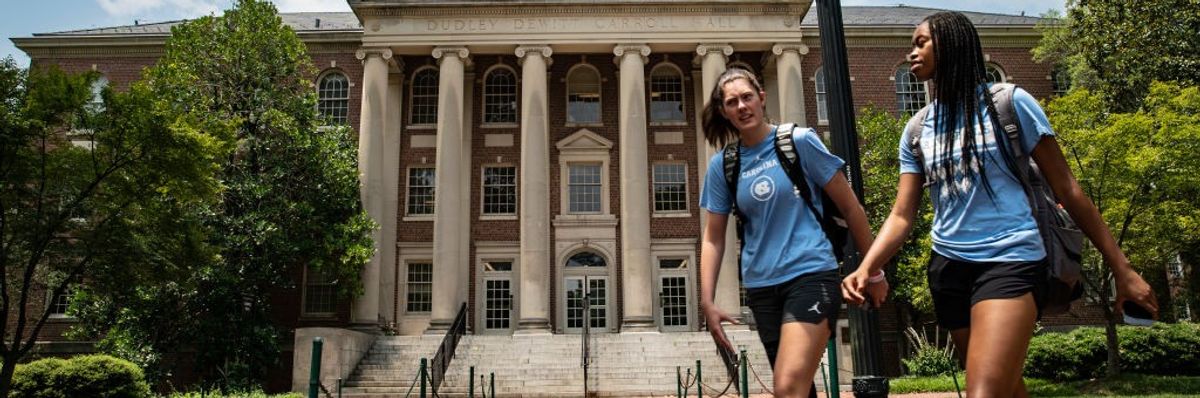
People walk on the campus of the University of North Carolina Chapel Hill on June 29, 2023, the day the U.S. Supreme Court ruled that race-conscious admission policies used by Harvard and the University of North Carolina violate the Constitution.
They must champion legislation that safeguards the ability of educational institutions to consider race as a factor in admissions, thereby ensuring that diversity remains a cornerstone of our educational system.
The recent Supreme Court decision to strike down race-based admissions at Harvard and the University of North Carolina is a concerning setback for equal opportunity and social progress. As an African American who has personally experienced the transformative power of education, I am outraged. Education has long served as a catalyst for upward mobility and wealth building, and eliminating race-conscious admissions policies threatens to hinder the growth of future generations. We must take action to ensure marginalized communities, particularly African Americans, maintain access to the educational opportunities they need to thrive.
Representation matters. As a former community organizer and staff member at The Center for Popular Democracy (CPD), I understand the broader implications of this decision. I recall my own profound experience at the Harvard Business School’s Summer Ventures in Management Program (SVMP), where I met fellow students who, like me, had never imagined attending an Ivy League institution. The program’s affirmative action initiative ensured that talented individuals from diverse backgrounds were introduced to essential business principles, alternative learning models, and a supportive network, providing them with the chance to excel and succeed.
This Supreme Court ruling places the SVMP and similar initiatives in jeopardy, undermining the progress made in fostering diversity and inclusivity in higher education. These programs offer hope and inspiration to marginalized communities, demonstrating that they too belong in spaces historically reserved for the privileged few.
The recent Supreme Court decision to strike down race-based admissions poses a significant threat to the progress we have made in building a more inclusive society.
Supreme Court Justice Sonia Sotomayor’s dissenting words resonate deeply: “Ignoring race will not equalize a racially unequal society. What was true in the 1860s, and again in 1954, is true today: Equality requires acknowledgment of inequality.” Affirmative action policies have been vital in addressing historical disparities and promoting diversity on campuses and in corporate America. By recognizing the unique challenges faced by underrepresented groups, these policies strive to level the playing field and create a more inclusive society. The Supreme Court’s decision threatens to reverse decades of progress, perpetuating the same systemic barriers that affirmative action seeks to dismantle.
To protect and reinforce the principles of equal opportunity, it is imperative that we call upon the Biden Administration and Congress to correct this injustice and reaffirm their commitment to affirmative action. They must champion legislation that safeguards the ability of educational institutions to consider race as a factor in admissions, thereby ensuring that diversity remains a cornerstone of our educational system. Additionally, Congress holds the power to advance fairness and inclusivity within the judiciary by passing the Judiciary Act of 2023, which would enable the expansion of the courts and promote equitable representation.
In addition to advocating for policy changes, it is crucial to support organizations like the Thurgood Marshall College Fund. This fund plays a vital role in providing scholarships and resources to students from historically Black colleges and universities, creating pathways for deserving students to access the opportunities they rightly deserve, regardless of their backgrounds.
Education stands as a potent force for change, social mobility, and breaking the cycle of inequality. The recent Supreme Court decision to strike down race-based admissions poses a significant threat to the progress we have made in building a more inclusive society. Let us wholeheartedly embrace the wisdom of Justice Sotomayor, who reminds us that “equality requires acknowledgment of inequality.” It is our collective responsibility to unite, raise our voices, and demand that our elected officials rectify this injustice. Affirmative action is not a handout, but a necessary means to ensure equal access to educational opportunities for all. By persistently advocating for a future where every individual, regardless of race or background, has the chance to thrive, succeed, and contribute, we can forge a more equitable world for generations to come.
Dear Common Dreams reader, It’s been nearly 30 years since I co-founded Common Dreams with my late wife, Lina Newhouser. We had the radical notion that journalism should serve the public good, not corporate profits. It was clear to us from the outset what it would take to build such a project. No paid advertisements. No corporate sponsors. No millionaire publisher telling us what to think or do. Many people said we wouldn't last a year, but we proved those doubters wrong. Together with a tremendous team of journalists and dedicated staff, we built an independent media outlet free from the constraints of profits and corporate control. Our mission has always been simple: To inform. To inspire. To ignite change for the common good. Building Common Dreams was not easy. Our survival was never guaranteed. When you take on the most powerful forces—Wall Street greed, fossil fuel industry destruction, Big Tech lobbyists, and uber-rich oligarchs who have spent billions upon billions rigging the economy and democracy in their favor—the only bulwark you have is supporters who believe in your work. But here’s the urgent message from me today. It's never been this bad out there. And it's never been this hard to keep us going. At the very moment Common Dreams is most needed, the threats we face are intensifying. We need your support now more than ever. We don't accept corporate advertising and never will. We don't have a paywall because we don't think people should be blocked from critical news based on their ability to pay. Everything we do is funded by the donations of readers like you. When everyone does the little they can afford, we are strong. But if that support retreats or dries up, so do we. Will you donate now to make sure Common Dreams not only survives but thrives? —Craig Brown, Co-founder |
The recent Supreme Court decision to strike down race-based admissions at Harvard and the University of North Carolina is a concerning setback for equal opportunity and social progress. As an African American who has personally experienced the transformative power of education, I am outraged. Education has long served as a catalyst for upward mobility and wealth building, and eliminating race-conscious admissions policies threatens to hinder the growth of future generations. We must take action to ensure marginalized communities, particularly African Americans, maintain access to the educational opportunities they need to thrive.
Representation matters. As a former community organizer and staff member at The Center for Popular Democracy (CPD), I understand the broader implications of this decision. I recall my own profound experience at the Harvard Business School’s Summer Ventures in Management Program (SVMP), where I met fellow students who, like me, had never imagined attending an Ivy League institution. The program’s affirmative action initiative ensured that talented individuals from diverse backgrounds were introduced to essential business principles, alternative learning models, and a supportive network, providing them with the chance to excel and succeed.
This Supreme Court ruling places the SVMP and similar initiatives in jeopardy, undermining the progress made in fostering diversity and inclusivity in higher education. These programs offer hope and inspiration to marginalized communities, demonstrating that they too belong in spaces historically reserved for the privileged few.
The recent Supreme Court decision to strike down race-based admissions poses a significant threat to the progress we have made in building a more inclusive society.
Supreme Court Justice Sonia Sotomayor’s dissenting words resonate deeply: “Ignoring race will not equalize a racially unequal society. What was true in the 1860s, and again in 1954, is true today: Equality requires acknowledgment of inequality.” Affirmative action policies have been vital in addressing historical disparities and promoting diversity on campuses and in corporate America. By recognizing the unique challenges faced by underrepresented groups, these policies strive to level the playing field and create a more inclusive society. The Supreme Court’s decision threatens to reverse decades of progress, perpetuating the same systemic barriers that affirmative action seeks to dismantle.
To protect and reinforce the principles of equal opportunity, it is imperative that we call upon the Biden Administration and Congress to correct this injustice and reaffirm their commitment to affirmative action. They must champion legislation that safeguards the ability of educational institutions to consider race as a factor in admissions, thereby ensuring that diversity remains a cornerstone of our educational system. Additionally, Congress holds the power to advance fairness and inclusivity within the judiciary by passing the Judiciary Act of 2023, which would enable the expansion of the courts and promote equitable representation.
In addition to advocating for policy changes, it is crucial to support organizations like the Thurgood Marshall College Fund. This fund plays a vital role in providing scholarships and resources to students from historically Black colleges and universities, creating pathways for deserving students to access the opportunities they rightly deserve, regardless of their backgrounds.
Education stands as a potent force for change, social mobility, and breaking the cycle of inequality. The recent Supreme Court decision to strike down race-based admissions poses a significant threat to the progress we have made in building a more inclusive society. Let us wholeheartedly embrace the wisdom of Justice Sotomayor, who reminds us that “equality requires acknowledgment of inequality.” It is our collective responsibility to unite, raise our voices, and demand that our elected officials rectify this injustice. Affirmative action is not a handout, but a necessary means to ensure equal access to educational opportunities for all. By persistently advocating for a future where every individual, regardless of race or background, has the chance to thrive, succeed, and contribute, we can forge a more equitable world for generations to come.
The recent Supreme Court decision to strike down race-based admissions at Harvard and the University of North Carolina is a concerning setback for equal opportunity and social progress. As an African American who has personally experienced the transformative power of education, I am outraged. Education has long served as a catalyst for upward mobility and wealth building, and eliminating race-conscious admissions policies threatens to hinder the growth of future generations. We must take action to ensure marginalized communities, particularly African Americans, maintain access to the educational opportunities they need to thrive.
Representation matters. As a former community organizer and staff member at The Center for Popular Democracy (CPD), I understand the broader implications of this decision. I recall my own profound experience at the Harvard Business School’s Summer Ventures in Management Program (SVMP), where I met fellow students who, like me, had never imagined attending an Ivy League institution. The program’s affirmative action initiative ensured that talented individuals from diverse backgrounds were introduced to essential business principles, alternative learning models, and a supportive network, providing them with the chance to excel and succeed.
This Supreme Court ruling places the SVMP and similar initiatives in jeopardy, undermining the progress made in fostering diversity and inclusivity in higher education. These programs offer hope and inspiration to marginalized communities, demonstrating that they too belong in spaces historically reserved for the privileged few.
The recent Supreme Court decision to strike down race-based admissions poses a significant threat to the progress we have made in building a more inclusive society.
Supreme Court Justice Sonia Sotomayor’s dissenting words resonate deeply: “Ignoring race will not equalize a racially unequal society. What was true in the 1860s, and again in 1954, is true today: Equality requires acknowledgment of inequality.” Affirmative action policies have been vital in addressing historical disparities and promoting diversity on campuses and in corporate America. By recognizing the unique challenges faced by underrepresented groups, these policies strive to level the playing field and create a more inclusive society. The Supreme Court’s decision threatens to reverse decades of progress, perpetuating the same systemic barriers that affirmative action seeks to dismantle.
To protect and reinforce the principles of equal opportunity, it is imperative that we call upon the Biden Administration and Congress to correct this injustice and reaffirm their commitment to affirmative action. They must champion legislation that safeguards the ability of educational institutions to consider race as a factor in admissions, thereby ensuring that diversity remains a cornerstone of our educational system. Additionally, Congress holds the power to advance fairness and inclusivity within the judiciary by passing the Judiciary Act of 2023, which would enable the expansion of the courts and promote equitable representation.
In addition to advocating for policy changes, it is crucial to support organizations like the Thurgood Marshall College Fund. This fund plays a vital role in providing scholarships and resources to students from historically Black colleges and universities, creating pathways for deserving students to access the opportunities they rightly deserve, regardless of their backgrounds.
Education stands as a potent force for change, social mobility, and breaking the cycle of inequality. The recent Supreme Court decision to strike down race-based admissions poses a significant threat to the progress we have made in building a more inclusive society. Let us wholeheartedly embrace the wisdom of Justice Sotomayor, who reminds us that “equality requires acknowledgment of inequality.” It is our collective responsibility to unite, raise our voices, and demand that our elected officials rectify this injustice. Affirmative action is not a handout, but a necessary means to ensure equal access to educational opportunities for all. By persistently advocating for a future where every individual, regardless of race or background, has the chance to thrive, succeed, and contribute, we can forge a more equitable world for generations to come.