SUBSCRIBE TO OUR FREE NEWSLETTER
Daily news & progressive opinion—funded by the people, not the corporations—delivered straight to your inbox.
5
#000000
#FFFFFF
To donate by check, phone, or other method, see our More Ways to Give page.
Daily news & progressive opinion—funded by the people, not the corporations—delivered straight to your inbox.
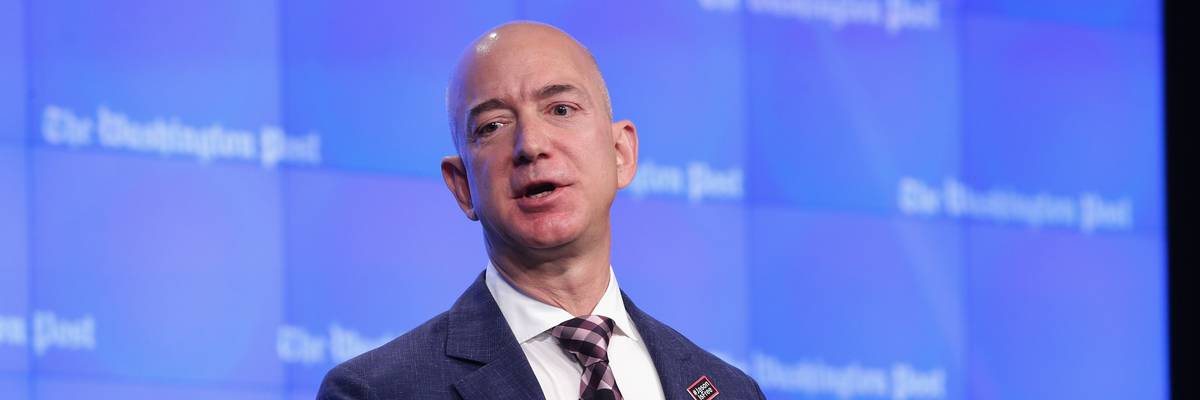
Amazon founder and Washington Post owner Jeff Bezos delivers remarks during the opening ceremony of the media company's new location January 28, 2016 in Washington, D.C.
The Washington Post’s shift toward free-market advocacy is not simply an editorial decision; it is a strategic move to reinforce the dominant ideological framework that benefits the billionaire class.
The recent directive by Jeff Bezos that The Washington Post editorial section should promote “personal liberties and free markets” is a stark reminder of how freedom under capitalism often boils down to the freedom of economic elites to dictate the parameters of public discourse. While Bezos has suggested that social media provides alternative perspectives, thus absolving his newspaper of the responsibility to represent diverse viewpoints, his decision is part of a broader trend of billionaire media ownership shaping acceptable discourse.
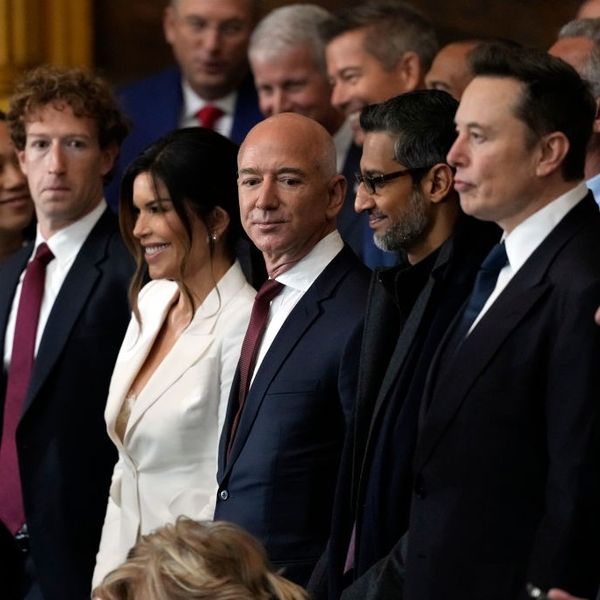
This phenomenon is visible across digital platforms as well. Elon Musk’s control over X (formerly Twitter) has demonstrated how ownership can shape public debate—both through direct interventions, such as the alleged suppression of progressive perspectives, and through more subtle changes to platform algorithms. Similarly, Mark Zuckerberg’s Meta has faced repeated allegations of privileging certain political narratives while suppressing others, including ending its “fact checking” policy that could challenge far-right viewpoints.
Perhaps the most glaring contradiction in Bezos’ advocacy for free markets is the extent to which he, and other billionaires like him, have benefited from state intervention as part of an intentional strategy of “corporate welfare.”
In each case, the rhetoric of “free speech” is selectively applied. While these platforms and newspapers claim to support open debate, their policies ultimately reflect the ideological preferences of their owners. This demonstrates a fundamental truth: In capitalist societies, freedom of expression is often contingent on the interests of those who control the means of communication. The Washington Post’s shift toward free-market advocacy is not simply an editorial decision; it is a strategic move to reinforce the dominant ideological framework that benefits the billionaire class.
Bezos’ framing of free markets as inherently linked to personal liberties exposes a deeper ideological assumption—namely, that economic success is the result of individual talent and merit rather than systemic privilege. This assumption is not unique to Bezos but is foundational to the way many economic elites understand their own wealth and influence.
The logic behind Bezos’ editorial direction is similar to the arguments used by the contemporary far-right to attack Diversity, Equity, and Inclusion (DEI) initiatives. The opposition to DEI is rooted in a desire to preserve the myth that success is determined purely by hard work and ability, rather than by racial, gender, or class privilege. By rejecting policies that acknowledge structural inequalities, The far-right seeks to uphold a narrative that justifies existing economic and social hierarchies.
This worldview is deeply intertwined with the ideology of neoliberalism, which insists that markets are neutral mechanisms that reward the most capable individuals. However, history shows that markets are anything but neutral. The barriers faced by marginalized groups are not simply the result of individual shortcomings; they are the product of centuries of systemic exclusion. The far-right’s attack on DEI serves to obscure these realities, just as Bezos’ insistence on free markets seeks to erase the role of privilege and power in determining economic outcomes.
By positioning The Washington Post as a champion of free markets, Bezos is promoting the idea that capitalism functions as a pure meritocracy. This serves not only to legitimize his own position but also to delegitimize calls for policies that challenge structural inequality, whether in the form of DEI programs, labor protections, or wealth redistribution measures.
Perhaps the most glaring contradiction in Bezos’ advocacy for free markets is the extent to which he, and other billionaires like him, have benefited from state intervention as part of an intentional strategy of “corporate welfare.” The notion of a truly free market, where economic actors compete on equal footing without government interference, is a fantasy. In reality, corporations like Amazon have thrived not because of unregulated competition, but because of significant government support.
From tax incentives to government contracts, Amazon has received billions in subsidies that have allowed it to dominate the retail and logistics industries. Moreover, the U.S. government plays a critical role in enforcing corporate-friendly trade policies, suppressing labor movements, and protecting the interests of multinational corporations abroad. These interventions are rarely acknowledged in discussions of free markets, yet they are crucial to understanding the power dynamics of contemporary capitalism.
If freedom under capitalism ultimately means the freedom of the wealthy to dictate the terms of discourse, then the very concept of free speech is in jeopardy.
Politically, Bezos’ editorial directive at The Washington Post serves to strengthen a broader ideological alignment between neoliberal economics and far-right nationalism. By framing free-market capitalism as an essential component of personal liberty, Bezos is laying the groundwork for a political agenda that fuses economic libertarianism with nationalist conservatism. This is significant because it provides an ideological foundation for challenging emerging economic policies that deviate from neoliberal orthodoxy—such as the rise of protectionism in response to globalization.
This alignment between free-market ideology and far-right nationalism is not new. Historically, neoliberalism has often coexisted with reactionary politics, as seen in the economic policies of figures like former U.S. President Ronald Reagan and former U.K. Prime Minister Margaret Thatcher. Today, this synthesis is being revived as right-wing populists seek to defend corporate interests while simultaneously appealing to nationalist sentiments. Bezos’ intervention in The Washington Post should be understood within this broader context: It is not just about shaping editorial policy but about consolidating an ideological framework that benefits economic elites while limiting the scope of acceptable political debate.
Bezos’ decision to impose a free-market ideology on The Washington Post is not an isolated event; it is part of a larger trend in which media ownership is used to shape public discourse in ways that serve elite interests. This phenomenon extends beyond traditional journalism to social media platforms, where billionaires like Musk and Zuckerberg wield immense power over the flow of information.
At its core, this issue is about more than just media bias—it is about the fundamental tension between democracy and concentrated economic power. A truly free and open society requires a diversity of perspectives, yet the dominance of billionaire-controlled media threatens to constrain the range of acceptable debate. If freedom under capitalism ultimately means the freedom of the wealthy to dictate the terms of discourse, then the very concept of free speech is in jeopardy.
The consolidation of media power in the hands of a few ultra-wealthy individuals raises urgent questions about the future of democratic debate. If we are to challenge the ideological hegemony of economic elites, we must first recognize the mechanisms through which they shape public discourse. Bezos’ editorial mandate is not just about The Washington Post—it is a reflection of the broader struggle over who gets to define the boundaries of political and economic debate in the 21st century.
Dear Common Dreams reader, It’s been nearly 30 years since I co-founded Common Dreams with my late wife, Lina Newhouser. We had the radical notion that journalism should serve the public good, not corporate profits. It was clear to us from the outset what it would take to build such a project. No paid advertisements. No corporate sponsors. No millionaire publisher telling us what to think or do. Many people said we wouldn't last a year, but we proved those doubters wrong. Together with a tremendous team of journalists and dedicated staff, we built an independent media outlet free from the constraints of profits and corporate control. Our mission has always been simple: To inform. To inspire. To ignite change for the common good. Building Common Dreams was not easy. Our survival was never guaranteed. When you take on the most powerful forces—Wall Street greed, fossil fuel industry destruction, Big Tech lobbyists, and uber-rich oligarchs who have spent billions upon billions rigging the economy and democracy in their favor—the only bulwark you have is supporters who believe in your work. But here’s the urgent message from me today. It's never been this bad out there. And it's never been this hard to keep us going. At the very moment Common Dreams is most needed, the threats we face are intensifying. We need your support now more than ever. We don't accept corporate advertising and never will. We don't have a paywall because we don't think people should be blocked from critical news based on their ability to pay. Everything we do is funded by the donations of readers like you. When everyone does the little they can afford, we are strong. But if that support retreats or dries up, so do we. Will you donate now to make sure Common Dreams not only survives but thrives? —Craig Brown, Co-founder |
The recent directive by Jeff Bezos that The Washington Post editorial section should promote “personal liberties and free markets” is a stark reminder of how freedom under capitalism often boils down to the freedom of economic elites to dictate the parameters of public discourse. While Bezos has suggested that social media provides alternative perspectives, thus absolving his newspaper of the responsibility to represent diverse viewpoints, his decision is part of a broader trend of billionaire media ownership shaping acceptable discourse.
This phenomenon is visible across digital platforms as well. Elon Musk’s control over X (formerly Twitter) has demonstrated how ownership can shape public debate—both through direct interventions, such as the alleged suppression of progressive perspectives, and through more subtle changes to platform algorithms. Similarly, Mark Zuckerberg’s Meta has faced repeated allegations of privileging certain political narratives while suppressing others, including ending its “fact checking” policy that could challenge far-right viewpoints.
Perhaps the most glaring contradiction in Bezos’ advocacy for free markets is the extent to which he, and other billionaires like him, have benefited from state intervention as part of an intentional strategy of “corporate welfare.”
In each case, the rhetoric of “free speech” is selectively applied. While these platforms and newspapers claim to support open debate, their policies ultimately reflect the ideological preferences of their owners. This demonstrates a fundamental truth: In capitalist societies, freedom of expression is often contingent on the interests of those who control the means of communication. The Washington Post’s shift toward free-market advocacy is not simply an editorial decision; it is a strategic move to reinforce the dominant ideological framework that benefits the billionaire class.
Bezos’ framing of free markets as inherently linked to personal liberties exposes a deeper ideological assumption—namely, that economic success is the result of individual talent and merit rather than systemic privilege. This assumption is not unique to Bezos but is foundational to the way many economic elites understand their own wealth and influence.
The logic behind Bezos’ editorial direction is similar to the arguments used by the contemporary far-right to attack Diversity, Equity, and Inclusion (DEI) initiatives. The opposition to DEI is rooted in a desire to preserve the myth that success is determined purely by hard work and ability, rather than by racial, gender, or class privilege. By rejecting policies that acknowledge structural inequalities, The far-right seeks to uphold a narrative that justifies existing economic and social hierarchies.
This worldview is deeply intertwined with the ideology of neoliberalism, which insists that markets are neutral mechanisms that reward the most capable individuals. However, history shows that markets are anything but neutral. The barriers faced by marginalized groups are not simply the result of individual shortcomings; they are the product of centuries of systemic exclusion. The far-right’s attack on DEI serves to obscure these realities, just as Bezos’ insistence on free markets seeks to erase the role of privilege and power in determining economic outcomes.
By positioning The Washington Post as a champion of free markets, Bezos is promoting the idea that capitalism functions as a pure meritocracy. This serves not only to legitimize his own position but also to delegitimize calls for policies that challenge structural inequality, whether in the form of DEI programs, labor protections, or wealth redistribution measures.
Perhaps the most glaring contradiction in Bezos’ advocacy for free markets is the extent to which he, and other billionaires like him, have benefited from state intervention as part of an intentional strategy of “corporate welfare.” The notion of a truly free market, where economic actors compete on equal footing without government interference, is a fantasy. In reality, corporations like Amazon have thrived not because of unregulated competition, but because of significant government support.
From tax incentives to government contracts, Amazon has received billions in subsidies that have allowed it to dominate the retail and logistics industries. Moreover, the U.S. government plays a critical role in enforcing corporate-friendly trade policies, suppressing labor movements, and protecting the interests of multinational corporations abroad. These interventions are rarely acknowledged in discussions of free markets, yet they are crucial to understanding the power dynamics of contemporary capitalism.
If freedom under capitalism ultimately means the freedom of the wealthy to dictate the terms of discourse, then the very concept of free speech is in jeopardy.
Politically, Bezos’ editorial directive at The Washington Post serves to strengthen a broader ideological alignment between neoliberal economics and far-right nationalism. By framing free-market capitalism as an essential component of personal liberty, Bezos is laying the groundwork for a political agenda that fuses economic libertarianism with nationalist conservatism. This is significant because it provides an ideological foundation for challenging emerging economic policies that deviate from neoliberal orthodoxy—such as the rise of protectionism in response to globalization.
This alignment between free-market ideology and far-right nationalism is not new. Historically, neoliberalism has often coexisted with reactionary politics, as seen in the economic policies of figures like former U.S. President Ronald Reagan and former U.K. Prime Minister Margaret Thatcher. Today, this synthesis is being revived as right-wing populists seek to defend corporate interests while simultaneously appealing to nationalist sentiments. Bezos’ intervention in The Washington Post should be understood within this broader context: It is not just about shaping editorial policy but about consolidating an ideological framework that benefits economic elites while limiting the scope of acceptable political debate.
Bezos’ decision to impose a free-market ideology on The Washington Post is not an isolated event; it is part of a larger trend in which media ownership is used to shape public discourse in ways that serve elite interests. This phenomenon extends beyond traditional journalism to social media platforms, where billionaires like Musk and Zuckerberg wield immense power over the flow of information.
At its core, this issue is about more than just media bias—it is about the fundamental tension between democracy and concentrated economic power. A truly free and open society requires a diversity of perspectives, yet the dominance of billionaire-controlled media threatens to constrain the range of acceptable debate. If freedom under capitalism ultimately means the freedom of the wealthy to dictate the terms of discourse, then the very concept of free speech is in jeopardy.
The consolidation of media power in the hands of a few ultra-wealthy individuals raises urgent questions about the future of democratic debate. If we are to challenge the ideological hegemony of economic elites, we must first recognize the mechanisms through which they shape public discourse. Bezos’ editorial mandate is not just about The Washington Post—it is a reflection of the broader struggle over who gets to define the boundaries of political and economic debate in the 21st century.
The recent directive by Jeff Bezos that The Washington Post editorial section should promote “personal liberties and free markets” is a stark reminder of how freedom under capitalism often boils down to the freedom of economic elites to dictate the parameters of public discourse. While Bezos has suggested that social media provides alternative perspectives, thus absolving his newspaper of the responsibility to represent diverse viewpoints, his decision is part of a broader trend of billionaire media ownership shaping acceptable discourse.
This phenomenon is visible across digital platforms as well. Elon Musk’s control over X (formerly Twitter) has demonstrated how ownership can shape public debate—both through direct interventions, such as the alleged suppression of progressive perspectives, and through more subtle changes to platform algorithms. Similarly, Mark Zuckerberg’s Meta has faced repeated allegations of privileging certain political narratives while suppressing others, including ending its “fact checking” policy that could challenge far-right viewpoints.
Perhaps the most glaring contradiction in Bezos’ advocacy for free markets is the extent to which he, and other billionaires like him, have benefited from state intervention as part of an intentional strategy of “corporate welfare.”
In each case, the rhetoric of “free speech” is selectively applied. While these platforms and newspapers claim to support open debate, their policies ultimately reflect the ideological preferences of their owners. This demonstrates a fundamental truth: In capitalist societies, freedom of expression is often contingent on the interests of those who control the means of communication. The Washington Post’s shift toward free-market advocacy is not simply an editorial decision; it is a strategic move to reinforce the dominant ideological framework that benefits the billionaire class.
Bezos’ framing of free markets as inherently linked to personal liberties exposes a deeper ideological assumption—namely, that economic success is the result of individual talent and merit rather than systemic privilege. This assumption is not unique to Bezos but is foundational to the way many economic elites understand their own wealth and influence.
The logic behind Bezos’ editorial direction is similar to the arguments used by the contemporary far-right to attack Diversity, Equity, and Inclusion (DEI) initiatives. The opposition to DEI is rooted in a desire to preserve the myth that success is determined purely by hard work and ability, rather than by racial, gender, or class privilege. By rejecting policies that acknowledge structural inequalities, The far-right seeks to uphold a narrative that justifies existing economic and social hierarchies.
This worldview is deeply intertwined with the ideology of neoliberalism, which insists that markets are neutral mechanisms that reward the most capable individuals. However, history shows that markets are anything but neutral. The barriers faced by marginalized groups are not simply the result of individual shortcomings; they are the product of centuries of systemic exclusion. The far-right’s attack on DEI serves to obscure these realities, just as Bezos’ insistence on free markets seeks to erase the role of privilege and power in determining economic outcomes.
By positioning The Washington Post as a champion of free markets, Bezos is promoting the idea that capitalism functions as a pure meritocracy. This serves not only to legitimize his own position but also to delegitimize calls for policies that challenge structural inequality, whether in the form of DEI programs, labor protections, or wealth redistribution measures.
Perhaps the most glaring contradiction in Bezos’ advocacy for free markets is the extent to which he, and other billionaires like him, have benefited from state intervention as part of an intentional strategy of “corporate welfare.” The notion of a truly free market, where economic actors compete on equal footing without government interference, is a fantasy. In reality, corporations like Amazon have thrived not because of unregulated competition, but because of significant government support.
From tax incentives to government contracts, Amazon has received billions in subsidies that have allowed it to dominate the retail and logistics industries. Moreover, the U.S. government plays a critical role in enforcing corporate-friendly trade policies, suppressing labor movements, and protecting the interests of multinational corporations abroad. These interventions are rarely acknowledged in discussions of free markets, yet they are crucial to understanding the power dynamics of contemporary capitalism.
If freedom under capitalism ultimately means the freedom of the wealthy to dictate the terms of discourse, then the very concept of free speech is in jeopardy.
Politically, Bezos’ editorial directive at The Washington Post serves to strengthen a broader ideological alignment between neoliberal economics and far-right nationalism. By framing free-market capitalism as an essential component of personal liberty, Bezos is laying the groundwork for a political agenda that fuses economic libertarianism with nationalist conservatism. This is significant because it provides an ideological foundation for challenging emerging economic policies that deviate from neoliberal orthodoxy—such as the rise of protectionism in response to globalization.
This alignment between free-market ideology and far-right nationalism is not new. Historically, neoliberalism has often coexisted with reactionary politics, as seen in the economic policies of figures like former U.S. President Ronald Reagan and former U.K. Prime Minister Margaret Thatcher. Today, this synthesis is being revived as right-wing populists seek to defend corporate interests while simultaneously appealing to nationalist sentiments. Bezos’ intervention in The Washington Post should be understood within this broader context: It is not just about shaping editorial policy but about consolidating an ideological framework that benefits economic elites while limiting the scope of acceptable political debate.
Bezos’ decision to impose a free-market ideology on The Washington Post is not an isolated event; it is part of a larger trend in which media ownership is used to shape public discourse in ways that serve elite interests. This phenomenon extends beyond traditional journalism to social media platforms, where billionaires like Musk and Zuckerberg wield immense power over the flow of information.
At its core, this issue is about more than just media bias—it is about the fundamental tension between democracy and concentrated economic power. A truly free and open society requires a diversity of perspectives, yet the dominance of billionaire-controlled media threatens to constrain the range of acceptable debate. If freedom under capitalism ultimately means the freedom of the wealthy to dictate the terms of discourse, then the very concept of free speech is in jeopardy.
The consolidation of media power in the hands of a few ultra-wealthy individuals raises urgent questions about the future of democratic debate. If we are to challenge the ideological hegemony of economic elites, we must first recognize the mechanisms through which they shape public discourse. Bezos’ editorial mandate is not just about The Washington Post—it is a reflection of the broader struggle over who gets to define the boundaries of political and economic debate in the 21st century.