SUBSCRIBE TO OUR FREE NEWSLETTER
Daily news & progressive opinion—funded by the people, not the corporations—delivered straight to your inbox.
5
#000000
#FFFFFF
To donate by check, phone, or other method, see our More Ways to Give page.
Daily news & progressive opinion—funded by the people, not the corporations—delivered straight to your inbox.
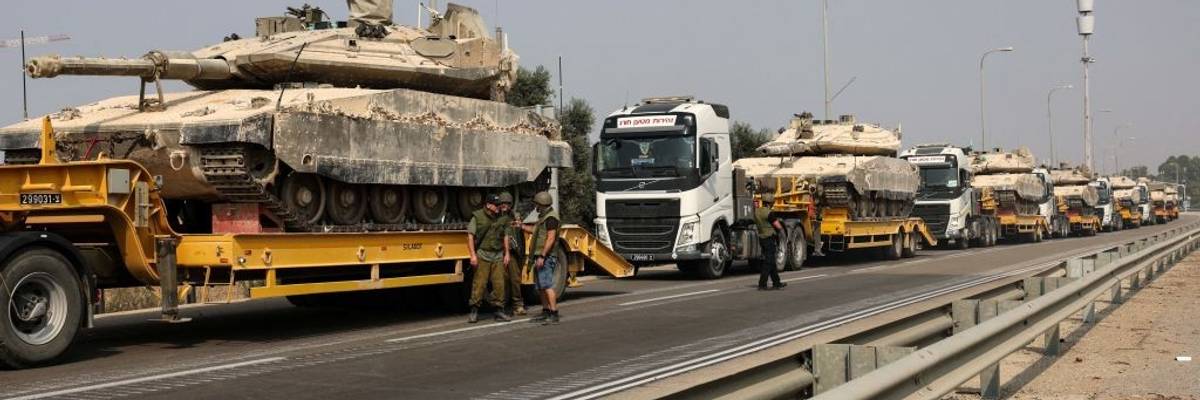
Israeli tanks are transported to the border with the Gaza Stip on October 8, 2023.
'Right now, we need U.S. support for the U.N. as it calls for an immediate ceasefire'
The most recent eruption of violence in Gaza and Israel is a tragic reminder of the human consequences of decades of oppression. The human toll – hundreds of Palestinians and Israelis killed so far – tells that appalling story. Many of the targets, and many of those killed, on both sides, were civilians.
And, as the United Nations’ special rapporteur on human rights in the occupied Palestinian territory noted about attacks on civilians, “whoever launches them (Palestinian armed groups or Israeli occupation forces) commits crimes that must be accounted for.”
But while it’s necessary, condemning attacks on civilians isn’t enough. If we are serious about ending this spiraling violence, we need to look at root causes. And that means – hard as it may be for some to acknowledge it – we must look at the context.
While this attack against Israel may have been a surprise to Israel’s political and military officials, it should not have been unexpected. Eruptions of violence have well-known causes; they are no secret. Human rights organizations (Israeli, Palestinian, American and international) and UN officials, parliamentarians and governments around the world have long warned that Israel’s longstanding denial of freedom and equality for Palestinians would continue sparking cycles of violence.
Our understanding of reality is shaped by when we start the clock.
Saturday’s attack from Gaza did not happen out of thin air. It took place in the context of decades of Israel’s domination and control over Palestinians. As the Israeli human rights organization B’tselem describes it, “in the entire area between the Mediterranean Sea and the Jordan River, the Israeli regime implements laws, practices and state violence designed to cement the supremacy of one group – Jews – over another – Palestinians. … [I]n 2007, Israel imposed a blockade on the Gaza Strip that is still in place. Throughout all of these years, Israel has continued to control nearly every aspect of life in Gaza from outside.”
Generations of Palestinians, 80 percent of them refugees, have grown up in the teeming, impoverished Gaza Strip, one of the most crowded pieces of land on Earth. Since Israel besieged Gaza in 2007, most of them have never been allowed to leave the walled-in, military-guarded Strip, have never glimpsed the West Bank or Jerusalem, let alone 1948 Israel, and certainly not the wider world.
In 2012 the UN determined that without “herculean action” by the international community, by 2020 Gaza “will not be livable” – largely, though not only, because of the profound lack of access to clean water. In 2015 the UN again reported that conditions had worsened, particularly because of the Israeli military assault in 2014 and its destruction of water and electrical infrastructure. And once again they urgently warned that Gaza would be “unlivable” by 2020.
Yet more than 2 million Palestinians remain in Gaza, locked into an open-air prison. 2020 has come and gone. The international community did not take “herculean action” to stop Israel’s blockade or to stop the current extremist government’s annexation of Palestinian land. They did nothing (then-President Trump even praised it) when Israel passed a law stating that “the right to exercise national self-determination in the State of Israel is unique to the Jewish people” — so even Palestinians who are Israeli citizens are officially denied equal rights. And Gaza remains unlivable.
In 2018, a series of overwhelmingly non-violent marches, organized by Ahmed Abu Artema, a young Gaza poet, and taking place inside the besieged Strip, called for an end to the blockade and freedom of movement for the Gaza population. They were met with tear gas, rubber bullets and Israeli sharpshooters taking aim at the mostly young protesters.
After two years, the result was 214 Palestinians killed, including 46 children, and more than 36,000 injured, including 8,800 children. More than 8,000 of those injured were hit by live ammunition. By the time the protests waned, in 2019, the United Nations reported that 1,700 of the protesters faced amputation of legs or arms because Gaza hospitals had insufficient health care funding to provide advanced care for those shot by Israeli snipers.
None of this makes attacks on civilians legal or acceptable. But without addressing the root causes, violence will continue to erupt. Israel remains the occupying power. Before today, Israeli soldiers had already killed more than 214 Palestinians, 47 of them children, in the occupied West Bank, and settler violence had escalated, with nearly 600 attacks in just the first six months of this year.
Too many Palestinians and too many Israelis have been killed. If Israel was in fact surprised by the attack, it was an intelligence failure – something that won’t be solved by sending it more weapons. The United States provides $3.8 billion – 20 percent of Israel’s military budget – every year, and that clearly isn’t helping deal with the root causes of violence.
Right now, we need U.S. support for the UN as it calls for an immediate ceasefire. And then we need a serious U.S. commitment to ending the violence — all the violence. That means ending Washington’s enabling of Israeli violations, and instead demanding real accountability for violations of human rights and international law, real moves to end the occupation and apartheid system and real moves to demand equality for all living under Israeli control.
Dear Common Dreams reader, It’s been nearly 30 years since I co-founded Common Dreams with my late wife, Lina Newhouser. We had the radical notion that journalism should serve the public good, not corporate profits. It was clear to us from the outset what it would take to build such a project. No paid advertisements. No corporate sponsors. No millionaire publisher telling us what to think or do. Many people said we wouldn't last a year, but we proved those doubters wrong. Together with a tremendous team of journalists and dedicated staff, we built an independent media outlet free from the constraints of profits and corporate control. Our mission has always been simple: To inform. To inspire. To ignite change for the common good. Building Common Dreams was not easy. Our survival was never guaranteed. When you take on the most powerful forces—Wall Street greed, fossil fuel industry destruction, Big Tech lobbyists, and uber-rich oligarchs who have spent billions upon billions rigging the economy and democracy in their favor—the only bulwark you have is supporters who believe in your work. But here’s the urgent message from me today. It's never been this bad out there. And it's never been this hard to keep us going. At the very moment Common Dreams is most needed, the threats we face are intensifying. We need your support now more than ever. We don't accept corporate advertising and never will. We don't have a paywall because we don't think people should be blocked from critical news based on their ability to pay. Everything we do is funded by the donations of readers like you. When everyone does the little they can afford, we are strong. But if that support retreats or dries up, so do we. Will you donate now to make sure Common Dreams not only survives but thrives? —Craig Brown, Co-founder |
The most recent eruption of violence in Gaza and Israel is a tragic reminder of the human consequences of decades of oppression. The human toll – hundreds of Palestinians and Israelis killed so far – tells that appalling story. Many of the targets, and many of those killed, on both sides, were civilians.
And, as the United Nations’ special rapporteur on human rights in the occupied Palestinian territory noted about attacks on civilians, “whoever launches them (Palestinian armed groups or Israeli occupation forces) commits crimes that must be accounted for.”
But while it’s necessary, condemning attacks on civilians isn’t enough. If we are serious about ending this spiraling violence, we need to look at root causes. And that means – hard as it may be for some to acknowledge it – we must look at the context.
While this attack against Israel may have been a surprise to Israel’s political and military officials, it should not have been unexpected. Eruptions of violence have well-known causes; they are no secret. Human rights organizations (Israeli, Palestinian, American and international) and UN officials, parliamentarians and governments around the world have long warned that Israel’s longstanding denial of freedom and equality for Palestinians would continue sparking cycles of violence.
Our understanding of reality is shaped by when we start the clock.
Saturday’s attack from Gaza did not happen out of thin air. It took place in the context of decades of Israel’s domination and control over Palestinians. As the Israeli human rights organization B’tselem describes it, “in the entire area between the Mediterranean Sea and the Jordan River, the Israeli regime implements laws, practices and state violence designed to cement the supremacy of one group – Jews – over another – Palestinians. … [I]n 2007, Israel imposed a blockade on the Gaza Strip that is still in place. Throughout all of these years, Israel has continued to control nearly every aspect of life in Gaza from outside.”
Generations of Palestinians, 80 percent of them refugees, have grown up in the teeming, impoverished Gaza Strip, one of the most crowded pieces of land on Earth. Since Israel besieged Gaza in 2007, most of them have never been allowed to leave the walled-in, military-guarded Strip, have never glimpsed the West Bank or Jerusalem, let alone 1948 Israel, and certainly not the wider world.
In 2012 the UN determined that without “herculean action” by the international community, by 2020 Gaza “will not be livable” – largely, though not only, because of the profound lack of access to clean water. In 2015 the UN again reported that conditions had worsened, particularly because of the Israeli military assault in 2014 and its destruction of water and electrical infrastructure. And once again they urgently warned that Gaza would be “unlivable” by 2020.
Yet more than 2 million Palestinians remain in Gaza, locked into an open-air prison. 2020 has come and gone. The international community did not take “herculean action” to stop Israel’s blockade or to stop the current extremist government’s annexation of Palestinian land. They did nothing (then-President Trump even praised it) when Israel passed a law stating that “the right to exercise national self-determination in the State of Israel is unique to the Jewish people” — so even Palestinians who are Israeli citizens are officially denied equal rights. And Gaza remains unlivable.
In 2018, a series of overwhelmingly non-violent marches, organized by Ahmed Abu Artema, a young Gaza poet, and taking place inside the besieged Strip, called for an end to the blockade and freedom of movement for the Gaza population. They were met with tear gas, rubber bullets and Israeli sharpshooters taking aim at the mostly young protesters.
After two years, the result was 214 Palestinians killed, including 46 children, and more than 36,000 injured, including 8,800 children. More than 8,000 of those injured were hit by live ammunition. By the time the protests waned, in 2019, the United Nations reported that 1,700 of the protesters faced amputation of legs or arms because Gaza hospitals had insufficient health care funding to provide advanced care for those shot by Israeli snipers.
None of this makes attacks on civilians legal or acceptable. But without addressing the root causes, violence will continue to erupt. Israel remains the occupying power. Before today, Israeli soldiers had already killed more than 214 Palestinians, 47 of them children, in the occupied West Bank, and settler violence had escalated, with nearly 600 attacks in just the first six months of this year.
Too many Palestinians and too many Israelis have been killed. If Israel was in fact surprised by the attack, it was an intelligence failure – something that won’t be solved by sending it more weapons. The United States provides $3.8 billion – 20 percent of Israel’s military budget – every year, and that clearly isn’t helping deal with the root causes of violence.
Right now, we need U.S. support for the UN as it calls for an immediate ceasefire. And then we need a serious U.S. commitment to ending the violence — all the violence. That means ending Washington’s enabling of Israeli violations, and instead demanding real accountability for violations of human rights and international law, real moves to end the occupation and apartheid system and real moves to demand equality for all living under Israeli control.
The most recent eruption of violence in Gaza and Israel is a tragic reminder of the human consequences of decades of oppression. The human toll – hundreds of Palestinians and Israelis killed so far – tells that appalling story. Many of the targets, and many of those killed, on both sides, were civilians.
And, as the United Nations’ special rapporteur on human rights in the occupied Palestinian territory noted about attacks on civilians, “whoever launches them (Palestinian armed groups or Israeli occupation forces) commits crimes that must be accounted for.”
But while it’s necessary, condemning attacks on civilians isn’t enough. If we are serious about ending this spiraling violence, we need to look at root causes. And that means – hard as it may be for some to acknowledge it – we must look at the context.
While this attack against Israel may have been a surprise to Israel’s political and military officials, it should not have been unexpected. Eruptions of violence have well-known causes; they are no secret. Human rights organizations (Israeli, Palestinian, American and international) and UN officials, parliamentarians and governments around the world have long warned that Israel’s longstanding denial of freedom and equality for Palestinians would continue sparking cycles of violence.
Our understanding of reality is shaped by when we start the clock.
Saturday’s attack from Gaza did not happen out of thin air. It took place in the context of decades of Israel’s domination and control over Palestinians. As the Israeli human rights organization B’tselem describes it, “in the entire area between the Mediterranean Sea and the Jordan River, the Israeli regime implements laws, practices and state violence designed to cement the supremacy of one group – Jews – over another – Palestinians. … [I]n 2007, Israel imposed a blockade on the Gaza Strip that is still in place. Throughout all of these years, Israel has continued to control nearly every aspect of life in Gaza from outside.”
Generations of Palestinians, 80 percent of them refugees, have grown up in the teeming, impoverished Gaza Strip, one of the most crowded pieces of land on Earth. Since Israel besieged Gaza in 2007, most of them have never been allowed to leave the walled-in, military-guarded Strip, have never glimpsed the West Bank or Jerusalem, let alone 1948 Israel, and certainly not the wider world.
In 2012 the UN determined that without “herculean action” by the international community, by 2020 Gaza “will not be livable” – largely, though not only, because of the profound lack of access to clean water. In 2015 the UN again reported that conditions had worsened, particularly because of the Israeli military assault in 2014 and its destruction of water and electrical infrastructure. And once again they urgently warned that Gaza would be “unlivable” by 2020.
Yet more than 2 million Palestinians remain in Gaza, locked into an open-air prison. 2020 has come and gone. The international community did not take “herculean action” to stop Israel’s blockade or to stop the current extremist government’s annexation of Palestinian land. They did nothing (then-President Trump even praised it) when Israel passed a law stating that “the right to exercise national self-determination in the State of Israel is unique to the Jewish people” — so even Palestinians who are Israeli citizens are officially denied equal rights. And Gaza remains unlivable.
In 2018, a series of overwhelmingly non-violent marches, organized by Ahmed Abu Artema, a young Gaza poet, and taking place inside the besieged Strip, called for an end to the blockade and freedom of movement for the Gaza population. They were met with tear gas, rubber bullets and Israeli sharpshooters taking aim at the mostly young protesters.
After two years, the result was 214 Palestinians killed, including 46 children, and more than 36,000 injured, including 8,800 children. More than 8,000 of those injured were hit by live ammunition. By the time the protests waned, in 2019, the United Nations reported that 1,700 of the protesters faced amputation of legs or arms because Gaza hospitals had insufficient health care funding to provide advanced care for those shot by Israeli snipers.
None of this makes attacks on civilians legal or acceptable. But without addressing the root causes, violence will continue to erupt. Israel remains the occupying power. Before today, Israeli soldiers had already killed more than 214 Palestinians, 47 of them children, in the occupied West Bank, and settler violence had escalated, with nearly 600 attacks in just the first six months of this year.
Too many Palestinians and too many Israelis have been killed. If Israel was in fact surprised by the attack, it was an intelligence failure – something that won’t be solved by sending it more weapons. The United States provides $3.8 billion – 20 percent of Israel’s military budget – every year, and that clearly isn’t helping deal with the root causes of violence.
Right now, we need U.S. support for the UN as it calls for an immediate ceasefire. And then we need a serious U.S. commitment to ending the violence — all the violence. That means ending Washington’s enabling of Israeli violations, and instead demanding real accountability for violations of human rights and international law, real moves to end the occupation and apartheid system and real moves to demand equality for all living under Israeli control.