SUBSCRIBE TO OUR FREE NEWSLETTER
Daily news & progressive opinion—funded by the people, not the corporations—delivered straight to your inbox.
5
#000000
#FFFFFF
To donate by check, phone, or other method, see our More Ways to Give page.
Daily news & progressive opinion—funded by the people, not the corporations—delivered straight to your inbox.
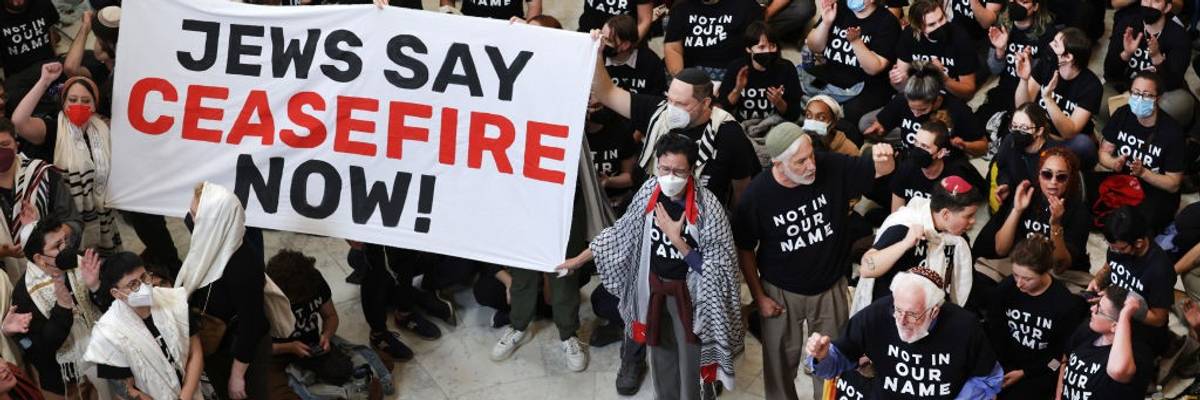
Protesters hold a demonstration in support of a cease fire in Gaza in the Cannon House Office Building on October 18, 2023 in Washington, DC. Members of the Jewish Voice for Peace and the IfNotNow movement staged a rally to call for a cease fire in the Israel–Hamas war.
May our prayers on this Yom Kippur be in the streets.
The famous rabbi, Abraham Joshua Heschel, was once asked by a journalist why he, as a religious leader, had come to a demonstration against the war in Vietnam. Heschel answered: “I am here because I cannot pray... Whenever I open the prayer book, I see images of children burning from napalm”
Now, as we approach this evening's Yom Kippur, the day when Jews traditionally reflect on the past and repent, I see the horrifying photos of Israeli and Palestinian children, women and men, who have been killed over the past year. The images of the dead and the brutal way in which they were killed, haunts me and I feel called to pray through protest as Rabbi Heschel once did.
The first anniversary of the October 7 Hamas attack on Israel was just five days ago and tonight we will remember the over 1100 Israelis who were killed, the 247 who were taken hostage, and the 97 Israelis still held as hostages in Gaza. It is not new for Jews to mark tragedies. But, this year, for the first time in more than 3,000 years of Jewish history, Jews will observe Yom Kippur as Israel continues a year long attack on Gaza that the International Court of Justice ruled is plausibly a case of genocide. Scholars like Raz Segal and Omer Bartov, and Francesca Albanese, the UN Special Rapporteur on Occupied Territories, agree.
“Prayer is meaningless unless it is subversive, unless it seeks to overthrow and to ruin the pyramids of callousness, hatred, opportunism, falsehoods.” —Rabbi Heschel
I was raised in a passionately Zionist community in Apartheid South Africa. My father was a leader of the Jewish community and the Judaism that I learned from him, in my Jewish Day school, and my Zionist youth movement, inspired deep loyalty to Israel no matter what decisions its leaders made. Despite this, I began to question Zionism. In 2003, I was one of the founders of Rabbis for Human Rights North America. In that role, I learned first-hand about the systemic injustice of daily life in Palestine, by trying to stop Israeli home demolitions. I also learned from Israeli and Palestinian activists about the Nakba, when thousands of Palestinians were displaced from their homes in 1948.
Today, I know that I’m complicit in Israel’s war as both a rabbi and an American. However I am not alone. All Americans are implicated in today’s atrocities. The United States has sent more than 50,000 tons of armaments and military equipment to Israel since October 7th. More than 41,000 Palestinians have been killed. Recently, reports of mass terror, rape, and abuse in Israeli detention centers have been added to the list of war crimes and atrocities. Israel has also destroyed schools, mosques, cultural centers, libraries, important historical heritage sites and more throughout Gaza.
As Americans, we must face the truth of our complicity with this horror. And, like Rabbi Heschel we must take bold action to end it, instead of simply praying for change. As Heschel said, “Prayer is meaningless unless it is subversive, unless it seeks to overthrow and to ruin the pyramids of callousness, hatred, opportunism, falsehoods.”
In the wake of October 7, I have followed Rabbi Heshel’s example, and prayed through protest, at several actions organized by Rabbis for Ceasefire and If Not Now. Here are four suggestions for how we can all take action in this new year: 1) Educate ourselves about the history of the Palestinian people, especially about the Nakba in 1948. 2) Support calls for an immediate ceasefire. The violence on both sides endangers everyone. 3) Demand an immediate arms embargo to end the supply of American bombs that have enabled the genocide. 4) Support a negotiated settlement that guarantees freedom, equality and justice for all who live in Israel and Palestine.
As the Palestinian journalis Ahmed Moor writes, “Hope for the future, such as it is, is fixed in a vision that requires the end of Jewish supremacy in Palestine.” May our prayers on this Yom Kippur be in the streets. May we end the genocide and advocate for equality, freedom, justice, and safety for all who live in Israel/Palestine.
Dear Common Dreams reader, It’s been nearly 30 years since I co-founded Common Dreams with my late wife, Lina Newhouser. We had the radical notion that journalism should serve the public good, not corporate profits. It was clear to us from the outset what it would take to build such a project. No paid advertisements. No corporate sponsors. No millionaire publisher telling us what to think or do. Many people said we wouldn't last a year, but we proved those doubters wrong. Together with a tremendous team of journalists and dedicated staff, we built an independent media outlet free from the constraints of profits and corporate control. Our mission has always been simple: To inform. To inspire. To ignite change for the common good. Building Common Dreams was not easy. Our survival was never guaranteed. When you take on the most powerful forces—Wall Street greed, fossil fuel industry destruction, Big Tech lobbyists, and uber-rich oligarchs who have spent billions upon billions rigging the economy and democracy in their favor—the only bulwark you have is supporters who believe in your work. But here’s the urgent message from me today. It's never been this bad out there. And it's never been this hard to keep us going. At the very moment Common Dreams is most needed, the threats we face are intensifying. We need your support now more than ever. We don't accept corporate advertising and never will. We don't have a paywall because we don't think people should be blocked from critical news based on their ability to pay. Everything we do is funded by the donations of readers like you. When everyone does the little they can afford, we are strong. But if that support retreats or dries up, so do we. Will you donate now to make sure Common Dreams not only survives but thrives? —Craig Brown, Co-founder |
The famous rabbi, Abraham Joshua Heschel, was once asked by a journalist why he, as a religious leader, had come to a demonstration against the war in Vietnam. Heschel answered: “I am here because I cannot pray... Whenever I open the prayer book, I see images of children burning from napalm”
Now, as we approach this evening's Yom Kippur, the day when Jews traditionally reflect on the past and repent, I see the horrifying photos of Israeli and Palestinian children, women and men, who have been killed over the past year. The images of the dead and the brutal way in which they were killed, haunts me and I feel called to pray through protest as Rabbi Heschel once did.
The first anniversary of the October 7 Hamas attack on Israel was just five days ago and tonight we will remember the over 1100 Israelis who were killed, the 247 who were taken hostage, and the 97 Israelis still held as hostages in Gaza. It is not new for Jews to mark tragedies. But, this year, for the first time in more than 3,000 years of Jewish history, Jews will observe Yom Kippur as Israel continues a year long attack on Gaza that the International Court of Justice ruled is plausibly a case of genocide. Scholars like Raz Segal and Omer Bartov, and Francesca Albanese, the UN Special Rapporteur on Occupied Territories, agree.
“Prayer is meaningless unless it is subversive, unless it seeks to overthrow and to ruin the pyramids of callousness, hatred, opportunism, falsehoods.” —Rabbi Heschel
I was raised in a passionately Zionist community in Apartheid South Africa. My father was a leader of the Jewish community and the Judaism that I learned from him, in my Jewish Day school, and my Zionist youth movement, inspired deep loyalty to Israel no matter what decisions its leaders made. Despite this, I began to question Zionism. In 2003, I was one of the founders of Rabbis for Human Rights North America. In that role, I learned first-hand about the systemic injustice of daily life in Palestine, by trying to stop Israeli home demolitions. I also learned from Israeli and Palestinian activists about the Nakba, when thousands of Palestinians were displaced from their homes in 1948.
Today, I know that I’m complicit in Israel’s war as both a rabbi and an American. However I am not alone. All Americans are implicated in today’s atrocities. The United States has sent more than 50,000 tons of armaments and military equipment to Israel since October 7th. More than 41,000 Palestinians have been killed. Recently, reports of mass terror, rape, and abuse in Israeli detention centers have been added to the list of war crimes and atrocities. Israel has also destroyed schools, mosques, cultural centers, libraries, important historical heritage sites and more throughout Gaza.
As Americans, we must face the truth of our complicity with this horror. And, like Rabbi Heschel we must take bold action to end it, instead of simply praying for change. As Heschel said, “Prayer is meaningless unless it is subversive, unless it seeks to overthrow and to ruin the pyramids of callousness, hatred, opportunism, falsehoods.”
In the wake of October 7, I have followed Rabbi Heshel’s example, and prayed through protest, at several actions organized by Rabbis for Ceasefire and If Not Now. Here are four suggestions for how we can all take action in this new year: 1) Educate ourselves about the history of the Palestinian people, especially about the Nakba in 1948. 2) Support calls for an immediate ceasefire. The violence on both sides endangers everyone. 3) Demand an immediate arms embargo to end the supply of American bombs that have enabled the genocide. 4) Support a negotiated settlement that guarantees freedom, equality and justice for all who live in Israel and Palestine.
As the Palestinian journalis Ahmed Moor writes, “Hope for the future, such as it is, is fixed in a vision that requires the end of Jewish supremacy in Palestine.” May our prayers on this Yom Kippur be in the streets. May we end the genocide and advocate for equality, freedom, justice, and safety for all who live in Israel/Palestine.
The famous rabbi, Abraham Joshua Heschel, was once asked by a journalist why he, as a religious leader, had come to a demonstration against the war in Vietnam. Heschel answered: “I am here because I cannot pray... Whenever I open the prayer book, I see images of children burning from napalm”
Now, as we approach this evening's Yom Kippur, the day when Jews traditionally reflect on the past and repent, I see the horrifying photos of Israeli and Palestinian children, women and men, who have been killed over the past year. The images of the dead and the brutal way in which they were killed, haunts me and I feel called to pray through protest as Rabbi Heschel once did.
The first anniversary of the October 7 Hamas attack on Israel was just five days ago and tonight we will remember the over 1100 Israelis who were killed, the 247 who were taken hostage, and the 97 Israelis still held as hostages in Gaza. It is not new for Jews to mark tragedies. But, this year, for the first time in more than 3,000 years of Jewish history, Jews will observe Yom Kippur as Israel continues a year long attack on Gaza that the International Court of Justice ruled is plausibly a case of genocide. Scholars like Raz Segal and Omer Bartov, and Francesca Albanese, the UN Special Rapporteur on Occupied Territories, agree.
“Prayer is meaningless unless it is subversive, unless it seeks to overthrow and to ruin the pyramids of callousness, hatred, opportunism, falsehoods.” —Rabbi Heschel
I was raised in a passionately Zionist community in Apartheid South Africa. My father was a leader of the Jewish community and the Judaism that I learned from him, in my Jewish Day school, and my Zionist youth movement, inspired deep loyalty to Israel no matter what decisions its leaders made. Despite this, I began to question Zionism. In 2003, I was one of the founders of Rabbis for Human Rights North America. In that role, I learned first-hand about the systemic injustice of daily life in Palestine, by trying to stop Israeli home demolitions. I also learned from Israeli and Palestinian activists about the Nakba, when thousands of Palestinians were displaced from their homes in 1948.
Today, I know that I’m complicit in Israel’s war as both a rabbi and an American. However I am not alone. All Americans are implicated in today’s atrocities. The United States has sent more than 50,000 tons of armaments and military equipment to Israel since October 7th. More than 41,000 Palestinians have been killed. Recently, reports of mass terror, rape, and abuse in Israeli detention centers have been added to the list of war crimes and atrocities. Israel has also destroyed schools, mosques, cultural centers, libraries, important historical heritage sites and more throughout Gaza.
As Americans, we must face the truth of our complicity with this horror. And, like Rabbi Heschel we must take bold action to end it, instead of simply praying for change. As Heschel said, “Prayer is meaningless unless it is subversive, unless it seeks to overthrow and to ruin the pyramids of callousness, hatred, opportunism, falsehoods.”
In the wake of October 7, I have followed Rabbi Heshel’s example, and prayed through protest, at several actions organized by Rabbis for Ceasefire and If Not Now. Here are four suggestions for how we can all take action in this new year: 1) Educate ourselves about the history of the Palestinian people, especially about the Nakba in 1948. 2) Support calls for an immediate ceasefire. The violence on both sides endangers everyone. 3) Demand an immediate arms embargo to end the supply of American bombs that have enabled the genocide. 4) Support a negotiated settlement that guarantees freedom, equality and justice for all who live in Israel and Palestine.
As the Palestinian journalis Ahmed Moor writes, “Hope for the future, such as it is, is fixed in a vision that requires the end of Jewish supremacy in Palestine.” May our prayers on this Yom Kippur be in the streets. May we end the genocide and advocate for equality, freedom, justice, and safety for all who live in Israel/Palestine.