SUBSCRIBE TO OUR FREE NEWSLETTER
Daily news & progressive opinion—funded by the people, not the corporations—delivered straight to your inbox.
5
#000000
#FFFFFF
To donate by check, phone, or other method, see our More Ways to Give page.
Daily news & progressive opinion—funded by the people, not the corporations—delivered straight to your inbox.
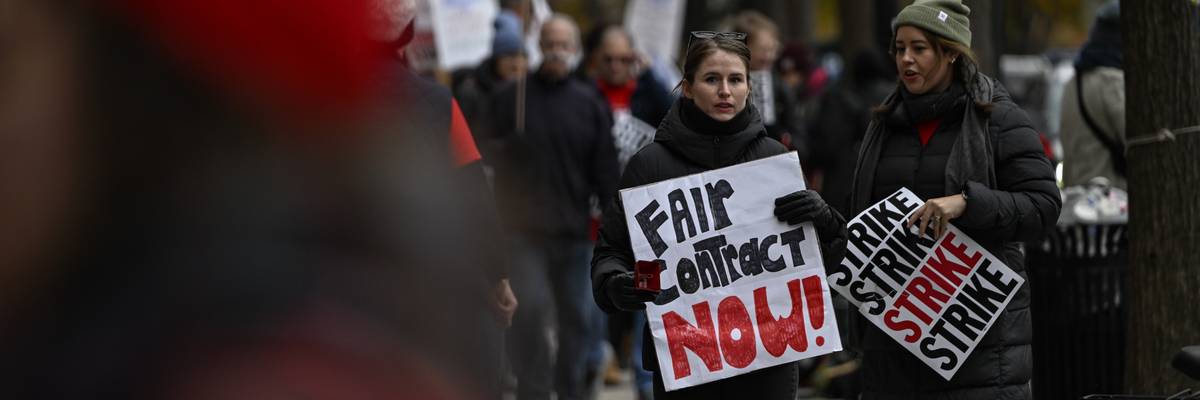
Hundreds of Washington Post employees hold a historic 24-hour strike on December 7, 2023 as they seek to ramp up pressure on management amid long-stalled contract negotiations and threatened layoffs in Washington D.C.
"Though The Post spent the past few weeks insisting they had no further movement for us, our members' tireless organizing... forced company leaders back to the table today," said the Washington Post Guild.
A mobilization by unionized Washington Post staffers that included a historic 24-hour strike helped push the newspaper to offer what the union described as "the best contract [it] has won in half a century" on Friday as it announced a tentative agreement with management.
The Washington Post Guild, which represents about 1,000 editorial, advertising, and non-newsroom workers, celebrated the breakthrough after 18 months of tumultuous negotiations, which pushed the union to hold a one-day work stoppage earlier this month.
Management had "refused to bargain in good faith and repeatedly—and illegally—shut down negotiations over key issues," the Post Guild said at the time, but executives were forced to reopen talks on Friday after an outpouring of support for staffers from the public and another action this week by staffers who plastered the newsroom's walls with readers' demands for a "fair deal."
"Though The Post spent the past few weeks insisting they had no further movement for us, our members' tireless organizing, and the public's outpouring of support, forced company leaders back to the table today," said the Post Guild.
The tentative deal reached on Friday includes an immediate $30 per week raise for all union employees, to be combined with a 2.5% raise that will go into effect in April and two 2% raises in 2025 and 2026. The salary floods for the lowest-paid union members will be nearly doubled by the three-year contract, according to the union.
The Post—which is owned by Amazon founder Jeff Bezos, currently the third-richest person in the world with a net worth of $175.9 billion—will also be required under the contract to give members a 60-day notice if management changes the current hybrid work schedule, and anyone who has taken the newspaper's recent buyout offer will receive a $500 bonus.
"The historic wins in this tentative agreement came as a result of relentless advocacy from hundreds of Guild members, who fought hard for contract guarantees that reflect our values: fair pay, a safer and more equitable workplace, and fundamental job protections for all," said the union. "We look forward to putting this historic deal to a vote. Thank you to all who helped us get here. Solidarity forever."
As it had prepared for its 24-hour strike on Dec. 7, the Guild decried layoffs of nearly 40 people in 2023 as well as offers for "voluntary buyouts" for 240 other staffers.
The Post is still aiming to shrink its workforce by about 10% by offering more buyouts.
The bargaining committee representing staffers said the new contract "will position our union to continue making The Post a better workplace in the next three years and beyond."
"Though it does not include everything we hoped to achieve, the bargaining committee supports ratifying this agreement," said the union.
Dear Common Dreams reader, It’s been nearly 30 years since I co-founded Common Dreams with my late wife, Lina Newhouser. We had the radical notion that journalism should serve the public good, not corporate profits. It was clear to us from the outset what it would take to build such a project. No paid advertisements. No corporate sponsors. No millionaire publisher telling us what to think or do. Many people said we wouldn't last a year, but we proved those doubters wrong. Together with a tremendous team of journalists and dedicated staff, we built an independent media outlet free from the constraints of profits and corporate control. Our mission has always been simple: To inform. To inspire. To ignite change for the common good. Building Common Dreams was not easy. Our survival was never guaranteed. When you take on the most powerful forces—Wall Street greed, fossil fuel industry destruction, Big Tech lobbyists, and uber-rich oligarchs who have spent billions upon billions rigging the economy and democracy in their favor—the only bulwark you have is supporters who believe in your work. But here’s the urgent message from me today. It's never been this bad out there. And it's never been this hard to keep us going. At the very moment Common Dreams is most needed, the threats we face are intensifying. We need your support now more than ever. We don't accept corporate advertising and never will. We don't have a paywall because we don't think people should be blocked from critical news based on their ability to pay. Everything we do is funded by the donations of readers like you. When everyone does the little they can afford, we are strong. But if that support retreats or dries up, so do we. Will you donate now to make sure Common Dreams not only survives but thrives? —Craig Brown, Co-founder |
A mobilization by unionized Washington Post staffers that included a historic 24-hour strike helped push the newspaper to offer what the union described as "the best contract [it] has won in half a century" on Friday as it announced a tentative agreement with management.
The Washington Post Guild, which represents about 1,000 editorial, advertising, and non-newsroom workers, celebrated the breakthrough after 18 months of tumultuous negotiations, which pushed the union to hold a one-day work stoppage earlier this month.
Management had "refused to bargain in good faith and repeatedly—and illegally—shut down negotiations over key issues," the Post Guild said at the time, but executives were forced to reopen talks on Friday after an outpouring of support for staffers from the public and another action this week by staffers who plastered the newsroom's walls with readers' demands for a "fair deal."
"Though The Post spent the past few weeks insisting they had no further movement for us, our members' tireless organizing, and the public's outpouring of support, forced company leaders back to the table today," said the Post Guild.
The tentative deal reached on Friday includes an immediate $30 per week raise for all union employees, to be combined with a 2.5% raise that will go into effect in April and two 2% raises in 2025 and 2026. The salary floods for the lowest-paid union members will be nearly doubled by the three-year contract, according to the union.
The Post—which is owned by Amazon founder Jeff Bezos, currently the third-richest person in the world with a net worth of $175.9 billion—will also be required under the contract to give members a 60-day notice if management changes the current hybrid work schedule, and anyone who has taken the newspaper's recent buyout offer will receive a $500 bonus.
"The historic wins in this tentative agreement came as a result of relentless advocacy from hundreds of Guild members, who fought hard for contract guarantees that reflect our values: fair pay, a safer and more equitable workplace, and fundamental job protections for all," said the union. "We look forward to putting this historic deal to a vote. Thank you to all who helped us get here. Solidarity forever."
As it had prepared for its 24-hour strike on Dec. 7, the Guild decried layoffs of nearly 40 people in 2023 as well as offers for "voluntary buyouts" for 240 other staffers.
The Post is still aiming to shrink its workforce by about 10% by offering more buyouts.
The bargaining committee representing staffers said the new contract "will position our union to continue making The Post a better workplace in the next three years and beyond."
"Though it does not include everything we hoped to achieve, the bargaining committee supports ratifying this agreement," said the union.
A mobilization by unionized Washington Post staffers that included a historic 24-hour strike helped push the newspaper to offer what the union described as "the best contract [it] has won in half a century" on Friday as it announced a tentative agreement with management.
The Washington Post Guild, which represents about 1,000 editorial, advertising, and non-newsroom workers, celebrated the breakthrough after 18 months of tumultuous negotiations, which pushed the union to hold a one-day work stoppage earlier this month.
Management had "refused to bargain in good faith and repeatedly—and illegally—shut down negotiations over key issues," the Post Guild said at the time, but executives were forced to reopen talks on Friday after an outpouring of support for staffers from the public and another action this week by staffers who plastered the newsroom's walls with readers' demands for a "fair deal."
"Though The Post spent the past few weeks insisting they had no further movement for us, our members' tireless organizing, and the public's outpouring of support, forced company leaders back to the table today," said the Post Guild.
The tentative deal reached on Friday includes an immediate $30 per week raise for all union employees, to be combined with a 2.5% raise that will go into effect in April and two 2% raises in 2025 and 2026. The salary floods for the lowest-paid union members will be nearly doubled by the three-year contract, according to the union.
The Post—which is owned by Amazon founder Jeff Bezos, currently the third-richest person in the world with a net worth of $175.9 billion—will also be required under the contract to give members a 60-day notice if management changes the current hybrid work schedule, and anyone who has taken the newspaper's recent buyout offer will receive a $500 bonus.
"The historic wins in this tentative agreement came as a result of relentless advocacy from hundreds of Guild members, who fought hard for contract guarantees that reflect our values: fair pay, a safer and more equitable workplace, and fundamental job protections for all," said the union. "We look forward to putting this historic deal to a vote. Thank you to all who helped us get here. Solidarity forever."
As it had prepared for its 24-hour strike on Dec. 7, the Guild decried layoffs of nearly 40 people in 2023 as well as offers for "voluntary buyouts" for 240 other staffers.
The Post is still aiming to shrink its workforce by about 10% by offering more buyouts.
The bargaining committee representing staffers said the new contract "will position our union to continue making The Post a better workplace in the next three years and beyond."
"Though it does not include everything we hoped to achieve, the bargaining committee supports ratifying this agreement," said the union.