SUBSCRIBE TO OUR FREE NEWSLETTER
Daily news & progressive opinion—funded by the people, not the corporations—delivered straight to your inbox.
5
#000000
#FFFFFF
To donate by check, phone, or other method, see our More Ways to Give page.
Daily news & progressive opinion—funded by the people, not the corporations—delivered straight to your inbox.
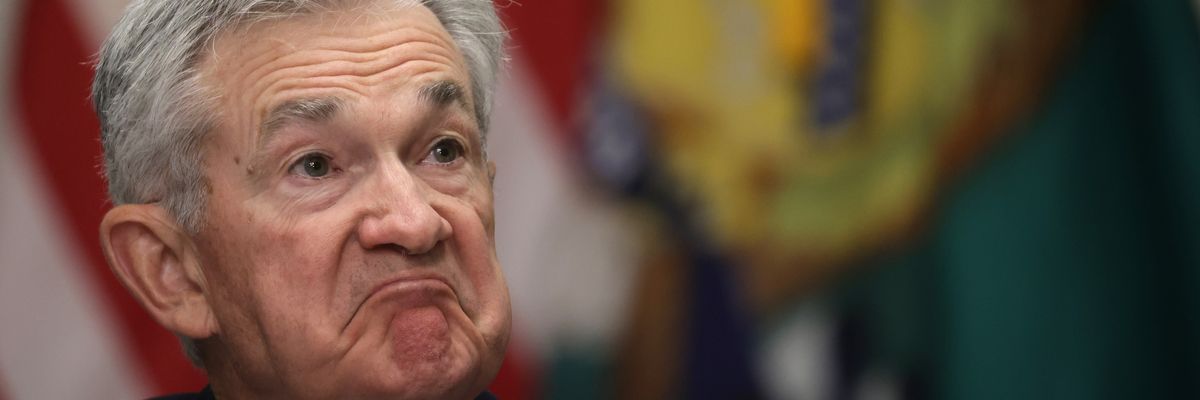
Fed Chair Jerome Powell listens during an open session of a Financial Stability Oversight Council meeting on April 21, 2023 in Washington, D.C.
"We strongly urge you to respect the Fed's dual mandate, pause your rate hikes, and avoid engineering a recession that destroys jobs and crushes small businesses."
Ten lawmakers including progressive Sens. Elizabeth Warren and Bernie Sanders implored the Federal Reserve to impose a pause on interest rate hikes during its Wednesday meeting, warning that further financial tightening in the name of fighting inflation would risk a brutal, job-killing recession.
In a letter to Fed Chair Jerome Powell earlier this week, the members of Congress expressed deep concern that "the Fed risks throwing millions of Americans out of work in its drive to raise interest rates even higher—even as Fed staff have already projected a recession this year amid financial market headwinds and even as you have acknowledged that inflation can slow without destroying the labor market, that the most significant drivers of inflation are not demand-based, and that the economy has not yet experienced the full impact of its earlier rate increases."
"We strongly urge you to respect the Fed's dual mandate, pause your rate hikes, and avoid engineering a recession that destroys jobs and crushes small businesses," they wrote.
The letter was sent amid further evidence that the Fed's aggressive interest rate increases—which are aimed at curbing economic demand by making borrowing more expensive—are taking their toll on the economy, with wage and job growth slowing and layoffs increasing. Recent turmoil in the banking industry, including the failure of several mid-sized banks, has also been tied to the Fed's nine consecutive rate hikes.
On top of worsening economic conditions at home and abroad, the lawmakers wrote in their letter to Powell that "it is even more difficult to justify such aggressive rate hikes at the moment given that inflation over the past six months has already declined significantly, averaging just 3.6% at an annualized rate, compared to 6.4% for the previous six months."
"While the Fed should remain flexible to incoming data as it assesses the economy's progress toward achieving lower inflation, the evidence to date suggests that progress can continue to be made without slamming the brakes on the economy and costing millions of Americans their jobs," the lawmakers continued. "Your recent comments, however, suggest that you remain committed to the idea that millions of workers must lose their jobs in order to bring inflation to heel."
The letter cites Powell's claim during a recent press conference that the economy can't "have a sustainable return to 2% inflation"—the Fed's arbitrary target—"without a better balance in the labor market," Fed-speak for more layoffs.
"Continuing to raise interest rates would be an abandonment of the Fed's dual mandate to achieve both maximum employment and price stability."
Powell has suggested that the Fed can prevent unemployment from rising to disastrous levels, but experts have warned that it is difficult to prevent mass layoffs from spreading once they begin.
The members of Congress echoed that fear in their letter to Powell, writing that "history casts doubt on the Fed's ability to engineer an unemployment rate that just 'rise[s] a bit.'"
"Since World War II, the unemployment rate has never increased by one percentage point within a year outside of a recession: the unemployment rate has increased by one percentage point 12 times since 1945, and in all 12 times that increase has been in the context of a recession," they noted. "And every time the unemployment rate increased by a full percentage point, it continued to increase far beyond that level. The Fed's projections that unemployment will essentially stay level in 2024 after pushing the economy into a recession in 2023, warns an economist concerned with maintaining full employment, 'amounts to a convenient delusion.'"
Warren (D-Mass.), Sanders (I-Vt.), Rep. Pramila Jayapal (D-Wash.), Rep. Brendan Boyle (D-Pa.), and the other letter signatories argued that rate hikes are not the solution to inflationary pressures caused by many factors beyond excessive economic demand—including supply chain shocks and corporate profiteering.
"Continuing to raise interest rates," they wrote, "would be an abandonment of the Fed's dual mandate to achieve both maximum employment and price stability and show little regard for the small businesses and working families that will get caught in the wreckage."
Despite such urgent warnings, the Fed is widely expected to raise interest rates by 25 basis points on Wednesday.
"At the end of its two-day gathering," the Financial Times reported Tuesday, "the Federal Open Market Committee is expected to raise its benchmark policy rate to a new target range of 5-5.25%, the highest level since mid-2007."
Fed-induced economic fears have been compounded by House Republicans' refusal to lift the debt ceiling, obstruction that is pushing the U.S. and global economies to the brink of a devastating crisis.
Rakeen Mabud, chief economist of the Groundwork Collaborative, said Tuesday that "Chair Powell and the Fed have made it clear that high interest rates are here to stay, even if it means trampling on one of the strongest labor markets in history."
"The Fed's actions are heightening the risk of a painful recession and causing instability in financial markets," said Mabud. "If the Fed insists on raising rates again this week, it is jeopardizing the progress we have made towards building a healthier and more inclusive economy for all."
Dear Common Dreams reader, It’s been nearly 30 years since I co-founded Common Dreams with my late wife, Lina Newhouser. We had the radical notion that journalism should serve the public good, not corporate profits. It was clear to us from the outset what it would take to build such a project. No paid advertisements. No corporate sponsors. No millionaire publisher telling us what to think or do. Many people said we wouldn't last a year, but we proved those doubters wrong. Together with a tremendous team of journalists and dedicated staff, we built an independent media outlet free from the constraints of profits and corporate control. Our mission has always been simple: To inform. To inspire. To ignite change for the common good. Building Common Dreams was not easy. Our survival was never guaranteed. When you take on the most powerful forces—Wall Street greed, fossil fuel industry destruction, Big Tech lobbyists, and uber-rich oligarchs who have spent billions upon billions rigging the economy and democracy in their favor—the only bulwark you have is supporters who believe in your work. But here’s the urgent message from me today. It's never been this bad out there. And it's never been this hard to keep us going. At the very moment Common Dreams is most needed, the threats we face are intensifying. We need your support now more than ever. We don't accept corporate advertising and never will. We don't have a paywall because we don't think people should be blocked from critical news based on their ability to pay. Everything we do is funded by the donations of readers like you. When everyone does the little they can afford, we are strong. But if that support retreats or dries up, so do we. Will you donate now to make sure Common Dreams not only survives but thrives? —Craig Brown, Co-founder |
Ten lawmakers including progressive Sens. Elizabeth Warren and Bernie Sanders implored the Federal Reserve to impose a pause on interest rate hikes during its Wednesday meeting, warning that further financial tightening in the name of fighting inflation would risk a brutal, job-killing recession.
In a letter to Fed Chair Jerome Powell earlier this week, the members of Congress expressed deep concern that "the Fed risks throwing millions of Americans out of work in its drive to raise interest rates even higher—even as Fed staff have already projected a recession this year amid financial market headwinds and even as you have acknowledged that inflation can slow without destroying the labor market, that the most significant drivers of inflation are not demand-based, and that the economy has not yet experienced the full impact of its earlier rate increases."
"We strongly urge you to respect the Fed's dual mandate, pause your rate hikes, and avoid engineering a recession that destroys jobs and crushes small businesses," they wrote.
The letter was sent amid further evidence that the Fed's aggressive interest rate increases—which are aimed at curbing economic demand by making borrowing more expensive—are taking their toll on the economy, with wage and job growth slowing and layoffs increasing. Recent turmoil in the banking industry, including the failure of several mid-sized banks, has also been tied to the Fed's nine consecutive rate hikes.
On top of worsening economic conditions at home and abroad, the lawmakers wrote in their letter to Powell that "it is even more difficult to justify such aggressive rate hikes at the moment given that inflation over the past six months has already declined significantly, averaging just 3.6% at an annualized rate, compared to 6.4% for the previous six months."
"While the Fed should remain flexible to incoming data as it assesses the economy's progress toward achieving lower inflation, the evidence to date suggests that progress can continue to be made without slamming the brakes on the economy and costing millions of Americans their jobs," the lawmakers continued. "Your recent comments, however, suggest that you remain committed to the idea that millions of workers must lose their jobs in order to bring inflation to heel."
The letter cites Powell's claim during a recent press conference that the economy can't "have a sustainable return to 2% inflation"—the Fed's arbitrary target—"without a better balance in the labor market," Fed-speak for more layoffs.
"Continuing to raise interest rates would be an abandonment of the Fed's dual mandate to achieve both maximum employment and price stability."
Powell has suggested that the Fed can prevent unemployment from rising to disastrous levels, but experts have warned that it is difficult to prevent mass layoffs from spreading once they begin.
The members of Congress echoed that fear in their letter to Powell, writing that "history casts doubt on the Fed's ability to engineer an unemployment rate that just 'rise[s] a bit.'"
"Since World War II, the unemployment rate has never increased by one percentage point within a year outside of a recession: the unemployment rate has increased by one percentage point 12 times since 1945, and in all 12 times that increase has been in the context of a recession," they noted. "And every time the unemployment rate increased by a full percentage point, it continued to increase far beyond that level. The Fed's projections that unemployment will essentially stay level in 2024 after pushing the economy into a recession in 2023, warns an economist concerned with maintaining full employment, 'amounts to a convenient delusion.'"
Warren (D-Mass.), Sanders (I-Vt.), Rep. Pramila Jayapal (D-Wash.), Rep. Brendan Boyle (D-Pa.), and the other letter signatories argued that rate hikes are not the solution to inflationary pressures caused by many factors beyond excessive economic demand—including supply chain shocks and corporate profiteering.
"Continuing to raise interest rates," they wrote, "would be an abandonment of the Fed's dual mandate to achieve both maximum employment and price stability and show little regard for the small businesses and working families that will get caught in the wreckage."
Despite such urgent warnings, the Fed is widely expected to raise interest rates by 25 basis points on Wednesday.
"At the end of its two-day gathering," the Financial Times reported Tuesday, "the Federal Open Market Committee is expected to raise its benchmark policy rate to a new target range of 5-5.25%, the highest level since mid-2007."
Fed-induced economic fears have been compounded by House Republicans' refusal to lift the debt ceiling, obstruction that is pushing the U.S. and global economies to the brink of a devastating crisis.
Rakeen Mabud, chief economist of the Groundwork Collaborative, said Tuesday that "Chair Powell and the Fed have made it clear that high interest rates are here to stay, even if it means trampling on one of the strongest labor markets in history."
"The Fed's actions are heightening the risk of a painful recession and causing instability in financial markets," said Mabud. "If the Fed insists on raising rates again this week, it is jeopardizing the progress we have made towards building a healthier and more inclusive economy for all."
Ten lawmakers including progressive Sens. Elizabeth Warren and Bernie Sanders implored the Federal Reserve to impose a pause on interest rate hikes during its Wednesday meeting, warning that further financial tightening in the name of fighting inflation would risk a brutal, job-killing recession.
In a letter to Fed Chair Jerome Powell earlier this week, the members of Congress expressed deep concern that "the Fed risks throwing millions of Americans out of work in its drive to raise interest rates even higher—even as Fed staff have already projected a recession this year amid financial market headwinds and even as you have acknowledged that inflation can slow without destroying the labor market, that the most significant drivers of inflation are not demand-based, and that the economy has not yet experienced the full impact of its earlier rate increases."
"We strongly urge you to respect the Fed's dual mandate, pause your rate hikes, and avoid engineering a recession that destroys jobs and crushes small businesses," they wrote.
The letter was sent amid further evidence that the Fed's aggressive interest rate increases—which are aimed at curbing economic demand by making borrowing more expensive—are taking their toll on the economy, with wage and job growth slowing and layoffs increasing. Recent turmoil in the banking industry, including the failure of several mid-sized banks, has also been tied to the Fed's nine consecutive rate hikes.
On top of worsening economic conditions at home and abroad, the lawmakers wrote in their letter to Powell that "it is even more difficult to justify such aggressive rate hikes at the moment given that inflation over the past six months has already declined significantly, averaging just 3.6% at an annualized rate, compared to 6.4% for the previous six months."
"While the Fed should remain flexible to incoming data as it assesses the economy's progress toward achieving lower inflation, the evidence to date suggests that progress can continue to be made without slamming the brakes on the economy and costing millions of Americans their jobs," the lawmakers continued. "Your recent comments, however, suggest that you remain committed to the idea that millions of workers must lose their jobs in order to bring inflation to heel."
The letter cites Powell's claim during a recent press conference that the economy can't "have a sustainable return to 2% inflation"—the Fed's arbitrary target—"without a better balance in the labor market," Fed-speak for more layoffs.
"Continuing to raise interest rates would be an abandonment of the Fed's dual mandate to achieve both maximum employment and price stability."
Powell has suggested that the Fed can prevent unemployment from rising to disastrous levels, but experts have warned that it is difficult to prevent mass layoffs from spreading once they begin.
The members of Congress echoed that fear in their letter to Powell, writing that "history casts doubt on the Fed's ability to engineer an unemployment rate that just 'rise[s] a bit.'"
"Since World War II, the unemployment rate has never increased by one percentage point within a year outside of a recession: the unemployment rate has increased by one percentage point 12 times since 1945, and in all 12 times that increase has been in the context of a recession," they noted. "And every time the unemployment rate increased by a full percentage point, it continued to increase far beyond that level. The Fed's projections that unemployment will essentially stay level in 2024 after pushing the economy into a recession in 2023, warns an economist concerned with maintaining full employment, 'amounts to a convenient delusion.'"
Warren (D-Mass.), Sanders (I-Vt.), Rep. Pramila Jayapal (D-Wash.), Rep. Brendan Boyle (D-Pa.), and the other letter signatories argued that rate hikes are not the solution to inflationary pressures caused by many factors beyond excessive economic demand—including supply chain shocks and corporate profiteering.
"Continuing to raise interest rates," they wrote, "would be an abandonment of the Fed's dual mandate to achieve both maximum employment and price stability and show little regard for the small businesses and working families that will get caught in the wreckage."
Despite such urgent warnings, the Fed is widely expected to raise interest rates by 25 basis points on Wednesday.
"At the end of its two-day gathering," the Financial Times reported Tuesday, "the Federal Open Market Committee is expected to raise its benchmark policy rate to a new target range of 5-5.25%, the highest level since mid-2007."
Fed-induced economic fears have been compounded by House Republicans' refusal to lift the debt ceiling, obstruction that is pushing the U.S. and global economies to the brink of a devastating crisis.
Rakeen Mabud, chief economist of the Groundwork Collaborative, said Tuesday that "Chair Powell and the Fed have made it clear that high interest rates are here to stay, even if it means trampling on one of the strongest labor markets in history."
"The Fed's actions are heightening the risk of a painful recession and causing instability in financial markets," said Mabud. "If the Fed insists on raising rates again this week, it is jeopardizing the progress we have made towards building a healthier and more inclusive economy for all."