SUBSCRIBE TO OUR FREE NEWSLETTER
Daily news & progressive opinion—funded by the people, not the corporations—delivered straight to your inbox.
5
#000000
#FFFFFF
To donate by check, phone, or other method, see our More Ways to Give page.
Daily news & progressive opinion—funded by the people, not the corporations—delivered straight to your inbox.
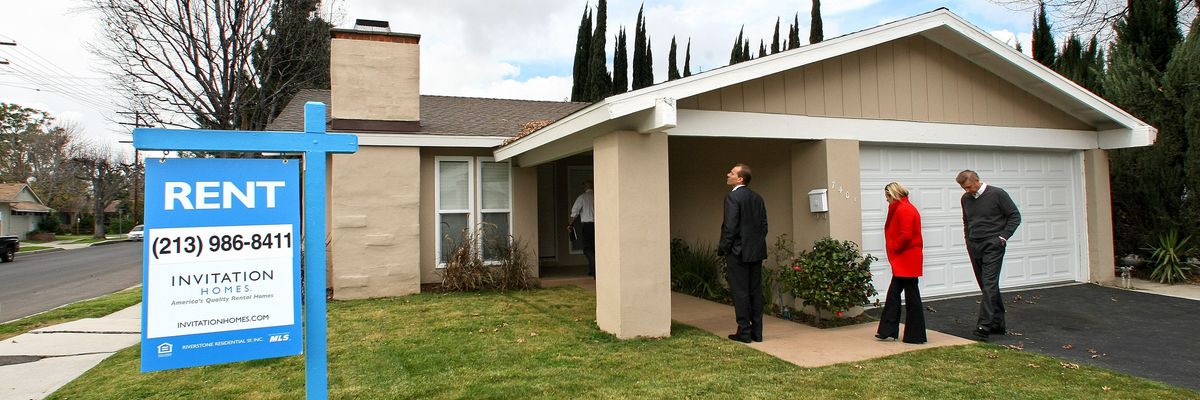
Executives of Invitation Homes, a subsidiary of the hedge fund Blackstone, tour a home the company bought and turned into a rental property in Los Angeles on February 8, 2013.
"Billionaires see housing as a way to boost their bottom line, instead of a necessity to survive."
A new report out Monday puts "into numbers the trend that ordinary Americans have known to be true for years," said economic justice advocates behind the analysis: "Their everyday struggles of affording a home are made worse by the sweeping influence that billionaires have over the market."
The Institute for Policy Studies (IPS) joined Popular Democracy in compiling a 71-page report titled Billionaire Blowback on Housing, aiming to get to the bottom of growing concerns in recent years about how Wall Street, as Democratic vice presidential nominee and Minnesota Gov. Tim Walz said earlier this month, is "buying up housing and making them less affordable."
The two groups found that a small number of wealthy individuals and their investment arms, who control "huge pools of wealth," have spent some of their vast resources on "predatory investment and wealth-parking in luxury housing"—contributing significantly to the crises of unaffordable rents, out-of-reach homeownership, and homelessness.
Billionaires are "supercharging existing problems" in the housing market, according to the report.
The authors take issue with assumptions about what is driving the housing crisis, which is characterized by record-breaking homelessness in 2023 with more than 653,000 people unhoused; half of tenants paying more than 30% of their income on rent, making them cost-burdened; and a significantly widened gap between the income needed to buy a house and the actual cost of a home.
"The real estate industry would like you to believe the problem is entirely one based on supply and demand," and that regulations need to be changed to allow for the construction of more affordable housing, reads the report. But with 16 million vacant homes across the U.S.—28 for every unhoused person—"the reality is that the owners of concentrated wealth... are playing a more pronounced role in residential housing, thereby creating price inflation, distortions, and inefficiencies in the market."
Signifying the U.S. real estate market's "emerging status as global tax haven," the number of vacant units in some communities exceed the number of unhoused people partially because wealthy investors are acquiring property and intentionally leaving it vacant, found IPS and Popular Democracy.
"The reality is that the owners of concentrated wealth... are playing a more pronounced role in residential housing, thereby creating price inflation, distortions, and inefficiencies in the market."
For example, in 2017 there were more than 93,500 vacant units in Los Angeles and an estimated 36,000 unhoused residents, with vacancies treated as "a structural feature of the market thanks to the presence of a small class of wealthy investors who engage in speculative financial behavior."
Billionaires and their investment firms, such as Blackstone—now the world's largest corporate landlord—are also "taking advantage of the tight low-income rental market, lack of publicly funded affordable housing, displacement after the foreclosure crisis, and inaccessible homeownership to get into the business of single-family and multifamily home rentals, and buying up mobile home parks," the report reads.
In one section of North Minneapolis, private equity firms including Pretium Partners "snatched up blocks of single-family rental homes, added fees on top of rent, and then proceeded to neglect the maintenance and upkeep of their properties."
Blackstone now owns 300,000 residential units across the U.S. and nearly doubled its portfolio in 2021. With $1 trillion in assets, it owns 63,000 single-family homes, 149,000 apartment units, and 70 mobile home parks.
Corporate ownership of rental housing stock "has not translated into housing stability, particularly for working-class households and communities of color," reads the report. "Rather, corporate landlords have concentrated their predatory investment practices—flipping, rent gouging, habitability violations, and evictions—in lower-income communities of color."
The billionaire class and its private equity firms, said Chuck Collins, co-author of the report and director of the Program on Inequality and the Common Good at IPS, has "severely disrupted" the housing market.
"This is not your grandparent's gentrification—but a hyper-gentrification fueled by concentrated wealth driving up land and housing costs, expanding short-term rentals, and treating housing like a commodity to speculate on or a place to park wealth," said Collins. "The billionaires are displacing the millionaires, and the millionaires are disrupting the housing market for everyone else."
The report calls on policymakers to expand social housing—housing developed by the government or a not-for-profit entity to ensure individuals, households, and families are guaranteed housing as a human right, which cannot be sold for profit.
Social housing could be paid for by levying mansion taxes, regulating predatory practices in the real estate market, and taxing billionaires.
Local communities can also protect residents and generate revenue for affordable housing through actions including:
"Billionaires see housing as a way to boost their bottom line, instead of a necessity to survive. This current system doesn't serve our communities," said Analilia Mejia and DaMareo Cooper, co-executive directors for Popular Democracy. "We need to do better. That starts with re-shaping our systems to look out for the needs and desires of working families, instead of billionaire investment and speculation. We need to safeguard renters' rights, and drastically expand the availability of permanently and truly affordable quality housing."
Dear Common Dreams reader, It’s been nearly 30 years since I co-founded Common Dreams with my late wife, Lina Newhouser. We had the radical notion that journalism should serve the public good, not corporate profits. It was clear to us from the outset what it would take to build such a project. No paid advertisements. No corporate sponsors. No millionaire publisher telling us what to think or do. Many people said we wouldn't last a year, but we proved those doubters wrong. Together with a tremendous team of journalists and dedicated staff, we built an independent media outlet free from the constraints of profits and corporate control. Our mission has always been simple: To inform. To inspire. To ignite change for the common good. Building Common Dreams was not easy. Our survival was never guaranteed. When you take on the most powerful forces—Wall Street greed, fossil fuel industry destruction, Big Tech lobbyists, and uber-rich oligarchs who have spent billions upon billions rigging the economy and democracy in their favor—the only bulwark you have is supporters who believe in your work. But here’s the urgent message from me today. It's never been this bad out there. And it's never been this hard to keep us going. At the very moment Common Dreams is most needed, the threats we face are intensifying. We need your support now more than ever. We don't accept corporate advertising and never will. We don't have a paywall because we don't think people should be blocked from critical news based on their ability to pay. Everything we do is funded by the donations of readers like you. When everyone does the little they can afford, we are strong. But if that support retreats or dries up, so do we. Will you donate now to make sure Common Dreams not only survives but thrives? —Craig Brown, Co-founder |
A new report out Monday puts "into numbers the trend that ordinary Americans have known to be true for years," said economic justice advocates behind the analysis: "Their everyday struggles of affording a home are made worse by the sweeping influence that billionaires have over the market."
The Institute for Policy Studies (IPS) joined Popular Democracy in compiling a 71-page report titled Billionaire Blowback on Housing, aiming to get to the bottom of growing concerns in recent years about how Wall Street, as Democratic vice presidential nominee and Minnesota Gov. Tim Walz said earlier this month, is "buying up housing and making them less affordable."
The two groups found that a small number of wealthy individuals and their investment arms, who control "huge pools of wealth," have spent some of their vast resources on "predatory investment and wealth-parking in luxury housing"—contributing significantly to the crises of unaffordable rents, out-of-reach homeownership, and homelessness.
Billionaires are "supercharging existing problems" in the housing market, according to the report.
The authors take issue with assumptions about what is driving the housing crisis, which is characterized by record-breaking homelessness in 2023 with more than 653,000 people unhoused; half of tenants paying more than 30% of their income on rent, making them cost-burdened; and a significantly widened gap between the income needed to buy a house and the actual cost of a home.
"The real estate industry would like you to believe the problem is entirely one based on supply and demand," and that regulations need to be changed to allow for the construction of more affordable housing, reads the report. But with 16 million vacant homes across the U.S.—28 for every unhoused person—"the reality is that the owners of concentrated wealth... are playing a more pronounced role in residential housing, thereby creating price inflation, distortions, and inefficiencies in the market."
Signifying the U.S. real estate market's "emerging status as global tax haven," the number of vacant units in some communities exceed the number of unhoused people partially because wealthy investors are acquiring property and intentionally leaving it vacant, found IPS and Popular Democracy.
"The reality is that the owners of concentrated wealth... are playing a more pronounced role in residential housing, thereby creating price inflation, distortions, and inefficiencies in the market."
For example, in 2017 there were more than 93,500 vacant units in Los Angeles and an estimated 36,000 unhoused residents, with vacancies treated as "a structural feature of the market thanks to the presence of a small class of wealthy investors who engage in speculative financial behavior."
Billionaires and their investment firms, such as Blackstone—now the world's largest corporate landlord—are also "taking advantage of the tight low-income rental market, lack of publicly funded affordable housing, displacement after the foreclosure crisis, and inaccessible homeownership to get into the business of single-family and multifamily home rentals, and buying up mobile home parks," the report reads.
In one section of North Minneapolis, private equity firms including Pretium Partners "snatched up blocks of single-family rental homes, added fees on top of rent, and then proceeded to neglect the maintenance and upkeep of their properties."
Blackstone now owns 300,000 residential units across the U.S. and nearly doubled its portfolio in 2021. With $1 trillion in assets, it owns 63,000 single-family homes, 149,000 apartment units, and 70 mobile home parks.
Corporate ownership of rental housing stock "has not translated into housing stability, particularly for working-class households and communities of color," reads the report. "Rather, corporate landlords have concentrated their predatory investment practices—flipping, rent gouging, habitability violations, and evictions—in lower-income communities of color."
The billionaire class and its private equity firms, said Chuck Collins, co-author of the report and director of the Program on Inequality and the Common Good at IPS, has "severely disrupted" the housing market.
"This is not your grandparent's gentrification—but a hyper-gentrification fueled by concentrated wealth driving up land and housing costs, expanding short-term rentals, and treating housing like a commodity to speculate on or a place to park wealth," said Collins. "The billionaires are displacing the millionaires, and the millionaires are disrupting the housing market for everyone else."
The report calls on policymakers to expand social housing—housing developed by the government or a not-for-profit entity to ensure individuals, households, and families are guaranteed housing as a human right, which cannot be sold for profit.
Social housing could be paid for by levying mansion taxes, regulating predatory practices in the real estate market, and taxing billionaires.
Local communities can also protect residents and generate revenue for affordable housing through actions including:
"Billionaires see housing as a way to boost their bottom line, instead of a necessity to survive. This current system doesn't serve our communities," said Analilia Mejia and DaMareo Cooper, co-executive directors for Popular Democracy. "We need to do better. That starts with re-shaping our systems to look out for the needs and desires of working families, instead of billionaire investment and speculation. We need to safeguard renters' rights, and drastically expand the availability of permanently and truly affordable quality housing."
A new report out Monday puts "into numbers the trend that ordinary Americans have known to be true for years," said economic justice advocates behind the analysis: "Their everyday struggles of affording a home are made worse by the sweeping influence that billionaires have over the market."
The Institute for Policy Studies (IPS) joined Popular Democracy in compiling a 71-page report titled Billionaire Blowback on Housing, aiming to get to the bottom of growing concerns in recent years about how Wall Street, as Democratic vice presidential nominee and Minnesota Gov. Tim Walz said earlier this month, is "buying up housing and making them less affordable."
The two groups found that a small number of wealthy individuals and their investment arms, who control "huge pools of wealth," have spent some of their vast resources on "predatory investment and wealth-parking in luxury housing"—contributing significantly to the crises of unaffordable rents, out-of-reach homeownership, and homelessness.
Billionaires are "supercharging existing problems" in the housing market, according to the report.
The authors take issue with assumptions about what is driving the housing crisis, which is characterized by record-breaking homelessness in 2023 with more than 653,000 people unhoused; half of tenants paying more than 30% of their income on rent, making them cost-burdened; and a significantly widened gap between the income needed to buy a house and the actual cost of a home.
"The real estate industry would like you to believe the problem is entirely one based on supply and demand," and that regulations need to be changed to allow for the construction of more affordable housing, reads the report. But with 16 million vacant homes across the U.S.—28 for every unhoused person—"the reality is that the owners of concentrated wealth... are playing a more pronounced role in residential housing, thereby creating price inflation, distortions, and inefficiencies in the market."
Signifying the U.S. real estate market's "emerging status as global tax haven," the number of vacant units in some communities exceed the number of unhoused people partially because wealthy investors are acquiring property and intentionally leaving it vacant, found IPS and Popular Democracy.
"The reality is that the owners of concentrated wealth... are playing a more pronounced role in residential housing, thereby creating price inflation, distortions, and inefficiencies in the market."
For example, in 2017 there were more than 93,500 vacant units in Los Angeles and an estimated 36,000 unhoused residents, with vacancies treated as "a structural feature of the market thanks to the presence of a small class of wealthy investors who engage in speculative financial behavior."
Billionaires and their investment firms, such as Blackstone—now the world's largest corporate landlord—are also "taking advantage of the tight low-income rental market, lack of publicly funded affordable housing, displacement after the foreclosure crisis, and inaccessible homeownership to get into the business of single-family and multifamily home rentals, and buying up mobile home parks," the report reads.
In one section of North Minneapolis, private equity firms including Pretium Partners "snatched up blocks of single-family rental homes, added fees on top of rent, and then proceeded to neglect the maintenance and upkeep of their properties."
Blackstone now owns 300,000 residential units across the U.S. and nearly doubled its portfolio in 2021. With $1 trillion in assets, it owns 63,000 single-family homes, 149,000 apartment units, and 70 mobile home parks.
Corporate ownership of rental housing stock "has not translated into housing stability, particularly for working-class households and communities of color," reads the report. "Rather, corporate landlords have concentrated their predatory investment practices—flipping, rent gouging, habitability violations, and evictions—in lower-income communities of color."
The billionaire class and its private equity firms, said Chuck Collins, co-author of the report and director of the Program on Inequality and the Common Good at IPS, has "severely disrupted" the housing market.
"This is not your grandparent's gentrification—but a hyper-gentrification fueled by concentrated wealth driving up land and housing costs, expanding short-term rentals, and treating housing like a commodity to speculate on or a place to park wealth," said Collins. "The billionaires are displacing the millionaires, and the millionaires are disrupting the housing market for everyone else."
The report calls on policymakers to expand social housing—housing developed by the government or a not-for-profit entity to ensure individuals, households, and families are guaranteed housing as a human right, which cannot be sold for profit.
Social housing could be paid for by levying mansion taxes, regulating predatory practices in the real estate market, and taxing billionaires.
Local communities can also protect residents and generate revenue for affordable housing through actions including:
"Billionaires see housing as a way to boost their bottom line, instead of a necessity to survive. This current system doesn't serve our communities," said Analilia Mejia and DaMareo Cooper, co-executive directors for Popular Democracy. "We need to do better. That starts with re-shaping our systems to look out for the needs and desires of working families, instead of billionaire investment and speculation. We need to safeguard renters' rights, and drastically expand the availability of permanently and truly affordable quality housing."