SUBSCRIBE TO OUR FREE NEWSLETTER
Daily news & progressive opinion—funded by the people, not the corporations—delivered straight to your inbox.
5
#000000
#FFFFFF
To donate by check, phone, or other method, see our More Ways to Give page.
Daily news & progressive opinion—funded by the people, not the corporations—delivered straight to your inbox.
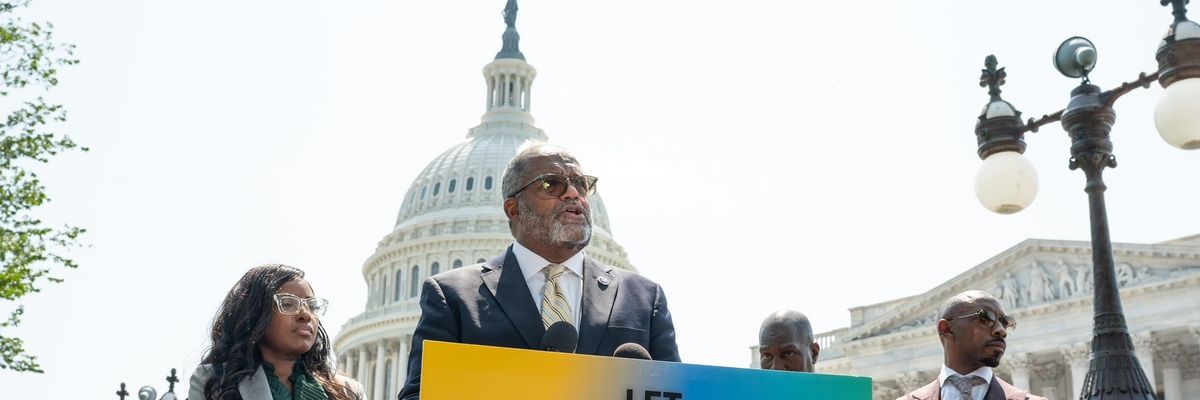
U.S. Rep. Troy Carter (D-La.) speaks at the a press conference about the Democracy Restoration Act on July 27, 2023.
"After 50 years of mass incarceration in America—and 50 years of stripping voting rights from justice-impacted individuals—it's time for a better path forward," said one advocate.
Voting rights and criminal justice reform advocates on Thursday applauded U.S. House Democrats for reintroducing legislation to end the disenfranchisement of 3.5 million people who are barred from voting in federal elections due to their past prison sentences—part of what Rep. Valerie Foushee, a co-sponsor of the bill, called the country's "long history of weaponizing incarceration status."
Foushee (D-N.C.) was one of six Democrats to introduce the Democracy Restoration Act, led by Rep. Jasmine Crockett (D-Texas.).
The bill would end the denial of federal voting rights to people who have been incarcerated for felony convictions and would provide outreach to people with past convictions about their newly restored right to participate in elections, eliminating what the Sentencing Project called "the complicated patchwork of state laws that creates a lack of uniform standards for voting in federal elections, exacerbates racial disparities in access to the ballot box, and contributes to confusion and misinformation regarding voting rights."
Twenty-four states plus the District of Columbia and Puerto Rico currently allow formerly incarcerated people to vote in state and local elections, but they cannot participate in federal elections. People on felony probation or parole cannot vote in 25 states, and in 11 states a conviction can lead to lifetime disenfranchisement.
"There's no justification for denying people who have paid their dues a voice in our democracy," said co-sponsor Rep. Troy Carter (D-La.), who spoke at a press conference on the bill on Thursday.
Reps. Jamie Raskin (D-Md.), Maxwell Frost (D-Fla.), and Greg Casar (D-Texas) are also co-sponsors of the House bill, while Sen. Ben Cardin (D-Md.) introduced the legislation in the Senate in May.
"It's in our values to say that a second chance is part of America," said Cardin at the press conference.
Recent polling from Stand Up America, the Sentencing Project, and other groups has shown that a majority of Americans believe the right to vote should be extended to all Americans regardless of past incarceration—a move that Nicole D. Porter of the Sentencing Project noted would end the United States' status as "an international outlier."
"After 50 years of mass incarceration in America—and 50 years of stripping voting rights from justice-impacted individuals—it's time for a better path forward," said Porter, senior director of advocacy for the group. "By empowering justice-impacted people with the right to vote, we strengthen the principles of fairness and equality in our democracy. That's why The Sentencing Project will continue to support legislative efforts that protect and expand the right to vote for all people impacted by the criminal legal system, including those currently in prison."
A policy brief by the Sentencing Project earlier this year explained how enfranchising formerly incarcerated people is a public safety measure, helping to reduce recidivism, as well as a way to advance criminal justice reform.
"Voting is among a range of prosocial behaviors in which justice-impacted persons can partake, like getting a college education, that is associated with reduced criminal conduct," the April report read. "Among Americans with a history of criminal legal system involvement, having the right to vote or the act of voting is related to reduced recidivism. The re-entry process after incarceration improves because restoring voting rights gives citizens the sense that their voice can be heard in the political process, and contributes to building an individual's positive identity as a community member."
Stand Up America founder and president Sean Eldridge said the bill is a step away from "a racist relic of the Jim Crow era."
"By introducing legislation to restore voting rights, Democrats in Congress are taking an important step toward acknowledging the injustice of these laws and building momentum to rectify them," said Eldridge. "Americans returning to their communities should have a say in who represents them in government and the policies that affect their lives—from the quality of their kids' education to access to parks and clean water—just like everyone else."
Dear Common Dreams reader, It’s been nearly 30 years since I co-founded Common Dreams with my late wife, Lina Newhouser. We had the radical notion that journalism should serve the public good, not corporate profits. It was clear to us from the outset what it would take to build such a project. No paid advertisements. No corporate sponsors. No millionaire publisher telling us what to think or do. Many people said we wouldn't last a year, but we proved those doubters wrong. Together with a tremendous team of journalists and dedicated staff, we built an independent media outlet free from the constraints of profits and corporate control. Our mission has always been simple: To inform. To inspire. To ignite change for the common good. Building Common Dreams was not easy. Our survival was never guaranteed. When you take on the most powerful forces—Wall Street greed, fossil fuel industry destruction, Big Tech lobbyists, and uber-rich oligarchs who have spent billions upon billions rigging the economy and democracy in their favor—the only bulwark you have is supporters who believe in your work. But here’s the urgent message from me today. It's never been this bad out there. And it's never been this hard to keep us going. At the very moment Common Dreams is most needed, the threats we face are intensifying. We need your support now more than ever. We don't accept corporate advertising and never will. We don't have a paywall because we don't think people should be blocked from critical news based on their ability to pay. Everything we do is funded by the donations of readers like you. When everyone does the little they can afford, we are strong. But if that support retreats or dries up, so do we. Will you donate now to make sure Common Dreams not only survives but thrives? —Craig Brown, Co-founder |
Voting rights and criminal justice reform advocates on Thursday applauded U.S. House Democrats for reintroducing legislation to end the disenfranchisement of 3.5 million people who are barred from voting in federal elections due to their past prison sentences—part of what Rep. Valerie Foushee, a co-sponsor of the bill, called the country's "long history of weaponizing incarceration status."
Foushee (D-N.C.) was one of six Democrats to introduce the Democracy Restoration Act, led by Rep. Jasmine Crockett (D-Texas.).
The bill would end the denial of federal voting rights to people who have been incarcerated for felony convictions and would provide outreach to people with past convictions about their newly restored right to participate in elections, eliminating what the Sentencing Project called "the complicated patchwork of state laws that creates a lack of uniform standards for voting in federal elections, exacerbates racial disparities in access to the ballot box, and contributes to confusion and misinformation regarding voting rights."
Twenty-four states plus the District of Columbia and Puerto Rico currently allow formerly incarcerated people to vote in state and local elections, but they cannot participate in federal elections. People on felony probation or parole cannot vote in 25 states, and in 11 states a conviction can lead to lifetime disenfranchisement.
"There's no justification for denying people who have paid their dues a voice in our democracy," said co-sponsor Rep. Troy Carter (D-La.), who spoke at a press conference on the bill on Thursday.
Reps. Jamie Raskin (D-Md.), Maxwell Frost (D-Fla.), and Greg Casar (D-Texas) are also co-sponsors of the House bill, while Sen. Ben Cardin (D-Md.) introduced the legislation in the Senate in May.
"It's in our values to say that a second chance is part of America," said Cardin at the press conference.
Recent polling from Stand Up America, the Sentencing Project, and other groups has shown that a majority of Americans believe the right to vote should be extended to all Americans regardless of past incarceration—a move that Nicole D. Porter of the Sentencing Project noted would end the United States' status as "an international outlier."
"After 50 years of mass incarceration in America—and 50 years of stripping voting rights from justice-impacted individuals—it's time for a better path forward," said Porter, senior director of advocacy for the group. "By empowering justice-impacted people with the right to vote, we strengthen the principles of fairness and equality in our democracy. That's why The Sentencing Project will continue to support legislative efforts that protect and expand the right to vote for all people impacted by the criminal legal system, including those currently in prison."
A policy brief by the Sentencing Project earlier this year explained how enfranchising formerly incarcerated people is a public safety measure, helping to reduce recidivism, as well as a way to advance criminal justice reform.
"Voting is among a range of prosocial behaviors in which justice-impacted persons can partake, like getting a college education, that is associated with reduced criminal conduct," the April report read. "Among Americans with a history of criminal legal system involvement, having the right to vote or the act of voting is related to reduced recidivism. The re-entry process after incarceration improves because restoring voting rights gives citizens the sense that their voice can be heard in the political process, and contributes to building an individual's positive identity as a community member."
Stand Up America founder and president Sean Eldridge said the bill is a step away from "a racist relic of the Jim Crow era."
"By introducing legislation to restore voting rights, Democrats in Congress are taking an important step toward acknowledging the injustice of these laws and building momentum to rectify them," said Eldridge. "Americans returning to their communities should have a say in who represents them in government and the policies that affect their lives—from the quality of their kids' education to access to parks and clean water—just like everyone else."
Voting rights and criminal justice reform advocates on Thursday applauded U.S. House Democrats for reintroducing legislation to end the disenfranchisement of 3.5 million people who are barred from voting in federal elections due to their past prison sentences—part of what Rep. Valerie Foushee, a co-sponsor of the bill, called the country's "long history of weaponizing incarceration status."
Foushee (D-N.C.) was one of six Democrats to introduce the Democracy Restoration Act, led by Rep. Jasmine Crockett (D-Texas.).
The bill would end the denial of federal voting rights to people who have been incarcerated for felony convictions and would provide outreach to people with past convictions about their newly restored right to participate in elections, eliminating what the Sentencing Project called "the complicated patchwork of state laws that creates a lack of uniform standards for voting in federal elections, exacerbates racial disparities in access to the ballot box, and contributes to confusion and misinformation regarding voting rights."
Twenty-four states plus the District of Columbia and Puerto Rico currently allow formerly incarcerated people to vote in state and local elections, but they cannot participate in federal elections. People on felony probation or parole cannot vote in 25 states, and in 11 states a conviction can lead to lifetime disenfranchisement.
"There's no justification for denying people who have paid their dues a voice in our democracy," said co-sponsor Rep. Troy Carter (D-La.), who spoke at a press conference on the bill on Thursday.
Reps. Jamie Raskin (D-Md.), Maxwell Frost (D-Fla.), and Greg Casar (D-Texas) are also co-sponsors of the House bill, while Sen. Ben Cardin (D-Md.) introduced the legislation in the Senate in May.
"It's in our values to say that a second chance is part of America," said Cardin at the press conference.
Recent polling from Stand Up America, the Sentencing Project, and other groups has shown that a majority of Americans believe the right to vote should be extended to all Americans regardless of past incarceration—a move that Nicole D. Porter of the Sentencing Project noted would end the United States' status as "an international outlier."
"After 50 years of mass incarceration in America—and 50 years of stripping voting rights from justice-impacted individuals—it's time for a better path forward," said Porter, senior director of advocacy for the group. "By empowering justice-impacted people with the right to vote, we strengthen the principles of fairness and equality in our democracy. That's why The Sentencing Project will continue to support legislative efforts that protect and expand the right to vote for all people impacted by the criminal legal system, including those currently in prison."
A policy brief by the Sentencing Project earlier this year explained how enfranchising formerly incarcerated people is a public safety measure, helping to reduce recidivism, as well as a way to advance criminal justice reform.
"Voting is among a range of prosocial behaviors in which justice-impacted persons can partake, like getting a college education, that is associated with reduced criminal conduct," the April report read. "Among Americans with a history of criminal legal system involvement, having the right to vote or the act of voting is related to reduced recidivism. The re-entry process after incarceration improves because restoring voting rights gives citizens the sense that their voice can be heard in the political process, and contributes to building an individual's positive identity as a community member."
Stand Up America founder and president Sean Eldridge said the bill is a step away from "a racist relic of the Jim Crow era."
"By introducing legislation to restore voting rights, Democrats in Congress are taking an important step toward acknowledging the injustice of these laws and building momentum to rectify them," said Eldridge. "Americans returning to their communities should have a say in who represents them in government and the policies that affect their lives—from the quality of their kids' education to access to parks and clean water—just like everyone else."