SUBSCRIBE TO OUR FREE NEWSLETTER
Daily news & progressive opinion—funded by the people, not the corporations—delivered straight to your inbox.
5
#000000
#FFFFFF
To donate by check, phone, or other method, see our More Ways to Give page.
Daily news & progressive opinion—funded by the people, not the corporations—delivered straight to your inbox.
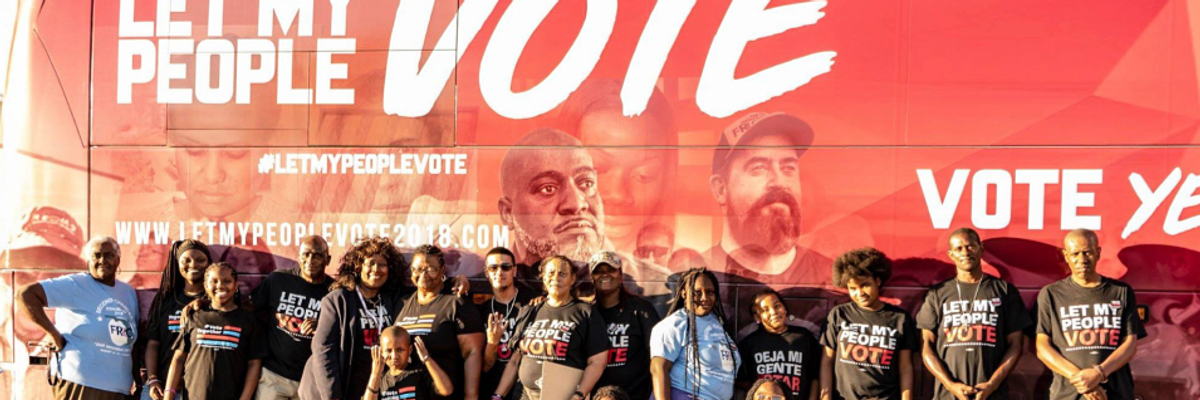
Florida voters on Tuesday overwhelmingly approved a constitutional amendment to restore voting rights to 1.4 million people with past felony convictions. (Photo: Public Citizen/Twitter)
In a "huge and hard fought victory" that writer and activist Shaun King called "one of the most important of our lifetime," Florida on Tuesday overwhelming approved Amendment 4, which restores voting rights for 1.4 million state residents with past felony convictions who were barred from participating in elections even after completing their sentences.
"Not only does this repeal one of the country's worst Jim Crow laws," noted Public Citizen, "it's also the largest expansion in voting rights since the Voting Rights Act," which was enacted in 1965.
With 81 percent reporting on Tuesday evening, the ballot measure surpassed the 60 percent threshold needed, securing support from 64.1 percent of voters. While the measure restores rights for most felons who have fully completed their sentences, it does not extend to those with murder or sex crime convictions.
"For too long, Florida has been an extreme outlier," concluded ACLU of Florida executive director Howard Simon. "Our state's lifetime voting ban was the single most powerful voter suppression tactic in the country, shutting more people out of the voting booth and out of our democracy than any other single law or policy in the country."
Prior to the state constitutional amendment's passage, as Ari Berman reported for Mother Jones, Florida was "one of only four states that prevent ex-felons from voting even after they've paid their debt to society. This felon disenfranchisement law, which dates back to the Jim Crow era, blocks 10 percent of Floridians from voting, including one in five African Americans."
The results came in ahead of a closely watched gubernatorial race between former Republican Congressman Ron DeSantis and Tallahassee Mayor Andrew Gillum.
"The constitutional amendment the voters have now approved is not the end of this saga; it is more like the end of the beginning," declared Simon, vowing to work with whoever is elected governor "to ensure that Amendment 4 is implemented as intended by the Floridians who placed in on the ballot and voted to approve it--without delay and without imposing more burdens on the process to register to vote."
While the move is expected to significantly influence the political future of Florida--as Berman put it on Twitter, "Restoring voting rights to 1.4 million people is game changer for voting rights & criminal justice reform & will transform Florida's political map"--Simon, and others, tied the outcome to the broader fight against attacks on democracy across the United States.
"Today, when democratic values are on the defensive worldwide," he said, "Florida voters made a resoundingly clear statement that the state's shameful lifetime ban on voting is not consistent with the values of democracy."
Our Revolution president Nina Turner said in a statement that "tonight's passage of Amendment 4, commonly referred to as 'Second Chances,' shows that we, as a country, are moving towards a more just, equitable society that lives up to the value of 'one person, one vote.'"
Dear Common Dreams reader, It’s been nearly 30 years since I co-founded Common Dreams with my late wife, Lina Newhouser. We had the radical notion that journalism should serve the public good, not corporate profits. It was clear to us from the outset what it would take to build such a project. No paid advertisements. No corporate sponsors. No millionaire publisher telling us what to think or do. Many people said we wouldn't last a year, but we proved those doubters wrong. Together with a tremendous team of journalists and dedicated staff, we built an independent media outlet free from the constraints of profits and corporate control. Our mission has always been simple: To inform. To inspire. To ignite change for the common good. Building Common Dreams was not easy. Our survival was never guaranteed. When you take on the most powerful forces—Wall Street greed, fossil fuel industry destruction, Big Tech lobbyists, and uber-rich oligarchs who have spent billions upon billions rigging the economy and democracy in their favor—the only bulwark you have is supporters who believe in your work. But here’s the urgent message from me today. It's never been this bad out there. And it's never been this hard to keep us going. At the very moment Common Dreams is most needed, the threats we face are intensifying. We need your support now more than ever. We don't accept corporate advertising and never will. We don't have a paywall because we don't think people should be blocked from critical news based on their ability to pay. Everything we do is funded by the donations of readers like you. When everyone does the little they can afford, we are strong. But if that support retreats or dries up, so do we. Will you donate now to make sure Common Dreams not only survives but thrives? —Craig Brown, Co-founder |
In a "huge and hard fought victory" that writer and activist Shaun King called "one of the most important of our lifetime," Florida on Tuesday overwhelming approved Amendment 4, which restores voting rights for 1.4 million state residents with past felony convictions who were barred from participating in elections even after completing their sentences.
"Not only does this repeal one of the country's worst Jim Crow laws," noted Public Citizen, "it's also the largest expansion in voting rights since the Voting Rights Act," which was enacted in 1965.
With 81 percent reporting on Tuesday evening, the ballot measure surpassed the 60 percent threshold needed, securing support from 64.1 percent of voters. While the measure restores rights for most felons who have fully completed their sentences, it does not extend to those with murder or sex crime convictions.
"For too long, Florida has been an extreme outlier," concluded ACLU of Florida executive director Howard Simon. "Our state's lifetime voting ban was the single most powerful voter suppression tactic in the country, shutting more people out of the voting booth and out of our democracy than any other single law or policy in the country."
Prior to the state constitutional amendment's passage, as Ari Berman reported for Mother Jones, Florida was "one of only four states that prevent ex-felons from voting even after they've paid their debt to society. This felon disenfranchisement law, which dates back to the Jim Crow era, blocks 10 percent of Floridians from voting, including one in five African Americans."
The results came in ahead of a closely watched gubernatorial race between former Republican Congressman Ron DeSantis and Tallahassee Mayor Andrew Gillum.
"The constitutional amendment the voters have now approved is not the end of this saga; it is more like the end of the beginning," declared Simon, vowing to work with whoever is elected governor "to ensure that Amendment 4 is implemented as intended by the Floridians who placed in on the ballot and voted to approve it--without delay and without imposing more burdens on the process to register to vote."
While the move is expected to significantly influence the political future of Florida--as Berman put it on Twitter, "Restoring voting rights to 1.4 million people is game changer for voting rights & criminal justice reform & will transform Florida's political map"--Simon, and others, tied the outcome to the broader fight against attacks on democracy across the United States.
"Today, when democratic values are on the defensive worldwide," he said, "Florida voters made a resoundingly clear statement that the state's shameful lifetime ban on voting is not consistent with the values of democracy."
Our Revolution president Nina Turner said in a statement that "tonight's passage of Amendment 4, commonly referred to as 'Second Chances,' shows that we, as a country, are moving towards a more just, equitable society that lives up to the value of 'one person, one vote.'"
In a "huge and hard fought victory" that writer and activist Shaun King called "one of the most important of our lifetime," Florida on Tuesday overwhelming approved Amendment 4, which restores voting rights for 1.4 million state residents with past felony convictions who were barred from participating in elections even after completing their sentences.
"Not only does this repeal one of the country's worst Jim Crow laws," noted Public Citizen, "it's also the largest expansion in voting rights since the Voting Rights Act," which was enacted in 1965.
With 81 percent reporting on Tuesday evening, the ballot measure surpassed the 60 percent threshold needed, securing support from 64.1 percent of voters. While the measure restores rights for most felons who have fully completed their sentences, it does not extend to those with murder or sex crime convictions.
"For too long, Florida has been an extreme outlier," concluded ACLU of Florida executive director Howard Simon. "Our state's lifetime voting ban was the single most powerful voter suppression tactic in the country, shutting more people out of the voting booth and out of our democracy than any other single law or policy in the country."
Prior to the state constitutional amendment's passage, as Ari Berman reported for Mother Jones, Florida was "one of only four states that prevent ex-felons from voting even after they've paid their debt to society. This felon disenfranchisement law, which dates back to the Jim Crow era, blocks 10 percent of Floridians from voting, including one in five African Americans."
The results came in ahead of a closely watched gubernatorial race between former Republican Congressman Ron DeSantis and Tallahassee Mayor Andrew Gillum.
"The constitutional amendment the voters have now approved is not the end of this saga; it is more like the end of the beginning," declared Simon, vowing to work with whoever is elected governor "to ensure that Amendment 4 is implemented as intended by the Floridians who placed in on the ballot and voted to approve it--without delay and without imposing more burdens on the process to register to vote."
While the move is expected to significantly influence the political future of Florida--as Berman put it on Twitter, "Restoring voting rights to 1.4 million people is game changer for voting rights & criminal justice reform & will transform Florida's political map"--Simon, and others, tied the outcome to the broader fight against attacks on democracy across the United States.
"Today, when democratic values are on the defensive worldwide," he said, "Florida voters made a resoundingly clear statement that the state's shameful lifetime ban on voting is not consistent with the values of democracy."
Our Revolution president Nina Turner said in a statement that "tonight's passage of Amendment 4, commonly referred to as 'Second Chances,' shows that we, as a country, are moving towards a more just, equitable society that lives up to the value of 'one person, one vote.'"