SUBSCRIBE TO OUR FREE NEWSLETTER
Daily news & progressive opinion—funded by the people, not the corporations—delivered straight to your inbox.
5
#000000
#FFFFFF
To donate by check, phone, or other method, see our More Ways to Give page.
Daily news & progressive opinion—funded by the people, not the corporations—delivered straight to your inbox.
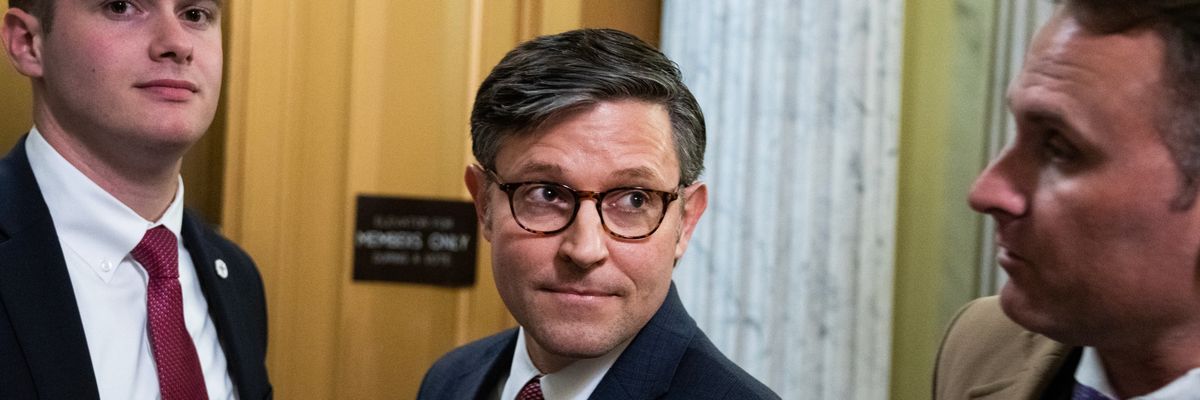
House Speaker Mike Johnson (R-La.) is seen in the U.S. Capitol on November 28, 2023.
The Republican-led push for a "fiscal commission" to examine Social Security and other key programs is "specifically designed to avoid accountability from voters," argued one critic.
Survey results out Thursday show that more than 80% of U.S. voters oppose cuts to Social Security and Medicare, a finding released a day after House Republicans and some right-wing Democrats made their case for a bipartisan "fiscal commission" that critics warn would fast-track cuts to the popular and critical programs.
Conducted by Navigator Research, the poll found that 81% of registered voters from across the political spectrum are against cutting funding for Social Security and Medicare while 82% support increasing funding for the programs.
The nationwide survey reached 1,000 U.S. voters and was run from November 9-13.
The deep unpopularity of Social Security cuts may help explain why Republicans, led by House Speaker Mike Johnson (R-La.), are pushing for a bipartisan, bicameral fiscal commission tasked with proposing legislative changes to U.S. trust fund programs. The Biden White House and progressive advocacy groups have called the commission a "death panel" for Social Security.
Under legislation that the Republican-controlled House Budget Committee examined during a hearing on Wednesday, proposals approved by the fiscal commission would be expedited in both chambers of Congress.
Nancy Altman, president of Social Security Works, wrote in an op-ed for Common Dreams on Thursday that the proposed commission is a ploy "specifically designed to avoid accountability from voters," as it would "require Congress to vote on the commission's recommendations right after the 2024 election, without any amendments."
"This will allow members to run on the claim that they won't cut Social Security and Medicare, and then turn around and vote for cut," Altman added. "They will insist that they hated the cuts, but had to do something about the federal debt, so their hands were tied. Some voting for it will have lost re-election or will be retiring, with nothing to lose. All of them will be as far away from the next election as possible."
"Commissions of this kind always focus on cutting benefits and never on the adequacy of benefits."
Two of the leading supporters of a fiscal commission—Sens. Mitt Romney (R-Utah) and Joe Manchin (D-W.Va.)—announced recently that they will not be running for reelection next year, shielding them from any political pressure to oppose Social Security cuts.
Johnson, the head of the House Republican caucus, described a fiscal commission as one of his top priorities after winning the gavel last month. When he served as chair of the Republican Study Committee (RSC) between 2019 and 2021, Johnson proposed massive cuts to Social Security and Medicare.
Max Richtman, president and CEO of the National Committee to Preserve Social Security and Medicare, said following Wednesday's budget committee hearing that "commissions of this kind always focus on cutting benefits and never on the adequacy of benefits," pointing to Social Security cuts proposed by the co-chairs of the infamous Bowles-Simpson commission.
"In fact, their main purpose is to give lawmakers political cover for cutting benefits. They routinely neglect revenue-side solutions, such as asking the wealthy to contribute their fair share," said Richtman. "On behalf of our members and supporters across the country, we urge members of Congress to vote against a fiscal commission, roll up their sleeves, and legislate improvements to Social Security and Medicare that protect—not punish—current and future beneficiaries."
Dear Common Dreams reader, It’s been nearly 30 years since I co-founded Common Dreams with my late wife, Lina Newhouser. We had the radical notion that journalism should serve the public good, not corporate profits. It was clear to us from the outset what it would take to build such a project. No paid advertisements. No corporate sponsors. No millionaire publisher telling us what to think or do. Many people said we wouldn't last a year, but we proved those doubters wrong. Together with a tremendous team of journalists and dedicated staff, we built an independent media outlet free from the constraints of profits and corporate control. Our mission has always been simple: To inform. To inspire. To ignite change for the common good. Building Common Dreams was not easy. Our survival was never guaranteed. When you take on the most powerful forces—Wall Street greed, fossil fuel industry destruction, Big Tech lobbyists, and uber-rich oligarchs who have spent billions upon billions rigging the economy and democracy in their favor—the only bulwark you have is supporters who believe in your work. But here’s the urgent message from me today. It's never been this bad out there. And it's never been this hard to keep us going. At the very moment Common Dreams is most needed, the threats we face are intensifying. We need your support now more than ever. We don't accept corporate advertising and never will. We don't have a paywall because we don't think people should be blocked from critical news based on their ability to pay. Everything we do is funded by the donations of readers like you. When everyone does the little they can afford, we are strong. But if that support retreats or dries up, so do we. Will you donate now to make sure Common Dreams not only survives but thrives? —Craig Brown, Co-founder |
Survey results out Thursday show that more than 80% of U.S. voters oppose cuts to Social Security and Medicare, a finding released a day after House Republicans and some right-wing Democrats made their case for a bipartisan "fiscal commission" that critics warn would fast-track cuts to the popular and critical programs.
Conducted by Navigator Research, the poll found that 81% of registered voters from across the political spectrum are against cutting funding for Social Security and Medicare while 82% support increasing funding for the programs.
The nationwide survey reached 1,000 U.S. voters and was run from November 9-13.
The deep unpopularity of Social Security cuts may help explain why Republicans, led by House Speaker Mike Johnson (R-La.), are pushing for a bipartisan, bicameral fiscal commission tasked with proposing legislative changes to U.S. trust fund programs. The Biden White House and progressive advocacy groups have called the commission a "death panel" for Social Security.
Under legislation that the Republican-controlled House Budget Committee examined during a hearing on Wednesday, proposals approved by the fiscal commission would be expedited in both chambers of Congress.
Nancy Altman, president of Social Security Works, wrote in an op-ed for Common Dreams on Thursday that the proposed commission is a ploy "specifically designed to avoid accountability from voters," as it would "require Congress to vote on the commission's recommendations right after the 2024 election, without any amendments."
"This will allow members to run on the claim that they won't cut Social Security and Medicare, and then turn around and vote for cut," Altman added. "They will insist that they hated the cuts, but had to do something about the federal debt, so their hands were tied. Some voting for it will have lost re-election or will be retiring, with nothing to lose. All of them will be as far away from the next election as possible."
"Commissions of this kind always focus on cutting benefits and never on the adequacy of benefits."
Two of the leading supporters of a fiscal commission—Sens. Mitt Romney (R-Utah) and Joe Manchin (D-W.Va.)—announced recently that they will not be running for reelection next year, shielding them from any political pressure to oppose Social Security cuts.
Johnson, the head of the House Republican caucus, described a fiscal commission as one of his top priorities after winning the gavel last month. When he served as chair of the Republican Study Committee (RSC) between 2019 and 2021, Johnson proposed massive cuts to Social Security and Medicare.
Max Richtman, president and CEO of the National Committee to Preserve Social Security and Medicare, said following Wednesday's budget committee hearing that "commissions of this kind always focus on cutting benefits and never on the adequacy of benefits," pointing to Social Security cuts proposed by the co-chairs of the infamous Bowles-Simpson commission.
"In fact, their main purpose is to give lawmakers political cover for cutting benefits. They routinely neglect revenue-side solutions, such as asking the wealthy to contribute their fair share," said Richtman. "On behalf of our members and supporters across the country, we urge members of Congress to vote against a fiscal commission, roll up their sleeves, and legislate improvements to Social Security and Medicare that protect—not punish—current and future beneficiaries."
Survey results out Thursday show that more than 80% of U.S. voters oppose cuts to Social Security and Medicare, a finding released a day after House Republicans and some right-wing Democrats made their case for a bipartisan "fiscal commission" that critics warn would fast-track cuts to the popular and critical programs.
Conducted by Navigator Research, the poll found that 81% of registered voters from across the political spectrum are against cutting funding for Social Security and Medicare while 82% support increasing funding for the programs.
The nationwide survey reached 1,000 U.S. voters and was run from November 9-13.
The deep unpopularity of Social Security cuts may help explain why Republicans, led by House Speaker Mike Johnson (R-La.), are pushing for a bipartisan, bicameral fiscal commission tasked with proposing legislative changes to U.S. trust fund programs. The Biden White House and progressive advocacy groups have called the commission a "death panel" for Social Security.
Under legislation that the Republican-controlled House Budget Committee examined during a hearing on Wednesday, proposals approved by the fiscal commission would be expedited in both chambers of Congress.
Nancy Altman, president of Social Security Works, wrote in an op-ed for Common Dreams on Thursday that the proposed commission is a ploy "specifically designed to avoid accountability from voters," as it would "require Congress to vote on the commission's recommendations right after the 2024 election, without any amendments."
"This will allow members to run on the claim that they won't cut Social Security and Medicare, and then turn around and vote for cut," Altman added. "They will insist that they hated the cuts, but had to do something about the federal debt, so their hands were tied. Some voting for it will have lost re-election or will be retiring, with nothing to lose. All of them will be as far away from the next election as possible."
"Commissions of this kind always focus on cutting benefits and never on the adequacy of benefits."
Two of the leading supporters of a fiscal commission—Sens. Mitt Romney (R-Utah) and Joe Manchin (D-W.Va.)—announced recently that they will not be running for reelection next year, shielding them from any political pressure to oppose Social Security cuts.
Johnson, the head of the House Republican caucus, described a fiscal commission as one of his top priorities after winning the gavel last month. When he served as chair of the Republican Study Committee (RSC) between 2019 and 2021, Johnson proposed massive cuts to Social Security and Medicare.
Max Richtman, president and CEO of the National Committee to Preserve Social Security and Medicare, said following Wednesday's budget committee hearing that "commissions of this kind always focus on cutting benefits and never on the adequacy of benefits," pointing to Social Security cuts proposed by the co-chairs of the infamous Bowles-Simpson commission.
"In fact, their main purpose is to give lawmakers political cover for cutting benefits. They routinely neglect revenue-side solutions, such as asking the wealthy to contribute their fair share," said Richtman. "On behalf of our members and supporters across the country, we urge members of Congress to vote against a fiscal commission, roll up their sleeves, and legislate improvements to Social Security and Medicare that protect—not punish—current and future beneficiaries."