

SUBSCRIBE TO OUR FREE NEWSLETTER
Daily news & progressive opinion—funded by the people, not the corporations—delivered straight to your inbox.
5
#000000
#FFFFFF
To donate by check, phone, or other method, see our More Ways to Give page.
Daily news & progressive opinion—funded by the people, not the corporations—delivered straight to your inbox.
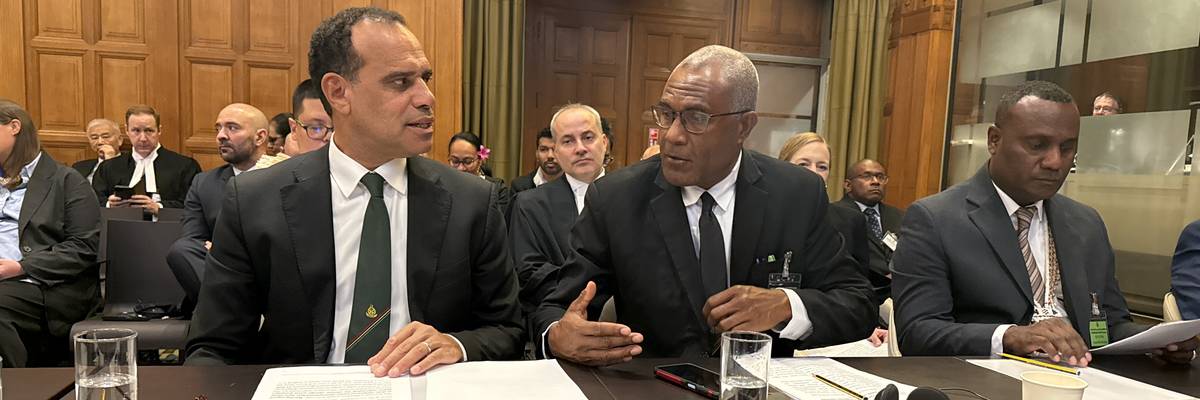
Ralph Regenvanu (left), Vanuatu's special envoy on climate change and the environment; Arnold Kiel Loughman (center), attorney general of Vanuatu; and Ilan Kiloe (right), legal advisor to the Melanesian Spearhead Group attend the advisory opinion sessions at the International Court of Justice (ICJ) in The Hague, Netherlands on December 2, 2024.
"What started in the Pacific is now a historic climate justice campaign, as the world's most urgent problem of climate change reaches the worlds highest court," said one campaigner.
The International Court of Justice (ICJ) heard arguments Monday in the largest climate case ever brought before it as a coalition of low-lying and developing nations demanded larger polluting nations be held to account under international law for causing "significant harm to the climate system and other parts of the environment" with runaway fossil fuel emissions over recent decades.
In the first day of hearings in The Hague that could last weeks, multiple representatives from the Pacific island of Vanuatu, which is leading the coalition of over 100 countries and allied organizations, laid the blame for the climate crisis at the feed of a small number of states that are large emitters of greenhouse gases.
"We know what the cause of climate change is: a conduct of specific States ... Vanuatu's contribution to global greenhouse gas emissions is negligible, and yet we are among those most affected by climate change," said Arnold Kiel Loughman, attorney general of the Republic of Vanuatu.
"We find ourselves on the frontlines of a crisis we did not create," said Ralph Regenvanu, Vanuatu's special envoy for climate change and environment, told the court.
Monday's historic moment at The Hague follows years of work on the part of Pacific Island nations, particularly Vanuatu, to push for the ICJ to take up the issue of global warming and human rights. The stakes of the planetary emergency are particularly high for these countries, which are under threat from rising seas and other climate impacts.
Ilan Kiloe, legal counsel for the Melanesian Spearhead Group, a regional subgroup that includes Fiji, Papua New Guinea, Solomon Islands, and Vanuatu, issued a stark warning during his remarks to the court: "Climate change is now depriving our peoples, again, of our ability to enjoy our right to self-determination in our lands. The harsh reality is that many of our people will not survive."
Last year, the United Nations General Assembly unanimously adopted a resolution calling on the ICJ to issue an advisory opinion on climate change and human rights. The measure, which was introduced by Vanuatu and co-sponsored by more than 130 governments, requested that the world's highest court outline countries' legal responsibilities for combatting fossil fuel-driven climate change and the legal consequences of failing to meet those obligations.
Over the next two weeks, the court will hear statements from nearly 100 nations, including wealthy developed countries such as the United States. Advisory opinions, unlike judgments, are not binding—but Vanuatu and other supporters hope that a forthcoming opinion would accelerate action around the climate emergency.
The country began pushing for the ICJ resolution in 2021, following a campaign launched in 2019 by a group of students from the University of the South Pacific.
"What started in the Pacific is now a historic climate justice campaign, as the world's most urgent problem of climate change reaches the world’s highest court," said Shiva Gounden of Greenpeace Australia Pacific.
"The next two weeks of hearings are the culmination of collective campaigning from 2019, powerful advocacy, and mobilizing the world behind this landmark campaign, to ensure the human rights of current and future generations are protected from climate destruction, and the biggest emitters are held accountable."
Polly Banks, Vanuatu country director for Save the Children, who travelled to The Hague for the proceedings, said that "the hearing before the Court goes to questions about the efficacy, equity and fairness of the current responses to climate change, which are particularly relevant for children, who have contributed the least to climate change but will be most affected by its consequences."
"Currently, only 2.4% of climate finance from multilateral funding sources is child-responsive. Even without the Court's opinion, we know that states need to do far more to protect children from the worst impacts of this crisis, by significantly increasing climate finance to uphold children’s basic rights and access to health, education and protection," Banks added.
The start of hearings at The Hague come on the heels of a COP29 climate summit that was heavily criticized. The summit focused heavily on climate finance, but the resulting deal was panned by critics as rich nations agreed to voluntarily provide just $300 billion to help developing nations decarbonize and deal with the impacts of the climate emergency. Poor nations and climate campaigners had demanded over a trillion dollars in funding in the form of debt-free grants and direct payments.
Dear Common Dreams reader, It’s been nearly 30 years since I co-founded Common Dreams with my late wife, Lina Newhouser. We had the radical notion that journalism should serve the public good, not corporate profits. It was clear to us from the outset what it would take to build such a project. No paid advertisements. No corporate sponsors. No millionaire publisher telling us what to think or do. Many people said we wouldn't last a year, but we proved those doubters wrong. Together with a tremendous team of journalists and dedicated staff, we built an independent media outlet free from the constraints of profits and corporate control. Our mission has always been simple: To inform. To inspire. To ignite change for the common good. Building Common Dreams was not easy. Our survival was never guaranteed. When you take on the most powerful forces—Wall Street greed, fossil fuel industry destruction, Big Tech lobbyists, and uber-rich oligarchs who have spent billions upon billions rigging the economy and democracy in their favor—the only bulwark you have is supporters who believe in your work. But here’s the urgent message from me today. It's never been this bad out there. And it's never been this hard to keep us going. At the very moment Common Dreams is most needed, the threats we face are intensifying. We need your support now more than ever. We don't accept corporate advertising and never will. We don't have a paywall because we don't think people should be blocked from critical news based on their ability to pay. Everything we do is funded by the donations of readers like you. When everyone does the little they can afford, we are strong. But if that support retreats or dries up, so do we. Will you donate now to make sure Common Dreams not only survives but thrives? —Craig Brown, Co-founder |
The International Court of Justice (ICJ) heard arguments Monday in the largest climate case ever brought before it as a coalition of low-lying and developing nations demanded larger polluting nations be held to account under international law for causing "significant harm to the climate system and other parts of the environment" with runaway fossil fuel emissions over recent decades.
In the first day of hearings in The Hague that could last weeks, multiple representatives from the Pacific island of Vanuatu, which is leading the coalition of over 100 countries and allied organizations, laid the blame for the climate crisis at the feed of a small number of states that are large emitters of greenhouse gases.
"We know what the cause of climate change is: a conduct of specific States ... Vanuatu's contribution to global greenhouse gas emissions is negligible, and yet we are among those most affected by climate change," said Arnold Kiel Loughman, attorney general of the Republic of Vanuatu.
"We find ourselves on the frontlines of a crisis we did not create," said Ralph Regenvanu, Vanuatu's special envoy for climate change and environment, told the court.
Monday's historic moment at The Hague follows years of work on the part of Pacific Island nations, particularly Vanuatu, to push for the ICJ to take up the issue of global warming and human rights. The stakes of the planetary emergency are particularly high for these countries, which are under threat from rising seas and other climate impacts.
Ilan Kiloe, legal counsel for the Melanesian Spearhead Group, a regional subgroup that includes Fiji, Papua New Guinea, Solomon Islands, and Vanuatu, issued a stark warning during his remarks to the court: "Climate change is now depriving our peoples, again, of our ability to enjoy our right to self-determination in our lands. The harsh reality is that many of our people will not survive."
Last year, the United Nations General Assembly unanimously adopted a resolution calling on the ICJ to issue an advisory opinion on climate change and human rights. The measure, which was introduced by Vanuatu and co-sponsored by more than 130 governments, requested that the world's highest court outline countries' legal responsibilities for combatting fossil fuel-driven climate change and the legal consequences of failing to meet those obligations.
Over the next two weeks, the court will hear statements from nearly 100 nations, including wealthy developed countries such as the United States. Advisory opinions, unlike judgments, are not binding—but Vanuatu and other supporters hope that a forthcoming opinion would accelerate action around the climate emergency.
The country began pushing for the ICJ resolution in 2021, following a campaign launched in 2019 by a group of students from the University of the South Pacific.
"What started in the Pacific is now a historic climate justice campaign, as the world's most urgent problem of climate change reaches the world’s highest court," said Shiva Gounden of Greenpeace Australia Pacific.
"The next two weeks of hearings are the culmination of collective campaigning from 2019, powerful advocacy, and mobilizing the world behind this landmark campaign, to ensure the human rights of current and future generations are protected from climate destruction, and the biggest emitters are held accountable."
Polly Banks, Vanuatu country director for Save the Children, who travelled to The Hague for the proceedings, said that "the hearing before the Court goes to questions about the efficacy, equity and fairness of the current responses to climate change, which are particularly relevant for children, who have contributed the least to climate change but will be most affected by its consequences."
"Currently, only 2.4% of climate finance from multilateral funding sources is child-responsive. Even without the Court's opinion, we know that states need to do far more to protect children from the worst impacts of this crisis, by significantly increasing climate finance to uphold children’s basic rights and access to health, education and protection," Banks added.
The start of hearings at The Hague come on the heels of a COP29 climate summit that was heavily criticized. The summit focused heavily on climate finance, but the resulting deal was panned by critics as rich nations agreed to voluntarily provide just $300 billion to help developing nations decarbonize and deal with the impacts of the climate emergency. Poor nations and climate campaigners had demanded over a trillion dollars in funding in the form of debt-free grants and direct payments.
The International Court of Justice (ICJ) heard arguments Monday in the largest climate case ever brought before it as a coalition of low-lying and developing nations demanded larger polluting nations be held to account under international law for causing "significant harm to the climate system and other parts of the environment" with runaway fossil fuel emissions over recent decades.
In the first day of hearings in The Hague that could last weeks, multiple representatives from the Pacific island of Vanuatu, which is leading the coalition of over 100 countries and allied organizations, laid the blame for the climate crisis at the feed of a small number of states that are large emitters of greenhouse gases.
"We know what the cause of climate change is: a conduct of specific States ... Vanuatu's contribution to global greenhouse gas emissions is negligible, and yet we are among those most affected by climate change," said Arnold Kiel Loughman, attorney general of the Republic of Vanuatu.
"We find ourselves on the frontlines of a crisis we did not create," said Ralph Regenvanu, Vanuatu's special envoy for climate change and environment, told the court.
Monday's historic moment at The Hague follows years of work on the part of Pacific Island nations, particularly Vanuatu, to push for the ICJ to take up the issue of global warming and human rights. The stakes of the planetary emergency are particularly high for these countries, which are under threat from rising seas and other climate impacts.
Ilan Kiloe, legal counsel for the Melanesian Spearhead Group, a regional subgroup that includes Fiji, Papua New Guinea, Solomon Islands, and Vanuatu, issued a stark warning during his remarks to the court: "Climate change is now depriving our peoples, again, of our ability to enjoy our right to self-determination in our lands. The harsh reality is that many of our people will not survive."
Last year, the United Nations General Assembly unanimously adopted a resolution calling on the ICJ to issue an advisory opinion on climate change and human rights. The measure, which was introduced by Vanuatu and co-sponsored by more than 130 governments, requested that the world's highest court outline countries' legal responsibilities for combatting fossil fuel-driven climate change and the legal consequences of failing to meet those obligations.
Over the next two weeks, the court will hear statements from nearly 100 nations, including wealthy developed countries such as the United States. Advisory opinions, unlike judgments, are not binding—but Vanuatu and other supporters hope that a forthcoming opinion would accelerate action around the climate emergency.
The country began pushing for the ICJ resolution in 2021, following a campaign launched in 2019 by a group of students from the University of the South Pacific.
"What started in the Pacific is now a historic climate justice campaign, as the world's most urgent problem of climate change reaches the world’s highest court," said Shiva Gounden of Greenpeace Australia Pacific.
"The next two weeks of hearings are the culmination of collective campaigning from 2019, powerful advocacy, and mobilizing the world behind this landmark campaign, to ensure the human rights of current and future generations are protected from climate destruction, and the biggest emitters are held accountable."
Polly Banks, Vanuatu country director for Save the Children, who travelled to The Hague for the proceedings, said that "the hearing before the Court goes to questions about the efficacy, equity and fairness of the current responses to climate change, which are particularly relevant for children, who have contributed the least to climate change but will be most affected by its consequences."
"Currently, only 2.4% of climate finance from multilateral funding sources is child-responsive. Even without the Court's opinion, we know that states need to do far more to protect children from the worst impacts of this crisis, by significantly increasing climate finance to uphold children’s basic rights and access to health, education and protection," Banks added.
The start of hearings at The Hague come on the heels of a COP29 climate summit that was heavily criticized. The summit focused heavily on climate finance, but the resulting deal was panned by critics as rich nations agreed to voluntarily provide just $300 billion to help developing nations decarbonize and deal with the impacts of the climate emergency. Poor nations and climate campaigners had demanded over a trillion dollars in funding in the form of debt-free grants and direct payments.

