

SUBSCRIBE TO OUR FREE NEWSLETTER
Daily news & progressive opinion—funded by the people, not the corporations—delivered straight to your inbox.
5
#000000
#FFFFFF
To donate by check, phone, or other method, see our More Ways to Give page.
Daily news & progressive opinion—funded by the people, not the corporations—delivered straight to your inbox.
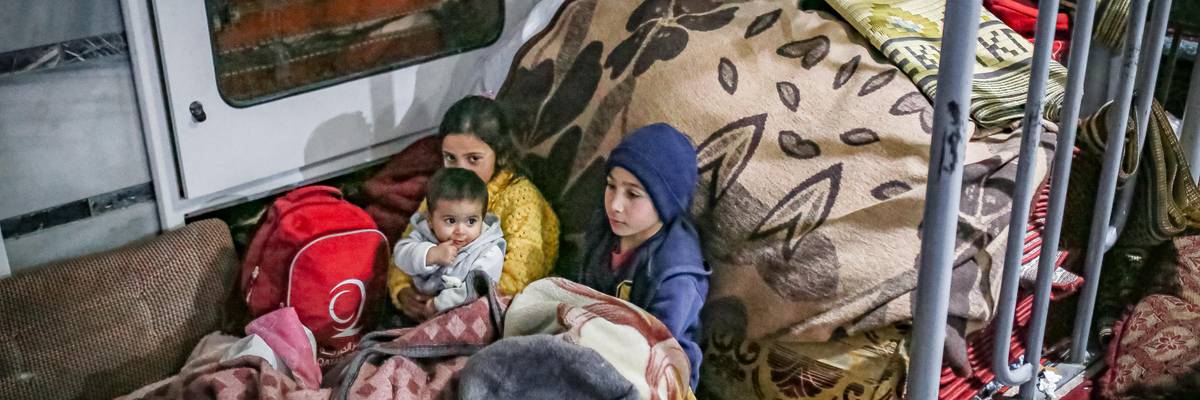
Syrian earthquake survivors spend a night at Ayse Mosque in Idlib, Syria on February 9, 2023. (Photo by Muhammed Said/Anadolu Agency via Getty Images)
"We welcome the decision by the U.S. Department of Treasury to issue a broad General License on Syria sanctions," said one advocate.
In the face of mounting pressure from rights groups and relief organizations on the ground, the Biden administration on Thursday issued a temporary license authorizing "all transactions related to earthquake relief that would be otherwise prohibited" by U.S. sanctions on Syria.
The move, announced by the Treasury Department on Thursday evening, amounts to a tacit admission that U.S. sanctions could have impacted the delivery of humanitarian aid to the country following the massive earthquake and dozens of aftershocks that killed more than 21,000 people in Syria and neighboring Turkey.
"As international allies and humanitarian partners mobilize to help those affected, I want to make very clear that U.S. sanctions in Syria will not stand in the way of lifesaving efforts for the Syrian people," said Deputy Treasury Secretary Wally Adeyemo. "While U.S. sanctions programs already contain robust exemptions for humanitarian efforts, today Treasury is issuing a blanket General License to authorize earthquake relief efforts so that those providing assistance can focus on what's needed most: saving lives and rebuilding."
The sanctions relief, which will be in effect for 180 days, came after U.S. officials repeatedly denied that the restrictions would impact humanitarian aid. Earlier Thursday, U.S. State Department spokesperson Ned Price said during a press briefing that "there are many hurdles to overcome when providing humanitarian assistance in Syria and especially after devastating earthquakes this week, but our Syrian sanctions policy is not among them."
But reporting and accounts from humanitarian leaders indicate that U.S. and European sanctions—which have long harmed Syrian civilians despite ostensibly being targeted at the Assad government—have hampered early aid and recovery efforts, compounding existing difficulties surrounding the delivery of emergency supplies to rebel-held areas of Syria. Freezing weather has also complicated aid and rescue operations.
Khaled Hboubati, the director of Syria's Red Crescent, said earlier this week that "we need heavy equipment, ambulances, and firefighting vehicles to continue to rescue and remove the rubble, and this entails lifting sanctions on Syria as soon as possible."
In a statement Tuesday, the Middle East Council of Churches called for "the immediate lifting of sanctions on Syria and allowing access to all materials, so sanctions may not turn into a crime against humanity."
The Associated Press reported that "in theory, aid operations in government areas should not be blocked by sanctions, since both the U.S. and EU have exemptions for humanitarian aid."
"But the reality on the ground is sometimes different," the outlet noted. "Banks might block transfers to pay suppliers or local workers for aid organizations for fear of running afoul of sanctions, despite the exemptions. Also, U.S. sanctions and to some extent E.U. ones try to prevent rebuilding of damaged infrastructure and property in government-held areas in the absence of a political solution, which could hamper post-earthquake recovery."
Abed Ayoub, director of the American-Arab Anti-Discrimination Committee, wrote on Twitter that "we welcome the decision by the U.S. Department of Treasury to issue a broad General License on Syria sanctions."
"This will ease sanctions and allow for much-needed additional aid into the country," Ayoub added.
Dear Common Dreams reader, It’s been nearly 30 years since I co-founded Common Dreams with my late wife, Lina Newhouser. We had the radical notion that journalism should serve the public good, not corporate profits. It was clear to us from the outset what it would take to build such a project. No paid advertisements. No corporate sponsors. No millionaire publisher telling us what to think or do. Many people said we wouldn't last a year, but we proved those doubters wrong. Together with a tremendous team of journalists and dedicated staff, we built an independent media outlet free from the constraints of profits and corporate control. Our mission has always been simple: To inform. To inspire. To ignite change for the common good. Building Common Dreams was not easy. Our survival was never guaranteed. When you take on the most powerful forces—Wall Street greed, fossil fuel industry destruction, Big Tech lobbyists, and uber-rich oligarchs who have spent billions upon billions rigging the economy and democracy in their favor—the only bulwark you have is supporters who believe in your work. But here’s the urgent message from me today. It's never been this bad out there. And it's never been this hard to keep us going. At the very moment Common Dreams is most needed, the threats we face are intensifying. We need your support now more than ever. We don't accept corporate advertising and never will. We don't have a paywall because we don't think people should be blocked from critical news based on their ability to pay. Everything we do is funded by the donations of readers like you. When everyone does the little they can afford, we are strong. But if that support retreats or dries up, so do we. Will you donate now to make sure Common Dreams not only survives but thrives? —Craig Brown, Co-founder |
In the face of mounting pressure from rights groups and relief organizations on the ground, the Biden administration on Thursday issued a temporary license authorizing "all transactions related to earthquake relief that would be otherwise prohibited" by U.S. sanctions on Syria.
The move, announced by the Treasury Department on Thursday evening, amounts to a tacit admission that U.S. sanctions could have impacted the delivery of humanitarian aid to the country following the massive earthquake and dozens of aftershocks that killed more than 21,000 people in Syria and neighboring Turkey.
"As international allies and humanitarian partners mobilize to help those affected, I want to make very clear that U.S. sanctions in Syria will not stand in the way of lifesaving efforts for the Syrian people," said Deputy Treasury Secretary Wally Adeyemo. "While U.S. sanctions programs already contain robust exemptions for humanitarian efforts, today Treasury is issuing a blanket General License to authorize earthquake relief efforts so that those providing assistance can focus on what's needed most: saving lives and rebuilding."
The sanctions relief, which will be in effect for 180 days, came after U.S. officials repeatedly denied that the restrictions would impact humanitarian aid. Earlier Thursday, U.S. State Department spokesperson Ned Price said during a press briefing that "there are many hurdles to overcome when providing humanitarian assistance in Syria and especially after devastating earthquakes this week, but our Syrian sanctions policy is not among them."
But reporting and accounts from humanitarian leaders indicate that U.S. and European sanctions—which have long harmed Syrian civilians despite ostensibly being targeted at the Assad government—have hampered early aid and recovery efforts, compounding existing difficulties surrounding the delivery of emergency supplies to rebel-held areas of Syria. Freezing weather has also complicated aid and rescue operations.
Khaled Hboubati, the director of Syria's Red Crescent, said earlier this week that "we need heavy equipment, ambulances, and firefighting vehicles to continue to rescue and remove the rubble, and this entails lifting sanctions on Syria as soon as possible."
In a statement Tuesday, the Middle East Council of Churches called for "the immediate lifting of sanctions on Syria and allowing access to all materials, so sanctions may not turn into a crime against humanity."
The Associated Press reported that "in theory, aid operations in government areas should not be blocked by sanctions, since both the U.S. and EU have exemptions for humanitarian aid."
"But the reality on the ground is sometimes different," the outlet noted. "Banks might block transfers to pay suppliers or local workers for aid organizations for fear of running afoul of sanctions, despite the exemptions. Also, U.S. sanctions and to some extent E.U. ones try to prevent rebuilding of damaged infrastructure and property in government-held areas in the absence of a political solution, which could hamper post-earthquake recovery."
Abed Ayoub, director of the American-Arab Anti-Discrimination Committee, wrote on Twitter that "we welcome the decision by the U.S. Department of Treasury to issue a broad General License on Syria sanctions."
"This will ease sanctions and allow for much-needed additional aid into the country," Ayoub added.
In the face of mounting pressure from rights groups and relief organizations on the ground, the Biden administration on Thursday issued a temporary license authorizing "all transactions related to earthquake relief that would be otherwise prohibited" by U.S. sanctions on Syria.
The move, announced by the Treasury Department on Thursday evening, amounts to a tacit admission that U.S. sanctions could have impacted the delivery of humanitarian aid to the country following the massive earthquake and dozens of aftershocks that killed more than 21,000 people in Syria and neighboring Turkey.
"As international allies and humanitarian partners mobilize to help those affected, I want to make very clear that U.S. sanctions in Syria will not stand in the way of lifesaving efforts for the Syrian people," said Deputy Treasury Secretary Wally Adeyemo. "While U.S. sanctions programs already contain robust exemptions for humanitarian efforts, today Treasury is issuing a blanket General License to authorize earthquake relief efforts so that those providing assistance can focus on what's needed most: saving lives and rebuilding."
The sanctions relief, which will be in effect for 180 days, came after U.S. officials repeatedly denied that the restrictions would impact humanitarian aid. Earlier Thursday, U.S. State Department spokesperson Ned Price said during a press briefing that "there are many hurdles to overcome when providing humanitarian assistance in Syria and especially after devastating earthquakes this week, but our Syrian sanctions policy is not among them."
But reporting and accounts from humanitarian leaders indicate that U.S. and European sanctions—which have long harmed Syrian civilians despite ostensibly being targeted at the Assad government—have hampered early aid and recovery efforts, compounding existing difficulties surrounding the delivery of emergency supplies to rebel-held areas of Syria. Freezing weather has also complicated aid and rescue operations.
Khaled Hboubati, the director of Syria's Red Crescent, said earlier this week that "we need heavy equipment, ambulances, and firefighting vehicles to continue to rescue and remove the rubble, and this entails lifting sanctions on Syria as soon as possible."
In a statement Tuesday, the Middle East Council of Churches called for "the immediate lifting of sanctions on Syria and allowing access to all materials, so sanctions may not turn into a crime against humanity."
The Associated Press reported that "in theory, aid operations in government areas should not be blocked by sanctions, since both the U.S. and EU have exemptions for humanitarian aid."
"But the reality on the ground is sometimes different," the outlet noted. "Banks might block transfers to pay suppliers or local workers for aid organizations for fear of running afoul of sanctions, despite the exemptions. Also, U.S. sanctions and to some extent E.U. ones try to prevent rebuilding of damaged infrastructure and property in government-held areas in the absence of a political solution, which could hamper post-earthquake recovery."
Abed Ayoub, director of the American-Arab Anti-Discrimination Committee, wrote on Twitter that "we welcome the decision by the U.S. Department of Treasury to issue a broad General License on Syria sanctions."
"This will ease sanctions and allow for much-needed additional aid into the country," Ayoub added.

