SUBSCRIBE TO OUR FREE NEWSLETTER
Daily news & progressive opinion—funded by the people, not the corporations—delivered straight to your inbox.
5
#000000
#FFFFFF
To donate by check, phone, or other method, see our More Ways to Give page.
Daily news & progressive opinion—funded by the people, not the corporations—delivered straight to your inbox.
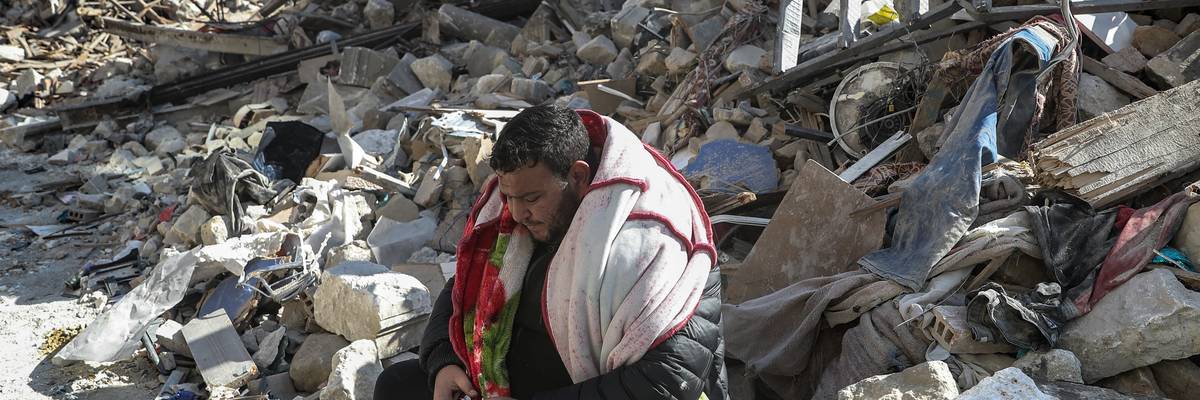
A man sits on the debris of collapsed buildings on February 16, 2023.
For the U.S., maintaining these failed sanctions while pledging to be "a partner to the people of Syria" is contradictory and counterproductive.
The devastating earthquake in Turkey and Syria has killed over 40,000 people, a number the United Nations has warned may escalate. The destruction is unfathomable.
According to the UN, at least 870,000 people across Turkey and Syria are in urgent need of hot meals. In Syria, around 5.3 million people are in need of shelter. Over 1 million people in Turkey are living in temporary shelters.
As a Syrian American whose family hails from Aleppo, it’s been painful for me to process the earthquake’s aftermath.
It feels like another punch in the gut after the horrors and anguish Syrians have already endured through years of war, displacement, and sanctions. Historic cultural treasures like Aleppo’s ancient Citadel, which greeted my parents on their way to school when they were growing up, have suffered significant damage.
Heartbreaking stories have emerged from Turkey and Syria. In one widely shared image, photographer Adem Altan memorialized the anguish of a father as he sat alone amidst the rubble, holding onto his deceased 15-year-old daughter’s hand.
Stories of rescue have also ignited flickers of hope amid such profound despair. Rescuers pulled a 10-year-old girl to safety after she was trapped for 147 hours beneath a collapsed building. A newborn baby was rescued from the rubble after relatives found her still tied by her umbilical cord to her mother, who had sadly passed away.
This earthquake is the latest crisis within a larger crisis in Syria, already fractured by tremors from political fault lines for over a decade now. Over 300,000 people have been killed there since war broke out in 2011.
Prior to the earthquake, an estimated 6.7 million people were already internally displaced. Millions more were impoverished by U.S. and European sanctions designed to strangle the economy and oust Syrian President Bashar al-Assad.
Additional U.S. sanctions since 2020 have targeted key sectors, including the Central Bank, oil, energy, and construction. They have also blocked food, medicine, medical equipment, and other necessities.
These sanctions have failed. Instead of removing Assad from power, they’ve collectively punished innocent Syrians. Ninety percent of Syrians now live in poverty, and 12 million are food insecure. With more than half of Syria’s infrastructure either destroyed or severely damaged by war, sanctions have made reconstruction and economic recovery impossible.
This was the situation before the earthquake struck.
Months earlier, UN envoy Alena Douhan called for an end to sanctions: “I urge the immediate lifting of all unilateral sanctions that severely harm human rights and prevent any efforts for early recovery, rebuilding, and reconstruction,” she said. Her recommendation has even greater urgency today.
In a de facto admission that sanctions are hurting civilians, the U.S. Department of Treasury recently agreed to open a 180-day window authorizing transactions “related to earthquake relief efforts” in Syria. Although a welcome development, it’s only a short-term reprieve from these sanctions’ far-reaching catastrophic impacts.
For the U.S., maintaining these failed sanctions while pledging to be “a partner to the people of Syria” is contradictory and counterproductive.
They should be permanently lifted to allow Syrians the chance to finally catch their breath and begin to rebuild from these crises with dignity. The U.S. and international community must also redouble their diplomatic efforts toward ending the war, instead of prolonging it. Tragedy should transcend political divisions, not reinforce them.
Turkey and Syria both face a long road to recovery. We should extend compassion and support to the earthquake victims. Sustained international aid is needed in both the immediate and long term.
Beyond aid, only an end to the war will bring lasting relief for Syrians.
Dear Common Dreams reader, It’s been nearly 30 years since I co-founded Common Dreams with my late wife, Lina Newhouser. We had the radical notion that journalism should serve the public good, not corporate profits. It was clear to us from the outset what it would take to build such a project. No paid advertisements. No corporate sponsors. No millionaire publisher telling us what to think or do. Many people said we wouldn't last a year, but we proved those doubters wrong. Together with a tremendous team of journalists and dedicated staff, we built an independent media outlet free from the constraints of profits and corporate control. Our mission has always been simple: To inform. To inspire. To ignite change for the common good. Building Common Dreams was not easy. Our survival was never guaranteed. When you take on the most powerful forces—Wall Street greed, fossil fuel industry destruction, Big Tech lobbyists, and uber-rich oligarchs who have spent billions upon billions rigging the economy and democracy in their favor—the only bulwark you have is supporters who believe in your work. But here’s the urgent message from me today. It's never been this bad out there. And it's never been this hard to keep us going. At the very moment Common Dreams is most needed, the threats we face are intensifying. We need your support now more than ever. We don't accept corporate advertising and never will. We don't have a paywall because we don't think people should be blocked from critical news based on their ability to pay. Everything we do is funded by the donations of readers like you. When everyone does the little they can afford, we are strong. But if that support retreats or dries up, so do we. Will you donate now to make sure Common Dreams not only survives but thrives? —Craig Brown, Co-founder |
The devastating earthquake in Turkey and Syria has killed over 40,000 people, a number the United Nations has warned may escalate. The destruction is unfathomable.
According to the UN, at least 870,000 people across Turkey and Syria are in urgent need of hot meals. In Syria, around 5.3 million people are in need of shelter. Over 1 million people in Turkey are living in temporary shelters.
As a Syrian American whose family hails from Aleppo, it’s been painful for me to process the earthquake’s aftermath.
It feels like another punch in the gut after the horrors and anguish Syrians have already endured through years of war, displacement, and sanctions. Historic cultural treasures like Aleppo’s ancient Citadel, which greeted my parents on their way to school when they were growing up, have suffered significant damage.
Heartbreaking stories have emerged from Turkey and Syria. In one widely shared image, photographer Adem Altan memorialized the anguish of a father as he sat alone amidst the rubble, holding onto his deceased 15-year-old daughter’s hand.
Stories of rescue have also ignited flickers of hope amid such profound despair. Rescuers pulled a 10-year-old girl to safety after she was trapped for 147 hours beneath a collapsed building. A newborn baby was rescued from the rubble after relatives found her still tied by her umbilical cord to her mother, who had sadly passed away.
This earthquake is the latest crisis within a larger crisis in Syria, already fractured by tremors from political fault lines for over a decade now. Over 300,000 people have been killed there since war broke out in 2011.
Prior to the earthquake, an estimated 6.7 million people were already internally displaced. Millions more were impoverished by U.S. and European sanctions designed to strangle the economy and oust Syrian President Bashar al-Assad.
Additional U.S. sanctions since 2020 have targeted key sectors, including the Central Bank, oil, energy, and construction. They have also blocked food, medicine, medical equipment, and other necessities.
These sanctions have failed. Instead of removing Assad from power, they’ve collectively punished innocent Syrians. Ninety percent of Syrians now live in poverty, and 12 million are food insecure. With more than half of Syria’s infrastructure either destroyed or severely damaged by war, sanctions have made reconstruction and economic recovery impossible.
This was the situation before the earthquake struck.
Months earlier, UN envoy Alena Douhan called for an end to sanctions: “I urge the immediate lifting of all unilateral sanctions that severely harm human rights and prevent any efforts for early recovery, rebuilding, and reconstruction,” she said. Her recommendation has even greater urgency today.
In a de facto admission that sanctions are hurting civilians, the U.S. Department of Treasury recently agreed to open a 180-day window authorizing transactions “related to earthquake relief efforts” in Syria. Although a welcome development, it’s only a short-term reprieve from these sanctions’ far-reaching catastrophic impacts.
For the U.S., maintaining these failed sanctions while pledging to be “a partner to the people of Syria” is contradictory and counterproductive.
They should be permanently lifted to allow Syrians the chance to finally catch their breath and begin to rebuild from these crises with dignity. The U.S. and international community must also redouble their diplomatic efforts toward ending the war, instead of prolonging it. Tragedy should transcend political divisions, not reinforce them.
Turkey and Syria both face a long road to recovery. We should extend compassion and support to the earthquake victims. Sustained international aid is needed in both the immediate and long term.
Beyond aid, only an end to the war will bring lasting relief for Syrians.
The devastating earthquake in Turkey and Syria has killed over 40,000 people, a number the United Nations has warned may escalate. The destruction is unfathomable.
According to the UN, at least 870,000 people across Turkey and Syria are in urgent need of hot meals. In Syria, around 5.3 million people are in need of shelter. Over 1 million people in Turkey are living in temporary shelters.
As a Syrian American whose family hails from Aleppo, it’s been painful for me to process the earthquake’s aftermath.
It feels like another punch in the gut after the horrors and anguish Syrians have already endured through years of war, displacement, and sanctions. Historic cultural treasures like Aleppo’s ancient Citadel, which greeted my parents on their way to school when they were growing up, have suffered significant damage.
Heartbreaking stories have emerged from Turkey and Syria. In one widely shared image, photographer Adem Altan memorialized the anguish of a father as he sat alone amidst the rubble, holding onto his deceased 15-year-old daughter’s hand.
Stories of rescue have also ignited flickers of hope amid such profound despair. Rescuers pulled a 10-year-old girl to safety after she was trapped for 147 hours beneath a collapsed building. A newborn baby was rescued from the rubble after relatives found her still tied by her umbilical cord to her mother, who had sadly passed away.
This earthquake is the latest crisis within a larger crisis in Syria, already fractured by tremors from political fault lines for over a decade now. Over 300,000 people have been killed there since war broke out in 2011.
Prior to the earthquake, an estimated 6.7 million people were already internally displaced. Millions more were impoverished by U.S. and European sanctions designed to strangle the economy and oust Syrian President Bashar al-Assad.
Additional U.S. sanctions since 2020 have targeted key sectors, including the Central Bank, oil, energy, and construction. They have also blocked food, medicine, medical equipment, and other necessities.
These sanctions have failed. Instead of removing Assad from power, they’ve collectively punished innocent Syrians. Ninety percent of Syrians now live in poverty, and 12 million are food insecure. With more than half of Syria’s infrastructure either destroyed or severely damaged by war, sanctions have made reconstruction and economic recovery impossible.
This was the situation before the earthquake struck.
Months earlier, UN envoy Alena Douhan called for an end to sanctions: “I urge the immediate lifting of all unilateral sanctions that severely harm human rights and prevent any efforts for early recovery, rebuilding, and reconstruction,” she said. Her recommendation has even greater urgency today.
In a de facto admission that sanctions are hurting civilians, the U.S. Department of Treasury recently agreed to open a 180-day window authorizing transactions “related to earthquake relief efforts” in Syria. Although a welcome development, it’s only a short-term reprieve from these sanctions’ far-reaching catastrophic impacts.
For the U.S., maintaining these failed sanctions while pledging to be “a partner to the people of Syria” is contradictory and counterproductive.
They should be permanently lifted to allow Syrians the chance to finally catch their breath and begin to rebuild from these crises with dignity. The U.S. and international community must also redouble their diplomatic efforts toward ending the war, instead of prolonging it. Tragedy should transcend political divisions, not reinforce them.
Turkey and Syria both face a long road to recovery. We should extend compassion and support to the earthquake victims. Sustained international aid is needed in both the immediate and long term.
Beyond aid, only an end to the war will bring lasting relief for Syrians.