SUBSCRIBE TO OUR FREE NEWSLETTER
Daily news & progressive opinion—funded by the people, not the corporations—delivered straight to your inbox.
5
#000000
#FFFFFF
To donate by check, phone, or other method, see our More Ways to Give page.
Daily news & progressive opinion—funded by the people, not the corporations—delivered straight to your inbox.

U.S. President Joe Biden and Chinese President Xi Jinping meet in Bali, Indonesia on November 14, 2022.
"International cooperation is not only in the best interests of all countries, but is absolutely necessary for the survival of the planet."
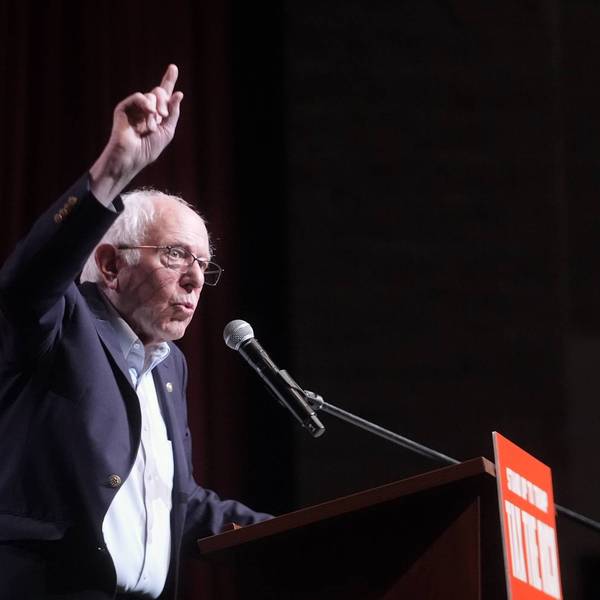
U.S. Sen. Bernie Sanders warned Monday that hawks in both his country and China are pulling the two superpowers into a "disastrous cold war" that threatens to undercut the possibility of cooperation against the worsening global climate emergency.
Sanders (I-Vt.), whose home state suffered catastrophic flooding last month, wrote in an op-ed for The Guardian that "if the United States, China, and other industrialized countries do not come together to dramatically decrease greenhouse gas emissions, the world we leave our children and future generations will become increasingly unhealthy and uninhabitable."
"Now is the time for a radical rethinking of geopolitics to reflect the reality that international cooperation is not only in the best interests of all countries, but is absolutely necessary for the survival of the planet," wrote Sanders.
Tensions between the U.S. and China have risen steadily in recent years as the two nuclear-armed nations have intensified trade restrictions and repeatedly exchanged warnings and threats over Taiwan, which the U.S. arms. Earlier this year, China voiced outrage over U.S. plans to sell nuclear-powered submarines to Australia as part of a new military partnership.
After U.S. Secretary of State Antony Blinken visited Beijing in June, China's foreign ministry said the relationship between the two nations was "at the lowest point since its establishment" and "in a downward spiral." A survey released last week found that 43% of Americans believe it is likely that the U.S. and China will be engaged in "direct military conflict" within the next five years.
"The science is clear: If the U.S., China, and the rest of the planet do not act with greater urgency to dramatically cut carbon emissions, our planet will face enormous and irreversible damage."
In his op-ed, Sanders argued that a deteriorating U.S.-China relationship is disastrous for the world, particularly given that the countries are the two largest contributors to planet-warming greenhouse gas emissions, which are fueling extreme weather that has impacted both the U.S. and China in recent months.
U.S. and Chinese officials
revived bilateral climate talks in July, but they did not come to any concrete agreement.
"The science is clear: If the U.S., China, and the rest of the planet do not act with greater urgency to dramatically cut carbon emissions, our planet will face enormous and irreversible damage," wrote Sanders.
While expressing opposition to China's treatment of the Uyghurs and other policy actions, Sanders argued that "organizing most of our national effort around a zero-sum global confrontation with China is unlikely to change Chinese behavior and will alienate allies and partners."
"Most importantly, it could doom our planet by making climate cooperation impossible between the world's two largest greenhouse emitters," the senator added. "We need to move in a bold new direction."
Sanders noted that both the U.S. and China have exploding military budgets, spending close to $900 billion and $300 billion per year respectively—an "insane dynamic," according to the Vermont senator.
"So here's a 'radical' idea," Sanders added. "Instead of spending enormous amounts of money planning for a war against each other, the U.S. and China should come to an agreement to mutually cut their military budgets and use the savings to move aggressively to improve energy efficiency, move toward sustainable energy, and end our reliance on fossil fuels," Sanders wrote. "They should also provide increased support for developing countries who are suffering from the climate crisis through no fault of their own."
Acknowledging that establishment figures would likely dismiss such a policy recommendation as "naive and unsophisticated," Sanders responded: "Go talk to the people in Vermont who have lost their homes because of unprecedented flooding and the families in Hawaii who lost loved ones in the recent fires. Go talk to the more than 1 million people in China who have been displaced by catastrophic floods. Go talk to the people in southern Africa who are starving because of the terrible drought and floods they are experiencing or farmers around the world who can no longer grow their crops because of water shortages."
"Perhaps most importantly, go talk to the hundreds of millions of young people in every country on Earth who are losing hope, wondering whether they should even have children of their own, given the enormous challenges the climate crisis poses for a normal life," he added. "If we are to save the planet, now is the time for bold action. Let's do it."
Dear Common Dreams reader, It’s been nearly 30 years since I co-founded Common Dreams with my late wife, Lina Newhouser. We had the radical notion that journalism should serve the public good, not corporate profits. It was clear to us from the outset what it would take to build such a project. No paid advertisements. No corporate sponsors. No millionaire publisher telling us what to think or do. Many people said we wouldn't last a year, but we proved those doubters wrong. Together with a tremendous team of journalists and dedicated staff, we built an independent media outlet free from the constraints of profits and corporate control. Our mission has always been simple: To inform. To inspire. To ignite change for the common good. Building Common Dreams was not easy. Our survival was never guaranteed. When you take on the most powerful forces—Wall Street greed, fossil fuel industry destruction, Big Tech lobbyists, and uber-rich oligarchs who have spent billions upon billions rigging the economy and democracy in their favor—the only bulwark you have is supporters who believe in your work. But here’s the urgent message from me today. It's never been this bad out there. And it's never been this hard to keep us going. At the very moment Common Dreams is most needed, the threats we face are intensifying. We need your support now more than ever. We don't accept corporate advertising and never will. We don't have a paywall because we don't think people should be blocked from critical news based on their ability to pay. Everything we do is funded by the donations of readers like you. When everyone does the little they can afford, we are strong. But if that support retreats or dries up, so do we. Will you donate now to make sure Common Dreams not only survives but thrives? —Craig Brown, Co-founder |
U.S. Sen. Bernie Sanders warned Monday that hawks in both his country and China are pulling the two superpowers into a "disastrous cold war" that threatens to undercut the possibility of cooperation against the worsening global climate emergency.
Sanders (I-Vt.), whose home state suffered catastrophic flooding last month, wrote in an op-ed for The Guardian that "if the United States, China, and other industrialized countries do not come together to dramatically decrease greenhouse gas emissions, the world we leave our children and future generations will become increasingly unhealthy and uninhabitable."
"Now is the time for a radical rethinking of geopolitics to reflect the reality that international cooperation is not only in the best interests of all countries, but is absolutely necessary for the survival of the planet," wrote Sanders.
Tensions between the U.S. and China have risen steadily in recent years as the two nuclear-armed nations have intensified trade restrictions and repeatedly exchanged warnings and threats over Taiwan, which the U.S. arms. Earlier this year, China voiced outrage over U.S. plans to sell nuclear-powered submarines to Australia as part of a new military partnership.
After U.S. Secretary of State Antony Blinken visited Beijing in June, China's foreign ministry said the relationship between the two nations was "at the lowest point since its establishment" and "in a downward spiral." A survey released last week found that 43% of Americans believe it is likely that the U.S. and China will be engaged in "direct military conflict" within the next five years.
"The science is clear: If the U.S., China, and the rest of the planet do not act with greater urgency to dramatically cut carbon emissions, our planet will face enormous and irreversible damage."
In his op-ed, Sanders argued that a deteriorating U.S.-China relationship is disastrous for the world, particularly given that the countries are the two largest contributors to planet-warming greenhouse gas emissions, which are fueling extreme weather that has impacted both the U.S. and China in recent months.
U.S. and Chinese officials
revived bilateral climate talks in July, but they did not come to any concrete agreement.
"The science is clear: If the U.S., China, and the rest of the planet do not act with greater urgency to dramatically cut carbon emissions, our planet will face enormous and irreversible damage," wrote Sanders.
While expressing opposition to China's treatment of the Uyghurs and other policy actions, Sanders argued that "organizing most of our national effort around a zero-sum global confrontation with China is unlikely to change Chinese behavior and will alienate allies and partners."
"Most importantly, it could doom our planet by making climate cooperation impossible between the world's two largest greenhouse emitters," the senator added. "We need to move in a bold new direction."
Sanders noted that both the U.S. and China have exploding military budgets, spending close to $900 billion and $300 billion per year respectively—an "insane dynamic," according to the Vermont senator.
"So here's a 'radical' idea," Sanders added. "Instead of spending enormous amounts of money planning for a war against each other, the U.S. and China should come to an agreement to mutually cut their military budgets and use the savings to move aggressively to improve energy efficiency, move toward sustainable energy, and end our reliance on fossil fuels," Sanders wrote. "They should also provide increased support for developing countries who are suffering from the climate crisis through no fault of their own."
Acknowledging that establishment figures would likely dismiss such a policy recommendation as "naive and unsophisticated," Sanders responded: "Go talk to the people in Vermont who have lost their homes because of unprecedented flooding and the families in Hawaii who lost loved ones in the recent fires. Go talk to the more than 1 million people in China who have been displaced by catastrophic floods. Go talk to the people in southern Africa who are starving because of the terrible drought and floods they are experiencing or farmers around the world who can no longer grow their crops because of water shortages."
"Perhaps most importantly, go talk to the hundreds of millions of young people in every country on Earth who are losing hope, wondering whether they should even have children of their own, given the enormous challenges the climate crisis poses for a normal life," he added. "If we are to save the planet, now is the time for bold action. Let's do it."
U.S. Sen. Bernie Sanders warned Monday that hawks in both his country and China are pulling the two superpowers into a "disastrous cold war" that threatens to undercut the possibility of cooperation against the worsening global climate emergency.
Sanders (I-Vt.), whose home state suffered catastrophic flooding last month, wrote in an op-ed for The Guardian that "if the United States, China, and other industrialized countries do not come together to dramatically decrease greenhouse gas emissions, the world we leave our children and future generations will become increasingly unhealthy and uninhabitable."
"Now is the time for a radical rethinking of geopolitics to reflect the reality that international cooperation is not only in the best interests of all countries, but is absolutely necessary for the survival of the planet," wrote Sanders.
Tensions between the U.S. and China have risen steadily in recent years as the two nuclear-armed nations have intensified trade restrictions and repeatedly exchanged warnings and threats over Taiwan, which the U.S. arms. Earlier this year, China voiced outrage over U.S. plans to sell nuclear-powered submarines to Australia as part of a new military partnership.
After U.S. Secretary of State Antony Blinken visited Beijing in June, China's foreign ministry said the relationship between the two nations was "at the lowest point since its establishment" and "in a downward spiral." A survey released last week found that 43% of Americans believe it is likely that the U.S. and China will be engaged in "direct military conflict" within the next five years.
"The science is clear: If the U.S., China, and the rest of the planet do not act with greater urgency to dramatically cut carbon emissions, our planet will face enormous and irreversible damage."
In his op-ed, Sanders argued that a deteriorating U.S.-China relationship is disastrous for the world, particularly given that the countries are the two largest contributors to planet-warming greenhouse gas emissions, which are fueling extreme weather that has impacted both the U.S. and China in recent months.
U.S. and Chinese officials
revived bilateral climate talks in July, but they did not come to any concrete agreement.
"The science is clear: If the U.S., China, and the rest of the planet do not act with greater urgency to dramatically cut carbon emissions, our planet will face enormous and irreversible damage," wrote Sanders.
While expressing opposition to China's treatment of the Uyghurs and other policy actions, Sanders argued that "organizing most of our national effort around a zero-sum global confrontation with China is unlikely to change Chinese behavior and will alienate allies and partners."
"Most importantly, it could doom our planet by making climate cooperation impossible between the world's two largest greenhouse emitters," the senator added. "We need to move in a bold new direction."
Sanders noted that both the U.S. and China have exploding military budgets, spending close to $900 billion and $300 billion per year respectively—an "insane dynamic," according to the Vermont senator.
"So here's a 'radical' idea," Sanders added. "Instead of spending enormous amounts of money planning for a war against each other, the U.S. and China should come to an agreement to mutually cut their military budgets and use the savings to move aggressively to improve energy efficiency, move toward sustainable energy, and end our reliance on fossil fuels," Sanders wrote. "They should also provide increased support for developing countries who are suffering from the climate crisis through no fault of their own."
Acknowledging that establishment figures would likely dismiss such a policy recommendation as "naive and unsophisticated," Sanders responded: "Go talk to the people in Vermont who have lost their homes because of unprecedented flooding and the families in Hawaii who lost loved ones in the recent fires. Go talk to the more than 1 million people in China who have been displaced by catastrophic floods. Go talk to the people in southern Africa who are starving because of the terrible drought and floods they are experiencing or farmers around the world who can no longer grow their crops because of water shortages."
"Perhaps most importantly, go talk to the hundreds of millions of young people in every country on Earth who are losing hope, wondering whether they should even have children of their own, given the enormous challenges the climate crisis poses for a normal life," he added. "If we are to save the planet, now is the time for bold action. Let's do it."