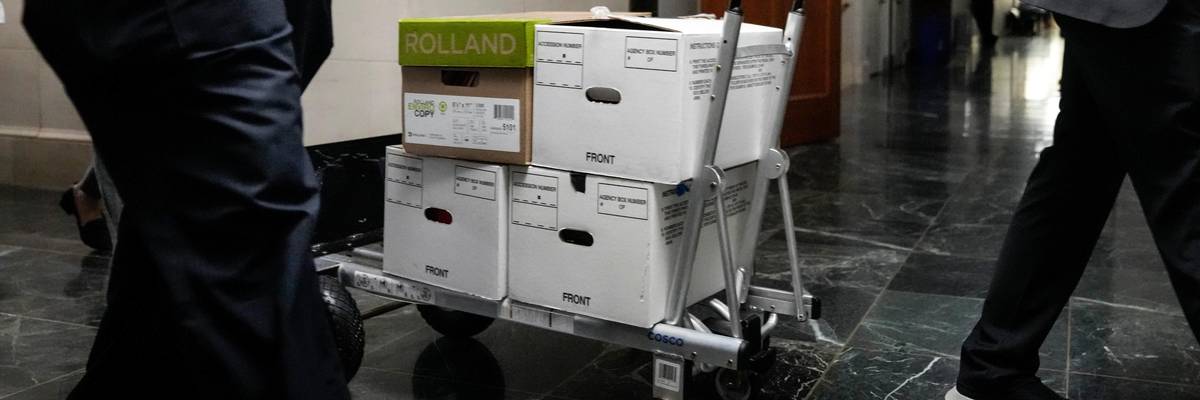
Staffers move boxes of documents from a hearing room to the office of the House Ways and Means Committee on December 20, 2022 in Washington, D.C.
House Panel Releases Six Years of Donald Trump's Tax Returns
"Trump used questionable or poorly substantiated deductions and a number of other tax avoidance schemes as justification to pay little or no federal income tax," said one House Democrat.
After a protracted legal fight and relentless obstruction by the former president, the House Ways and Means Committee on Friday finally released six years of Donald Trump's individual and business tax returns.
"It is a bittersweet moment," Rep. Bill Pascrell (D-N.J.), a member of the House Ways and Means Oversight Subcommittee, wrote on Twitter, lamenting how long it took for lawmakers to obtain the documents and make them public. "I will read through them today and you should too. Every American deserves this sunlight. This is what democracy is about."
A download link for the returns, which span 2015 to 2020 and are redacted to conceal sensitive personal information such as Social Security numbers, is here (warning: the file is very large—1.1 GB—and in ZIP format).
Citizens for Responsibility and Ethics in Washington (CREW) also published the documents as more easily downloadable PDFs on its website.
The long-awaited release of the documents came after the House Ways and Means Committee voted last week to make them public. The committee also published a summary confirming that Trump—who broke with longstanding tradition by refusing to release the documents voluntarily—paid just $750 in federal income taxes in 2016 and 2017 and $0 in 2020.
The summary made clear that Trump turned to avoidance tactics that the ultra-rich often use to slash their tax bills. In the years covered by the newly published documents, the former president reported massive net operating losses, allowing him to dramatically reduce or completely zero out his tax liabilities.
The House committee, which Democrats control until next week, also revealed earlier this month that the IRS didn't begin auditing Trump's taxes until 2019, despite the agency's mandatory presidential audit policy.
"Trump acted as though he had something to hide, a pattern consistent with the recent conviction of his family business for criminal tax fraud," Rep. Don Beyer (D-Va.), a member of the House tax panel, said in a statement Friday. "As the public will now be able to see, Trump used questionable or poorly substantiated deductions and a number of other tax avoidance schemes as justification to pay little or no federal income tax in several of the years examined."
"These findings underscore the fact that our tax laws are often inequitable, and that enforcement of them is often unjust," Beyer continued. "Trump was able to bypass even the mandatory IRS presidential audit program for years, but many other wealthy and powerful people evade billions in tax dues every year through more quotidian tax avoidance. Congress has so much work to do to make tax enforcement in this country fairer."
In response to the release of his returns, Trump—a 2024 presidential candidate—proudly touted his expansive use of deductions to lower his tax bills.
"The 'Trump' tax returns once again show how proudly successful I have been and how I have been able to use depreciation and various other tax deductions as an incentive for creating thousands of jobs and magnificent structures and enterprises," the former president said.
"The radical, left Democrats have weaponized everything," he fumed, "but remember, that is a dangerous two-way street!"
The former president's returns show that he personally benefited from some of the provisions of the tax-cut measure he signed into law in 2017. As Bloomberg noted, Trump took advantage of the law's "expanded write-offs for business expenses" and "the scaling back of the alternative minimum tax, or AMT, allowing him to claim more individual deductions."
"Trump acted as though he had something to hide, a pattern consistent with the recent conviction of his family business for criminal tax fraud."
Writing for The Atlantic on Friday, CREW president Noah Bookbinder urged the Senate Finance Committee to investigate the IRS' failure to audit Trump in the early years of his presidency.
"The public needs to know whether one more key government function was politicized, allowing a president to shield possible conflicts of interest and escape accountability," Bookbinder wrote. "The American people need reassurances that transparency, oversight, and accountability will once again become matters of course rather than subjects of prolonged litigation."
"Donald Trump attempted to hijack the United States government to keep himself in power, and American democracy almost didn't survive," he added. "His tax returns may have been another part of that effort. That merits investigation—not over another six years, but now."
We are at a crossroads
This country and this world are at a monumental crossroads. In a few short weeks, US voters will have an opportunity to beat back the forces of fascism and confront the billionaires who are rigging the economy, our media system, and our democracy, making it increasingly impossible for ordinary people to get by. We’re not just talking about the election. We’re talking about what must be done once these fascist elements are vanquished from power. We need a bolder set of solutions than what either major party has so far been willing to offer and a working-class movement ready to fight like hell for it. Trump didn't emerge from nowhere. The conditions that fueled MAGA authoritarianism were created by decades of radical neoliberal economic policies and a corrupt political system dominated by corporate interests. They slashed taxes on the super-rich, promising that the benefits would trickle down. They said giveaways to the corporate titans would make life more affordable for the rest of us. It was all bullshit. And when a bitter, betrayed populace searches for someone to blame, right-wing demagogues have little trouble finding scapegoats. People know when they're being lied to, but you won't hear any of this from the corporate media. Only independent journalism—powered and funded by people who believe in building a better world—can deliver truly trustworthy daily news. Our Fall Campaign is underway, and we need your help. To power our newsroom through the rest of the year, we need to raise $125,000 by midnight on October 31. So if you share our vision, please contribute whatever you can to sustain our work. |
After a protracted legal fight and relentless obstruction by the former president, the House Ways and Means Committee on Friday finally released six years of Donald Trump's individual and business tax returns.
"It is a bittersweet moment," Rep. Bill Pascrell (D-N.J.), a member of the House Ways and Means Oversight Subcommittee, wrote on Twitter, lamenting how long it took for lawmakers to obtain the documents and make them public. "I will read through them today and you should too. Every American deserves this sunlight. This is what democracy is about."
A download link for the returns, which span 2015 to 2020 and are redacted to conceal sensitive personal information such as Social Security numbers, is here (warning: the file is very large—1.1 GB—and in ZIP format).
Citizens for Responsibility and Ethics in Washington (CREW) also published the documents as more easily downloadable PDFs on its website.
The long-awaited release of the documents came after the House Ways and Means Committee voted last week to make them public. The committee also published a summary confirming that Trump—who broke with longstanding tradition by refusing to release the documents voluntarily—paid just $750 in federal income taxes in 2016 and 2017 and $0 in 2020.
The summary made clear that Trump turned to avoidance tactics that the ultra-rich often use to slash their tax bills. In the years covered by the newly published documents, the former president reported massive net operating losses, allowing him to dramatically reduce or completely zero out his tax liabilities.
The House committee, which Democrats control until next week, also revealed earlier this month that the IRS didn't begin auditing Trump's taxes until 2019, despite the agency's mandatory presidential audit policy.
"Trump acted as though he had something to hide, a pattern consistent with the recent conviction of his family business for criminal tax fraud," Rep. Don Beyer (D-Va.), a member of the House tax panel, said in a statement Friday. "As the public will now be able to see, Trump used questionable or poorly substantiated deductions and a number of other tax avoidance schemes as justification to pay little or no federal income tax in several of the years examined."
"These findings underscore the fact that our tax laws are often inequitable, and that enforcement of them is often unjust," Beyer continued. "Trump was able to bypass even the mandatory IRS presidential audit program for years, but many other wealthy and powerful people evade billions in tax dues every year through more quotidian tax avoidance. Congress has so much work to do to make tax enforcement in this country fairer."
In response to the release of his returns, Trump—a 2024 presidential candidate—proudly touted his expansive use of deductions to lower his tax bills.
"The 'Trump' tax returns once again show how proudly successful I have been and how I have been able to use depreciation and various other tax deductions as an incentive for creating thousands of jobs and magnificent structures and enterprises," the former president said.
"The radical, left Democrats have weaponized everything," he fumed, "but remember, that is a dangerous two-way street!"
The former president's returns show that he personally benefited from some of the provisions of the tax-cut measure he signed into law in 2017. As Bloomberg noted, Trump took advantage of the law's "expanded write-offs for business expenses" and "the scaling back of the alternative minimum tax, or AMT, allowing him to claim more individual deductions."
"Trump acted as though he had something to hide, a pattern consistent with the recent conviction of his family business for criminal tax fraud."
Writing for The Atlantic on Friday, CREW president Noah Bookbinder urged the Senate Finance Committee to investigate the IRS' failure to audit Trump in the early years of his presidency.
"The public needs to know whether one more key government function was politicized, allowing a president to shield possible conflicts of interest and escape accountability," Bookbinder wrote. "The American people need reassurances that transparency, oversight, and accountability will once again become matters of course rather than subjects of prolonged litigation."
"Donald Trump attempted to hijack the United States government to keep himself in power, and American democracy almost didn't survive," he added. "His tax returns may have been another part of that effort. That merits investigation—not over another six years, but now."
- Top Democrat Suggests Trump Tax Returns Resemble 'Those of Many Other Wealthy Tax Cheats' ›
- US Supreme Court Denies Trump's Bid to Keep Tax Returns From House Committee ›
- 'A Good Day': House Dems Vote to Make Trump Tax Returns Public ›
- On Greed and Tax Avoidance, Says Bernie Sanders, 'Trump Is Not Alone' ›
After a protracted legal fight and relentless obstruction by the former president, the House Ways and Means Committee on Friday finally released six years of Donald Trump's individual and business tax returns.
"It is a bittersweet moment," Rep. Bill Pascrell (D-N.J.), a member of the House Ways and Means Oversight Subcommittee, wrote on Twitter, lamenting how long it took for lawmakers to obtain the documents and make them public. "I will read through them today and you should too. Every American deserves this sunlight. This is what democracy is about."
A download link for the returns, which span 2015 to 2020 and are redacted to conceal sensitive personal information such as Social Security numbers, is here (warning: the file is very large—1.1 GB—and in ZIP format).
Citizens for Responsibility and Ethics in Washington (CREW) also published the documents as more easily downloadable PDFs on its website.
The long-awaited release of the documents came after the House Ways and Means Committee voted last week to make them public. The committee also published a summary confirming that Trump—who broke with longstanding tradition by refusing to release the documents voluntarily—paid just $750 in federal income taxes in 2016 and 2017 and $0 in 2020.
The summary made clear that Trump turned to avoidance tactics that the ultra-rich often use to slash their tax bills. In the years covered by the newly published documents, the former president reported massive net operating losses, allowing him to dramatically reduce or completely zero out his tax liabilities.
The House committee, which Democrats control until next week, also revealed earlier this month that the IRS didn't begin auditing Trump's taxes until 2019, despite the agency's mandatory presidential audit policy.
"Trump acted as though he had something to hide, a pattern consistent with the recent conviction of his family business for criminal tax fraud," Rep. Don Beyer (D-Va.), a member of the House tax panel, said in a statement Friday. "As the public will now be able to see, Trump used questionable or poorly substantiated deductions and a number of other tax avoidance schemes as justification to pay little or no federal income tax in several of the years examined."
"These findings underscore the fact that our tax laws are often inequitable, and that enforcement of them is often unjust," Beyer continued. "Trump was able to bypass even the mandatory IRS presidential audit program for years, but many other wealthy and powerful people evade billions in tax dues every year through more quotidian tax avoidance. Congress has so much work to do to make tax enforcement in this country fairer."
In response to the release of his returns, Trump—a 2024 presidential candidate—proudly touted his expansive use of deductions to lower his tax bills.
"The 'Trump' tax returns once again show how proudly successful I have been and how I have been able to use depreciation and various other tax deductions as an incentive for creating thousands of jobs and magnificent structures and enterprises," the former president said.
"The radical, left Democrats have weaponized everything," he fumed, "but remember, that is a dangerous two-way street!"
The former president's returns show that he personally benefited from some of the provisions of the tax-cut measure he signed into law in 2017. As Bloomberg noted, Trump took advantage of the law's "expanded write-offs for business expenses" and "the scaling back of the alternative minimum tax, or AMT, allowing him to claim more individual deductions."
"Trump acted as though he had something to hide, a pattern consistent with the recent conviction of his family business for criminal tax fraud."
Writing for The Atlantic on Friday, CREW president Noah Bookbinder urged the Senate Finance Committee to investigate the IRS' failure to audit Trump in the early years of his presidency.
"The public needs to know whether one more key government function was politicized, allowing a president to shield possible conflicts of interest and escape accountability," Bookbinder wrote. "The American people need reassurances that transparency, oversight, and accountability will once again become matters of course rather than subjects of prolonged litigation."
"Donald Trump attempted to hijack the United States government to keep himself in power, and American democracy almost didn't survive," he added. "His tax returns may have been another part of that effort. That merits investigation—not over another six years, but now."
- Top Democrat Suggests Trump Tax Returns Resemble 'Those of Many Other Wealthy Tax Cheats' ›
- US Supreme Court Denies Trump's Bid to Keep Tax Returns From House Committee ›
- 'A Good Day': House Dems Vote to Make Trump Tax Returns Public ›
- On Greed and Tax Avoidance, Says Bernie Sanders, 'Trump Is Not Alone' ›