SUBSCRIBE TO OUR FREE NEWSLETTER
Daily news & progressive opinion—funded by the people, not the corporations—delivered straight to your inbox.
5
#000000
#FFFFFF
To donate by check, phone, or other method, see our More Ways to Give page.
Daily news & progressive opinion—funded by the people, not the corporations—delivered straight to your inbox.
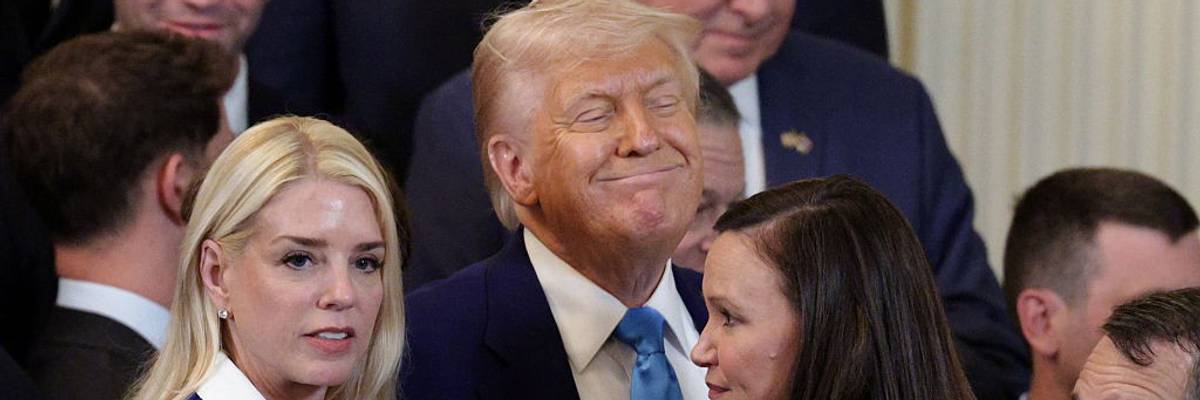
U.S. President Donald Trump, Attorney General Pam Bondi (L), and Sen. Ashley Moody (R-Fla.) attend an event in the East Room of the White House on May 21, 2025 in Washington, D.C.
"There has never been a more urgent time for the ABA to defend its members, our profession and the rule of law itself," said the group's president.
The American Bar Association sued U.S. President Donald Trump's administration in a Washington, D.C. federal court on Monday over what the ABA called his "law firm intimidation policy."
"Since taking office earlier this year, President Trump has used the vast powers of the executive branch to coerce lawyers and law firms to abandon clients, causes, and policy positions the president does not like," states the ABA complaint, which names various entities and leaders in the administration as defendants.
The document lays out how the administration has carried out this policy using "executive orders designed to severely damage particular law firms and intimidate other firms and lawyers," as well as "'deals' or 'settlements' between the administration and certain law firms in order to avoid such orders or have them rescinded."
Trump's administration has also relied on "other related executive orders, letters, and memoranda," and "public statements by the president and his administration publicizing the objectives of the law firm intimidation policy," the complaint details. "The president's attacks on law firms through the faw firm orders are thus not isolated events, but one component of a broader, deliberate policy designed to intimidate and coerce law firms and lawyers to refrain from challenging the president or his administration in court, or from even speaking publicly in support of policies or causes that the president does not like."
The filing stresses that "without skilled lawyers to bring and argue cases—and to do so by advancing the interests of their clients without fear of reprisal from the government—the judiciary cannot function as a meaningful check on executive overreach."
Some firms are already fighting back against Trump's attacks, which the ABA called "unprecedented and uniquely dangerous to the rule of law." As Bloomberg detailed Monday:
Three firms hit with executive orders—Perkins Coie, Jenner & Block, and WilmerHale—later obtained permanent injunctions against the executive orders, with judges striking them down as unconstitutional. Susman has obtained a temporary injunction and is awaiting a ruling on a request for a final decision.
Nine other firms have pledged a total of nearly $1 billion in free legal services as part of deals to avoid similar orders. They committed to working on causes championed by Trump, including combating antisemitism, assisting veterans, and ensuring fairness" in the justice system.
After powerhouse firm Paul Weiss struck a deal with Trump, eight others—A&O Shearman, Cadwalader, Kirkland & Ellis, Latham & Watkins, Milbank, Simpson Thacher, Skadden Arps, and Wilkie Farr—followed suit. The firms have faced intense criticism for the agreements.
Meanwhile, as the ABA filing points out, "public reporting demonstrates that the chill on the legal profession—and particularly on 'Big Law' firms—has not been relieved by these favorable rulings. 504 law firms filed an amicus brief in support of Perkins' motion for summary judgment. As was widely reported, though, none of the top 25 U.S. law firms by revenue signed the brief, and fewer than 10 of the top 100 firms (the AmLaw 100) signed."
"By the time Susman filed its motion for summary judgment, four different judges had enjoined executive orders targeting law firms as likely unconstitutional," the complaint adds. "Yet still, fewer than 10 of the AmLaw 100 firms signed the brief in support of Susman, and none of the top 25 firms did."
The complaint also highlights other impacts, including that "many attorneys are no longer willing to take on representations that would require suing the federal government," and "others have dropped ongoing representations; ended their participation in
contemplated cases; or declined representations—even of clients with whom they had longstanding prior attorney-client relationships—not because the merits of the case were weak or the attorney had some substantive objection to taking the case, but because the representation was deemed too likely to result in severe retaliation from the president."
"Public interest attorneys who rely on their partnership with and representation by law firms—particularly in time- and resource-intensive pro bono cases—have not brought cases that they otherwise would have because their choice of counsel has been compromised," the filing says. "Still others have abstained from expression related to their prior representations that they would otherwise have engaged in, or even removed existing writings related to past representations from the public sphere."
"And those attorneys who do intend to proceed with work disfavored by the president now do so under the objective threat of potentially devastating retaliation pursuant to the policy, with all the severe harm, expense, and distraction that accompany such threat," the document warns. "All such harms are already happening; are ongoing; and will continue in the absence of relief from the court."
While the White House hasn't yet commented on ABA v. Executive Office of the President et al., William R. Bay, president of the association, said in a Monday statement that "this is the time to stand up, speak out and seek relief from our courts... There has never been a more urgent time for the ABA to defend its members, our profession, and the rule of law itself."
This is not the legal group's only case against the administration. Bloomberg noted that "the ABA earlier this year laid off one-third of its workforce after the Trump administration cut $69 million of its grant funding. The organization is waging another suit against the Justice Department as it tries to cut another $3.2 million in federal grants."
Dear Common Dreams reader, It’s been nearly 30 years since I co-founded Common Dreams with my late wife, Lina Newhouser. We had the radical notion that journalism should serve the public good, not corporate profits. It was clear to us from the outset what it would take to build such a project. No paid advertisements. No corporate sponsors. No millionaire publisher telling us what to think or do. Many people said we wouldn't last a year, but we proved those doubters wrong. Together with a tremendous team of journalists and dedicated staff, we built an independent media outlet free from the constraints of profits and corporate control. Our mission has always been simple: To inform. To inspire. To ignite change for the common good. Building Common Dreams was not easy. Our survival was never guaranteed. When you take on the most powerful forces—Wall Street greed, fossil fuel industry destruction, Big Tech lobbyists, and uber-rich oligarchs who have spent billions upon billions rigging the economy and democracy in their favor—the only bulwark you have is supporters who believe in your work. But here’s the urgent message from me today. It's never been this bad out there. And it's never been this hard to keep us going. At the very moment Common Dreams is most needed, the threats we face are intensifying. We need your support now more than ever. We don't accept corporate advertising and never will. We don't have a paywall because we don't think people should be blocked from critical news based on their ability to pay. Everything we do is funded by the donations of readers like you. When everyone does the little they can afford, we are strong. But if that support retreats or dries up, so do we. Will you donate now to make sure Common Dreams not only survives but thrives? —Craig Brown, Co-founder |
The American Bar Association sued U.S. President Donald Trump's administration in a Washington, D.C. federal court on Monday over what the ABA called his "law firm intimidation policy."
"Since taking office earlier this year, President Trump has used the vast powers of the executive branch to coerce lawyers and law firms to abandon clients, causes, and policy positions the president does not like," states the ABA complaint, which names various entities and leaders in the administration as defendants.
The document lays out how the administration has carried out this policy using "executive orders designed to severely damage particular law firms and intimidate other firms and lawyers," as well as "'deals' or 'settlements' between the administration and certain law firms in order to avoid such orders or have them rescinded."
Trump's administration has also relied on "other related executive orders, letters, and memoranda," and "public statements by the president and his administration publicizing the objectives of the law firm intimidation policy," the complaint details. "The president's attacks on law firms through the faw firm orders are thus not isolated events, but one component of a broader, deliberate policy designed to intimidate and coerce law firms and lawyers to refrain from challenging the president or his administration in court, or from even speaking publicly in support of policies or causes that the president does not like."
The filing stresses that "without skilled lawyers to bring and argue cases—and to do so by advancing the interests of their clients without fear of reprisal from the government—the judiciary cannot function as a meaningful check on executive overreach."
Some firms are already fighting back against Trump's attacks, which the ABA called "unprecedented and uniquely dangerous to the rule of law." As Bloomberg detailed Monday:
Three firms hit with executive orders—Perkins Coie, Jenner & Block, and WilmerHale—later obtained permanent injunctions against the executive orders, with judges striking them down as unconstitutional. Susman has obtained a temporary injunction and is awaiting a ruling on a request for a final decision.
Nine other firms have pledged a total of nearly $1 billion in free legal services as part of deals to avoid similar orders. They committed to working on causes championed by Trump, including combating antisemitism, assisting veterans, and ensuring fairness" in the justice system.
After powerhouse firm Paul Weiss struck a deal with Trump, eight others—A&O Shearman, Cadwalader, Kirkland & Ellis, Latham & Watkins, Milbank, Simpson Thacher, Skadden Arps, and Wilkie Farr—followed suit. The firms have faced intense criticism for the agreements.
Meanwhile, as the ABA filing points out, "public reporting demonstrates that the chill on the legal profession—and particularly on 'Big Law' firms—has not been relieved by these favorable rulings. 504 law firms filed an amicus brief in support of Perkins' motion for summary judgment. As was widely reported, though, none of the top 25 U.S. law firms by revenue signed the brief, and fewer than 10 of the top 100 firms (the AmLaw 100) signed."
"By the time Susman filed its motion for summary judgment, four different judges had enjoined executive orders targeting law firms as likely unconstitutional," the complaint adds. "Yet still, fewer than 10 of the AmLaw 100 firms signed the brief in support of Susman, and none of the top 25 firms did."
The complaint also highlights other impacts, including that "many attorneys are no longer willing to take on representations that would require suing the federal government," and "others have dropped ongoing representations; ended their participation in
contemplated cases; or declined representations—even of clients with whom they had longstanding prior attorney-client relationships—not because the merits of the case were weak or the attorney had some substantive objection to taking the case, but because the representation was deemed too likely to result in severe retaliation from the president."
"Public interest attorneys who rely on their partnership with and representation by law firms—particularly in time- and resource-intensive pro bono cases—have not brought cases that they otherwise would have because their choice of counsel has been compromised," the filing says. "Still others have abstained from expression related to their prior representations that they would otherwise have engaged in, or even removed existing writings related to past representations from the public sphere."
"And those attorneys who do intend to proceed with work disfavored by the president now do so under the objective threat of potentially devastating retaliation pursuant to the policy, with all the severe harm, expense, and distraction that accompany such threat," the document warns. "All such harms are already happening; are ongoing; and will continue in the absence of relief from the court."
While the White House hasn't yet commented on ABA v. Executive Office of the President et al., William R. Bay, president of the association, said in a Monday statement that "this is the time to stand up, speak out and seek relief from our courts... There has never been a more urgent time for the ABA to defend its members, our profession, and the rule of law itself."
This is not the legal group's only case against the administration. Bloomberg noted that "the ABA earlier this year laid off one-third of its workforce after the Trump administration cut $69 million of its grant funding. The organization is waging another suit against the Justice Department as it tries to cut another $3.2 million in federal grants."
The American Bar Association sued U.S. President Donald Trump's administration in a Washington, D.C. federal court on Monday over what the ABA called his "law firm intimidation policy."
"Since taking office earlier this year, President Trump has used the vast powers of the executive branch to coerce lawyers and law firms to abandon clients, causes, and policy positions the president does not like," states the ABA complaint, which names various entities and leaders in the administration as defendants.
The document lays out how the administration has carried out this policy using "executive orders designed to severely damage particular law firms and intimidate other firms and lawyers," as well as "'deals' or 'settlements' between the administration and certain law firms in order to avoid such orders or have them rescinded."
Trump's administration has also relied on "other related executive orders, letters, and memoranda," and "public statements by the president and his administration publicizing the objectives of the law firm intimidation policy," the complaint details. "The president's attacks on law firms through the faw firm orders are thus not isolated events, but one component of a broader, deliberate policy designed to intimidate and coerce law firms and lawyers to refrain from challenging the president or his administration in court, or from even speaking publicly in support of policies or causes that the president does not like."
The filing stresses that "without skilled lawyers to bring and argue cases—and to do so by advancing the interests of their clients without fear of reprisal from the government—the judiciary cannot function as a meaningful check on executive overreach."
Some firms are already fighting back against Trump's attacks, which the ABA called "unprecedented and uniquely dangerous to the rule of law." As Bloomberg detailed Monday:
Three firms hit with executive orders—Perkins Coie, Jenner & Block, and WilmerHale—later obtained permanent injunctions against the executive orders, with judges striking them down as unconstitutional. Susman has obtained a temporary injunction and is awaiting a ruling on a request for a final decision.
Nine other firms have pledged a total of nearly $1 billion in free legal services as part of deals to avoid similar orders. They committed to working on causes championed by Trump, including combating antisemitism, assisting veterans, and ensuring fairness" in the justice system.
After powerhouse firm Paul Weiss struck a deal with Trump, eight others—A&O Shearman, Cadwalader, Kirkland & Ellis, Latham & Watkins, Milbank, Simpson Thacher, Skadden Arps, and Wilkie Farr—followed suit. The firms have faced intense criticism for the agreements.
Meanwhile, as the ABA filing points out, "public reporting demonstrates that the chill on the legal profession—and particularly on 'Big Law' firms—has not been relieved by these favorable rulings. 504 law firms filed an amicus brief in support of Perkins' motion for summary judgment. As was widely reported, though, none of the top 25 U.S. law firms by revenue signed the brief, and fewer than 10 of the top 100 firms (the AmLaw 100) signed."
"By the time Susman filed its motion for summary judgment, four different judges had enjoined executive orders targeting law firms as likely unconstitutional," the complaint adds. "Yet still, fewer than 10 of the AmLaw 100 firms signed the brief in support of Susman, and none of the top 25 firms did."
The complaint also highlights other impacts, including that "many attorneys are no longer willing to take on representations that would require suing the federal government," and "others have dropped ongoing representations; ended their participation in
contemplated cases; or declined representations—even of clients with whom they had longstanding prior attorney-client relationships—not because the merits of the case were weak or the attorney had some substantive objection to taking the case, but because the representation was deemed too likely to result in severe retaliation from the president."
"Public interest attorneys who rely on their partnership with and representation by law firms—particularly in time- and resource-intensive pro bono cases—have not brought cases that they otherwise would have because their choice of counsel has been compromised," the filing says. "Still others have abstained from expression related to their prior representations that they would otherwise have engaged in, or even removed existing writings related to past representations from the public sphere."
"And those attorneys who do intend to proceed with work disfavored by the president now do so under the objective threat of potentially devastating retaliation pursuant to the policy, with all the severe harm, expense, and distraction that accompany such threat," the document warns. "All such harms are already happening; are ongoing; and will continue in the absence of relief from the court."
While the White House hasn't yet commented on ABA v. Executive Office of the President et al., William R. Bay, president of the association, said in a Monday statement that "this is the time to stand up, speak out and seek relief from our courts... There has never been a more urgent time for the ABA to defend its members, our profession, and the rule of law itself."
This is not the legal group's only case against the administration. Bloomberg noted that "the ABA earlier this year laid off one-third of its workforce after the Trump administration cut $69 million of its grant funding. The organization is waging another suit against the Justice Department as it tries to cut another $3.2 million in federal grants."