SUBSCRIBE TO OUR FREE NEWSLETTER
Daily news & progressive opinion—funded by the people, not the corporations—delivered straight to your inbox.
5
#000000
#FFFFFF
To donate by check, phone, or other method, see our More Ways to Give page.
Daily news & progressive opinion—funded by the people, not the corporations—delivered straight to your inbox.
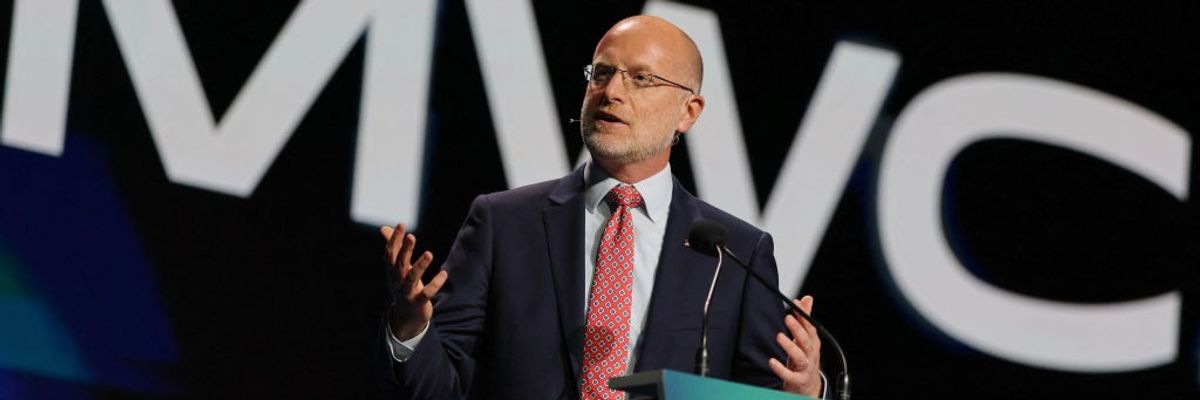
Brendan Carr, chair of the U.S. Federal Communications Commission, delivers a speech during Mobile World Congress in Barcelona, Spain on March 3, 2025.
The 16 groups urge the agency "to uphold its obligation to promote competition, localism, and diversity in the U.S. media."
A coalition of 16 civil liberties, press freedom, and labor groups this week urged U.S. President Donald Trump's administration to abandon any plans to loosen media ownership restrictions and warned against opening the floodgates to further corporate consolidation.
Public comments on the National Television Multiple Ownership Rule were due to the Federal Communications Commission by Monday—which is when the coalition wrote to the FCC about the 39% national audience reach cap for U.S. broadcast media conglomerates, and how more mergers could negatively impact "the independence of the nation's press and the vitality of its local journalism."
"In our experience, the past 30 years of media consolidation have not fostered a better environment for local news and information. The Telecommunications Act of 1996 radically changed the radio and television broadcasting marketplace, causing rapid consolidation of radio station ownership," the coalition detailed. "Since the 1996 act, lawmakers and regulators have further relaxed television ownership limits, spurring further waves of station consolidation, the full harms of which are being felt by local newsrooms and the communities they serve."
The coalition highlighted how this consolidation has spread "across the entire news media ecosystem, including newspapers, online news outlets, and even online platforms," and led to "newsroom layoffs and closures, and the related spread of 'news deserts' across the country."
"Over a similar period, the economic model for news production has been undercut by technology platforms owned by the likes of Alphabet, Amazon, and Meta, which have offered an advertising model for better targeting readers, listeners, and viewers, and attracted much of the advertising revenue that once funded local journalism," the coalition noted.
While "lobbyists working for large news media companies argue that further consolidation is the economic answer, giving them the size necessary to compete with Big Tech," the letter argues, "in fact, the opposite appears to be true."
We object."Handing even more control of the public airwaves to a handful of capitulating broadcast conglomerates undermines press freedom." - S. Derek TurnerOur statement: https://www.freepress.net/news/free-press-slams-trump-fccs-broadcast-ownership-proceeding-wildly-dangerous-democracy
[image or embed]
— Free Press (@freepress.bsky.social) August 5, 2025 at 12:58 PM
The letter points out that a recent analysis from Free Press—one of the groups that signed the letter—found a "pervasive pattern of editorial compromise and capitulation" at 35 of the largest media and tech companies in the United States, "as owners of massive media conglomerates seek to curry favor with political leadership."
That analysis—released last week alongside a Media Capitulation Index—makes clear that "the interests of wealthy media owners have become so inextricably entangled with government officials that they've limited their news operations' ability to act as checks against abuses of political power," according to the coalition.
In addition to warning about further consolidation and urging the FCC "to uphold its obligation to promote competition, localism, and diversity in the U.S. media," the coalition argued that the agency actually "lacks the authority to change the national audience reach cap," citing congressional action in 2004.
Along with Free Press co-CEO Craig Aaron, the letter is signed by leaders at Fairness and Accuracy in Reporting, National Association of Broadcast Employees and Technicians - Communications Workers of America, National Coalition Against Censorship, Local Independent Online News Publishers, Media Freedom Foundation, NewsGuild-CWA, Open Markets Institute, Park Center for Independent Media, Project Censored, Reporters Without Borders USA, Society of Professional Journalists, Tully Center for Free Speech, Whistleblower and Source Protection Program at ExposeFacts, and Writers Guild of America East and West.
Free Press also filed its own comments. In a related Tuesday statement, senior economic and policy adviser S. Derek Turner, who co-authored the filing, accused FCC Chair Brendan Carr of "placing a for-sale sign on the public airwaves and inviting media companies to monopolize the local news markets as long as they agree to display political fealty to Donald Trump and the MAGA movement."
"The price broadcast companies have to pay for consolidating further is bending the knee, and the line starts outside of the FCC chairman's office," said Turner. "Trump's autocratic demands seemingly have no bounds, and Carr apparently has no qualms about satisfying them. Carr's grossly partisan and deeply hypocritical water-carrying for Trump has already stained the agency, making it clear that this FCC is no longer independent, impartial, or fair."
Dear Common Dreams reader, It’s been nearly 30 years since I co-founded Common Dreams with my late wife, Lina Newhouser. We had the radical notion that journalism should serve the public good, not corporate profits. It was clear to us from the outset what it would take to build such a project. No paid advertisements. No corporate sponsors. No millionaire publisher telling us what to think or do. Many people said we wouldn't last a year, but we proved those doubters wrong. Together with a tremendous team of journalists and dedicated staff, we built an independent media outlet free from the constraints of profits and corporate control. Our mission has always been simple: To inform. To inspire. To ignite change for the common good. Building Common Dreams was not easy. Our survival was never guaranteed. When you take on the most powerful forces—Wall Street greed, fossil fuel industry destruction, Big Tech lobbyists, and uber-rich oligarchs who have spent billions upon billions rigging the economy and democracy in their favor—the only bulwark you have is supporters who believe in your work. But here’s the urgent message from me today. It's never been this bad out there. And it's never been this hard to keep us going. At the very moment Common Dreams is most needed, the threats we face are intensifying. We need your support now more than ever. We don't accept corporate advertising and never will. We don't have a paywall because we don't think people should be blocked from critical news based on their ability to pay. Everything we do is funded by the donations of readers like you. When everyone does the little they can afford, we are strong. But if that support retreats or dries up, so do we. Will you donate now to make sure Common Dreams not only survives but thrives? —Craig Brown, Co-founder |
A coalition of 16 civil liberties, press freedom, and labor groups this week urged U.S. President Donald Trump's administration to abandon any plans to loosen media ownership restrictions and warned against opening the floodgates to further corporate consolidation.
Public comments on the National Television Multiple Ownership Rule were due to the Federal Communications Commission by Monday—which is when the coalition wrote to the FCC about the 39% national audience reach cap for U.S. broadcast media conglomerates, and how more mergers could negatively impact "the independence of the nation's press and the vitality of its local journalism."
"In our experience, the past 30 years of media consolidation have not fostered a better environment for local news and information. The Telecommunications Act of 1996 radically changed the radio and television broadcasting marketplace, causing rapid consolidation of radio station ownership," the coalition detailed. "Since the 1996 act, lawmakers and regulators have further relaxed television ownership limits, spurring further waves of station consolidation, the full harms of which are being felt by local newsrooms and the communities they serve."
The coalition highlighted how this consolidation has spread "across the entire news media ecosystem, including newspapers, online news outlets, and even online platforms," and led to "newsroom layoffs and closures, and the related spread of 'news deserts' across the country."
"Over a similar period, the economic model for news production has been undercut by technology platforms owned by the likes of Alphabet, Amazon, and Meta, which have offered an advertising model for better targeting readers, listeners, and viewers, and attracted much of the advertising revenue that once funded local journalism," the coalition noted.
While "lobbyists working for large news media companies argue that further consolidation is the economic answer, giving them the size necessary to compete with Big Tech," the letter argues, "in fact, the opposite appears to be true."
We object."Handing even more control of the public airwaves to a handful of capitulating broadcast conglomerates undermines press freedom." - S. Derek TurnerOur statement: https://www.freepress.net/news/free-press-slams-trump-fccs-broadcast-ownership-proceeding-wildly-dangerous-democracy
[image or embed]
— Free Press (@freepress.bsky.social) August 5, 2025 at 12:58 PM
The letter points out that a recent analysis from Free Press—one of the groups that signed the letter—found a "pervasive pattern of editorial compromise and capitulation" at 35 of the largest media and tech companies in the United States, "as owners of massive media conglomerates seek to curry favor with political leadership."
That analysis—released last week alongside a Media Capitulation Index—makes clear that "the interests of wealthy media owners have become so inextricably entangled with government officials that they've limited their news operations' ability to act as checks against abuses of political power," according to the coalition.
In addition to warning about further consolidation and urging the FCC "to uphold its obligation to promote competition, localism, and diversity in the U.S. media," the coalition argued that the agency actually "lacks the authority to change the national audience reach cap," citing congressional action in 2004.
Along with Free Press co-CEO Craig Aaron, the letter is signed by leaders at Fairness and Accuracy in Reporting, National Association of Broadcast Employees and Technicians - Communications Workers of America, National Coalition Against Censorship, Local Independent Online News Publishers, Media Freedom Foundation, NewsGuild-CWA, Open Markets Institute, Park Center for Independent Media, Project Censored, Reporters Without Borders USA, Society of Professional Journalists, Tully Center for Free Speech, Whistleblower and Source Protection Program at ExposeFacts, and Writers Guild of America East and West.
Free Press also filed its own comments. In a related Tuesday statement, senior economic and policy adviser S. Derek Turner, who co-authored the filing, accused FCC Chair Brendan Carr of "placing a for-sale sign on the public airwaves and inviting media companies to monopolize the local news markets as long as they agree to display political fealty to Donald Trump and the MAGA movement."
"The price broadcast companies have to pay for consolidating further is bending the knee, and the line starts outside of the FCC chairman's office," said Turner. "Trump's autocratic demands seemingly have no bounds, and Carr apparently has no qualms about satisfying them. Carr's grossly partisan and deeply hypocritical water-carrying for Trump has already stained the agency, making it clear that this FCC is no longer independent, impartial, or fair."
A coalition of 16 civil liberties, press freedom, and labor groups this week urged U.S. President Donald Trump's administration to abandon any plans to loosen media ownership restrictions and warned against opening the floodgates to further corporate consolidation.
Public comments on the National Television Multiple Ownership Rule were due to the Federal Communications Commission by Monday—which is when the coalition wrote to the FCC about the 39% national audience reach cap for U.S. broadcast media conglomerates, and how more mergers could negatively impact "the independence of the nation's press and the vitality of its local journalism."
"In our experience, the past 30 years of media consolidation have not fostered a better environment for local news and information. The Telecommunications Act of 1996 radically changed the radio and television broadcasting marketplace, causing rapid consolidation of radio station ownership," the coalition detailed. "Since the 1996 act, lawmakers and regulators have further relaxed television ownership limits, spurring further waves of station consolidation, the full harms of which are being felt by local newsrooms and the communities they serve."
The coalition highlighted how this consolidation has spread "across the entire news media ecosystem, including newspapers, online news outlets, and even online platforms," and led to "newsroom layoffs and closures, and the related spread of 'news deserts' across the country."
"Over a similar period, the economic model for news production has been undercut by technology platforms owned by the likes of Alphabet, Amazon, and Meta, which have offered an advertising model for better targeting readers, listeners, and viewers, and attracted much of the advertising revenue that once funded local journalism," the coalition noted.
While "lobbyists working for large news media companies argue that further consolidation is the economic answer, giving them the size necessary to compete with Big Tech," the letter argues, "in fact, the opposite appears to be true."
We object."Handing even more control of the public airwaves to a handful of capitulating broadcast conglomerates undermines press freedom." - S. Derek TurnerOur statement: https://www.freepress.net/news/free-press-slams-trump-fccs-broadcast-ownership-proceeding-wildly-dangerous-democracy
[image or embed]
— Free Press (@freepress.bsky.social) August 5, 2025 at 12:58 PM
The letter points out that a recent analysis from Free Press—one of the groups that signed the letter—found a "pervasive pattern of editorial compromise and capitulation" at 35 of the largest media and tech companies in the United States, "as owners of massive media conglomerates seek to curry favor with political leadership."
That analysis—released last week alongside a Media Capitulation Index—makes clear that "the interests of wealthy media owners have become so inextricably entangled with government officials that they've limited their news operations' ability to act as checks against abuses of political power," according to the coalition.
In addition to warning about further consolidation and urging the FCC "to uphold its obligation to promote competition, localism, and diversity in the U.S. media," the coalition argued that the agency actually "lacks the authority to change the national audience reach cap," citing congressional action in 2004.
Along with Free Press co-CEO Craig Aaron, the letter is signed by leaders at Fairness and Accuracy in Reporting, National Association of Broadcast Employees and Technicians - Communications Workers of America, National Coalition Against Censorship, Local Independent Online News Publishers, Media Freedom Foundation, NewsGuild-CWA, Open Markets Institute, Park Center for Independent Media, Project Censored, Reporters Without Borders USA, Society of Professional Journalists, Tully Center for Free Speech, Whistleblower and Source Protection Program at ExposeFacts, and Writers Guild of America East and West.
Free Press also filed its own comments. In a related Tuesday statement, senior economic and policy adviser S. Derek Turner, who co-authored the filing, accused FCC Chair Brendan Carr of "placing a for-sale sign on the public airwaves and inviting media companies to monopolize the local news markets as long as they agree to display political fealty to Donald Trump and the MAGA movement."
"The price broadcast companies have to pay for consolidating further is bending the knee, and the line starts outside of the FCC chairman's office," said Turner. "Trump's autocratic demands seemingly have no bounds, and Carr apparently has no qualms about satisfying them. Carr's grossly partisan and deeply hypocritical water-carrying for Trump has already stained the agency, making it clear that this FCC is no longer independent, impartial, or fair."