SUBSCRIBE TO OUR FREE NEWSLETTER
Daily news & progressive opinion—funded by the people, not the corporations—delivered straight to your inbox.
5
#000000
#FFFFFF
To donate by check, phone, or other method, see our More Ways to Give page.
Daily news & progressive opinion—funded by the people, not the corporations—delivered straight to your inbox.
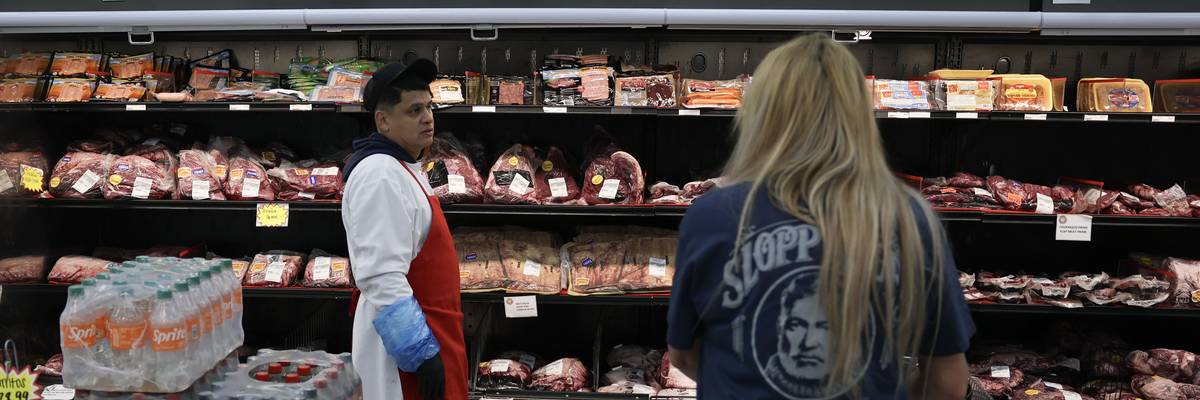
A worker helps a customer shop in the meat aisle in a grocery store on July 22, 2025 in Miami, Florida.
"Get ready for even higher prices for chicken, turkey, and pork," said one antitrust attorney.
US President Donald Trump's Justice Department moved Thursday to settle a Biden-era antitrust lawsuit against the analytics firm Agri Stats, proposing an agreement that critics say would effectively give the stamp of federal approval to meat industry price-fixing schemes.
The Justice Department—now headed by Acting Attorney General Todd Blanche, formerly Trump's personal lawyer—hailed the proposed settlement as a "historic" win over a company whose "business model directly raised the price of chicken, turkey, and pork in local grocery stores across our nation." But critics said the agreement, which must undergo review by a federal judge, would do nothing substantial to rein in price-fixing in the meat industry.
Lee Hepner, senior legal counsel for the American Economic Liberties Project, said the deal "stinks of rotting meat," noting that the settlement was proposed just days before the case was set to go to trial.
"No way does it address the harms," Hepner said of the 79-page settlement. "Agri Stats spent decades hiking prices on over 90% of processed meat in the country. Now they're being told to exercise some discretion going forward."
"It's a gut punch to those who worked on this case for four years thinking it might actually deter these price fixing services from cropping up in every other industry," Hepner added.
The Biden administration brought the antitrust lawsuit against Agri Stats in September 2023, accusing the company and its subsidiary EMI of "collecting, integrating, and distributing competitively sensitive information related to price, cost, and output among competing meat processors."
"While distributing troves of competitively sensitive information among participating processors, Agri Stats withholds its reports from meat purchasers, workers and American consumers, resulting in an information asymmetry that further exacerbates the competitive harm of Agri Stats’ information exchanges," the Biden DOJ said.
"This settlement legalizes meat price-fixing—it just says you have to bring the giant retailers and distributors in on the game."
The Trump Justice Department's settlement would require Agri Stats to "make the vast majority of information" it distributes "available to all interested domestic purchasers on reasonable and non-discriminatory terms," along with several other conditions.
But the settlement states that EMI is not otherwise "prohibited... from continuing to provide EMI Price Reports in substantially the same manner as it did as of April 24, 2026."
Agri Stats noted in a statement Thursday that it "denied all allegations" of illegal conduct and "has admitted no wrongdoing" as part of the settlement. Agri Stats' lead counsel in the case called the deal "a win" for both the company and consumers—a claim that antitrust advocates rejected, calling the agreement blatantly one-sided in the corporation's favor.
"This settlement legalizes meat price-fixing—it just says you have to bring the giant retailers and distributors in on the game," wrote Basel Musharbash, managing attorney at Antimonopoly Counsel. "Get ready for even higher prices for chicken, turkey, and pork."
The proposed Agri Stats settlement is the latest favorable deal that Trump's Justice Department—which is in the grip of lobbyists with ties to the president—has cut with a major corporation accused of illegal price-fixing.
Last November, as Common Dreams reported, the Justice Department agreed to settle a Biden-era lawsuit filed against the real estate software company RealPage, which was accused of an "unlawful scheme to decrease competition among landlords in apartment pricing and to monopolize the market for commercial revenue management software."
RealPage welcomed the settlement, noting that the agreement included "no financial penalties, damages, or findings or admissions of wrongdoing."
Dear Common Dreams reader, It’s been nearly 30 years since I co-founded Common Dreams with my late wife, Lina Newhouser. We had the radical notion that journalism should serve the public good, not corporate profits. It was clear to us from the outset what it would take to build such a project. No paid advertisements. No corporate sponsors. No millionaire publisher telling us what to think or do. Many people said we wouldn't last a year, but we proved those doubters wrong. Together with a tremendous team of journalists and dedicated staff, we built an independent media outlet free from the constraints of profits and corporate control. Our mission has always been simple: To inform. To inspire. To ignite change for the common good. Building Common Dreams was not easy. Our survival was never guaranteed. When you take on the most powerful forces—Wall Street greed, fossil fuel industry destruction, Big Tech lobbyists, and uber-rich oligarchs who have spent billions upon billions rigging the economy and democracy in their favor—the only bulwark you have is supporters who believe in your work. But here’s the urgent message from me today. It's never been this bad out there. And it's never been this hard to keep us going. At the very moment Common Dreams is most needed, the threats we face are intensifying. We need your support now more than ever. We don't accept corporate advertising and never will. We don't have a paywall because we don't think people should be blocked from critical news based on their ability to pay. Everything we do is funded by the donations of readers like you. When everyone does the little they can afford, we are strong. But if that support retreats or dries up, so do we. Will you donate now to make sure Common Dreams not only survives but thrives? —Craig Brown, Co-founder |
US President Donald Trump's Justice Department moved Thursday to settle a Biden-era antitrust lawsuit against the analytics firm Agri Stats, proposing an agreement that critics say would effectively give the stamp of federal approval to meat industry price-fixing schemes.
The Justice Department—now headed by Acting Attorney General Todd Blanche, formerly Trump's personal lawyer—hailed the proposed settlement as a "historic" win over a company whose "business model directly raised the price of chicken, turkey, and pork in local grocery stores across our nation." But critics said the agreement, which must undergo review by a federal judge, would do nothing substantial to rein in price-fixing in the meat industry.
Lee Hepner, senior legal counsel for the American Economic Liberties Project, said the deal "stinks of rotting meat," noting that the settlement was proposed just days before the case was set to go to trial.
"No way does it address the harms," Hepner said of the 79-page settlement. "Agri Stats spent decades hiking prices on over 90% of processed meat in the country. Now they're being told to exercise some discretion going forward."
"It's a gut punch to those who worked on this case for four years thinking it might actually deter these price fixing services from cropping up in every other industry," Hepner added.
The Biden administration brought the antitrust lawsuit against Agri Stats in September 2023, accusing the company and its subsidiary EMI of "collecting, integrating, and distributing competitively sensitive information related to price, cost, and output among competing meat processors."
"While distributing troves of competitively sensitive information among participating processors, Agri Stats withholds its reports from meat purchasers, workers and American consumers, resulting in an information asymmetry that further exacerbates the competitive harm of Agri Stats’ information exchanges," the Biden DOJ said.
"This settlement legalizes meat price-fixing—it just says you have to bring the giant retailers and distributors in on the game."
The Trump Justice Department's settlement would require Agri Stats to "make the vast majority of information" it distributes "available to all interested domestic purchasers on reasonable and non-discriminatory terms," along with several other conditions.
But the settlement states that EMI is not otherwise "prohibited... from continuing to provide EMI Price Reports in substantially the same manner as it did as of April 24, 2026."
Agri Stats noted in a statement Thursday that it "denied all allegations" of illegal conduct and "has admitted no wrongdoing" as part of the settlement. Agri Stats' lead counsel in the case called the deal "a win" for both the company and consumers—a claim that antitrust advocates rejected, calling the agreement blatantly one-sided in the corporation's favor.
"This settlement legalizes meat price-fixing—it just says you have to bring the giant retailers and distributors in on the game," wrote Basel Musharbash, managing attorney at Antimonopoly Counsel. "Get ready for even higher prices for chicken, turkey, and pork."
The proposed Agri Stats settlement is the latest favorable deal that Trump's Justice Department—which is in the grip of lobbyists with ties to the president—has cut with a major corporation accused of illegal price-fixing.
Last November, as Common Dreams reported, the Justice Department agreed to settle a Biden-era lawsuit filed against the real estate software company RealPage, which was accused of an "unlawful scheme to decrease competition among landlords in apartment pricing and to monopolize the market for commercial revenue management software."
RealPage welcomed the settlement, noting that the agreement included "no financial penalties, damages, or findings or admissions of wrongdoing."
US President Donald Trump's Justice Department moved Thursday to settle a Biden-era antitrust lawsuit against the analytics firm Agri Stats, proposing an agreement that critics say would effectively give the stamp of federal approval to meat industry price-fixing schemes.
The Justice Department—now headed by Acting Attorney General Todd Blanche, formerly Trump's personal lawyer—hailed the proposed settlement as a "historic" win over a company whose "business model directly raised the price of chicken, turkey, and pork in local grocery stores across our nation." But critics said the agreement, which must undergo review by a federal judge, would do nothing substantial to rein in price-fixing in the meat industry.
Lee Hepner, senior legal counsel for the American Economic Liberties Project, said the deal "stinks of rotting meat," noting that the settlement was proposed just days before the case was set to go to trial.
"No way does it address the harms," Hepner said of the 79-page settlement. "Agri Stats spent decades hiking prices on over 90% of processed meat in the country. Now they're being told to exercise some discretion going forward."
"It's a gut punch to those who worked on this case for four years thinking it might actually deter these price fixing services from cropping up in every other industry," Hepner added.
The Biden administration brought the antitrust lawsuit against Agri Stats in September 2023, accusing the company and its subsidiary EMI of "collecting, integrating, and distributing competitively sensitive information related to price, cost, and output among competing meat processors."
"While distributing troves of competitively sensitive information among participating processors, Agri Stats withholds its reports from meat purchasers, workers and American consumers, resulting in an information asymmetry that further exacerbates the competitive harm of Agri Stats’ information exchanges," the Biden DOJ said.
"This settlement legalizes meat price-fixing—it just says you have to bring the giant retailers and distributors in on the game."
The Trump Justice Department's settlement would require Agri Stats to "make the vast majority of information" it distributes "available to all interested domestic purchasers on reasonable and non-discriminatory terms," along with several other conditions.
But the settlement states that EMI is not otherwise "prohibited... from continuing to provide EMI Price Reports in substantially the same manner as it did as of April 24, 2026."
Agri Stats noted in a statement Thursday that it "denied all allegations" of illegal conduct and "has admitted no wrongdoing" as part of the settlement. Agri Stats' lead counsel in the case called the deal "a win" for both the company and consumers—a claim that antitrust advocates rejected, calling the agreement blatantly one-sided in the corporation's favor.
"This settlement legalizes meat price-fixing—it just says you have to bring the giant retailers and distributors in on the game," wrote Basel Musharbash, managing attorney at Antimonopoly Counsel. "Get ready for even higher prices for chicken, turkey, and pork."
The proposed Agri Stats settlement is the latest favorable deal that Trump's Justice Department—which is in the grip of lobbyists with ties to the president—has cut with a major corporation accused of illegal price-fixing.
Last November, as Common Dreams reported, the Justice Department agreed to settle a Biden-era lawsuit filed against the real estate software company RealPage, which was accused of an "unlawful scheme to decrease competition among landlords in apartment pricing and to monopolize the market for commercial revenue management software."
RealPage welcomed the settlement, noting that the agreement included "no financial penalties, damages, or findings or admissions of wrongdoing."