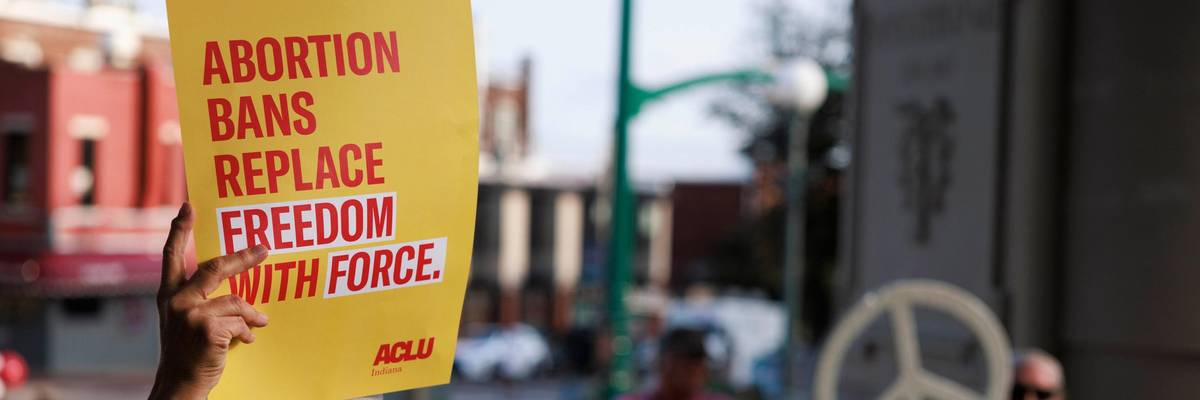
An abortion rights activist holds a placard saying, "Abortion bans replace freedom with force," in Bloomington, Indiana on September 15, 2022.
After Texas Abortion Ruling, 'Make No Mistake—This Is the America the GOP Wants'
The case of a woman who had to flee Texas to get abortion care "has shown the world that abortion bans are dangerous for pregnant people," said one advocate.
The Texas Supreme Court's ruling late Monday, in which the all-Republican panel said Dallas resident Kate Cox could not obtain an abortion despite a lethal fetal diagnosis, did not stop the 31-year-old woman from getting care outside the state. But the ruling, said rights advocates on Tuesday, carries major implications for other Texans and people across the United States.
The state Supreme Court handed down a seven-page ruling saying that Travis County District Judge Maya Guerra Gamble was wrong to issue a temporary restraining order last week, which had barred the state from prosecuting Cox's physician for providing abortion care.
Cox learned earlier this month at about 20 weeks pregnant that her fetus had trisomy 18, a condition that results in miscarriage, stillbirth, or the death of a newborn in the days or weeks after birth.
Under Texas' near-total abortion ban, which ostensibly allows exceptions in cases in which an abortion is medically necessary to protect the pregnant person's life or to prevent unspecified "substantial impairment," Cox's physician said she would have to carry the pregnancy and have a Caesarean section, which could have resulted in uterine rupture and threatened her future fertility.
Republican Attorney General Ken Paxton appealed Gamble's ruling to the state Supreme Court, which said in its decision Monday: "A woman who meets the medical-necessity exception need not seek a court order to obtain an abortion. Under the law, it is a doctor who must decide that a woman is suffering from a life-threatening condition during a pregnancy, raising the necessity for an abortion to save her life or to prevent impairment of a major bodily function."
In other words, said Politico healthcare reporter Alice Miranda Ollstein, "the court views the lawsuit itself as evidence Cox does not qualify for relief from the state's ban."
The Republican justices, like the state abortion ban, did not provide guidance to help physicians determine situations in which they could provide abortion care without fearing prosecution and a potential life prison sentence.
Molly Duane, a senior staff attorney at the Center for Reproductive Rights (CRR) who has represented Cox in the case, said on Tuesday that Cox's ordeal offers the latest proof that so-called "exceptions" don't work, and it's dangerous to be pregnant in any state with an abortion ban."
"This ruling should enrage every Texan to their core. If Kate can't get an abortion in Texas, who can?" said Duane. "Doctors still don't know what the exception means, and the Texas Medical Board remains silent. If the highest court in Texas can't figure out what this law means, I'm not sure how a doctor could. Meanwhile, the lives of Texans hang in the balance.”
The court's ruling and its vague reasoning about co-called "exceptions" to abortion bans, said Mini Timmaraju, president and CEO of Reproductive Freedom for All, represents "the America the GOP wants."
For many Texans, said Nancy Northrup, president and CEO of CRR, a pregnancy complication like Cox's "could be a death sentence" under the state's laws.
"Kate's case has shown the world that abortion bans are dangerous for pregnant people," Northup said. "She desperately wanted to be able to get care where she lives and recover at home surrounded by family. While Kate had the ability to leave the state, most people do not."
Meanwhile, said author and advocate Jessica Valenti, Republicans are still pushing for a nationwide 15-week abortion ban. Susan B. Anthony Pro-Life America, a major group that supports forced pregnancy, has said it will not endorse a 2024 GOP candidate who doesn't back the proposal.
"What if there was no other state to go to? What if instead of being forced to travel to a neighboring state—an already-impossible hurdle for many Americans—Cox had to travel to a nearby country?" wrote Valenti on Monday. "That is not some hyperbolic hypothetical: It's exactly what life would look like under Republicans' 15-week national ban. And we can't let voters forget it."
We are at a crossroads
This country and this world are at a monumental crossroads. In a few short weeks, US voters will have an opportunity to beat back the forces of fascism and confront the billionaires who are rigging the economy, our media system, and our democracy, making it increasingly impossible for ordinary people to get by. We’re not just talking about the election. We’re talking about what must be done once these fascist elements are vanquished from power. We need a bolder set of solutions than what either major party has so far been willing to offer and a working-class movement ready to fight like hell for it. Trump didn't emerge from nowhere. The conditions that fueled MAGA authoritarianism were created by decades of radical neoliberal economic policies and a corrupt political system dominated by corporate interests. They slashed taxes on the super-rich, promising that the benefits would trickle down. They said giveaways to the corporate titans would make life more affordable for the rest of us. It was all bullshit. And when a bitter, betrayed populace searches for someone to blame, right-wing demagogues have little trouble finding scapegoats. People know when they're being lied to, but you won't hear any of this from the corporate media. Only independent journalism—powered and funded by people who believe in building a better world—can deliver truly trustworthy daily news. Our Fall Campaign is underway, and we need your help. To power our newsroom through the rest of the year, we need to raise $125,000 by midnight on October 31. So if you share our vision, please contribute whatever you can to sustain our work. |
The Texas Supreme Court's ruling late Monday, in which the all-Republican panel said Dallas resident Kate Cox could not obtain an abortion despite a lethal fetal diagnosis, did not stop the 31-year-old woman from getting care outside the state. But the ruling, said rights advocates on Tuesday, carries major implications for other Texans and people across the United States.
The state Supreme Court handed down a seven-page ruling saying that Travis County District Judge Maya Guerra Gamble was wrong to issue a temporary restraining order last week, which had barred the state from prosecuting Cox's physician for providing abortion care.
Cox learned earlier this month at about 20 weeks pregnant that her fetus had trisomy 18, a condition that results in miscarriage, stillbirth, or the death of a newborn in the days or weeks after birth.
Under Texas' near-total abortion ban, which ostensibly allows exceptions in cases in which an abortion is medically necessary to protect the pregnant person's life or to prevent unspecified "substantial impairment," Cox's physician said she would have to carry the pregnancy and have a Caesarean section, which could have resulted in uterine rupture and threatened her future fertility.
Republican Attorney General Ken Paxton appealed Gamble's ruling to the state Supreme Court, which said in its decision Monday: "A woman who meets the medical-necessity exception need not seek a court order to obtain an abortion. Under the law, it is a doctor who must decide that a woman is suffering from a life-threatening condition during a pregnancy, raising the necessity for an abortion to save her life or to prevent impairment of a major bodily function."
In other words, said Politico healthcare reporter Alice Miranda Ollstein, "the court views the lawsuit itself as evidence Cox does not qualify for relief from the state's ban."
The Republican justices, like the state abortion ban, did not provide guidance to help physicians determine situations in which they could provide abortion care without fearing prosecution and a potential life prison sentence.
Molly Duane, a senior staff attorney at the Center for Reproductive Rights (CRR) who has represented Cox in the case, said on Tuesday that Cox's ordeal offers the latest proof that so-called "exceptions" don't work, and it's dangerous to be pregnant in any state with an abortion ban."
"This ruling should enrage every Texan to their core. If Kate can't get an abortion in Texas, who can?" said Duane. "Doctors still don't know what the exception means, and the Texas Medical Board remains silent. If the highest court in Texas can't figure out what this law means, I'm not sure how a doctor could. Meanwhile, the lives of Texans hang in the balance.”
The court's ruling and its vague reasoning about co-called "exceptions" to abortion bans, said Mini Timmaraju, president and CEO of Reproductive Freedom for All, represents "the America the GOP wants."
For many Texans, said Nancy Northrup, president and CEO of CRR, a pregnancy complication like Cox's "could be a death sentence" under the state's laws.
"Kate's case has shown the world that abortion bans are dangerous for pregnant people," Northup said. "She desperately wanted to be able to get care where she lives and recover at home surrounded by family. While Kate had the ability to leave the state, most people do not."
Meanwhile, said author and advocate Jessica Valenti, Republicans are still pushing for a nationwide 15-week abortion ban. Susan B. Anthony Pro-Life America, a major group that supports forced pregnancy, has said it will not endorse a 2024 GOP candidate who doesn't back the proposal.
"What if there was no other state to go to? What if instead of being forced to travel to a neighboring state—an already-impossible hurdle for many Americans—Cox had to travel to a nearby country?" wrote Valenti on Monday. "That is not some hyperbolic hypothetical: It's exactly what life would look like under Republicans' 15-week national ban. And we can't let voters forget it."
- Texas Woman's Near-Death Experience Is What GOP 'Hopes to See Nationwide' ›
- 'Tip of the Iceberg': GOP-Led States Eye Texas Model to Attack Abortion Rights ›
- Critics Say Texas GOP's New Exception to Abortion Ban Is Meant to 'Deceive Voters' ›
- Opinion | Returning to Draconian Abortion Bans Doesn’t Make America Great | Common Dreams ›
- Texas GOP Wish List Includes Death Penalty for Abortion Patients | Common Dreams ›
The Texas Supreme Court's ruling late Monday, in which the all-Republican panel said Dallas resident Kate Cox could not obtain an abortion despite a lethal fetal diagnosis, did not stop the 31-year-old woman from getting care outside the state. But the ruling, said rights advocates on Tuesday, carries major implications for other Texans and people across the United States.
The state Supreme Court handed down a seven-page ruling saying that Travis County District Judge Maya Guerra Gamble was wrong to issue a temporary restraining order last week, which had barred the state from prosecuting Cox's physician for providing abortion care.
Cox learned earlier this month at about 20 weeks pregnant that her fetus had trisomy 18, a condition that results in miscarriage, stillbirth, or the death of a newborn in the days or weeks after birth.
Under Texas' near-total abortion ban, which ostensibly allows exceptions in cases in which an abortion is medically necessary to protect the pregnant person's life or to prevent unspecified "substantial impairment," Cox's physician said she would have to carry the pregnancy and have a Caesarean section, which could have resulted in uterine rupture and threatened her future fertility.
Republican Attorney General Ken Paxton appealed Gamble's ruling to the state Supreme Court, which said in its decision Monday: "A woman who meets the medical-necessity exception need not seek a court order to obtain an abortion. Under the law, it is a doctor who must decide that a woman is suffering from a life-threatening condition during a pregnancy, raising the necessity for an abortion to save her life or to prevent impairment of a major bodily function."
In other words, said Politico healthcare reporter Alice Miranda Ollstein, "the court views the lawsuit itself as evidence Cox does not qualify for relief from the state's ban."
The Republican justices, like the state abortion ban, did not provide guidance to help physicians determine situations in which they could provide abortion care without fearing prosecution and a potential life prison sentence.
Molly Duane, a senior staff attorney at the Center for Reproductive Rights (CRR) who has represented Cox in the case, said on Tuesday that Cox's ordeal offers the latest proof that so-called "exceptions" don't work, and it's dangerous to be pregnant in any state with an abortion ban."
"This ruling should enrage every Texan to their core. If Kate can't get an abortion in Texas, who can?" said Duane. "Doctors still don't know what the exception means, and the Texas Medical Board remains silent. If the highest court in Texas can't figure out what this law means, I'm not sure how a doctor could. Meanwhile, the lives of Texans hang in the balance.”
The court's ruling and its vague reasoning about co-called "exceptions" to abortion bans, said Mini Timmaraju, president and CEO of Reproductive Freedom for All, represents "the America the GOP wants."
For many Texans, said Nancy Northrup, president and CEO of CRR, a pregnancy complication like Cox's "could be a death sentence" under the state's laws.
"Kate's case has shown the world that abortion bans are dangerous for pregnant people," Northup said. "She desperately wanted to be able to get care where she lives and recover at home surrounded by family. While Kate had the ability to leave the state, most people do not."
Meanwhile, said author and advocate Jessica Valenti, Republicans are still pushing for a nationwide 15-week abortion ban. Susan B. Anthony Pro-Life America, a major group that supports forced pregnancy, has said it will not endorse a 2024 GOP candidate who doesn't back the proposal.
"What if there was no other state to go to? What if instead of being forced to travel to a neighboring state—an already-impossible hurdle for many Americans—Cox had to travel to a nearby country?" wrote Valenti on Monday. "That is not some hyperbolic hypothetical: It's exactly what life would look like under Republicans' 15-week national ban. And we can't let voters forget it."
- Texas Woman's Near-Death Experience Is What GOP 'Hopes to See Nationwide' ›
- 'Tip of the Iceberg': GOP-Led States Eye Texas Model to Attack Abortion Rights ›
- Critics Say Texas GOP's New Exception to Abortion Ban Is Meant to 'Deceive Voters' ›
- Opinion | Returning to Draconian Abortion Bans Doesn’t Make America Great | Common Dreams ›
- Texas GOP Wish List Includes Death Penalty for Abortion Patients | Common Dreams ›