SUBSCRIBE TO OUR FREE NEWSLETTER
Daily news & progressive opinion—funded by the people, not the corporations—delivered straight to your inbox.
5
#000000
#FFFFFF
To donate by check, phone, or other method, see our More Ways to Give page.
Daily news & progressive opinion—funded by the people, not the corporations—delivered straight to your inbox.
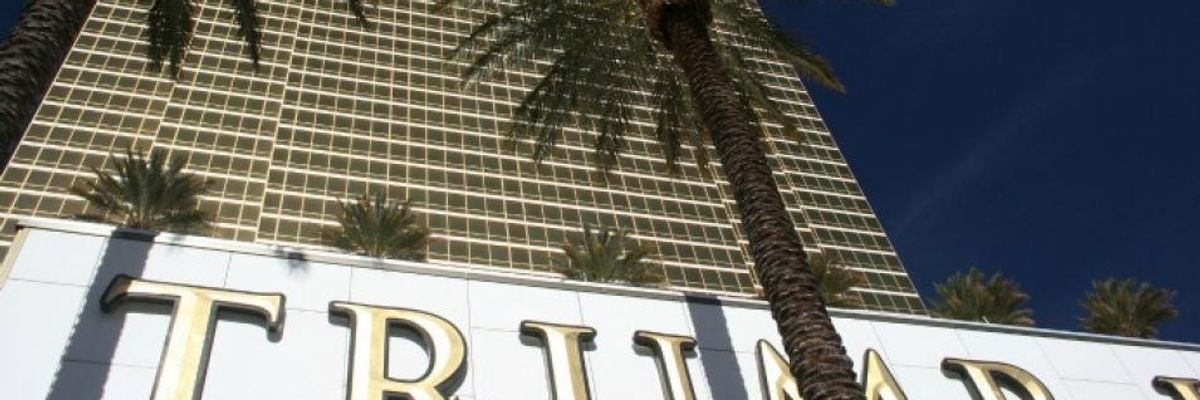
President Donald Trump co-owns the Trump International Hotel in Las Vegas with casino mogul Phil Ruffin. (Photo: ian mcwilliams/flickr/cc)
The New York Times continued its explosive reporting on President Donald Trump's tax records on Friday by divulging that he engineered an eight-figure windfall shortly before contributing $10 million to his "self-funded" 2016 presidential campaign--which sparked fresh calls for probing the president's tax and business practices.
"Voters had a right to know where Trump was getting the money for his campaign."
--Trevor Potter, CLC
"The more we learn about what Trump is hiding in his tax returns, the worse it looks," Tax March tweeted Friday with a link to the report. The group is leading a coalition of progressive organizations behind the #WePaidMore campaign to raise awareness about the country's "utterly rigged" tax system, as demonstrated by Trump's actions.
The latest piece for the Times' investigation into Trump tax documents obtained by the newspaper--which kicked off last month with a bombshell expose detailing how he paid little-to-no federal income taxes in the years leading up to his presidency--generated concerns the president illegally funded his campaign with a business loan.
Times journalists Susanne Craig, Mike McIntire, and Russ Buettner report that as Trump struggled to raise money for his White House run in 2016, he secured "more than $21 million in what experts describe as highly unusual one-off payments from the Las Vegas hotel he owns with his friend the casino mogul Phil Ruffin."
As the trio of journalists detail:
The tax records, by their nature, do not specify whether the more than $21 million in payments from the Trump-Ruffin hotel helped prop up Mr. Trump's campaign, his businesses, or both. But they do show how the cash flowed, in a chain of transactions, to several Trump-controlled companies and then directly to Mr. Trump himself.
The bulk of the money went through a company called Trump Las Vegas Sales and Marketing that had little previous income, no clear business purpose and no employees. The Trump-Ruffin joint venture wrote it all off as a business expense.
The report raises concerns about potential legal problems related to both claiming the tax deduction and whether the payments are technically campaign contributions.
Just weeks before the 2016 election, "the Trump-Ruffin partnership borrowed $30 million from City National Bank in Los Angeles," according to the Times. "Mr. Trump signed the loan documents in New York City, but tax records show that Mr. Ruffin personally guaranteed nearly the entire amount, should the company ever be unable to pay."
"The partnership was not required to disclose on its tax returns how the borrowed money would be spent," the reporters note. "But the timing of the loan, combined with the partnership's lack of available cash that year, strongly suggests that the loan funded the millions of dollars in payments to Mr. Trump."
Campaign Legal Center (CLC) president and former Republican chairman of the Federal Election Commission Trevor Potter said in a statement Friday that "if Trump took out a bank loan in the LLC's name for the purpose of financing his election, then the Trump campaign violated its legal reporting requirements by failing to disclose the loan, and failing to disclose that Trump's Vegas property was used as collateral."
"If Trump secretly financed his 2016 campaign using an undisclosed bank loan backed by a billionaire developer, then voters have been illegally deprived of important information about the true sources of Trump's financial support," he said. "Additionally, if the LLC took a tax deduction for the payments to Trump, it would mean that Trump secretly relied on taxpayers to help subsidize his 2016 campaign."
"Disclosure to voters in 2016 would have been important, since Trump's claim that he was self-financing his campaign was central to his campaign message, and created a veneer of credibility for him to accuse rivals of being beholden to wealthy special interests," Potter added. "Voters had a right to know where Trump was getting the money for his campaign."
The Times report goes on to detail Ruffin's friendship with the president and years serving as a "wingman for Mr. Trump's political ambitions." Jennifer Renzelman, a spokesperson for Ruffin, told the newspaper that the 85-year-old was not involved in the day-to-day operations of the hotel in question and that "all tax statements go to the people who work on his taxes."
White House spokesperson Judd Deere called the report "yet another politically motivated hit piece inaccurately smearing a standard business deal," and said that "during his years as a successful businessman, Donald Trump was longtime partners with Phil Ruffin and earned whatever payments he received."
Meanwhile, tax and campaign finance experts, reporters, and other political commentators highlighted the legal concerns raised and called for further investigation:
Dear Common Dreams reader, It’s been nearly 30 years since I co-founded Common Dreams with my late wife, Lina Newhouser. We had the radical notion that journalism should serve the public good, not corporate profits. It was clear to us from the outset what it would take to build such a project. No paid advertisements. No corporate sponsors. No millionaire publisher telling us what to think or do. Many people said we wouldn't last a year, but we proved those doubters wrong. Together with a tremendous team of journalists and dedicated staff, we built an independent media outlet free from the constraints of profits and corporate control. Our mission has always been simple: To inform. To inspire. To ignite change for the common good. Building Common Dreams was not easy. Our survival was never guaranteed. When you take on the most powerful forces—Wall Street greed, fossil fuel industry destruction, Big Tech lobbyists, and uber-rich oligarchs who have spent billions upon billions rigging the economy and democracy in their favor—the only bulwark you have is supporters who believe in your work. But here’s the urgent message from me today. It's never been this bad out there. And it's never been this hard to keep us going. At the very moment Common Dreams is most needed, the threats we face are intensifying. We need your support now more than ever. We don't accept corporate advertising and never will. We don't have a paywall because we don't think people should be blocked from critical news based on their ability to pay. Everything we do is funded by the donations of readers like you. When everyone does the little they can afford, we are strong. But if that support retreats or dries up, so do we. Will you donate now to make sure Common Dreams not only survives but thrives? —Craig Brown, Co-founder |
The New York Times continued its explosive reporting on President Donald Trump's tax records on Friday by divulging that he engineered an eight-figure windfall shortly before contributing $10 million to his "self-funded" 2016 presidential campaign--which sparked fresh calls for probing the president's tax and business practices.
"Voters had a right to know where Trump was getting the money for his campaign."
--Trevor Potter, CLC
"The more we learn about what Trump is hiding in his tax returns, the worse it looks," Tax March tweeted Friday with a link to the report. The group is leading a coalition of progressive organizations behind the #WePaidMore campaign to raise awareness about the country's "utterly rigged" tax system, as demonstrated by Trump's actions.
The latest piece for the Times' investigation into Trump tax documents obtained by the newspaper--which kicked off last month with a bombshell expose detailing how he paid little-to-no federal income taxes in the years leading up to his presidency--generated concerns the president illegally funded his campaign with a business loan.
Times journalists Susanne Craig, Mike McIntire, and Russ Buettner report that as Trump struggled to raise money for his White House run in 2016, he secured "more than $21 million in what experts describe as highly unusual one-off payments from the Las Vegas hotel he owns with his friend the casino mogul Phil Ruffin."
As the trio of journalists detail:
The tax records, by their nature, do not specify whether the more than $21 million in payments from the Trump-Ruffin hotel helped prop up Mr. Trump's campaign, his businesses, or both. But they do show how the cash flowed, in a chain of transactions, to several Trump-controlled companies and then directly to Mr. Trump himself.
The bulk of the money went through a company called Trump Las Vegas Sales and Marketing that had little previous income, no clear business purpose and no employees. The Trump-Ruffin joint venture wrote it all off as a business expense.
The report raises concerns about potential legal problems related to both claiming the tax deduction and whether the payments are technically campaign contributions.
Just weeks before the 2016 election, "the Trump-Ruffin partnership borrowed $30 million from City National Bank in Los Angeles," according to the Times. "Mr. Trump signed the loan documents in New York City, but tax records show that Mr. Ruffin personally guaranteed nearly the entire amount, should the company ever be unable to pay."
"The partnership was not required to disclose on its tax returns how the borrowed money would be spent," the reporters note. "But the timing of the loan, combined with the partnership's lack of available cash that year, strongly suggests that the loan funded the millions of dollars in payments to Mr. Trump."
Campaign Legal Center (CLC) president and former Republican chairman of the Federal Election Commission Trevor Potter said in a statement Friday that "if Trump took out a bank loan in the LLC's name for the purpose of financing his election, then the Trump campaign violated its legal reporting requirements by failing to disclose the loan, and failing to disclose that Trump's Vegas property was used as collateral."
"If Trump secretly financed his 2016 campaign using an undisclosed bank loan backed by a billionaire developer, then voters have been illegally deprived of important information about the true sources of Trump's financial support," he said. "Additionally, if the LLC took a tax deduction for the payments to Trump, it would mean that Trump secretly relied on taxpayers to help subsidize his 2016 campaign."
"Disclosure to voters in 2016 would have been important, since Trump's claim that he was self-financing his campaign was central to his campaign message, and created a veneer of credibility for him to accuse rivals of being beholden to wealthy special interests," Potter added. "Voters had a right to know where Trump was getting the money for his campaign."
The Times report goes on to detail Ruffin's friendship with the president and years serving as a "wingman for Mr. Trump's political ambitions." Jennifer Renzelman, a spokesperson for Ruffin, told the newspaper that the 85-year-old was not involved in the day-to-day operations of the hotel in question and that "all tax statements go to the people who work on his taxes."
White House spokesperson Judd Deere called the report "yet another politically motivated hit piece inaccurately smearing a standard business deal," and said that "during his years as a successful businessman, Donald Trump was longtime partners with Phil Ruffin and earned whatever payments he received."
Meanwhile, tax and campaign finance experts, reporters, and other political commentators highlighted the legal concerns raised and called for further investigation:
The New York Times continued its explosive reporting on President Donald Trump's tax records on Friday by divulging that he engineered an eight-figure windfall shortly before contributing $10 million to his "self-funded" 2016 presidential campaign--which sparked fresh calls for probing the president's tax and business practices.
"Voters had a right to know where Trump was getting the money for his campaign."
--Trevor Potter, CLC
"The more we learn about what Trump is hiding in his tax returns, the worse it looks," Tax March tweeted Friday with a link to the report. The group is leading a coalition of progressive organizations behind the #WePaidMore campaign to raise awareness about the country's "utterly rigged" tax system, as demonstrated by Trump's actions.
The latest piece for the Times' investigation into Trump tax documents obtained by the newspaper--which kicked off last month with a bombshell expose detailing how he paid little-to-no federal income taxes in the years leading up to his presidency--generated concerns the president illegally funded his campaign with a business loan.
Times journalists Susanne Craig, Mike McIntire, and Russ Buettner report that as Trump struggled to raise money for his White House run in 2016, he secured "more than $21 million in what experts describe as highly unusual one-off payments from the Las Vegas hotel he owns with his friend the casino mogul Phil Ruffin."
As the trio of journalists detail:
The tax records, by their nature, do not specify whether the more than $21 million in payments from the Trump-Ruffin hotel helped prop up Mr. Trump's campaign, his businesses, or both. But they do show how the cash flowed, in a chain of transactions, to several Trump-controlled companies and then directly to Mr. Trump himself.
The bulk of the money went through a company called Trump Las Vegas Sales and Marketing that had little previous income, no clear business purpose and no employees. The Trump-Ruffin joint venture wrote it all off as a business expense.
The report raises concerns about potential legal problems related to both claiming the tax deduction and whether the payments are technically campaign contributions.
Just weeks before the 2016 election, "the Trump-Ruffin partnership borrowed $30 million from City National Bank in Los Angeles," according to the Times. "Mr. Trump signed the loan documents in New York City, but tax records show that Mr. Ruffin personally guaranteed nearly the entire amount, should the company ever be unable to pay."
"The partnership was not required to disclose on its tax returns how the borrowed money would be spent," the reporters note. "But the timing of the loan, combined with the partnership's lack of available cash that year, strongly suggests that the loan funded the millions of dollars in payments to Mr. Trump."
Campaign Legal Center (CLC) president and former Republican chairman of the Federal Election Commission Trevor Potter said in a statement Friday that "if Trump took out a bank loan in the LLC's name for the purpose of financing his election, then the Trump campaign violated its legal reporting requirements by failing to disclose the loan, and failing to disclose that Trump's Vegas property was used as collateral."
"If Trump secretly financed his 2016 campaign using an undisclosed bank loan backed by a billionaire developer, then voters have been illegally deprived of important information about the true sources of Trump's financial support," he said. "Additionally, if the LLC took a tax deduction for the payments to Trump, it would mean that Trump secretly relied on taxpayers to help subsidize his 2016 campaign."
"Disclosure to voters in 2016 would have been important, since Trump's claim that he was self-financing his campaign was central to his campaign message, and created a veneer of credibility for him to accuse rivals of being beholden to wealthy special interests," Potter added. "Voters had a right to know where Trump was getting the money for his campaign."
The Times report goes on to detail Ruffin's friendship with the president and years serving as a "wingman for Mr. Trump's political ambitions." Jennifer Renzelman, a spokesperson for Ruffin, told the newspaper that the 85-year-old was not involved in the day-to-day operations of the hotel in question and that "all tax statements go to the people who work on his taxes."
White House spokesperson Judd Deere called the report "yet another politically motivated hit piece inaccurately smearing a standard business deal," and said that "during his years as a successful businessman, Donald Trump was longtime partners with Phil Ruffin and earned whatever payments he received."
Meanwhile, tax and campaign finance experts, reporters, and other political commentators highlighted the legal concerns raised and called for further investigation: