SUBSCRIBE TO OUR FREE NEWSLETTER
Daily news & progressive opinion—funded by the people, not the corporations—delivered straight to your inbox.
5
#000000
#FFFFFF
To donate by check, phone, or other method, see our More Ways to Give page.
Daily news & progressive opinion—funded by the people, not the corporations—delivered straight to your inbox.
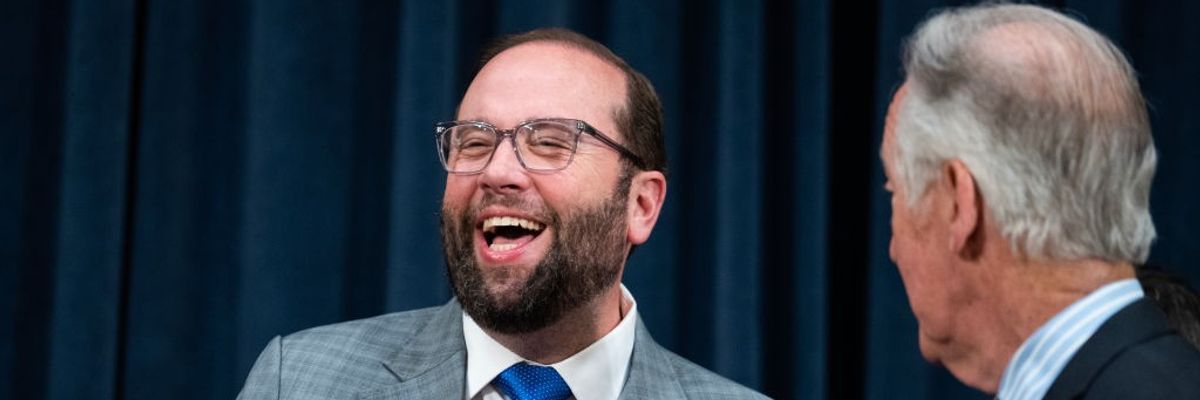
U.S. House Ways and Means Committee Chair Jason Smith (R-Mo.) attends a markup in Washington, D.C. on February 26, 2025.
"Despite their rhetoric," Republicans are "failing to deliver for millions of working-class families," said one tax expert.
Since Republican leadership in the U.S. House of Representatives on Friday evening released tax-related legislative language and announced a markup for President Donald Trump's "One, Big, Beautiful Bill," economic justice advocates have sounded the alarm.
House Ways and Means Committee Chair Jason Smith (R-Mo.) scheduled a Tuesday afternoon hearing, shared 28 pages of legislative proposals for the reconciliation package, and positively framed the Tax Cuts and Jobs Act (TCJA) that congressional Republicans passed and Trump signed in 2017. The tax reform push comes just months away from parts of that law—which critics call the "GOP tax scam"—expiring.
"So far this costly bill appears to double down on trickle down, with huge tax cuts that will further enrich the rich and not much for the rest of us," said Amy Hanauer, executive director of the Institute on Taxation and Economic Policy (ITEP), in a Saturday statement. "What's more, many of the modest improvements for lower- and middle-income families are proposed to be temporary, whereas the benefits for the wealthiest are proposed to be permanent."
Hanauer's group specifically noted that "the 2017 changes to personal income tax rates and brackets would be made permanent," as would the deduction that individuals receive from "pass-through" businesses, which would also increase from 20% to 22%. Republicans also want to hike the estate tax exemption from $13.99 million per spouse to $15 million and have it continue to rise with inflation.
"The very generous version of a tax break for offshore profits (the GILTI deduction) would be made permanent, effectively taxing the foreign profits of American corporations half as much (at most) as their domestic profits are taxed," the think tank highlighted.
ITEP also flagged that "the 2017 change to the standard deduction would be made permanent, and a temporary four-year boost would bump it up to $16,000 for individuals, $24,000 for taxpayers filing as head of household, and $32,000 for married couples."
"The child tax credit would temporarily increase to $2,500 per child from $2,000 per child for four years, but 4.5 million citizen kids would lose access to the... CTC due to a requirement that both their parents have Social Security numbers," the group warned.
Chuck Marr, vice president of federal tax policy at the Center on Budget and Policy Priorities, similarly said in a series of Friday social media posts that the emerging "bill appears highly skewed to the wealthy, [with] several regressive expansions of 2017 tax cuts and full of costly timing gimmicks, while, despite their rhetoric, failing to deliver for millions of working-class families."
Like ITEP, Marr blasted House Republicans for their "glaring failure" on the CTC as well as for continuing to push the pass-through deduction and estate tax exemption, the latter of which he called "the most skewed provision of the 2017 law."
"On Tuesday, House Republicans in one committee will be taking away people's health insurance and in another taking away food assistance, while in a third they will be permanently increasing the amount the wealthiest heirs in the country can inherit tax-free," he said, stressing that the GOP aims to pay for its tax giveaways to the rich by gutting Medicaid and the Supplemental Nutrition Assistance Program (SNAP).
"It also looks like House Republicans are repeating a brazen pattern from 2017: Make the provisions for rich people permanent (recall the 2017 massive corporate rate cut) while making the broader provisions temporary—backwards priorities," Marr declared.
"So tonight we've learned—despite all the Trump bluster—House Republicans are proposing more tax cuts for the wealthy, increasing its already bloated costs, while harshly failing to deliver for millions of families he promised to help," he concluded.
Smith's legislative text notably does not include letting the top tax rate revert from 37% to 39.6% for taxable income greater than $5 million for married couples and $2.5 million—an idea that Trump floated this week but, as NBC News put it, "is running into a buzz saw of opposition in the Republican Party."
Trump said on his Truth Social Platform early Friday: "The problem with even a 'TINY' tax increase for the RICH, which I and all others would graciously accept in order to help the lower and middle income workers, is that the Radical Left Democrat Lunatics would go around screaming, 'Read my lips,' the fabled Quote by George Bush the Elder that is said to have cost him the Election. NO, Ross Perot cost him the Election! In any event, Republicans should probably not do it, but I'm OK if they do!!!"
While Trump's comments this week have generated headlines about the president proposing "to raise income taxes on wealthy Americans," ITEP's Steve Wamhoff and Carl Davis argued in a blog post that "nobody should be deceived: The wealthiest taxpayers got enormous tax breaks from Trump's 2017 law and are getting additional large tax breaks in what Trump and Republicans are proposing now."
"We need legislation that requires rich people to pay more taxes, not less," they added. "The Republican legislation will do the opposite, regardless of whether or not Congress includes this latest suggestion from Donald Trump."
This country and this world are at a monumental crossroads. US voters have an opportunity to beat back the forces of fascism and confront the billionaires who are rigging the economy, our media system, and our democracy, making it increasingly impossible for ordinary people to get by. We’re not just talking about the election. We’re talking about what must be done once these fascist elements are vanquished from power. We need a bolder set of solutions than what either major party has so far been willing to offer and a working-class movement ready to fight like hell for it. Trump didn't emerge from nowhere. The conditions that fueled MAGA authoritarianism were created by decades of radical neoliberal economic policies and a corrupt political system dominated by corporate interests. They slashed taxes on the super-rich, promising that the benefits would trickle down. They said giveaways to the corporate titans would make life more affordable for the rest of us. It was all bullshit. And when a bitter, betrayed populace searches for someone to blame, right-wing demagogues have little trouble finding scapegoats. People know when they're being lied to, but you won't hear any of this from the corporate media. Only independent journalism—powered and funded by people who believe in building a better world—can deliver truly trustworthy daily news. If you share our vision, please contribute whatever you can to sustain our work. |
Since Republican leadership in the U.S. House of Representatives on Friday evening released tax-related legislative language and announced a markup for President Donald Trump's "One, Big, Beautiful Bill," economic justice advocates have sounded the alarm.
House Ways and Means Committee Chair Jason Smith (R-Mo.) scheduled a Tuesday afternoon hearing, shared 28 pages of legislative proposals for the reconciliation package, and positively framed the Tax Cuts and Jobs Act (TCJA) that congressional Republicans passed and Trump signed in 2017. The tax reform push comes just months away from parts of that law—which critics call the "GOP tax scam"—expiring.
"So far this costly bill appears to double down on trickle down, with huge tax cuts that will further enrich the rich and not much for the rest of us," said Amy Hanauer, executive director of the Institute on Taxation and Economic Policy (ITEP), in a Saturday statement. "What's more, many of the modest improvements for lower- and middle-income families are proposed to be temporary, whereas the benefits for the wealthiest are proposed to be permanent."
Hanauer's group specifically noted that "the 2017 changes to personal income tax rates and brackets would be made permanent," as would the deduction that individuals receive from "pass-through" businesses, which would also increase from 20% to 22%. Republicans also want to hike the estate tax exemption from $13.99 million per spouse to $15 million and have it continue to rise with inflation.
"The very generous version of a tax break for offshore profits (the GILTI deduction) would be made permanent, effectively taxing the foreign profits of American corporations half as much (at most) as their domestic profits are taxed," the think tank highlighted.
ITEP also flagged that "the 2017 change to the standard deduction would be made permanent, and a temporary four-year boost would bump it up to $16,000 for individuals, $24,000 for taxpayers filing as head of household, and $32,000 for married couples."
"The child tax credit would temporarily increase to $2,500 per child from $2,000 per child for four years, but 4.5 million citizen kids would lose access to the... CTC due to a requirement that both their parents have Social Security numbers," the group warned.
Chuck Marr, vice president of federal tax policy at the Center on Budget and Policy Priorities, similarly said in a series of Friday social media posts that the emerging "bill appears highly skewed to the wealthy, [with] several regressive expansions of 2017 tax cuts and full of costly timing gimmicks, while, despite their rhetoric, failing to deliver for millions of working-class families."
Like ITEP, Marr blasted House Republicans for their "glaring failure" on the CTC as well as for continuing to push the pass-through deduction and estate tax exemption, the latter of which he called "the most skewed provision of the 2017 law."
"On Tuesday, House Republicans in one committee will be taking away people's health insurance and in another taking away food assistance, while in a third they will be permanently increasing the amount the wealthiest heirs in the country can inherit tax-free," he said, stressing that the GOP aims to pay for its tax giveaways to the rich by gutting Medicaid and the Supplemental Nutrition Assistance Program (SNAP).
"It also looks like House Republicans are repeating a brazen pattern from 2017: Make the provisions for rich people permanent (recall the 2017 massive corporate rate cut) while making the broader provisions temporary—backwards priorities," Marr declared.
"So tonight we've learned—despite all the Trump bluster—House Republicans are proposing more tax cuts for the wealthy, increasing its already bloated costs, while harshly failing to deliver for millions of families he promised to help," he concluded.
Smith's legislative text notably does not include letting the top tax rate revert from 37% to 39.6% for taxable income greater than $5 million for married couples and $2.5 million—an idea that Trump floated this week but, as NBC News put it, "is running into a buzz saw of opposition in the Republican Party."
Trump said on his Truth Social Platform early Friday: "The problem with even a 'TINY' tax increase for the RICH, which I and all others would graciously accept in order to help the lower and middle income workers, is that the Radical Left Democrat Lunatics would go around screaming, 'Read my lips,' the fabled Quote by George Bush the Elder that is said to have cost him the Election. NO, Ross Perot cost him the Election! In any event, Republicans should probably not do it, but I'm OK if they do!!!"
While Trump's comments this week have generated headlines about the president proposing "to raise income taxes on wealthy Americans," ITEP's Steve Wamhoff and Carl Davis argued in a blog post that "nobody should be deceived: The wealthiest taxpayers got enormous tax breaks from Trump's 2017 law and are getting additional large tax breaks in what Trump and Republicans are proposing now."
"We need legislation that requires rich people to pay more taxes, not less," they added. "The Republican legislation will do the opposite, regardless of whether or not Congress includes this latest suggestion from Donald Trump."