SUBSCRIBE TO OUR FREE NEWSLETTER
Daily news & progressive opinion—funded by the people, not the corporations—delivered straight to your inbox.
5
#000000
#FFFFFF
To donate by check, phone, or other method, see our More Ways to Give page.
Daily news & progressive opinion—funded by the people, not the corporations—delivered straight to your inbox.
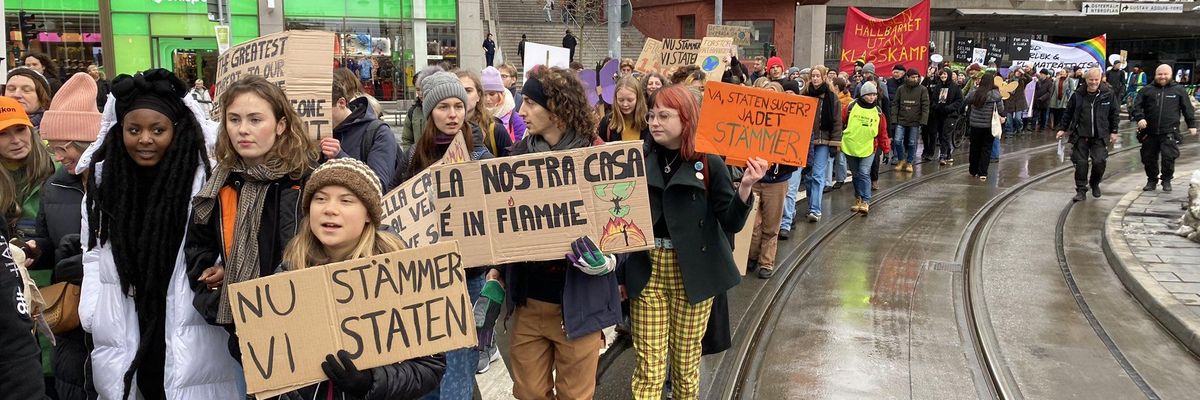
Greta Thunberg joins climate action campaigners for a march through Stockholm, Sweden on November 25, 2022.
The country's climate action "constitutes a violation of human rights," argues one Swedish group.
A Swedish court on Tuesday ruled that hundreds of youth climate activists including Greta Thunberg can collectively sue Sweden for the government's "insufficient climate policy."
More than 600 people under age 26, including 20-year-old Thunberg, signed the 87-page document that is the basis for the lawsuit, which was filed in Stockholm in November and coincided with a march through the city.
"Sweden has never treated the climate crisis like a crisis," Anton Foley of the youth-led group Aurora, which prepared and filed the class-action suit, said at the time. "Sweden is failing in its responsibility and breaking the law."
The Nacka District Court determined Tuesday that the case can proceed and gave the Swedish government three months to respond.
"The district court has today issued a summons in a high-profile class-action lawsuit," the court said. "In the case, demands have been made for the district court to determine that the state has an obligation to take certain specified measures to limit climate change."
"Limiting global warming to 1.5°C requires drastic emission reductions starting now."
"At present, the district court cannot give a forecast as to when the case may be finalized or when it may be necessary to hold hearings in the case," the court continued, adding that the case could go to trial or be settled in writing.
As Aurora's webpage for the case explains, the young activists believe the climate emergency "is a problem we all have to solve together, but the responsibility is not evenly distributed between the countries of the world" and "Sweden, as a rich country with historically high emissions, has a particularly big responsibility to take the lead."
Referencing the 2015 Paris agreement's more ambitious goal for global heating by the end of this century, the activists argue that their country's climate action "is insufficient to be in line with Sweden's fair share of limiting global warming to 1.5 °C" and therefore "constitutes a violation of human rights."
"Limiting global warming to 1.5°C requires drastic emission reductions starting now," the youth warn, noting calculations that suggest Sweden doing its fair share would involve moves to cut emissions by 6.5-9.4 million tons annually from 2019-30.
The climate crisis also negatively impacts mental health, "partly as a consequence of the extreme weather and environmental changes that are happening and will happen, but also due to anxiety and stress during youth," the site stresses. "Everyone who is involved in the class action is young and therefore runs a high risk of suffering these consequences during their lifetime."
The Swedish court's decision came a day after the release of a highly anticipated Intergovernmental Panel on Climate Change (IPCC) report that United Nations Secretary-General António Guterres called "a survival guide for humanity" which shows the 1.5°C goal for this century is still achievable but requires "a quantum leap in climate action."
Thunberg, founder of the global Fridays for Future movement, tweeted Monday in response to the report, "The fact that people in power still somehow live in denial, and actively move in the wrong direction, will eventually be seen for and understood as the unprecedented betrayal it is."
"Today, after yesterday's IPCC report, everything is back to normal—as always," Thunberg added Tuesday. "We continue to ignore the climate crisis as if nothing happened. Our societies are still in denial, and those in power go on with their never ending quests to maximize profits. We cannot afford this."
Dear Common Dreams reader, It’s been nearly 30 years since I co-founded Common Dreams with my late wife, Lina Newhouser. We had the radical notion that journalism should serve the public good, not corporate profits. It was clear to us from the outset what it would take to build such a project. No paid advertisements. No corporate sponsors. No millionaire publisher telling us what to think or do. Many people said we wouldn't last a year, but we proved those doubters wrong. Together with a tremendous team of journalists and dedicated staff, we built an independent media outlet free from the constraints of profits and corporate control. Our mission has always been simple: To inform. To inspire. To ignite change for the common good. Building Common Dreams was not easy. Our survival was never guaranteed. When you take on the most powerful forces—Wall Street greed, fossil fuel industry destruction, Big Tech lobbyists, and uber-rich oligarchs who have spent billions upon billions rigging the economy and democracy in their favor—the only bulwark you have is supporters who believe in your work. But here’s the urgent message from me today. It's never been this bad out there. And it's never been this hard to keep us going. At the very moment Common Dreams is most needed, the threats we face are intensifying. We need your support now more than ever. We don't accept corporate advertising and never will. We don't have a paywall because we don't think people should be blocked from critical news based on their ability to pay. Everything we do is funded by the donations of readers like you. When everyone does the little they can afford, we are strong. But if that support retreats or dries up, so do we. Will you donate now to make sure Common Dreams not only survives but thrives? —Craig Brown, Co-founder |
A Swedish court on Tuesday ruled that hundreds of youth climate activists including Greta Thunberg can collectively sue Sweden for the government's "insufficient climate policy."
More than 600 people under age 26, including 20-year-old Thunberg, signed the 87-page document that is the basis for the lawsuit, which was filed in Stockholm in November and coincided with a march through the city.
"Sweden has never treated the climate crisis like a crisis," Anton Foley of the youth-led group Aurora, which prepared and filed the class-action suit, said at the time. "Sweden is failing in its responsibility and breaking the law."
The Nacka District Court determined Tuesday that the case can proceed and gave the Swedish government three months to respond.
"The district court has today issued a summons in a high-profile class-action lawsuit," the court said. "In the case, demands have been made for the district court to determine that the state has an obligation to take certain specified measures to limit climate change."
"Limiting global warming to 1.5°C requires drastic emission reductions starting now."
"At present, the district court cannot give a forecast as to when the case may be finalized or when it may be necessary to hold hearings in the case," the court continued, adding that the case could go to trial or be settled in writing.
As Aurora's webpage for the case explains, the young activists believe the climate emergency "is a problem we all have to solve together, but the responsibility is not evenly distributed between the countries of the world" and "Sweden, as a rich country with historically high emissions, has a particularly big responsibility to take the lead."
Referencing the 2015 Paris agreement's more ambitious goal for global heating by the end of this century, the activists argue that their country's climate action "is insufficient to be in line with Sweden's fair share of limiting global warming to 1.5 °C" and therefore "constitutes a violation of human rights."
"Limiting global warming to 1.5°C requires drastic emission reductions starting now," the youth warn, noting calculations that suggest Sweden doing its fair share would involve moves to cut emissions by 6.5-9.4 million tons annually from 2019-30.
The climate crisis also negatively impacts mental health, "partly as a consequence of the extreme weather and environmental changes that are happening and will happen, but also due to anxiety and stress during youth," the site stresses. "Everyone who is involved in the class action is young and therefore runs a high risk of suffering these consequences during their lifetime."
The Swedish court's decision came a day after the release of a highly anticipated Intergovernmental Panel on Climate Change (IPCC) report that United Nations Secretary-General António Guterres called "a survival guide for humanity" which shows the 1.5°C goal for this century is still achievable but requires "a quantum leap in climate action."
Thunberg, founder of the global Fridays for Future movement, tweeted Monday in response to the report, "The fact that people in power still somehow live in denial, and actively move in the wrong direction, will eventually be seen for and understood as the unprecedented betrayal it is."
"Today, after yesterday's IPCC report, everything is back to normal—as always," Thunberg added Tuesday. "We continue to ignore the climate crisis as if nothing happened. Our societies are still in denial, and those in power go on with their never ending quests to maximize profits. We cannot afford this."
A Swedish court on Tuesday ruled that hundreds of youth climate activists including Greta Thunberg can collectively sue Sweden for the government's "insufficient climate policy."
More than 600 people under age 26, including 20-year-old Thunberg, signed the 87-page document that is the basis for the lawsuit, which was filed in Stockholm in November and coincided with a march through the city.
"Sweden has never treated the climate crisis like a crisis," Anton Foley of the youth-led group Aurora, which prepared and filed the class-action suit, said at the time. "Sweden is failing in its responsibility and breaking the law."
The Nacka District Court determined Tuesday that the case can proceed and gave the Swedish government three months to respond.
"The district court has today issued a summons in a high-profile class-action lawsuit," the court said. "In the case, demands have been made for the district court to determine that the state has an obligation to take certain specified measures to limit climate change."
"Limiting global warming to 1.5°C requires drastic emission reductions starting now."
"At present, the district court cannot give a forecast as to when the case may be finalized or when it may be necessary to hold hearings in the case," the court continued, adding that the case could go to trial or be settled in writing.
As Aurora's webpage for the case explains, the young activists believe the climate emergency "is a problem we all have to solve together, but the responsibility is not evenly distributed between the countries of the world" and "Sweden, as a rich country with historically high emissions, has a particularly big responsibility to take the lead."
Referencing the 2015 Paris agreement's more ambitious goal for global heating by the end of this century, the activists argue that their country's climate action "is insufficient to be in line with Sweden's fair share of limiting global warming to 1.5 °C" and therefore "constitutes a violation of human rights."
"Limiting global warming to 1.5°C requires drastic emission reductions starting now," the youth warn, noting calculations that suggest Sweden doing its fair share would involve moves to cut emissions by 6.5-9.4 million tons annually from 2019-30.
The climate crisis also negatively impacts mental health, "partly as a consequence of the extreme weather and environmental changes that are happening and will happen, but also due to anxiety and stress during youth," the site stresses. "Everyone who is involved in the class action is young and therefore runs a high risk of suffering these consequences during their lifetime."
The Swedish court's decision came a day after the release of a highly anticipated Intergovernmental Panel on Climate Change (IPCC) report that United Nations Secretary-General António Guterres called "a survival guide for humanity" which shows the 1.5°C goal for this century is still achievable but requires "a quantum leap in climate action."
Thunberg, founder of the global Fridays for Future movement, tweeted Monday in response to the report, "The fact that people in power still somehow live in denial, and actively move in the wrong direction, will eventually be seen for and understood as the unprecedented betrayal it is."
"Today, after yesterday's IPCC report, everything is back to normal—as always," Thunberg added Tuesday. "We continue to ignore the climate crisis as if nothing happened. Our societies are still in denial, and those in power go on with their never ending quests to maximize profits. We cannot afford this."