SUBSCRIBE TO OUR FREE NEWSLETTER
Daily news & progressive opinion—funded by the people, not the corporations—delivered straight to your inbox.
5
#000000
#FFFFFF
To donate by check, phone, or other method, see our More Ways to Give page.
Daily news & progressive opinion—funded by the people, not the corporations—delivered straight to your inbox.
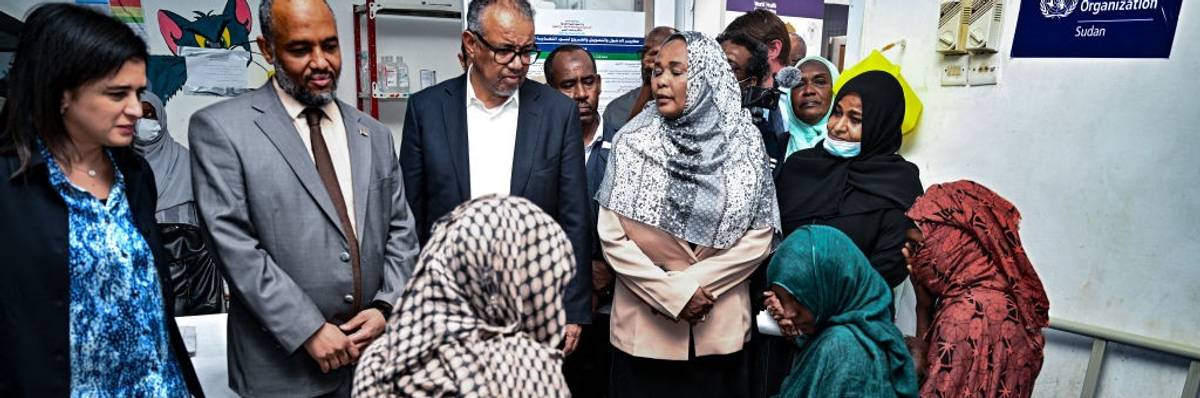
Director-General of the World Health Organization Tedros Adhanom Ghebreyesus, center, visits a children's hospital in Port Sudan on September 7, 2024.
"The international community has seemingly forgotten about Sudan, and is paying little heed to the conflict tearing it apart."
The head of the World Health Organization on Sunday warned of a devastating set of crises in war-torn Sudan and called for a stronger international response.
Tedros Adhanom Ghebreyesus, director-general of the WHO, a United Nations agency, delivered remarks from the city of Port Sudan following visits to health facilities in the country, which is locked in civil war and faces the prospect of a large-scale famine.
"I was shaken by the state of many of the tiny, wasted children," Ghebreyesus said.
"The scale of the emergency is shocking, as is the insufficient action being taken to curtail the conflict, and respond to the suffering it is causing," he added.
Ghebreyesus said he'd come to Sudan to draw attention to the dire situation there.
"The international community has seemingly forgotten about Sudan, and is paying little heed to the conflict tearing it apart, with repercussions in the region," he said.
#Sudan’s health system is on the verge of collapse after 16 months of war, with over 25M people in dire need of aid. “The scale of the emergency is shocking,” warns WHO chief @DrTedros. The world must wake up and act now to prevent further catastrophe.https://t.co/uuebggGhMG
— Africa Renewal, UN (@africarenewal) September 9, 2024
The two main parties in the civil war are the Sudanese Armed Forces (SAF), the country's official military, and the Rapid Support Forces (RSF), a paramilitary group. The two groups shared power for two years before the civil war erupted in April 2023.
The war's death toll is above 20,000, and that's an underestimate, Ghebreyesus said. Both sides have been accused of atrocities and of obstructing international aid. Parts of Sudan are facing famine and others are at risk of it; overall, 25.6 million Sudanese are expected to face high levels of food insecurity, Ghebreyesus warned.
A report issued last week by U.N. agencies and partner groups found that as of August, 8.5 million Sudanese faced "Emergency" conditions of food insecurity, the second-highest level, while 750,000 faced "Catastrophe/Famine," the highest level.
Last week, three international humanitarian groups warned that Sudan faced a hunger crisis of "historic proportions."
Dire warnings have been issued for many months but the international community has been slow to act. At a conference in Paris in April, rich countries did pledge $2.1 billion in support for Sudan, a bit less than the $2.7 billion the U.N. had sought; in any case, only $1.1 billion has actually been received in Sudan, as of the end of August.
Sudan faces the world's worst displacement crisis, with more than 10 million people having been forced to move within the country, and 2 million having left its borders, according to data cited by Ghebreyesus.
Ghebreyesus, an Ethiopian public health official who's led the WHO since 2017, said he felt a close affinity with Sudan—it's "like my home," he said—and was deeply saddened by the situation there. He described the following "perfect storm of crises":
One of the most conflict-stricken areas of the country is Darfur, which became a cause célèbre during a war in the 2000s but hasn't received the same level of international attention this time.
Dear Common Dreams reader, It’s been nearly 30 years since I co-founded Common Dreams with my late wife, Lina Newhouser. We had the radical notion that journalism should serve the public good, not corporate profits. It was clear to us from the outset what it would take to build such a project. No paid advertisements. No corporate sponsors. No millionaire publisher telling us what to think or do. Many people said we wouldn't last a year, but we proved those doubters wrong. Together with a tremendous team of journalists and dedicated staff, we built an independent media outlet free from the constraints of profits and corporate control. Our mission has always been simple: To inform. To inspire. To ignite change for the common good. Building Common Dreams was not easy. Our survival was never guaranteed. When you take on the most powerful forces—Wall Street greed, fossil fuel industry destruction, Big Tech lobbyists, and uber-rich oligarchs who have spent billions upon billions rigging the economy and democracy in their favor—the only bulwark you have is supporters who believe in your work. But here’s the urgent message from me today. It's never been this bad out there. And it's never been this hard to keep us going. At the very moment Common Dreams is most needed, the threats we face are intensifying. We need your support now more than ever. We don't accept corporate advertising and never will. We don't have a paywall because we don't think people should be blocked from critical news based on their ability to pay. Everything we do is funded by the donations of readers like you. When everyone does the little they can afford, we are strong. But if that support retreats or dries up, so do we. Will you donate now to make sure Common Dreams not only survives but thrives? —Craig Brown, Co-founder |
The head of the World Health Organization on Sunday warned of a devastating set of crises in war-torn Sudan and called for a stronger international response.
Tedros Adhanom Ghebreyesus, director-general of the WHO, a United Nations agency, delivered remarks from the city of Port Sudan following visits to health facilities in the country, which is locked in civil war and faces the prospect of a large-scale famine.
"I was shaken by the state of many of the tiny, wasted children," Ghebreyesus said.
"The scale of the emergency is shocking, as is the insufficient action being taken to curtail the conflict, and respond to the suffering it is causing," he added.
Ghebreyesus said he'd come to Sudan to draw attention to the dire situation there.
"The international community has seemingly forgotten about Sudan, and is paying little heed to the conflict tearing it apart, with repercussions in the region," he said.
#Sudan’s health system is on the verge of collapse after 16 months of war, with over 25M people in dire need of aid. “The scale of the emergency is shocking,” warns WHO chief @DrTedros. The world must wake up and act now to prevent further catastrophe.https://t.co/uuebggGhMG
— Africa Renewal, UN (@africarenewal) September 9, 2024
The two main parties in the civil war are the Sudanese Armed Forces (SAF), the country's official military, and the Rapid Support Forces (RSF), a paramilitary group. The two groups shared power for two years before the civil war erupted in April 2023.
The war's death toll is above 20,000, and that's an underestimate, Ghebreyesus said. Both sides have been accused of atrocities and of obstructing international aid. Parts of Sudan are facing famine and others are at risk of it; overall, 25.6 million Sudanese are expected to face high levels of food insecurity, Ghebreyesus warned.
A report issued last week by U.N. agencies and partner groups found that as of August, 8.5 million Sudanese faced "Emergency" conditions of food insecurity, the second-highest level, while 750,000 faced "Catastrophe/Famine," the highest level.
Last week, three international humanitarian groups warned that Sudan faced a hunger crisis of "historic proportions."
Dire warnings have been issued for many months but the international community has been slow to act. At a conference in Paris in April, rich countries did pledge $2.1 billion in support for Sudan, a bit less than the $2.7 billion the U.N. had sought; in any case, only $1.1 billion has actually been received in Sudan, as of the end of August.
Sudan faces the world's worst displacement crisis, with more than 10 million people having been forced to move within the country, and 2 million having left its borders, according to data cited by Ghebreyesus.
Ghebreyesus, an Ethiopian public health official who's led the WHO since 2017, said he felt a close affinity with Sudan—it's "like my home," he said—and was deeply saddened by the situation there. He described the following "perfect storm of crises":
One of the most conflict-stricken areas of the country is Darfur, which became a cause célèbre during a war in the 2000s but hasn't received the same level of international attention this time.
The head of the World Health Organization on Sunday warned of a devastating set of crises in war-torn Sudan and called for a stronger international response.
Tedros Adhanom Ghebreyesus, director-general of the WHO, a United Nations agency, delivered remarks from the city of Port Sudan following visits to health facilities in the country, which is locked in civil war and faces the prospect of a large-scale famine.
"I was shaken by the state of many of the tiny, wasted children," Ghebreyesus said.
"The scale of the emergency is shocking, as is the insufficient action being taken to curtail the conflict, and respond to the suffering it is causing," he added.
Ghebreyesus said he'd come to Sudan to draw attention to the dire situation there.
"The international community has seemingly forgotten about Sudan, and is paying little heed to the conflict tearing it apart, with repercussions in the region," he said.
#Sudan’s health system is on the verge of collapse after 16 months of war, with over 25M people in dire need of aid. “The scale of the emergency is shocking,” warns WHO chief @DrTedros. The world must wake up and act now to prevent further catastrophe.https://t.co/uuebggGhMG
— Africa Renewal, UN (@africarenewal) September 9, 2024
The two main parties in the civil war are the Sudanese Armed Forces (SAF), the country's official military, and the Rapid Support Forces (RSF), a paramilitary group. The two groups shared power for two years before the civil war erupted in April 2023.
The war's death toll is above 20,000, and that's an underestimate, Ghebreyesus said. Both sides have been accused of atrocities and of obstructing international aid. Parts of Sudan are facing famine and others are at risk of it; overall, 25.6 million Sudanese are expected to face high levels of food insecurity, Ghebreyesus warned.
A report issued last week by U.N. agencies and partner groups found that as of August, 8.5 million Sudanese faced "Emergency" conditions of food insecurity, the second-highest level, while 750,000 faced "Catastrophe/Famine," the highest level.
Last week, three international humanitarian groups warned that Sudan faced a hunger crisis of "historic proportions."
Dire warnings have been issued for many months but the international community has been slow to act. At a conference in Paris in April, rich countries did pledge $2.1 billion in support for Sudan, a bit less than the $2.7 billion the U.N. had sought; in any case, only $1.1 billion has actually been received in Sudan, as of the end of August.
Sudan faces the world's worst displacement crisis, with more than 10 million people having been forced to move within the country, and 2 million having left its borders, according to data cited by Ghebreyesus.
Ghebreyesus, an Ethiopian public health official who's led the WHO since 2017, said he felt a close affinity with Sudan—it's "like my home," he said—and was deeply saddened by the situation there. He described the following "perfect storm of crises":
One of the most conflict-stricken areas of the country is Darfur, which became a cause célèbre during a war in the 2000s but hasn't received the same level of international attention this time.