SUBSCRIBE TO OUR FREE NEWSLETTER
Daily news & progressive opinion—funded by the people, not the corporations—delivered straight to your inbox.
5
#000000
#FFFFFF
To donate by check, phone, or other method, see our More Ways to Give page.
Daily news & progressive opinion—funded by the people, not the corporations—delivered straight to your inbox.
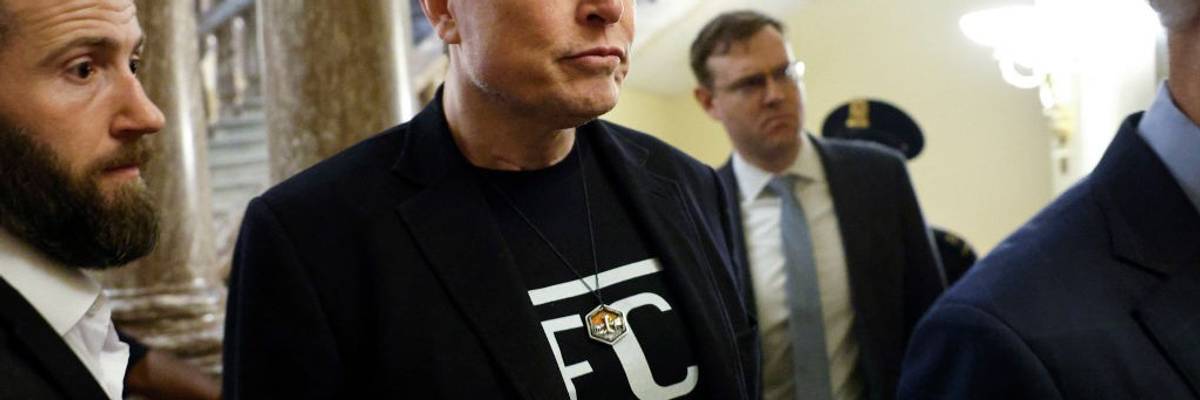
Tesla and SpaceX CEO Elon Musk arrives for a meeting with Senate Republicans at the US Capitol on March 5, 2025 in Washington, DC.
As the Trump-backed oligarch tries to grow even more wealthy and with longstanding rules changed to his benefit ahead of the SpaceX public offering, "retirees could take huge losses, while insiders cash out."
Billionaire Elon Musk has ambitions to become the world's first trillionaire when his company SpaceX makes what is expected to be the biggest initial public offering in history—and money unwittingly invested by ordinary Americans may help him get there.
Progressive media outlet More Perfect Union on Wednesday published a video detailing how the Nasdaq stock market exchange changed its own rules so that SpaceX can be immediately included in index funds without having to wait through the one-year "seasoning" period that used to be required for newly public companies.
The reason companies in the past had to wait a year to be included in index funds is that such funds contain a large chunk of Americans' retirement savings, and are thus supposed to be more averse to risk.
Watch the 12-minute video:
NEW: Elon Musk wants a SpaceX IPO valuing the company at upwards of $1.75 trillion.
To get there he got the rules changed so that index funds, with millions of Americans' retirement savings, are forced to buy in.
Retirees could take huge losses, while insiders cash out. pic.twitter.com/DviJEt0XAu
— More Perfect Union (@MorePerfectUS) May 27, 2026
This means that ordinary investors could see their money plunged into an unproven company while investors who have bankrolled Musk's previous ventures now rolled into SpaceX could cash out at inflated prices.
"Every piece of evidence we have is that the IPO is being engineered to rise very rapidly after it prices, and then fall very dramatically after that," George Pearkes, global macro strategist for Bespoke Investment Group, told More Perfect Union. "That is a recipe for retail investors, especially, to take large losses."
SpaceX is a particularly risky bet, Preakes added, given that it is seeking a $1.75 trillion valuation with its IPO. For a company that made only $19 billion in profits last fiscal year, critics say a valuation 54 times larger than its projected revenue multiple, a measure of its value based on expected future earnings, is a huge red flag.
"This combination of extreme size and this extreme multiple," Peakes said, "is completely unprecedented."
Pearkes isn't in the only expert concerned about the structure of the SpaceX IPO.
Writing at Seeking Alpha, independent equity researcher Julia Ostian similarly argued that the SpaceX IPO is structured using a "calculated mechanism that will feed the artificial demand generated by the forced index fund buyers," and thus at least initially send share values soaring beyond what the company's fundamentals would suggest, and giving insiders an opportunity to quickly cash out.
Ostian added that "it is clear who is the beneficiary here and who pays the price for this engineered system," and said that "the rich are getting richer openly, without hiding it or even without trying to pretend it’s something else."
As More Perfect Union emphasized, the entire IPO was orchestrated by Musk for maximum advantage to himself and his closest allies, but he needed regular Americans to put up the money for the scheme to work.
"He got the rules changed so that index funds, with millions of Americans' retirement savings, are forced to buy in," the outlet noted. "Retirees could take huge losses, while insiders cash out."
Dear Common Dreams reader, It’s been nearly 30 years since I co-founded Common Dreams with my late wife, Lina Newhouser. We had the radical notion that journalism should serve the public good, not corporate profits. It was clear to us from the outset what it would take to build such a project. No paid advertisements. No corporate sponsors. No millionaire publisher telling us what to think or do. Many people said we wouldn't last a year, but we proved those doubters wrong. Together with a tremendous team of journalists and dedicated staff, we built an independent media outlet free from the constraints of profits and corporate control. Our mission has always been simple: To inform. To inspire. To ignite change for the common good. Building Common Dreams was not easy. Our survival was never guaranteed. When you take on the most powerful forces—Wall Street greed, fossil fuel industry destruction, Big Tech lobbyists, and uber-rich oligarchs who have spent billions upon billions rigging the economy and democracy in their favor—the only bulwark you have is supporters who believe in your work. But here’s the urgent message from me today. It's never been this bad out there. And it's never been this hard to keep us going. At the very moment Common Dreams is most needed, the threats we face are intensifying. We need your support now more than ever. We don't accept corporate advertising and never will. We don't have a paywall because we don't think people should be blocked from critical news based on their ability to pay. Everything we do is funded by the donations of readers like you. When everyone does the little they can afford, we are strong. But if that support retreats or dries up, so do we. Will you donate now to make sure Common Dreams not only survives but thrives? —Craig Brown, Co-founder |
Billionaire Elon Musk has ambitions to become the world's first trillionaire when his company SpaceX makes what is expected to be the biggest initial public offering in history—and money unwittingly invested by ordinary Americans may help him get there.
Progressive media outlet More Perfect Union on Wednesday published a video detailing how the Nasdaq stock market exchange changed its own rules so that SpaceX can be immediately included in index funds without having to wait through the one-year "seasoning" period that used to be required for newly public companies.
The reason companies in the past had to wait a year to be included in index funds is that such funds contain a large chunk of Americans' retirement savings, and are thus supposed to be more averse to risk.
Watch the 12-minute video:
NEW: Elon Musk wants a SpaceX IPO valuing the company at upwards of $1.75 trillion.
To get there he got the rules changed so that index funds, with millions of Americans' retirement savings, are forced to buy in.
Retirees could take huge losses, while insiders cash out. pic.twitter.com/DviJEt0XAu
— More Perfect Union (@MorePerfectUS) May 27, 2026
This means that ordinary investors could see their money plunged into an unproven company while investors who have bankrolled Musk's previous ventures now rolled into SpaceX could cash out at inflated prices.
"Every piece of evidence we have is that the IPO is being engineered to rise very rapidly after it prices, and then fall very dramatically after that," George Pearkes, global macro strategist for Bespoke Investment Group, told More Perfect Union. "That is a recipe for retail investors, especially, to take large losses."
SpaceX is a particularly risky bet, Preakes added, given that it is seeking a $1.75 trillion valuation with its IPO. For a company that made only $19 billion in profits last fiscal year, critics say a valuation 54 times larger than its projected revenue multiple, a measure of its value based on expected future earnings, is a huge red flag.
"This combination of extreme size and this extreme multiple," Peakes said, "is completely unprecedented."
Pearkes isn't in the only expert concerned about the structure of the SpaceX IPO.
Writing at Seeking Alpha, independent equity researcher Julia Ostian similarly argued that the SpaceX IPO is structured using a "calculated mechanism that will feed the artificial demand generated by the forced index fund buyers," and thus at least initially send share values soaring beyond what the company's fundamentals would suggest, and giving insiders an opportunity to quickly cash out.
Ostian added that "it is clear who is the beneficiary here and who pays the price for this engineered system," and said that "the rich are getting richer openly, without hiding it or even without trying to pretend it’s something else."
As More Perfect Union emphasized, the entire IPO was orchestrated by Musk for maximum advantage to himself and his closest allies, but he needed regular Americans to put up the money for the scheme to work.
"He got the rules changed so that index funds, with millions of Americans' retirement savings, are forced to buy in," the outlet noted. "Retirees could take huge losses, while insiders cash out."
Billionaire Elon Musk has ambitions to become the world's first trillionaire when his company SpaceX makes what is expected to be the biggest initial public offering in history—and money unwittingly invested by ordinary Americans may help him get there.
Progressive media outlet More Perfect Union on Wednesday published a video detailing how the Nasdaq stock market exchange changed its own rules so that SpaceX can be immediately included in index funds without having to wait through the one-year "seasoning" period that used to be required for newly public companies.
The reason companies in the past had to wait a year to be included in index funds is that such funds contain a large chunk of Americans' retirement savings, and are thus supposed to be more averse to risk.
Watch the 12-minute video:
NEW: Elon Musk wants a SpaceX IPO valuing the company at upwards of $1.75 trillion.
To get there he got the rules changed so that index funds, with millions of Americans' retirement savings, are forced to buy in.
Retirees could take huge losses, while insiders cash out. pic.twitter.com/DviJEt0XAu
— More Perfect Union (@MorePerfectUS) May 27, 2026
This means that ordinary investors could see their money plunged into an unproven company while investors who have bankrolled Musk's previous ventures now rolled into SpaceX could cash out at inflated prices.
"Every piece of evidence we have is that the IPO is being engineered to rise very rapidly after it prices, and then fall very dramatically after that," George Pearkes, global macro strategist for Bespoke Investment Group, told More Perfect Union. "That is a recipe for retail investors, especially, to take large losses."
SpaceX is a particularly risky bet, Preakes added, given that it is seeking a $1.75 trillion valuation with its IPO. For a company that made only $19 billion in profits last fiscal year, critics say a valuation 54 times larger than its projected revenue multiple, a measure of its value based on expected future earnings, is a huge red flag.
"This combination of extreme size and this extreme multiple," Peakes said, "is completely unprecedented."
Pearkes isn't in the only expert concerned about the structure of the SpaceX IPO.
Writing at Seeking Alpha, independent equity researcher Julia Ostian similarly argued that the SpaceX IPO is structured using a "calculated mechanism that will feed the artificial demand generated by the forced index fund buyers," and thus at least initially send share values soaring beyond what the company's fundamentals would suggest, and giving insiders an opportunity to quickly cash out.
Ostian added that "it is clear who is the beneficiary here and who pays the price for this engineered system," and said that "the rich are getting richer openly, without hiding it or even without trying to pretend it’s something else."
As More Perfect Union emphasized, the entire IPO was orchestrated by Musk for maximum advantage to himself and his closest allies, but he needed regular Americans to put up the money for the scheme to work.
"He got the rules changed so that index funds, with millions of Americans' retirement savings, are forced to buy in," the outlet noted. "Retirees could take huge losses, while insiders cash out."