SUBSCRIBE TO OUR FREE NEWSLETTER
Daily news & progressive opinion—funded by the people, not the corporations—delivered straight to your inbox.
5
#000000
#FFFFFF
To donate by check, phone, or other method, see our More Ways to Give page.
Daily news & progressive opinion—funded by the people, not the corporations—delivered straight to your inbox.

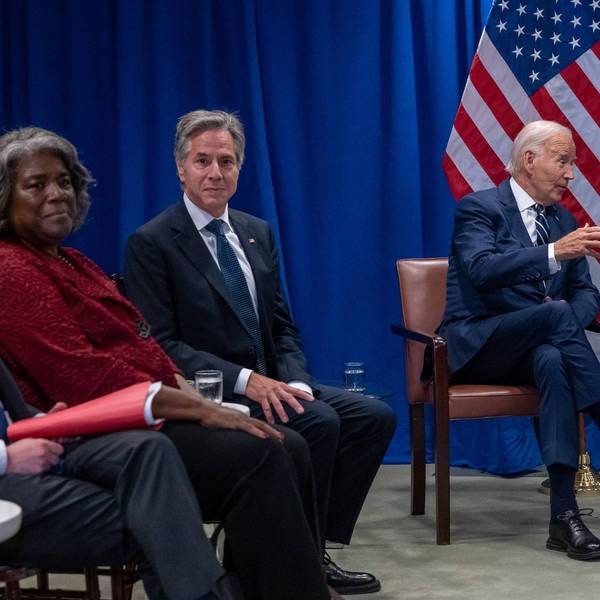
U.S. Secretary of State Antony Blinken is seen during an October 3, 2022 press conference in Bogota, Colombia.
The U.S. secretary of state dismissed South Africa's case as he admitted 90% of Gaza residents are facing acute hunger.
In the same speech in which he admitted that 90% of people in Gaza are facing acute food insecurity amid Israel's blockade and bombardment, U.S. Secretary of State Antony Blinken claimed on Tuesday that South Africa's lawsuit accusing Israel of genocide is "meritless" despite the exhaustive evidence set to be reviewed by a United Nations court this week.
"We believe the submission against Israel at the International Court of Justice distracts the world from [humanitarian] efforts," said Blinken at a press conference in Tel Aviv, where he met with Israeli leaders. "And moreover, the charge of genocide is meritless."
The charge Blinken was referring to was exhaustively detailed in an 84-page complaint submitted by South Africa to the ICJ, the U.N.'s top judicial body, which is planning to hold a hearing on Thursday and Friday regarding the manner.
South Africa compiled numerous recent statements from high-level Israeli leaders including Prime Minister Benjamin Netanyahu, President Isaac Herzog, and Defense Minister Yoav Gallant, who said he had "removed every restriction" on Israeli forces as they began air and ground attacks on Gaza in October in retaliation for Hamas' attack on southern Israel.
The removal of those restrictions—as well as Netanyahu's call for Israeli soldiers to recall the biblical story of Amalek, in which Israelites were told to "spare no one, but kill alike men and women, infants"—preceded the killing of at least 23,210 people in Gaza, with thousands more feared dead under rubble.
Similar statements have also been documented by Law for Palestine, which recorded more than 500 instances of genocidal rhetoric from Israeli officials.
Despite this, the Biden administration has said more than once in recent days that there is no truth to the allegations presented by South Africa.
U.S. National Security Council spokesperson John Kirby last week dismissed the lawsuit as "meritless, counterproductive, and completely without any basis in fact whatsoever," and State Department spokesperson Matt Miller told reporters that the U.S. is "not seeing any acts that constitute genocide."
But while dismissing South Africa's evidence on Tuesday, pointed out Intercept reporter Prem Thakker, Blinken noted that nearly 2 million people in Gaza are facing starvation.
"Blinken calling accusations of genocide against Israel 'meritless' in the same moment he cites the United Nations warning about starvation in Gaza is notable not just because of the contradiction, but because of the U.S.'s own recent behavior at the U.N.," Thakker added, citing a number of recent votes for a cease-fire which the U.S. opposed or vetoed.
Contrary to the Biden administration's repeated claims, wrote former U.N. High Commissioner for Human Rights official Craig Mokhiber and Institute for Policy Studies fellow Phyllis Bennis in a column on Tuesday, "South Africa's petition to the ICJ is filled with clear and horrifically compelling examples, identifying Israeli actions that match at least three of the five acts that constitute genocide when linked to specific intent."
"Those include killing members of the group, causing serious physical or mental harm to members of the group, and, perhaps most indicative of genocidal purpose, creating 'conditions of life calculated to bring about their physical destruction,'" they wrote. "As South Africa documents, Israel has shown the world, at levels unprecedented in the 21st century, what those conditions look like."
Dear Common Dreams reader, It’s been nearly 30 years since I co-founded Common Dreams with my late wife, Lina Newhouser. We had the radical notion that journalism should serve the public good, not corporate profits. It was clear to us from the outset what it would take to build such a project. No paid advertisements. No corporate sponsors. No millionaire publisher telling us what to think or do. Many people said we wouldn't last a year, but we proved those doubters wrong. Together with a tremendous team of journalists and dedicated staff, we built an independent media outlet free from the constraints of profits and corporate control. Our mission has always been simple: To inform. To inspire. To ignite change for the common good. Building Common Dreams was not easy. Our survival was never guaranteed. When you take on the most powerful forces—Wall Street greed, fossil fuel industry destruction, Big Tech lobbyists, and uber-rich oligarchs who have spent billions upon billions rigging the economy and democracy in their favor—the only bulwark you have is supporters who believe in your work. But here’s the urgent message from me today. It's never been this bad out there. And it's never been this hard to keep us going. At the very moment Common Dreams is most needed, the threats we face are intensifying. We need your support now more than ever. We don't accept corporate advertising and never will. We don't have a paywall because we don't think people should be blocked from critical news based on their ability to pay. Everything we do is funded by the donations of readers like you. When everyone does the little they can afford, we are strong. But if that support retreats or dries up, so do we. Will you donate now to make sure Common Dreams not only survives but thrives? —Craig Brown, Co-founder |
In the same speech in which he admitted that 90% of people in Gaza are facing acute food insecurity amid Israel's blockade and bombardment, U.S. Secretary of State Antony Blinken claimed on Tuesday that South Africa's lawsuit accusing Israel of genocide is "meritless" despite the exhaustive evidence set to be reviewed by a United Nations court this week.
"We believe the submission against Israel at the International Court of Justice distracts the world from [humanitarian] efforts," said Blinken at a press conference in Tel Aviv, where he met with Israeli leaders. "And moreover, the charge of genocide is meritless."
The charge Blinken was referring to was exhaustively detailed in an 84-page complaint submitted by South Africa to the ICJ, the U.N.'s top judicial body, which is planning to hold a hearing on Thursday and Friday regarding the manner.
South Africa compiled numerous recent statements from high-level Israeli leaders including Prime Minister Benjamin Netanyahu, President Isaac Herzog, and Defense Minister Yoav Gallant, who said he had "removed every restriction" on Israeli forces as they began air and ground attacks on Gaza in October in retaliation for Hamas' attack on southern Israel.
The removal of those restrictions—as well as Netanyahu's call for Israeli soldiers to recall the biblical story of Amalek, in which Israelites were told to "spare no one, but kill alike men and women, infants"—preceded the killing of at least 23,210 people in Gaza, with thousands more feared dead under rubble.
Similar statements have also been documented by Law for Palestine, which recorded more than 500 instances of genocidal rhetoric from Israeli officials.
Despite this, the Biden administration has said more than once in recent days that there is no truth to the allegations presented by South Africa.
U.S. National Security Council spokesperson John Kirby last week dismissed the lawsuit as "meritless, counterproductive, and completely without any basis in fact whatsoever," and State Department spokesperson Matt Miller told reporters that the U.S. is "not seeing any acts that constitute genocide."
But while dismissing South Africa's evidence on Tuesday, pointed out Intercept reporter Prem Thakker, Blinken noted that nearly 2 million people in Gaza are facing starvation.
"Blinken calling accusations of genocide against Israel 'meritless' in the same moment he cites the United Nations warning about starvation in Gaza is notable not just because of the contradiction, but because of the U.S.'s own recent behavior at the U.N.," Thakker added, citing a number of recent votes for a cease-fire which the U.S. opposed or vetoed.
Contrary to the Biden administration's repeated claims, wrote former U.N. High Commissioner for Human Rights official Craig Mokhiber and Institute for Policy Studies fellow Phyllis Bennis in a column on Tuesday, "South Africa's petition to the ICJ is filled with clear and horrifically compelling examples, identifying Israeli actions that match at least three of the five acts that constitute genocide when linked to specific intent."
"Those include killing members of the group, causing serious physical or mental harm to members of the group, and, perhaps most indicative of genocidal purpose, creating 'conditions of life calculated to bring about their physical destruction,'" they wrote. "As South Africa documents, Israel has shown the world, at levels unprecedented in the 21st century, what those conditions look like."
In the same speech in which he admitted that 90% of people in Gaza are facing acute food insecurity amid Israel's blockade and bombardment, U.S. Secretary of State Antony Blinken claimed on Tuesday that South Africa's lawsuit accusing Israel of genocide is "meritless" despite the exhaustive evidence set to be reviewed by a United Nations court this week.
"We believe the submission against Israel at the International Court of Justice distracts the world from [humanitarian] efforts," said Blinken at a press conference in Tel Aviv, where he met with Israeli leaders. "And moreover, the charge of genocide is meritless."
The charge Blinken was referring to was exhaustively detailed in an 84-page complaint submitted by South Africa to the ICJ, the U.N.'s top judicial body, which is planning to hold a hearing on Thursday and Friday regarding the manner.
South Africa compiled numerous recent statements from high-level Israeli leaders including Prime Minister Benjamin Netanyahu, President Isaac Herzog, and Defense Minister Yoav Gallant, who said he had "removed every restriction" on Israeli forces as they began air and ground attacks on Gaza in October in retaliation for Hamas' attack on southern Israel.
The removal of those restrictions—as well as Netanyahu's call for Israeli soldiers to recall the biblical story of Amalek, in which Israelites were told to "spare no one, but kill alike men and women, infants"—preceded the killing of at least 23,210 people in Gaza, with thousands more feared dead under rubble.
Similar statements have also been documented by Law for Palestine, which recorded more than 500 instances of genocidal rhetoric from Israeli officials.
Despite this, the Biden administration has said more than once in recent days that there is no truth to the allegations presented by South Africa.
U.S. National Security Council spokesperson John Kirby last week dismissed the lawsuit as "meritless, counterproductive, and completely without any basis in fact whatsoever," and State Department spokesperson Matt Miller told reporters that the U.S. is "not seeing any acts that constitute genocide."
But while dismissing South Africa's evidence on Tuesday, pointed out Intercept reporter Prem Thakker, Blinken noted that nearly 2 million people in Gaza are facing starvation.
"Blinken calling accusations of genocide against Israel 'meritless' in the same moment he cites the United Nations warning about starvation in Gaza is notable not just because of the contradiction, but because of the U.S.'s own recent behavior at the U.N.," Thakker added, citing a number of recent votes for a cease-fire which the U.S. opposed or vetoed.
Contrary to the Biden administration's repeated claims, wrote former U.N. High Commissioner for Human Rights official Craig Mokhiber and Institute for Policy Studies fellow Phyllis Bennis in a column on Tuesday, "South Africa's petition to the ICJ is filled with clear and horrifically compelling examples, identifying Israeli actions that match at least three of the five acts that constitute genocide when linked to specific intent."
"Those include killing members of the group, causing serious physical or mental harm to members of the group, and, perhaps most indicative of genocidal purpose, creating 'conditions of life calculated to bring about their physical destruction,'" they wrote. "As South Africa documents, Israel has shown the world, at levels unprecedented in the 21st century, what those conditions look like."