SUBSCRIBE TO OUR FREE NEWSLETTER
Daily news & progressive opinion—funded by the people, not the corporations—delivered straight to your inbox.
5
#000000
#FFFFFF
To donate by check, phone, or other method, see our More Ways to Give page.
Daily news & progressive opinion—funded by the people, not the corporations—delivered straight to your inbox.
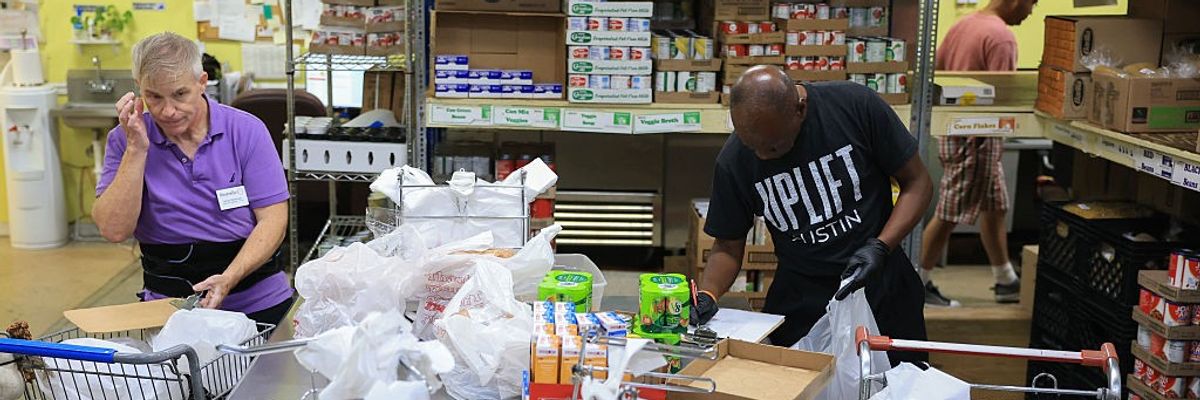
Charity workers fill food orders at the Poverello Food Pantry on May 14, 2025 in Wilton Manors, Florida.
One analysis warned that the GOP plan "may result in some states opting to end SNAP entirely if they are unable to come up with the state funds required to fill the hole left by deep federal cuts."
State and local officials, anti-hunger organizations, farmers, and families across the United States are bracing for impact as congressional Republicans plow ahead with legislation that would slash federal nutrition assistance by hundreds of billions of dollars, a potentially devastating blow to low-income Americans that would reverberate in every community across the country.
A centerpiece of the Republican measure, which passed out of the House Agriculture Committee on Wednesday, is a proposal to force states to pay a percentage of the funding for food aid provided under the Supplemental Nutrition Assistance Program (SNAP). Currently, SNAP food benefits are 100% funded by the federal government, with states picking up roughly half of the costs of administering the program.
If enacted, the Republican plan would require states to pay between 5% and 25% of the cost of SNAP food aid, depending on payment error rates. The legislation would also force states to pick up 75% of the program's administrative costs, effective immediately.
In a letter to lawmakers earlier this week, Massachusetts Gov. Maura Healey warned that the GOP proposal would shift "significant costs to states that they did not plan for and cannot afford."
Healey estimated that the Republican plan would cost her state up to $650 million annually, which the Democratic governor called "an exorbitant burden" that neither Massachusetts nor other states would be able to absorb.
"These proposed changes would create an impossible situation for our most vulnerable families and residents," Healey wrote. "SNAP supports more than one million Massachusetts residents, one-third of whom are elderly, one-quarter of them are children, and a quarter of those who receive SNAP in our state have a disability."
"Beyond the direct benefits to families, SNAP is essential to the state's economy," she added. "Every dollar in SNAP benefits generates up to $1.50 in local economic activity, supporting thousands of Massachusetts jobs across many different industries, including farmers, grocers, manufacturers, delivery drivers, and other positions throughout the food supply chain."
"They know damn well that neither states nor individuals can meet the new requirements put on them by these changes, and that this is how they plan to force millions of people off of SNAP."
The impacts of the SNAP cuts would be far-reaching, with direct and indirect consequences in states nationwide. One independent grocery store owner in Opelika, Alabama told The Washington Post that "in all my years of business, I don't remember laying anybody off."
"These reductions may make it where I have to visit that for the first time," he said.
The National Grocers Association, the top trade organization for the independent grocery industry, estimated earlier this month that SNAP funding backs roughly 388,000 jobs, accounts for more than $20 billion in direct wages, and helps generate billions of dollars in state and federal revenue.
The Center on Budget and Policy Priorities warned Tuesday that "if every state had needed to pay 5% of food benefit costs last year, states would have needed to collectively pay about $4.7 billion."
"Because SNAP is an optional program for states," the group said, "these deep federal funding cuts may result in some states opting to end SNAP entirely if they are unable to come up with the state funds required to fill the hole left by deep federal cuts."
Farmers have joined independent grocers, state leaders, and others in advocating against the GOP's proposed cuts.
Crystal FitzSimons, president of the Food Research & Action Center, stressed Wednesday that the proposed SNAP cuts "do not exist in a vacuum."
"While framed as a fiscal measure, the impact of these changes would ripple across entire sectors—harming families, farmers, grocers, local governments, and local economies," said FitzSimons. "This bill is a cruel attempt to drastically shrink access to critical food assistance and deter enrollment."
On top of the cost-sharing provisions, the Republican bill would significantly expand SNAP work requirements, adding another layer of bureaucracy that could put millions at risk of losing benefits.
"This bill is unacceptable, inhumane, and reckless," said Abby Leibman, the president and CEO of MAZON: A Jewish Response to Hunger. "Republicans in the White House and Congress know that these proposed changes to SNAP—which go even further than the budget reconciliation directives—are outrageous and destructive."
"In fact, that's the point," Leibman said. "They know damn well that neither states nor individuals can meet the new requirements put on them by these changes, and that this is how they plan to force millions of people off of SNAP while giving tax breaks to their wealthiest donors."
Dear Common Dreams reader, It’s been nearly 30 years since I co-founded Common Dreams with my late wife, Lina Newhouser. We had the radical notion that journalism should serve the public good, not corporate profits. It was clear to us from the outset what it would take to build such a project. No paid advertisements. No corporate sponsors. No millionaire publisher telling us what to think or do. Many people said we wouldn't last a year, but we proved those doubters wrong. Together with a tremendous team of journalists and dedicated staff, we built an independent media outlet free from the constraints of profits and corporate control. Our mission has always been simple: To inform. To inspire. To ignite change for the common good. Building Common Dreams was not easy. Our survival was never guaranteed. When you take on the most powerful forces—Wall Street greed, fossil fuel industry destruction, Big Tech lobbyists, and uber-rich oligarchs who have spent billions upon billions rigging the economy and democracy in their favor—the only bulwark you have is supporters who believe in your work. But here’s the urgent message from me today. It's never been this bad out there. And it's never been this hard to keep us going. At the very moment Common Dreams is most needed, the threats we face are intensifying. We need your support now more than ever. We don't accept corporate advertising and never will. We don't have a paywall because we don't think people should be blocked from critical news based on their ability to pay. Everything we do is funded by the donations of readers like you. When everyone does the little they can afford, we are strong. But if that support retreats or dries up, so do we. Will you donate now to make sure Common Dreams not only survives but thrives? —Craig Brown, Co-founder |
State and local officials, anti-hunger organizations, farmers, and families across the United States are bracing for impact as congressional Republicans plow ahead with legislation that would slash federal nutrition assistance by hundreds of billions of dollars, a potentially devastating blow to low-income Americans that would reverberate in every community across the country.
A centerpiece of the Republican measure, which passed out of the House Agriculture Committee on Wednesday, is a proposal to force states to pay a percentage of the funding for food aid provided under the Supplemental Nutrition Assistance Program (SNAP). Currently, SNAP food benefits are 100% funded by the federal government, with states picking up roughly half of the costs of administering the program.
If enacted, the Republican plan would require states to pay between 5% and 25% of the cost of SNAP food aid, depending on payment error rates. The legislation would also force states to pick up 75% of the program's administrative costs, effective immediately.
In a letter to lawmakers earlier this week, Massachusetts Gov. Maura Healey warned that the GOP proposal would shift "significant costs to states that they did not plan for and cannot afford."
Healey estimated that the Republican plan would cost her state up to $650 million annually, which the Democratic governor called "an exorbitant burden" that neither Massachusetts nor other states would be able to absorb.
"These proposed changes would create an impossible situation for our most vulnerable families and residents," Healey wrote. "SNAP supports more than one million Massachusetts residents, one-third of whom are elderly, one-quarter of them are children, and a quarter of those who receive SNAP in our state have a disability."
"Beyond the direct benefits to families, SNAP is essential to the state's economy," she added. "Every dollar in SNAP benefits generates up to $1.50 in local economic activity, supporting thousands of Massachusetts jobs across many different industries, including farmers, grocers, manufacturers, delivery drivers, and other positions throughout the food supply chain."
"They know damn well that neither states nor individuals can meet the new requirements put on them by these changes, and that this is how they plan to force millions of people off of SNAP."
The impacts of the SNAP cuts would be far-reaching, with direct and indirect consequences in states nationwide. One independent grocery store owner in Opelika, Alabama told The Washington Post that "in all my years of business, I don't remember laying anybody off."
"These reductions may make it where I have to visit that for the first time," he said.
The National Grocers Association, the top trade organization for the independent grocery industry, estimated earlier this month that SNAP funding backs roughly 388,000 jobs, accounts for more than $20 billion in direct wages, and helps generate billions of dollars in state and federal revenue.
The Center on Budget and Policy Priorities warned Tuesday that "if every state had needed to pay 5% of food benefit costs last year, states would have needed to collectively pay about $4.7 billion."
"Because SNAP is an optional program for states," the group said, "these deep federal funding cuts may result in some states opting to end SNAP entirely if they are unable to come up with the state funds required to fill the hole left by deep federal cuts."
Farmers have joined independent grocers, state leaders, and others in advocating against the GOP's proposed cuts.
Crystal FitzSimons, president of the Food Research & Action Center, stressed Wednesday that the proposed SNAP cuts "do not exist in a vacuum."
"While framed as a fiscal measure, the impact of these changes would ripple across entire sectors—harming families, farmers, grocers, local governments, and local economies," said FitzSimons. "This bill is a cruel attempt to drastically shrink access to critical food assistance and deter enrollment."
On top of the cost-sharing provisions, the Republican bill would significantly expand SNAP work requirements, adding another layer of bureaucracy that could put millions at risk of losing benefits.
"This bill is unacceptable, inhumane, and reckless," said Abby Leibman, the president and CEO of MAZON: A Jewish Response to Hunger. "Republicans in the White House and Congress know that these proposed changes to SNAP—which go even further than the budget reconciliation directives—are outrageous and destructive."
"In fact, that's the point," Leibman said. "They know damn well that neither states nor individuals can meet the new requirements put on them by these changes, and that this is how they plan to force millions of people off of SNAP while giving tax breaks to their wealthiest donors."
State and local officials, anti-hunger organizations, farmers, and families across the United States are bracing for impact as congressional Republicans plow ahead with legislation that would slash federal nutrition assistance by hundreds of billions of dollars, a potentially devastating blow to low-income Americans that would reverberate in every community across the country.
A centerpiece of the Republican measure, which passed out of the House Agriculture Committee on Wednesday, is a proposal to force states to pay a percentage of the funding for food aid provided under the Supplemental Nutrition Assistance Program (SNAP). Currently, SNAP food benefits are 100% funded by the federal government, with states picking up roughly half of the costs of administering the program.
If enacted, the Republican plan would require states to pay between 5% and 25% of the cost of SNAP food aid, depending on payment error rates. The legislation would also force states to pick up 75% of the program's administrative costs, effective immediately.
In a letter to lawmakers earlier this week, Massachusetts Gov. Maura Healey warned that the GOP proposal would shift "significant costs to states that they did not plan for and cannot afford."
Healey estimated that the Republican plan would cost her state up to $650 million annually, which the Democratic governor called "an exorbitant burden" that neither Massachusetts nor other states would be able to absorb.
"These proposed changes would create an impossible situation for our most vulnerable families and residents," Healey wrote. "SNAP supports more than one million Massachusetts residents, one-third of whom are elderly, one-quarter of them are children, and a quarter of those who receive SNAP in our state have a disability."
"Beyond the direct benefits to families, SNAP is essential to the state's economy," she added. "Every dollar in SNAP benefits generates up to $1.50 in local economic activity, supporting thousands of Massachusetts jobs across many different industries, including farmers, grocers, manufacturers, delivery drivers, and other positions throughout the food supply chain."
"They know damn well that neither states nor individuals can meet the new requirements put on them by these changes, and that this is how they plan to force millions of people off of SNAP."
The impacts of the SNAP cuts would be far-reaching, with direct and indirect consequences in states nationwide. One independent grocery store owner in Opelika, Alabama told The Washington Post that "in all my years of business, I don't remember laying anybody off."
"These reductions may make it where I have to visit that for the first time," he said.
The National Grocers Association, the top trade organization for the independent grocery industry, estimated earlier this month that SNAP funding backs roughly 388,000 jobs, accounts for more than $20 billion in direct wages, and helps generate billions of dollars in state and federal revenue.
The Center on Budget and Policy Priorities warned Tuesday that "if every state had needed to pay 5% of food benefit costs last year, states would have needed to collectively pay about $4.7 billion."
"Because SNAP is an optional program for states," the group said, "these deep federal funding cuts may result in some states opting to end SNAP entirely if they are unable to come up with the state funds required to fill the hole left by deep federal cuts."
Farmers have joined independent grocers, state leaders, and others in advocating against the GOP's proposed cuts.
Crystal FitzSimons, president of the Food Research & Action Center, stressed Wednesday that the proposed SNAP cuts "do not exist in a vacuum."
"While framed as a fiscal measure, the impact of these changes would ripple across entire sectors—harming families, farmers, grocers, local governments, and local economies," said FitzSimons. "This bill is a cruel attempt to drastically shrink access to critical food assistance and deter enrollment."
On top of the cost-sharing provisions, the Republican bill would significantly expand SNAP work requirements, adding another layer of bureaucracy that could put millions at risk of losing benefits.
"This bill is unacceptable, inhumane, and reckless," said Abby Leibman, the president and CEO of MAZON: A Jewish Response to Hunger. "Republicans in the White House and Congress know that these proposed changes to SNAP—which go even further than the budget reconciliation directives—are outrageous and destructive."
"In fact, that's the point," Leibman said. "They know damn well that neither states nor individuals can meet the new requirements put on them by these changes, and that this is how they plan to force millions of people off of SNAP while giving tax breaks to their wealthiest donors."