SUBSCRIBE TO OUR FREE NEWSLETTER
Daily news & progressive opinion—funded by the people, not the corporations—delivered straight to your inbox.
5
#000000
#FFFFFF
To donate by check, phone, or other method, see our More Ways to Give page.
Daily news & progressive opinion—funded by the people, not the corporations—delivered straight to your inbox.
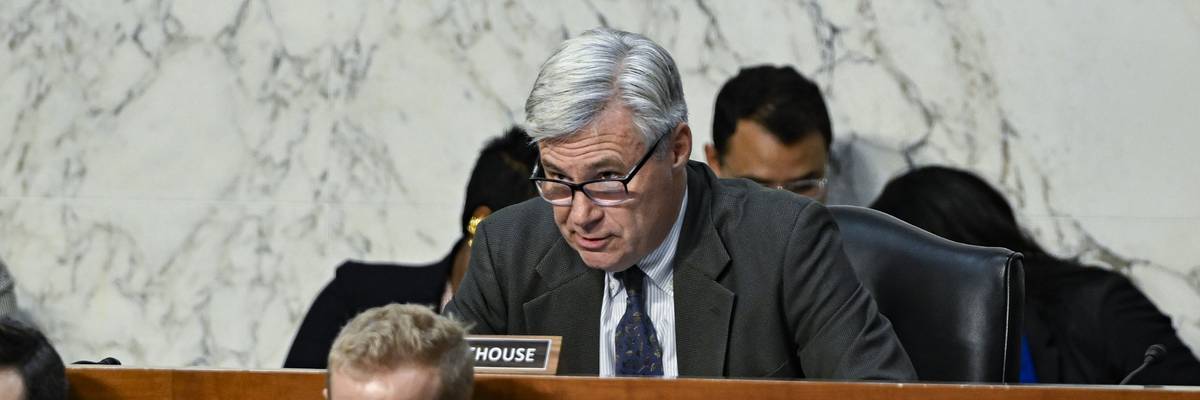
U.S. Sen. Sheldon Whitehouse attends a hearing in the Hart Senate Office Building in Washington D.C. on December 5, 2023.
"If not for the Bush tax cuts, their extensions, and then the Trump tax cuts, the U.S. debt-to-GDP ratio would be declining indefinitely," wrote Sen. Sheldon Whitehouse.
The Democratic chair of the Senate Budget Committee rebuked his Republican colleagues on Thursday for demanding action to reduce the U.S. debt after adding roughly $10 trillion to it with tax cuts for the rich and large corporations.
Sen. Sheldon Whitehouse (D-R.I.) was responding to a letter he received earlier this week from Republican members of the budget committee, who criticized the chair for dedicating "significant time and attention to climate issues" while purportedly neglecting "the impending budgetary and fiscal crisis facing our nation."
In a written reply, Whitehouse noted that "if not for the Bush tax cuts, their extensions, and then the Trump tax cuts, the U.S. debt-
to-GDP ratio would be declining indefinitely."
The Bush administration's decision to launch the so-called "war on terror"—which received bipartisan support in Congress—also cost the U.S. upwards of $8 trillion, Brown University's Costs of War project has estimated.
Whitehouse described Republicans' proposed solutions, such as their balanced budget plan, as "magical thinking," pointing to the Congressional Budget Office's recent conclusion that the GOP push to balance the federal budget within the next decade would not be possible without cuts to Social Security and Medicare—programs that are currently in the right-wing party's crosshairs.
"That wild notion would zero out all other federal spending and still not completely eliminate the deficit," Whitehouse wrote, observing that the GOP balanced budget plan would require the elimination of Medicaid, federal nutrition assistance, and other critical programs.
"Some billion-dollar corporations pay no income taxes at all. When you are willing to engage seriously with this problem, let me know."
Whitehouse also defended his decision to focus a significant portion of the committee's work on climate, arguing that "the next fiscal emergencies will be climate-related, and similarly disastrous for the federal budget, with cascading economy-wide 'systemic risks.'"
The U.S. has faced at least 23 billion-dollar extreme weather disasters this year, according to the National Oceanic and Atmospheric Administration. Democrats on the Senate Budget Committee are currently investigating the climate-induced insurance crisis.
"We presented testimony from leading bankers, insurance CEOs, top corporate advisory firms, mortgage lenders, and scientists about these risks; you responded mostly with mockery, climate denial, and fringe witnesses on the fossil fuel payroll," Whitehouse wrote Thursday.
The Democratic senator's exchange with his GOP counterparts came as Republicans and some Democrats are demanding a "fiscal commission" to craft legislative changes to the nation's trust fund programs, which the GOP has characterized as key contributors to the national debt. (Social Security is not a driver of federal deficits.)
Critics warn the fiscal commission would be a Trojan horse for Social Security and Medicare cuts.
Whitehouse and other congressional Democrats have proposed legislation that would extend Social Security's solvency for more than 75 years by raising taxes on the wealthy. Republicans, for their part, have called for raising the retirement age while working to shield rich tax dodgers.
"As we all know, the tax system is corrupted by special interests, and million-dollar earners can pay lower tax rates than plumbers and firefighters," Whitehouse wrote Thursday. "Some billion-dollar corporations pay no income taxes at all. When you are willing to engage seriously with this problem, let me know. There is a revenue side to the deficit problem, and we can correct injustices at the same time."
Dear Common Dreams reader, It’s been nearly 30 years since I co-founded Common Dreams with my late wife, Lina Newhouser. We had the radical notion that journalism should serve the public good, not corporate profits. It was clear to us from the outset what it would take to build such a project. No paid advertisements. No corporate sponsors. No millionaire publisher telling us what to think or do. Many people said we wouldn't last a year, but we proved those doubters wrong. Together with a tremendous team of journalists and dedicated staff, we built an independent media outlet free from the constraints of profits and corporate control. Our mission has always been simple: To inform. To inspire. To ignite change for the common good. Building Common Dreams was not easy. Our survival was never guaranteed. When you take on the most powerful forces—Wall Street greed, fossil fuel industry destruction, Big Tech lobbyists, and uber-rich oligarchs who have spent billions upon billions rigging the economy and democracy in their favor—the only bulwark you have is supporters who believe in your work. But here’s the urgent message from me today. It's never been this bad out there. And it's never been this hard to keep us going. At the very moment Common Dreams is most needed, the threats we face are intensifying. We need your support now more than ever. We don't accept corporate advertising and never will. We don't have a paywall because we don't think people should be blocked from critical news based on their ability to pay. Everything we do is funded by the donations of readers like you. When everyone does the little they can afford, we are strong. But if that support retreats or dries up, so do we. Will you donate now to make sure Common Dreams not only survives but thrives? —Craig Brown, Co-founder |
The Democratic chair of the Senate Budget Committee rebuked his Republican colleagues on Thursday for demanding action to reduce the U.S. debt after adding roughly $10 trillion to it with tax cuts for the rich and large corporations.
Sen. Sheldon Whitehouse (D-R.I.) was responding to a letter he received earlier this week from Republican members of the budget committee, who criticized the chair for dedicating "significant time and attention to climate issues" while purportedly neglecting "the impending budgetary and fiscal crisis facing our nation."
In a written reply, Whitehouse noted that "if not for the Bush tax cuts, their extensions, and then the Trump tax cuts, the U.S. debt-
to-GDP ratio would be declining indefinitely."
The Bush administration's decision to launch the so-called "war on terror"—which received bipartisan support in Congress—also cost the U.S. upwards of $8 trillion, Brown University's Costs of War project has estimated.
Whitehouse described Republicans' proposed solutions, such as their balanced budget plan, as "magical thinking," pointing to the Congressional Budget Office's recent conclusion that the GOP push to balance the federal budget within the next decade would not be possible without cuts to Social Security and Medicare—programs that are currently in the right-wing party's crosshairs.
"That wild notion would zero out all other federal spending and still not completely eliminate the deficit," Whitehouse wrote, observing that the GOP balanced budget plan would require the elimination of Medicaid, federal nutrition assistance, and other critical programs.
"Some billion-dollar corporations pay no income taxes at all. When you are willing to engage seriously with this problem, let me know."
Whitehouse also defended his decision to focus a significant portion of the committee's work on climate, arguing that "the next fiscal emergencies will be climate-related, and similarly disastrous for the federal budget, with cascading economy-wide 'systemic risks.'"
The U.S. has faced at least 23 billion-dollar extreme weather disasters this year, according to the National Oceanic and Atmospheric Administration. Democrats on the Senate Budget Committee are currently investigating the climate-induced insurance crisis.
"We presented testimony from leading bankers, insurance CEOs, top corporate advisory firms, mortgage lenders, and scientists about these risks; you responded mostly with mockery, climate denial, and fringe witnesses on the fossil fuel payroll," Whitehouse wrote Thursday.
The Democratic senator's exchange with his GOP counterparts came as Republicans and some Democrats are demanding a "fiscal commission" to craft legislative changes to the nation's trust fund programs, which the GOP has characterized as key contributors to the national debt. (Social Security is not a driver of federal deficits.)
Critics warn the fiscal commission would be a Trojan horse for Social Security and Medicare cuts.
Whitehouse and other congressional Democrats have proposed legislation that would extend Social Security's solvency for more than 75 years by raising taxes on the wealthy. Republicans, for their part, have called for raising the retirement age while working to shield rich tax dodgers.
"As we all know, the tax system is corrupted by special interests, and million-dollar earners can pay lower tax rates than plumbers and firefighters," Whitehouse wrote Thursday. "Some billion-dollar corporations pay no income taxes at all. When you are willing to engage seriously with this problem, let me know. There is a revenue side to the deficit problem, and we can correct injustices at the same time."
The Democratic chair of the Senate Budget Committee rebuked his Republican colleagues on Thursday for demanding action to reduce the U.S. debt after adding roughly $10 trillion to it with tax cuts for the rich and large corporations.
Sen. Sheldon Whitehouse (D-R.I.) was responding to a letter he received earlier this week from Republican members of the budget committee, who criticized the chair for dedicating "significant time and attention to climate issues" while purportedly neglecting "the impending budgetary and fiscal crisis facing our nation."
In a written reply, Whitehouse noted that "if not for the Bush tax cuts, their extensions, and then the Trump tax cuts, the U.S. debt-
to-GDP ratio would be declining indefinitely."
The Bush administration's decision to launch the so-called "war on terror"—which received bipartisan support in Congress—also cost the U.S. upwards of $8 trillion, Brown University's Costs of War project has estimated.
Whitehouse described Republicans' proposed solutions, such as their balanced budget plan, as "magical thinking," pointing to the Congressional Budget Office's recent conclusion that the GOP push to balance the federal budget within the next decade would not be possible without cuts to Social Security and Medicare—programs that are currently in the right-wing party's crosshairs.
"That wild notion would zero out all other federal spending and still not completely eliminate the deficit," Whitehouse wrote, observing that the GOP balanced budget plan would require the elimination of Medicaid, federal nutrition assistance, and other critical programs.
"Some billion-dollar corporations pay no income taxes at all. When you are willing to engage seriously with this problem, let me know."
Whitehouse also defended his decision to focus a significant portion of the committee's work on climate, arguing that "the next fiscal emergencies will be climate-related, and similarly disastrous for the federal budget, with cascading economy-wide 'systemic risks.'"
The U.S. has faced at least 23 billion-dollar extreme weather disasters this year, according to the National Oceanic and Atmospheric Administration. Democrats on the Senate Budget Committee are currently investigating the climate-induced insurance crisis.
"We presented testimony from leading bankers, insurance CEOs, top corporate advisory firms, mortgage lenders, and scientists about these risks; you responded mostly with mockery, climate denial, and fringe witnesses on the fossil fuel payroll," Whitehouse wrote Thursday.
The Democratic senator's exchange with his GOP counterparts came as Republicans and some Democrats are demanding a "fiscal commission" to craft legislative changes to the nation's trust fund programs, which the GOP has characterized as key contributors to the national debt. (Social Security is not a driver of federal deficits.)
Critics warn the fiscal commission would be a Trojan horse for Social Security and Medicare cuts.
Whitehouse and other congressional Democrats have proposed legislation that would extend Social Security's solvency for more than 75 years by raising taxes on the wealthy. Republicans, for their part, have called for raising the retirement age while working to shield rich tax dodgers.
"As we all know, the tax system is corrupted by special interests, and million-dollar earners can pay lower tax rates than plumbers and firefighters," Whitehouse wrote Thursday. "Some billion-dollar corporations pay no income taxes at all. When you are willing to engage seriously with this problem, let me know. There is a revenue side to the deficit problem, and we can correct injustices at the same time."