

SUBSCRIBE TO OUR FREE NEWSLETTER
Daily news & progressive opinion—funded by the people, not the corporations—delivered straight to your inbox.
5
#000000
#FFFFFF
To donate by check, phone, or other method, see our More Ways to Give page.
Daily news & progressive opinion—funded by the people, not the corporations—delivered straight to your inbox.
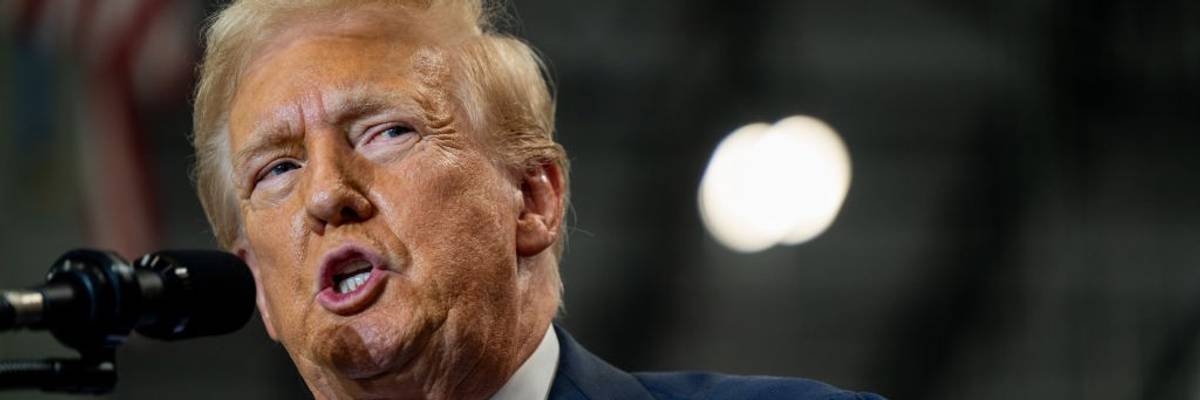
Republican U.S. President-elect Donald Trump—who has repeatedly called the media the "enemy of the people"—speaks during a September 25, 2024 campaign rally in Mint Hill, North Carolina.
One expert said that while the lawsuit has little chance of success, Trump's "true motivation is to intimidate the press and journalists."
Free press advocates voiced alarm Tuesday over what one commentator called the "chilling effect" of a lawsuit filed by U.S. President-elect Donald Trump against a prominent pollster, her firm, and an Iowa newspaper that published a preelection poll showing Vice Kamala Harris leading the Republican nominee in the state which he ultimately won by double digits.
Trump sued pollster J. Ann Selzer, her polling firm Selzer & Company, The Des Moines Register, and the paper's parent company, Gannett, alleging fraud and "brazen election interference" over a November 2 poll showing Harris, the Democratic nominee, ahead of Trump by 3 points. Trump won Iowa by 13 points.
"I'm doing this because I feel I have an obligation to," Trump explained after filing the suit on Monday. "I'm going to be bringing one against the people in Iowa, their newspaper, which had a very, very good pollster who got me right all the time, and then just before the election, she said I was going to lose by 3 or 4 points."
Trump's lawyers say the disparity between Selzer's polling and the election's actual outcome shows the defendants acted with "intentional" malice and engaged in "election-interfering fiction."
Unlike other Trump lawsuits including the one ABC News agreed Saturday to settle for $15 million plus $1 million in legal fees, the new suit does not accuse the defendants of defaming the president-elect. Instead, it alleges violations of the Iowa Consumer Fraud Act and related provisions.
Responding to the filing, a spokesperson for Gannett—which owns over 100 daily and 1,000 weekly newspapers in the United States and abroad—said that "we stand by our reporting on the matter and believe this lawsuit is without merit."
Media and legal experts said that although the new lawsuit has very little chance of success, Trump—who has called the press the "enemy of the people" and has even suggested that he would not mind if journalists were shot—is aiming to silence critical media through resource-sapping lawfare.
"The odds of success here are slim to none, but winning in court is not likely the real goal of this lawsuit," Clay Calvert, a media law expert and professor at the University of Florida's Levin College of Law, told NBC News. "The true motivation is to intimidate the press and journalists. I unfortunately suspect this lawsuit is just a harbinger of things to come."
Fox News commentator Howard Kurtz said on social media that while it is "very hard for a public figure to win" a lawsuit like the one Trump filed, "the chilling effect is clear."
Trump said today that he’s planning to sue the Des Moines Register, 60 Minutes, Bob Woodward, and even the Pulitzer Prizes, awarded by Columbia University. He claims the Justice Department should have done it for him. The weaponization of power is on full display.
— Voter Protection Project (@voterprotectpac.bsky.social) December 16, 2024 at 4:39 PM
Joel Simon, director of the City University of New York's Journalism Protection Initiative, told CNN that he "would not have imagined" that such tactics "would be deployed in the United States."
"I would also be concerned about the arbitrary, petty, and vindictive nature of these legal actions that President-elect Trump is pursuing," he said. "The possibility of legal victory is slim because under the 'actual malice' standard reporting done in good faith is protected in the U.S. But for a smaller or less-resourced news organization, mounting a legal defense can be a serious challenge."
Dear Common Dreams reader, It’s been nearly 30 years since I co-founded Common Dreams with my late wife, Lina Newhouser. We had the radical notion that journalism should serve the public good, not corporate profits. It was clear to us from the outset what it would take to build such a project. No paid advertisements. No corporate sponsors. No millionaire publisher telling us what to think or do. Many people said we wouldn't last a year, but we proved those doubters wrong. Together with a tremendous team of journalists and dedicated staff, we built an independent media outlet free from the constraints of profits and corporate control. Our mission has always been simple: To inform. To inspire. To ignite change for the common good. Building Common Dreams was not easy. Our survival was never guaranteed. When you take on the most powerful forces—Wall Street greed, fossil fuel industry destruction, Big Tech lobbyists, and uber-rich oligarchs who have spent billions upon billions rigging the economy and democracy in their favor—the only bulwark you have is supporters who believe in your work. But here’s the urgent message from me today. It's never been this bad out there. And it's never been this hard to keep us going. At the very moment Common Dreams is most needed, the threats we face are intensifying. We need your support now more than ever. We don't accept corporate advertising and never will. We don't have a paywall because we don't think people should be blocked from critical news based on their ability to pay. Everything we do is funded by the donations of readers like you. When everyone does the little they can afford, we are strong. But if that support retreats or dries up, so do we. Will you donate now to make sure Common Dreams not only survives but thrives? —Craig Brown, Co-founder |
Free press advocates voiced alarm Tuesday over what one commentator called the "chilling effect" of a lawsuit filed by U.S. President-elect Donald Trump against a prominent pollster, her firm, and an Iowa newspaper that published a preelection poll showing Vice Kamala Harris leading the Republican nominee in the state which he ultimately won by double digits.
Trump sued pollster J. Ann Selzer, her polling firm Selzer & Company, The Des Moines Register, and the paper's parent company, Gannett, alleging fraud and "brazen election interference" over a November 2 poll showing Harris, the Democratic nominee, ahead of Trump by 3 points. Trump won Iowa by 13 points.
"I'm doing this because I feel I have an obligation to," Trump explained after filing the suit on Monday. "I'm going to be bringing one against the people in Iowa, their newspaper, which had a very, very good pollster who got me right all the time, and then just before the election, she said I was going to lose by 3 or 4 points."
Trump's lawyers say the disparity between Selzer's polling and the election's actual outcome shows the defendants acted with "intentional" malice and engaged in "election-interfering fiction."
Unlike other Trump lawsuits including the one ABC News agreed Saturday to settle for $15 million plus $1 million in legal fees, the new suit does not accuse the defendants of defaming the president-elect. Instead, it alleges violations of the Iowa Consumer Fraud Act and related provisions.
Responding to the filing, a spokesperson for Gannett—which owns over 100 daily and 1,000 weekly newspapers in the United States and abroad—said that "we stand by our reporting on the matter and believe this lawsuit is without merit."
Media and legal experts said that although the new lawsuit has very little chance of success, Trump—who has called the press the "enemy of the people" and has even suggested that he would not mind if journalists were shot—is aiming to silence critical media through resource-sapping lawfare.
"The odds of success here are slim to none, but winning in court is not likely the real goal of this lawsuit," Clay Calvert, a media law expert and professor at the University of Florida's Levin College of Law, told NBC News. "The true motivation is to intimidate the press and journalists. I unfortunately suspect this lawsuit is just a harbinger of things to come."
Fox News commentator Howard Kurtz said on social media that while it is "very hard for a public figure to win" a lawsuit like the one Trump filed, "the chilling effect is clear."
Trump said today that he’s planning to sue the Des Moines Register, 60 Minutes, Bob Woodward, and even the Pulitzer Prizes, awarded by Columbia University. He claims the Justice Department should have done it for him. The weaponization of power is on full display.
— Voter Protection Project (@voterprotectpac.bsky.social) December 16, 2024 at 4:39 PM
Joel Simon, director of the City University of New York's Journalism Protection Initiative, told CNN that he "would not have imagined" that such tactics "would be deployed in the United States."
"I would also be concerned about the arbitrary, petty, and vindictive nature of these legal actions that President-elect Trump is pursuing," he said. "The possibility of legal victory is slim because under the 'actual malice' standard reporting done in good faith is protected in the U.S. But for a smaller or less-resourced news organization, mounting a legal defense can be a serious challenge."
Free press advocates voiced alarm Tuesday over what one commentator called the "chilling effect" of a lawsuit filed by U.S. President-elect Donald Trump against a prominent pollster, her firm, and an Iowa newspaper that published a preelection poll showing Vice Kamala Harris leading the Republican nominee in the state which he ultimately won by double digits.
Trump sued pollster J. Ann Selzer, her polling firm Selzer & Company, The Des Moines Register, and the paper's parent company, Gannett, alleging fraud and "brazen election interference" over a November 2 poll showing Harris, the Democratic nominee, ahead of Trump by 3 points. Trump won Iowa by 13 points.
"I'm doing this because I feel I have an obligation to," Trump explained after filing the suit on Monday. "I'm going to be bringing one against the people in Iowa, their newspaper, which had a very, very good pollster who got me right all the time, and then just before the election, she said I was going to lose by 3 or 4 points."
Trump's lawyers say the disparity between Selzer's polling and the election's actual outcome shows the defendants acted with "intentional" malice and engaged in "election-interfering fiction."
Unlike other Trump lawsuits including the one ABC News agreed Saturday to settle for $15 million plus $1 million in legal fees, the new suit does not accuse the defendants of defaming the president-elect. Instead, it alleges violations of the Iowa Consumer Fraud Act and related provisions.
Responding to the filing, a spokesperson for Gannett—which owns over 100 daily and 1,000 weekly newspapers in the United States and abroad—said that "we stand by our reporting on the matter and believe this lawsuit is without merit."
Media and legal experts said that although the new lawsuit has very little chance of success, Trump—who has called the press the "enemy of the people" and has even suggested that he would not mind if journalists were shot—is aiming to silence critical media through resource-sapping lawfare.
"The odds of success here are slim to none, but winning in court is not likely the real goal of this lawsuit," Clay Calvert, a media law expert and professor at the University of Florida's Levin College of Law, told NBC News. "The true motivation is to intimidate the press and journalists. I unfortunately suspect this lawsuit is just a harbinger of things to come."
Fox News commentator Howard Kurtz said on social media that while it is "very hard for a public figure to win" a lawsuit like the one Trump filed, "the chilling effect is clear."
Trump said today that he’s planning to sue the Des Moines Register, 60 Minutes, Bob Woodward, and even the Pulitzer Prizes, awarded by Columbia University. He claims the Justice Department should have done it for him. The weaponization of power is on full display.
— Voter Protection Project (@voterprotectpac.bsky.social) December 16, 2024 at 4:39 PM
Joel Simon, director of the City University of New York's Journalism Protection Initiative, told CNN that he "would not have imagined" that such tactics "would be deployed in the United States."
"I would also be concerned about the arbitrary, petty, and vindictive nature of these legal actions that President-elect Trump is pursuing," he said. "The possibility of legal victory is slim because under the 'actual malice' standard reporting done in good faith is protected in the U.S. But for a smaller or less-resourced news organization, mounting a legal defense can be a serious challenge."

