SUBSCRIBE TO OUR FREE NEWSLETTER
Daily news & progressive opinion—funded by the people, not the corporations—delivered straight to your inbox.
5
#000000
#FFFFFF
To donate by check, phone, or other method, see our More Ways to Give page.
Daily news & progressive opinion—funded by the people, not the corporations—delivered straight to your inbox.
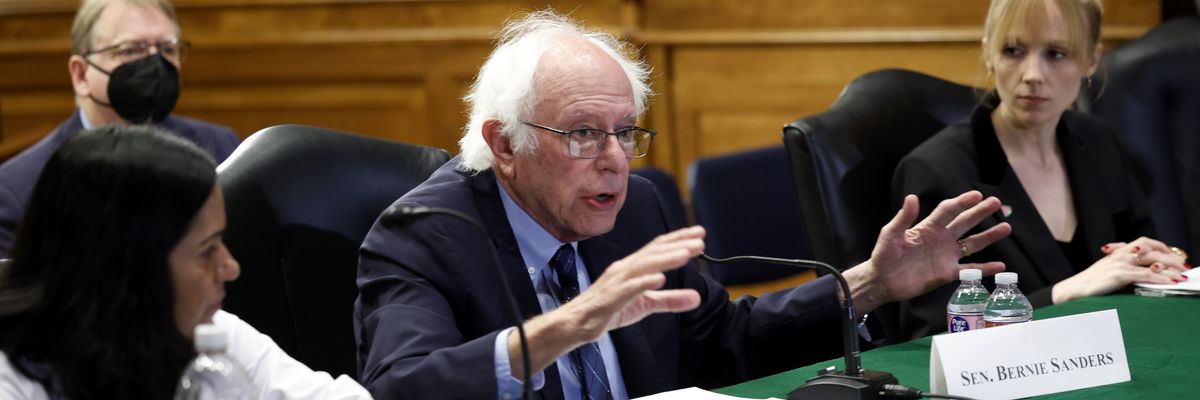
U.S. Sen. Bernie Sanders (I-Vt.) during a panel discussion on prescription drug costs on September 17, 2024 in Washington, D.C.
"Why? Excessive corporate greed," said Sen. Bernie Sanders.
U.S. Sen. Bernie Sanders called out the pharmaceutical giant Novo Nordisk on Tuesday for charging American patients more than $900 a month for the increasingly popular diabetes drug Ozempic, even though generic manufacturers are willing to sell the medication for significantly less.
During a panel discussion with experts, Sanders (I-Vt.) said he and his staff have been in contact with the top executives of major drug makers who say they could sell a generic version of Ozempic for less than $100 a month—and still turn a profit. A recent study found that the drug can be manufactured for less than $5 a month.
"Novo Nordisk, which has made nearly $50 billion in sales off of Ozempic and Wegovy, charges Americans almost $1,000 a month—the highest prices in the world," Sanders, the chair of the Senate Health, Education, Labor, and Pensions (HELP) Committee, said Tuesday. "Why? Excessive corporate greed."
Ozempic and Wegovy are part of a class of treatments known as GLP-1s. Wegovy, a weight-loss drug that Novo Nordisk sells for $1,349 a month in the U.S., contains the same active ingredient as Ozempic, which is approved only for people with Type 2 diabetes.
The drugs' growing popularity in the U.S. has drawn greater scrutiny to Novo Nordisk's pricing. Sanders' office noted Tuesday that the company's price tag for Wegovy is $186 in Denmark, $140 in Germany, and $92 in the United Kingdom.
Novo Nordisk's high prices for the drugs in the U.S. could have far-reaching impacts on the nation's healthcare system. A group of economists wrote in a recent op-ed for The New York Times earlier this year that "under reasonable assumptions and at current prices, making this class of drugs available to all obese Americans could eventually cost over $1 trillion per year," which is "almost as much as the government spends on the entire Medicare program and almost one-fifth of the entire amount America spends on healthcare."
Sanders warned Tuesday that if the prices of Ozempic and Wegovy aren't reined in, Medicare premiums could surge.
"Our healthcare system, I think most people understand, is in crisis," Sanders said during the panel discussion. "The business model of the pharmaceutical industry is unsustainable."
Over the course of our investigation into the outrageous cost of Ozempic and Wegovy in the U.S., I spoke with the CEOs of major generic pharmaceutical companies who confirmed:
They can sell a generic version of Ozempic for $100/mo. https://t.co/XDHdBRPIcM
— Bernie Sanders (@SenSanders) September 17, 2024
Peter Maybarduk, director of the Access to Medicines Program at Public Citizen, said in a statement Tuesday that "all we need to make Ozempic for $100 a reality is to overcome Novo's patent monopoly, which the government has the power to do any time."
"States and clinicians are asking the feds for help," said Maybarduk. "We estimate taking action on Novo's patents could save Medicare more than $14 billion in the first two years of competition, while making diabetes and obesity drugs affordable."
Last month, Public Citizen delivered a petition to U.S. Health and Human Services Secretary Xavier Becerra urging him to use existing law to "authorize generic competitors to Ozempic and Wegovy."
"Novo Nordisk’s outrageous pricing of [Ozempic and Wegovy] threatens to break the coffers of federal health programs," the group wrote. "Pursuant to 28 U.S.C. § 1498, the administration should authorize use of any and all patents necessary to allow manufacturers to produce generic alternatives to these treatments on behalf of the United States government, which can be used to supply Medicare, Medicaid, and other federal health programs. This will facilitate competition and make the treatments more affordable and accessible for patients."
The CEO of Novo Nordisk, which has spent aggressively on lobbying this year, is scheduled to testify before the Senate HELP Committee next week.
Dear Common Dreams reader, It’s been nearly 30 years since I co-founded Common Dreams with my late wife, Lina Newhouser. We had the radical notion that journalism should serve the public good, not corporate profits. It was clear to us from the outset what it would take to build such a project. No paid advertisements. No corporate sponsors. No millionaire publisher telling us what to think or do. Many people said we wouldn't last a year, but we proved those doubters wrong. Together with a tremendous team of journalists and dedicated staff, we built an independent media outlet free from the constraints of profits and corporate control. Our mission has always been simple: To inform. To inspire. To ignite change for the common good. Building Common Dreams was not easy. Our survival was never guaranteed. When you take on the most powerful forces—Wall Street greed, fossil fuel industry destruction, Big Tech lobbyists, and uber-rich oligarchs who have spent billions upon billions rigging the economy and democracy in their favor—the only bulwark you have is supporters who believe in your work. But here’s the urgent message from me today. It's never been this bad out there. And it's never been this hard to keep us going. At the very moment Common Dreams is most needed, the threats we face are intensifying. We need your support now more than ever. We don't accept corporate advertising and never will. We don't have a paywall because we don't think people should be blocked from critical news based on their ability to pay. Everything we do is funded by the donations of readers like you. When everyone does the little they can afford, we are strong. But if that support retreats or dries up, so do we. Will you donate now to make sure Common Dreams not only survives but thrives? —Craig Brown, Co-founder |
U.S. Sen. Bernie Sanders called out the pharmaceutical giant Novo Nordisk on Tuesday for charging American patients more than $900 a month for the increasingly popular diabetes drug Ozempic, even though generic manufacturers are willing to sell the medication for significantly less.
During a panel discussion with experts, Sanders (I-Vt.) said he and his staff have been in contact with the top executives of major drug makers who say they could sell a generic version of Ozempic for less than $100 a month—and still turn a profit. A recent study found that the drug can be manufactured for less than $5 a month.
"Novo Nordisk, which has made nearly $50 billion in sales off of Ozempic and Wegovy, charges Americans almost $1,000 a month—the highest prices in the world," Sanders, the chair of the Senate Health, Education, Labor, and Pensions (HELP) Committee, said Tuesday. "Why? Excessive corporate greed."
Ozempic and Wegovy are part of a class of treatments known as GLP-1s. Wegovy, a weight-loss drug that Novo Nordisk sells for $1,349 a month in the U.S., contains the same active ingredient as Ozempic, which is approved only for people with Type 2 diabetes.
The drugs' growing popularity in the U.S. has drawn greater scrutiny to Novo Nordisk's pricing. Sanders' office noted Tuesday that the company's price tag for Wegovy is $186 in Denmark, $140 in Germany, and $92 in the United Kingdom.
Novo Nordisk's high prices for the drugs in the U.S. could have far-reaching impacts on the nation's healthcare system. A group of economists wrote in a recent op-ed for The New York Times earlier this year that "under reasonable assumptions and at current prices, making this class of drugs available to all obese Americans could eventually cost over $1 trillion per year," which is "almost as much as the government spends on the entire Medicare program and almost one-fifth of the entire amount America spends on healthcare."
Sanders warned Tuesday that if the prices of Ozempic and Wegovy aren't reined in, Medicare premiums could surge.
"Our healthcare system, I think most people understand, is in crisis," Sanders said during the panel discussion. "The business model of the pharmaceutical industry is unsustainable."
Over the course of our investigation into the outrageous cost of Ozempic and Wegovy in the U.S., I spoke with the CEOs of major generic pharmaceutical companies who confirmed:
They can sell a generic version of Ozempic for $100/mo. https://t.co/XDHdBRPIcM
— Bernie Sanders (@SenSanders) September 17, 2024
Peter Maybarduk, director of the Access to Medicines Program at Public Citizen, said in a statement Tuesday that "all we need to make Ozempic for $100 a reality is to overcome Novo's patent monopoly, which the government has the power to do any time."
"States and clinicians are asking the feds for help," said Maybarduk. "We estimate taking action on Novo's patents could save Medicare more than $14 billion in the first two years of competition, while making diabetes and obesity drugs affordable."
Last month, Public Citizen delivered a petition to U.S. Health and Human Services Secretary Xavier Becerra urging him to use existing law to "authorize generic competitors to Ozempic and Wegovy."
"Novo Nordisk’s outrageous pricing of [Ozempic and Wegovy] threatens to break the coffers of federal health programs," the group wrote. "Pursuant to 28 U.S.C. § 1498, the administration should authorize use of any and all patents necessary to allow manufacturers to produce generic alternatives to these treatments on behalf of the United States government, which can be used to supply Medicare, Medicaid, and other federal health programs. This will facilitate competition and make the treatments more affordable and accessible for patients."
The CEO of Novo Nordisk, which has spent aggressively on lobbying this year, is scheduled to testify before the Senate HELP Committee next week.
U.S. Sen. Bernie Sanders called out the pharmaceutical giant Novo Nordisk on Tuesday for charging American patients more than $900 a month for the increasingly popular diabetes drug Ozempic, even though generic manufacturers are willing to sell the medication for significantly less.
During a panel discussion with experts, Sanders (I-Vt.) said he and his staff have been in contact with the top executives of major drug makers who say they could sell a generic version of Ozempic for less than $100 a month—and still turn a profit. A recent study found that the drug can be manufactured for less than $5 a month.
"Novo Nordisk, which has made nearly $50 billion in sales off of Ozempic and Wegovy, charges Americans almost $1,000 a month—the highest prices in the world," Sanders, the chair of the Senate Health, Education, Labor, and Pensions (HELP) Committee, said Tuesday. "Why? Excessive corporate greed."
Ozempic and Wegovy are part of a class of treatments known as GLP-1s. Wegovy, a weight-loss drug that Novo Nordisk sells for $1,349 a month in the U.S., contains the same active ingredient as Ozempic, which is approved only for people with Type 2 diabetes.
The drugs' growing popularity in the U.S. has drawn greater scrutiny to Novo Nordisk's pricing. Sanders' office noted Tuesday that the company's price tag for Wegovy is $186 in Denmark, $140 in Germany, and $92 in the United Kingdom.
Novo Nordisk's high prices for the drugs in the U.S. could have far-reaching impacts on the nation's healthcare system. A group of economists wrote in a recent op-ed for The New York Times earlier this year that "under reasonable assumptions and at current prices, making this class of drugs available to all obese Americans could eventually cost over $1 trillion per year," which is "almost as much as the government spends on the entire Medicare program and almost one-fifth of the entire amount America spends on healthcare."
Sanders warned Tuesday that if the prices of Ozempic and Wegovy aren't reined in, Medicare premiums could surge.
"Our healthcare system, I think most people understand, is in crisis," Sanders said during the panel discussion. "The business model of the pharmaceutical industry is unsustainable."
Over the course of our investigation into the outrageous cost of Ozempic and Wegovy in the U.S., I spoke with the CEOs of major generic pharmaceutical companies who confirmed:
They can sell a generic version of Ozempic for $100/mo. https://t.co/XDHdBRPIcM
— Bernie Sanders (@SenSanders) September 17, 2024
Peter Maybarduk, director of the Access to Medicines Program at Public Citizen, said in a statement Tuesday that "all we need to make Ozempic for $100 a reality is to overcome Novo's patent monopoly, which the government has the power to do any time."
"States and clinicians are asking the feds for help," said Maybarduk. "We estimate taking action on Novo's patents could save Medicare more than $14 billion in the first two years of competition, while making diabetes and obesity drugs affordable."
Last month, Public Citizen delivered a petition to U.S. Health and Human Services Secretary Xavier Becerra urging him to use existing law to "authorize generic competitors to Ozempic and Wegovy."
"Novo Nordisk’s outrageous pricing of [Ozempic and Wegovy] threatens to break the coffers of federal health programs," the group wrote. "Pursuant to 28 U.S.C. § 1498, the administration should authorize use of any and all patents necessary to allow manufacturers to produce generic alternatives to these treatments on behalf of the United States government, which can be used to supply Medicare, Medicaid, and other federal health programs. This will facilitate competition and make the treatments more affordable and accessible for patients."
The CEO of Novo Nordisk, which has spent aggressively on lobbying this year, is scheduled to testify before the Senate HELP Committee next week.