SUBSCRIBE TO OUR FREE NEWSLETTER
Daily news & progressive opinion—funded by the people, not the corporations—delivered straight to your inbox.
5
#000000
#FFFFFF
To donate by check, phone, or other method, see our More Ways to Give page.
Daily news & progressive opinion—funded by the people, not the corporations—delivered straight to your inbox.
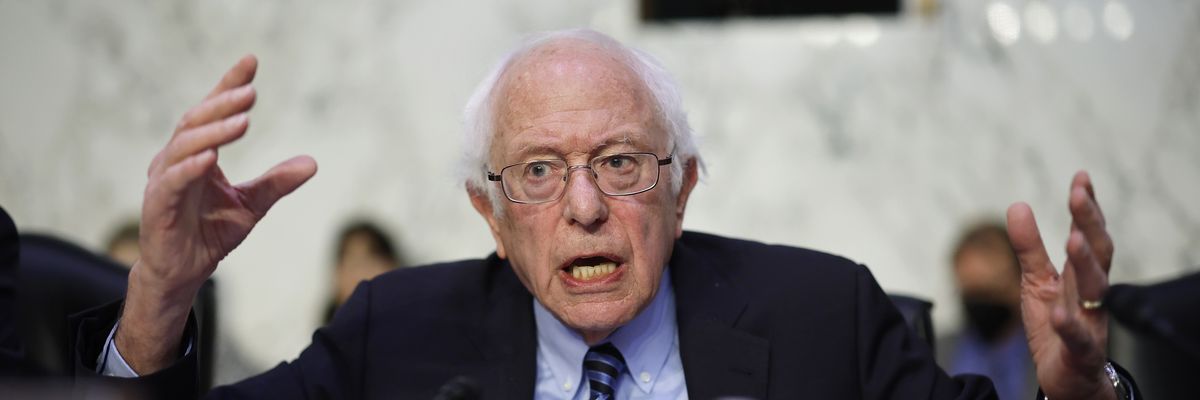
Senate Health, Education, Labor, and Pensions Committee Chairman Bernie Sanders (I-Vt.) delivers opening remarks during a hearing in the Hart Senate Office Building on Capitol Hill on March 22, 2023.
"The CEOs of the largest banks in America should not be allowed to serve as directors of the main agency we have in this country in charge of regulating those very same financial institutions," the senator said.
U.S. Sen. Bernie Sanders on Thursday introduced the Federal Reserve Independence Act to prevent bank executives from serving on regional Fed boards that are responsible for regulating their institutions.
The bill—which would also bar the U.S. central bank's board members and employees from owning any stock or investing in any company that is regulated by the Federal Reserve—comes as Fed leadership is under fire for recent interest rate hikes and regulatory rollbacks that preceded the Silicon Valley Bank (SVB) and Signature Bank failures.
"The Fed has got to become a more democratic institution that is responsive to the needs of working people and the middle class."
"I think it would come as a shock to most Americans to find out that Gregory Becker, the CEO of Silicon Valley Bank, who successfully lobbied for the deregulation of his financial institution was allowed to serve as a director of the same body in charge of regulating his bank: the San Francisco Federal Reserve," Sanders (I-Vt.) said in a statement.
"It is clear to me and to the American people, that the CEOs of the largest banks in America should not be allowed to serve as directors of the main agency we have in this country in charge of regulating those very same financial institutions," he asserted. "The Fed has got to become a more democratic institution that is responsive to the needs of working people and the middle class, not just CEOs of some of the largest financial institutions in America."
In a letter to his congressional colleagues about the bill, Sanders highlighted:
Gregory Becker may be the poster child for why we need this legislation, but he is not alone. Incredibly, two-thirds of the directors of these boards are hand-picked by the same bankers that the Federal Reserve is in charge of regulating.
Today, five top executives of financial institutions with over $150 billion in assets currently serve as directors of Federal Reserve banks. For example, the CEO of State Street (a financial institution with nearly $300 billion in assets) currently serves as a director of the Boston Federal Reserve. The CEO of M&T Bank (a financial institution with over $200 billion in assets) currently serves as a director of the New York Fed. The CFO of Ally Bank which has assets of over $180 billion is currently a director of the Richmond Fed. And the CEO of Northern Trust with assets of more than $150 billion currently serves on the Chicago Fed.
Sanders also pointed to a 2011 Government Accountability Office study which "found that allowing members of the banking industry to both elect and serve on the Federal Reserve's board of directors creates 'an appearance of a conflict of interest' and poses 'reputational risks' to the Federal Reserve System."
The senator provided examples involving Stephen Friedman, a former chairman of the New York Federal Reserve board as well as a Goldman Sachs board member and stockholder, and JPMorgan Chase CEO Jamie Dimon, whose bank got $391 billion in assistance while he sat on that same regional Fed board.
Along with seeking support for his bill—which is backed by Americans for Financial Reform, Demos, Revolving Door Project, Public Citizen, Working Families Party, and Association of Flight Attendants-CWA—Sanders is urging Congress to take other action in the wake of the SVB and Signature collapses.
Specifically, the senator is calling for:
As Sanders put it earlier this month: "We cannot continue down the road of more socialism for the rich and rugged individualism for everyone else. Let us have the courage to stand up to Wall Street, repeal the disastrous 2018 bank deregulation law, break up too big to fail banks, and address the needs of working families not the risky bets of vulture capitalists."
Dear Common Dreams reader, It’s been nearly 30 years since I co-founded Common Dreams with my late wife, Lina Newhouser. We had the radical notion that journalism should serve the public good, not corporate profits. It was clear to us from the outset what it would take to build such a project. No paid advertisements. No corporate sponsors. No millionaire publisher telling us what to think or do. Many people said we wouldn't last a year, but we proved those doubters wrong. Together with a tremendous team of journalists and dedicated staff, we built an independent media outlet free from the constraints of profits and corporate control. Our mission has always been simple: To inform. To inspire. To ignite change for the common good. Building Common Dreams was not easy. Our survival was never guaranteed. When you take on the most powerful forces—Wall Street greed, fossil fuel industry destruction, Big Tech lobbyists, and uber-rich oligarchs who have spent billions upon billions rigging the economy and democracy in their favor—the only bulwark you have is supporters who believe in your work. But here’s the urgent message from me today. It's never been this bad out there. And it's never been this hard to keep us going. At the very moment Common Dreams is most needed, the threats we face are intensifying. We need your support now more than ever. We don't accept corporate advertising and never will. We don't have a paywall because we don't think people should be blocked from critical news based on their ability to pay. Everything we do is funded by the donations of readers like you. When everyone does the little they can afford, we are strong. But if that support retreats or dries up, so do we. Will you donate now to make sure Common Dreams not only survives but thrives? —Craig Brown, Co-founder |
U.S. Sen. Bernie Sanders on Thursday introduced the Federal Reserve Independence Act to prevent bank executives from serving on regional Fed boards that are responsible for regulating their institutions.
The bill—which would also bar the U.S. central bank's board members and employees from owning any stock or investing in any company that is regulated by the Federal Reserve—comes as Fed leadership is under fire for recent interest rate hikes and regulatory rollbacks that preceded the Silicon Valley Bank (SVB) and Signature Bank failures.
"The Fed has got to become a more democratic institution that is responsive to the needs of working people and the middle class."
"I think it would come as a shock to most Americans to find out that Gregory Becker, the CEO of Silicon Valley Bank, who successfully lobbied for the deregulation of his financial institution was allowed to serve as a director of the same body in charge of regulating his bank: the San Francisco Federal Reserve," Sanders (I-Vt.) said in a statement.
"It is clear to me and to the American people, that the CEOs of the largest banks in America should not be allowed to serve as directors of the main agency we have in this country in charge of regulating those very same financial institutions," he asserted. "The Fed has got to become a more democratic institution that is responsive to the needs of working people and the middle class, not just CEOs of some of the largest financial institutions in America."
In a letter to his congressional colleagues about the bill, Sanders highlighted:
Gregory Becker may be the poster child for why we need this legislation, but he is not alone. Incredibly, two-thirds of the directors of these boards are hand-picked by the same bankers that the Federal Reserve is in charge of regulating.
Today, five top executives of financial institutions with over $150 billion in assets currently serve as directors of Federal Reserve banks. For example, the CEO of State Street (a financial institution with nearly $300 billion in assets) currently serves as a director of the Boston Federal Reserve. The CEO of M&T Bank (a financial institution with over $200 billion in assets) currently serves as a director of the New York Fed. The CFO of Ally Bank which has assets of over $180 billion is currently a director of the Richmond Fed. And the CEO of Northern Trust with assets of more than $150 billion currently serves on the Chicago Fed.
Sanders also pointed to a 2011 Government Accountability Office study which "found that allowing members of the banking industry to both elect and serve on the Federal Reserve's board of directors creates 'an appearance of a conflict of interest' and poses 'reputational risks' to the Federal Reserve System."
The senator provided examples involving Stephen Friedman, a former chairman of the New York Federal Reserve board as well as a Goldman Sachs board member and stockholder, and JPMorgan Chase CEO Jamie Dimon, whose bank got $391 billion in assistance while he sat on that same regional Fed board.
Along with seeking support for his bill—which is backed by Americans for Financial Reform, Demos, Revolving Door Project, Public Citizen, Working Families Party, and Association of Flight Attendants-CWA—Sanders is urging Congress to take other action in the wake of the SVB and Signature collapses.
Specifically, the senator is calling for:
As Sanders put it earlier this month: "We cannot continue down the road of more socialism for the rich and rugged individualism for everyone else. Let us have the courage to stand up to Wall Street, repeal the disastrous 2018 bank deregulation law, break up too big to fail banks, and address the needs of working families not the risky bets of vulture capitalists."
U.S. Sen. Bernie Sanders on Thursday introduced the Federal Reserve Independence Act to prevent bank executives from serving on regional Fed boards that are responsible for regulating their institutions.
The bill—which would also bar the U.S. central bank's board members and employees from owning any stock or investing in any company that is regulated by the Federal Reserve—comes as Fed leadership is under fire for recent interest rate hikes and regulatory rollbacks that preceded the Silicon Valley Bank (SVB) and Signature Bank failures.
"The Fed has got to become a more democratic institution that is responsive to the needs of working people and the middle class."
"I think it would come as a shock to most Americans to find out that Gregory Becker, the CEO of Silicon Valley Bank, who successfully lobbied for the deregulation of his financial institution was allowed to serve as a director of the same body in charge of regulating his bank: the San Francisco Federal Reserve," Sanders (I-Vt.) said in a statement.
"It is clear to me and to the American people, that the CEOs of the largest banks in America should not be allowed to serve as directors of the main agency we have in this country in charge of regulating those very same financial institutions," he asserted. "The Fed has got to become a more democratic institution that is responsive to the needs of working people and the middle class, not just CEOs of some of the largest financial institutions in America."
In a letter to his congressional colleagues about the bill, Sanders highlighted:
Gregory Becker may be the poster child for why we need this legislation, but he is not alone. Incredibly, two-thirds of the directors of these boards are hand-picked by the same bankers that the Federal Reserve is in charge of regulating.
Today, five top executives of financial institutions with over $150 billion in assets currently serve as directors of Federal Reserve banks. For example, the CEO of State Street (a financial institution with nearly $300 billion in assets) currently serves as a director of the Boston Federal Reserve. The CEO of M&T Bank (a financial institution with over $200 billion in assets) currently serves as a director of the New York Fed. The CFO of Ally Bank which has assets of over $180 billion is currently a director of the Richmond Fed. And the CEO of Northern Trust with assets of more than $150 billion currently serves on the Chicago Fed.
Sanders also pointed to a 2011 Government Accountability Office study which "found that allowing members of the banking industry to both elect and serve on the Federal Reserve's board of directors creates 'an appearance of a conflict of interest' and poses 'reputational risks' to the Federal Reserve System."
The senator provided examples involving Stephen Friedman, a former chairman of the New York Federal Reserve board as well as a Goldman Sachs board member and stockholder, and JPMorgan Chase CEO Jamie Dimon, whose bank got $391 billion in assistance while he sat on that same regional Fed board.
Along with seeking support for his bill—which is backed by Americans for Financial Reform, Demos, Revolving Door Project, Public Citizen, Working Families Party, and Association of Flight Attendants-CWA—Sanders is urging Congress to take other action in the wake of the SVB and Signature collapses.
Specifically, the senator is calling for:
As Sanders put it earlier this month: "We cannot continue down the road of more socialism for the rich and rugged individualism for everyone else. Let us have the courage to stand up to Wall Street, repeal the disastrous 2018 bank deregulation law, break up too big to fail banks, and address the needs of working families not the risky bets of vulture capitalists."