

SUBSCRIBE TO OUR FREE NEWSLETTER
Daily news & progressive opinion—funded by the people, not the corporations—delivered straight to your inbox.
5
#000000
#FFFFFF
To donate by check, phone, or other method, see our More Ways to Give page.
Daily news & progressive opinion—funded by the people, not the corporations—delivered straight to your inbox.
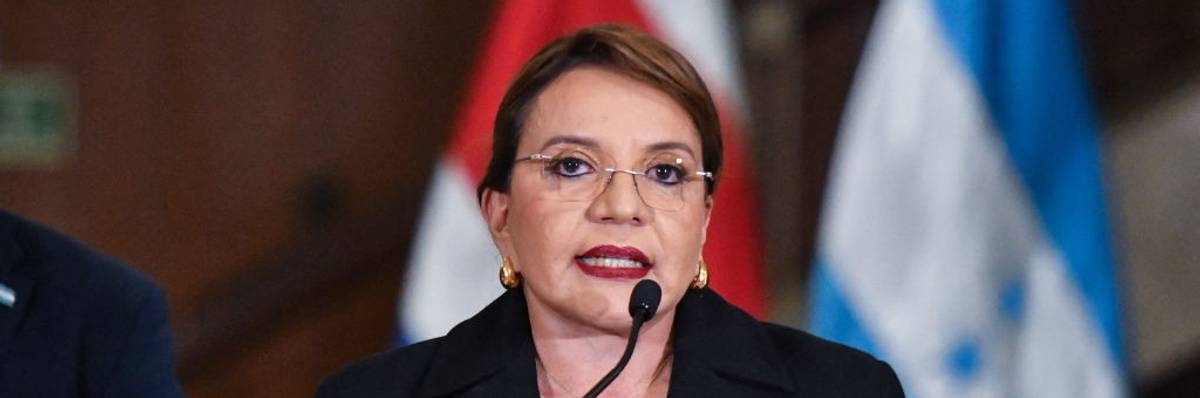
Honduras President Xiomara Castro, in power since 2022, has proposed progressive tax reforms and other left-leaning policies.
"Such a law has implications far beyond Honduras' borders, setting an example of how states can assert sovereignty through taking action against tax injustice individually and collectively," 85 leading economists wrote.
Eighty five progressive economists from around the world on Wednesday issued a statement in support of a tax reform being considered in Honduras, arguing that it could be a model for other Global South countries, as it would tighten tax law for rich people and corporations while preventing the country from becoming a tax haven.
The Tax Justice Law, first proposed by the administration of leftist President Xiomara Castro in March 2023, has remained stuck in parliament due to opposition from conservative, pro-business forces in Honduras, one of the poorest and most unequal countries in the Western Hemisphere.
The proposed reforms include closing corporate tax loopholes; taxing companies' global profits, not just national profits; ending bank secrecy; and holding beneficial owners liable for their taxes. The law wouldn't create new taxes or raise current rates.
The 85 economists, including Joseph Stiglitz, Gabriel Zucman, Jeffrey Sachs, Ann Pettifor, and Yanis Varoufakis, published the statement in Progressive International, a left-wing network establish in 2020. They cited estimates that the country had lost about $20 billion in tax revenues between 2010 and 2023 due to tax loopholes—more than the entire $16.6 billion debt that the country faces, at crippling interest rates.
TEGUCIGALPA, Honduras 🇭🇳 — 85 of the world's leading economists, incl. @JosephEStiglitz, @Jayati1609, @JoseA_Ocampo, @AnnPettifor, @gabriel_zucman and @yanisvaroufakis, endorse the @PartidoLibre Tax Justice Law, "setting an example" for tax policy worldwide. Read the letter ⬇️ pic.twitter.com/9ogi9SlWtf
— Progressive International (@ProgIntl) July 31, 2024
Castro was elected in late 2021 and took office in January 2022 with an "inspiring agenda," but has faced opposition from conservative forces and the United States, according to Karen Spring, coordinator of the Honduras Solidarity Network.
Castro's husband Manuel Zelaya, also a leftist, led the country from 2006 until 2009 but was ousted in a coup, and the country descended into chaos in the 2010s, with drug gangs dominant and the government mired in corruption. The Intercept has reported that the U.S. may have encouraged the 2009 coup.
In 2022, Castro and the National Congress of Honduras reversed a conservative initiative to establish special economic zones, most notably one on the island of Roatán. However, Honduras Próspera, a U.S. company backed by billionaire libertarian Peter Thiel and others, has sued the government for $11 billion over the reversal, using the investor-state dispute settlement (ISDS) system that allows multinationals to sue nations that institute new laws that affect their profits and have the cases heard by private tribunals.
U.S. Sen. Elizabeth Warren (D-Mass.) and other progressive lawmakers cited the Honduras Próspera case when pushing to abolish the ISDS system last year.
As with Castro's efforts on special economic zones, her tax reforms face hurdles.
"Big capital and the media ecosystem close to it have launched a smear campaign against the Tax Justice Law," Ojalá, a digital nonprofit magazine based in Mexico, reported last year.
Every major union organization in Honduras supports the proposed law, a union leader told Ojalá. And the proposal has now gained international attention. Last week, the South Centre, a research institute based in Geneva, issued a report in favor of the law, calling it "timely and welcome," and arguing that it's in keeping with the global minimum tax agreement made by 137 countries in 2021, whose implementation is ongoing.
Similarly, the group of economists on Wednesday wrote that Honduras was "on the path to being labeled a tax haven" but could "turn the page" with the passage of the Tax Justice Law, which would "establish a fairer and more robust system of taxation and incentives that will provide a sounder footing for Honduran development."
The economists concluded that "such a law has implications far beyond Honduras' borders, setting an example of how states can assert sovereignty through taking action against tax injustice individually and collectively."
Dear Common Dreams reader, It’s been nearly 30 years since I co-founded Common Dreams with my late wife, Lina Newhouser. We had the radical notion that journalism should serve the public good, not corporate profits. It was clear to us from the outset what it would take to build such a project. No paid advertisements. No corporate sponsors. No millionaire publisher telling us what to think or do. Many people said we wouldn't last a year, but we proved those doubters wrong. Together with a tremendous team of journalists and dedicated staff, we built an independent media outlet free from the constraints of profits and corporate control. Our mission has always been simple: To inform. To inspire. To ignite change for the common good. Building Common Dreams was not easy. Our survival was never guaranteed. When you take on the most powerful forces—Wall Street greed, fossil fuel industry destruction, Big Tech lobbyists, and uber-rich oligarchs who have spent billions upon billions rigging the economy and democracy in their favor—the only bulwark you have is supporters who believe in your work. But here’s the urgent message from me today. It's never been this bad out there. And it's never been this hard to keep us going. At the very moment Common Dreams is most needed, the threats we face are intensifying. We need your support now more than ever. We don't accept corporate advertising and never will. We don't have a paywall because we don't think people should be blocked from critical news based on their ability to pay. Everything we do is funded by the donations of readers like you. When everyone does the little they can afford, we are strong. But if that support retreats or dries up, so do we. Will you donate now to make sure Common Dreams not only survives but thrives? —Craig Brown, Co-founder |
Eighty five progressive economists from around the world on Wednesday issued a statement in support of a tax reform being considered in Honduras, arguing that it could be a model for other Global South countries, as it would tighten tax law for rich people and corporations while preventing the country from becoming a tax haven.
The Tax Justice Law, first proposed by the administration of leftist President Xiomara Castro in March 2023, has remained stuck in parliament due to opposition from conservative, pro-business forces in Honduras, one of the poorest and most unequal countries in the Western Hemisphere.
The proposed reforms include closing corporate tax loopholes; taxing companies' global profits, not just national profits; ending bank secrecy; and holding beneficial owners liable for their taxes. The law wouldn't create new taxes or raise current rates.
The 85 economists, including Joseph Stiglitz, Gabriel Zucman, Jeffrey Sachs, Ann Pettifor, and Yanis Varoufakis, published the statement in Progressive International, a left-wing network establish in 2020. They cited estimates that the country had lost about $20 billion in tax revenues between 2010 and 2023 due to tax loopholes—more than the entire $16.6 billion debt that the country faces, at crippling interest rates.
TEGUCIGALPA, Honduras 🇭🇳 — 85 of the world's leading economists, incl. @JosephEStiglitz, @Jayati1609, @JoseA_Ocampo, @AnnPettifor, @gabriel_zucman and @yanisvaroufakis, endorse the @PartidoLibre Tax Justice Law, "setting an example" for tax policy worldwide. Read the letter ⬇️ pic.twitter.com/9ogi9SlWtf
— Progressive International (@ProgIntl) July 31, 2024
Castro was elected in late 2021 and took office in January 2022 with an "inspiring agenda," but has faced opposition from conservative forces and the United States, according to Karen Spring, coordinator of the Honduras Solidarity Network.
Castro's husband Manuel Zelaya, also a leftist, led the country from 2006 until 2009 but was ousted in a coup, and the country descended into chaos in the 2010s, with drug gangs dominant and the government mired in corruption. The Intercept has reported that the U.S. may have encouraged the 2009 coup.
In 2022, Castro and the National Congress of Honduras reversed a conservative initiative to establish special economic zones, most notably one on the island of Roatán. However, Honduras Próspera, a U.S. company backed by billionaire libertarian Peter Thiel and others, has sued the government for $11 billion over the reversal, using the investor-state dispute settlement (ISDS) system that allows multinationals to sue nations that institute new laws that affect their profits and have the cases heard by private tribunals.
U.S. Sen. Elizabeth Warren (D-Mass.) and other progressive lawmakers cited the Honduras Próspera case when pushing to abolish the ISDS system last year.
As with Castro's efforts on special economic zones, her tax reforms face hurdles.
"Big capital and the media ecosystem close to it have launched a smear campaign against the Tax Justice Law," Ojalá, a digital nonprofit magazine based in Mexico, reported last year.
Every major union organization in Honduras supports the proposed law, a union leader told Ojalá. And the proposal has now gained international attention. Last week, the South Centre, a research institute based in Geneva, issued a report in favor of the law, calling it "timely and welcome," and arguing that it's in keeping with the global minimum tax agreement made by 137 countries in 2021, whose implementation is ongoing.
Similarly, the group of economists on Wednesday wrote that Honduras was "on the path to being labeled a tax haven" but could "turn the page" with the passage of the Tax Justice Law, which would "establish a fairer and more robust system of taxation and incentives that will provide a sounder footing for Honduran development."
The economists concluded that "such a law has implications far beyond Honduras' borders, setting an example of how states can assert sovereignty through taking action against tax injustice individually and collectively."
Eighty five progressive economists from around the world on Wednesday issued a statement in support of a tax reform being considered in Honduras, arguing that it could be a model for other Global South countries, as it would tighten tax law for rich people and corporations while preventing the country from becoming a tax haven.
The Tax Justice Law, first proposed by the administration of leftist President Xiomara Castro in March 2023, has remained stuck in parliament due to opposition from conservative, pro-business forces in Honduras, one of the poorest and most unequal countries in the Western Hemisphere.
The proposed reforms include closing corporate tax loopholes; taxing companies' global profits, not just national profits; ending bank secrecy; and holding beneficial owners liable for their taxes. The law wouldn't create new taxes or raise current rates.
The 85 economists, including Joseph Stiglitz, Gabriel Zucman, Jeffrey Sachs, Ann Pettifor, and Yanis Varoufakis, published the statement in Progressive International, a left-wing network establish in 2020. They cited estimates that the country had lost about $20 billion in tax revenues between 2010 and 2023 due to tax loopholes—more than the entire $16.6 billion debt that the country faces, at crippling interest rates.
TEGUCIGALPA, Honduras 🇭🇳 — 85 of the world's leading economists, incl. @JosephEStiglitz, @Jayati1609, @JoseA_Ocampo, @AnnPettifor, @gabriel_zucman and @yanisvaroufakis, endorse the @PartidoLibre Tax Justice Law, "setting an example" for tax policy worldwide. Read the letter ⬇️ pic.twitter.com/9ogi9SlWtf
— Progressive International (@ProgIntl) July 31, 2024
Castro was elected in late 2021 and took office in January 2022 with an "inspiring agenda," but has faced opposition from conservative forces and the United States, according to Karen Spring, coordinator of the Honduras Solidarity Network.
Castro's husband Manuel Zelaya, also a leftist, led the country from 2006 until 2009 but was ousted in a coup, and the country descended into chaos in the 2010s, with drug gangs dominant and the government mired in corruption. The Intercept has reported that the U.S. may have encouraged the 2009 coup.
In 2022, Castro and the National Congress of Honduras reversed a conservative initiative to establish special economic zones, most notably one on the island of Roatán. However, Honduras Próspera, a U.S. company backed by billionaire libertarian Peter Thiel and others, has sued the government for $11 billion over the reversal, using the investor-state dispute settlement (ISDS) system that allows multinationals to sue nations that institute new laws that affect their profits and have the cases heard by private tribunals.
U.S. Sen. Elizabeth Warren (D-Mass.) and other progressive lawmakers cited the Honduras Próspera case when pushing to abolish the ISDS system last year.
As with Castro's efforts on special economic zones, her tax reforms face hurdles.
"Big capital and the media ecosystem close to it have launched a smear campaign against the Tax Justice Law," Ojalá, a digital nonprofit magazine based in Mexico, reported last year.
Every major union organization in Honduras supports the proposed law, a union leader told Ojalá. And the proposal has now gained international attention. Last week, the South Centre, a research institute based in Geneva, issued a report in favor of the law, calling it "timely and welcome," and arguing that it's in keeping with the global minimum tax agreement made by 137 countries in 2021, whose implementation is ongoing.
Similarly, the group of economists on Wednesday wrote that Honduras was "on the path to being labeled a tax haven" but could "turn the page" with the passage of the Tax Justice Law, which would "establish a fairer and more robust system of taxation and incentives that will provide a sounder footing for Honduran development."
The economists concluded that "such a law has implications far beyond Honduras' borders, setting an example of how states can assert sovereignty through taking action against tax injustice individually and collectively."

