SUBSCRIBE TO OUR FREE NEWSLETTER
Daily news & progressive opinion—funded by the people, not the corporations—delivered straight to your inbox.
5
#000000
#FFFFFF
To donate by check, phone, or other method, see our More Ways to Give page.
Daily news & progressive opinion—funded by the people, not the corporations—delivered straight to your inbox.
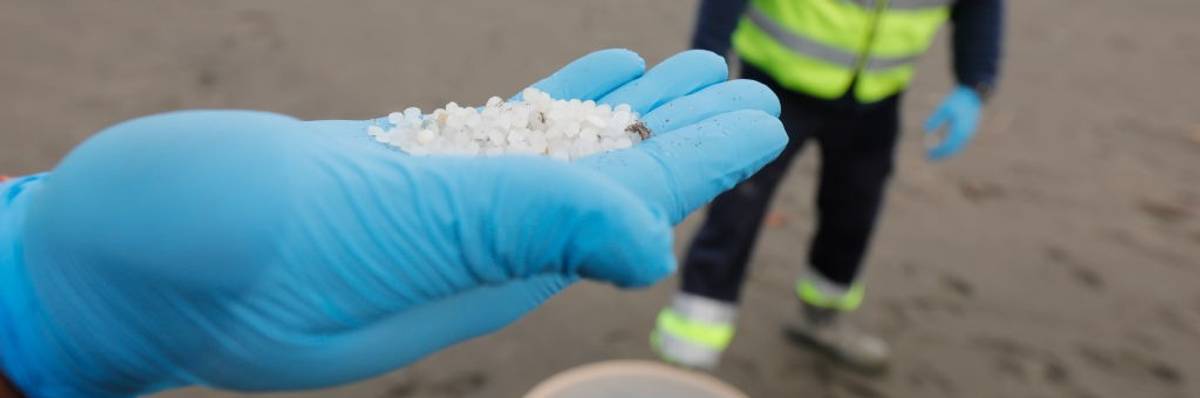
A worker catches plastic pellets with his hand, at Otur beach, on January 9, 2024, in Valdes, Asturias, Spain. The Principality of Asturias has activated an emergency level two for the dumping of plastic pellets on the region's beaches.
The countless beads of plastic, which experts fear are toxic and harmful to marine life and people, are believed to have spilled from a cargo ship.
Millions, or perhaps billions, of plastic pellets continue to wash up on the shores of Spain, leading local governments to declare an environmental emergency and launch a criminal probe after a cargo ship off the coast of Portugal lost six containers overboard last month.
"These little balls of plastic are an environmental problem because fish confuse them with fish eggs and eat them and they enter the food chain … and end up on our dinner tables," Cristobal López, a spokesperson for the Spanish environmental group Ecologistas en Acción, explained to the Associated Press from a cleanup site in Galicia.
According to BBC, "The tiny plastic balls—used to manufacture common goods such as plastic bottles—are less than 5mm wide, making cleaning up extremely difficult. Volunteers have been combing through sand and sieving water to find the plastic pellets."
The spillage at sea is believed to have occurred on Dec. 8, but it took time for the plastic pellets to make their way to shore.
As The Guardian reports:
In the weeks since the spill, millions of the pellets have washed up on beaches in north-west Spain, prompting a clean-up operation by regional workers and volunteers.
On Tuesday, the regional governments of Galicia and neighbouring Asturias issued level 2 alerts, which will allow more personnel and resources to be assigned to the task as well as logistical assistance from the Spanish government's environment and transport ministries.
Alfonso Rueda, the regional president of Galicia, said there was still time to stop more pellets washing up on the shoreline. "There are hundreds of sacks right now that have not reached the coast," he said on Tuesday. "The time to collect them, or at least to try, is now that they are at sea. It seems there will be currents these days that will make it a little easier."
Prosecutors in Galicia have started a criminal investigation into the episode, while environmental campaigners and government officials have said the spill is just the latest example of the harmful impacts of the plastics industry.
"The contamination of the oceans and ecosystems with plastics is one of the biggest problems faced by humanity," said Teresa Ribera, Spain's environmental minister. "So the spilling of such an important quantity of plastics requires close oversight and to determine if the transport company and shipping company exercised the proper precautions."
Greenpeace Spain has launched a petition demanding the harms of plastics be addressed.
"Plastic has invaded our planet and we can already find it in seas, forests, and rivers around the world," states the petition, which calls on the government "to take measures to reduce the production and consumption of plastics that suffocate our environment."
Dear Common Dreams reader, It’s been nearly 30 years since I co-founded Common Dreams with my late wife, Lina Newhouser. We had the radical notion that journalism should serve the public good, not corporate profits. It was clear to us from the outset what it would take to build such a project. No paid advertisements. No corporate sponsors. No millionaire publisher telling us what to think or do. Many people said we wouldn't last a year, but we proved those doubters wrong. Together with a tremendous team of journalists and dedicated staff, we built an independent media outlet free from the constraints of profits and corporate control. Our mission has always been simple: To inform. To inspire. To ignite change for the common good. Building Common Dreams was not easy. Our survival was never guaranteed. When you take on the most powerful forces—Wall Street greed, fossil fuel industry destruction, Big Tech lobbyists, and uber-rich oligarchs who have spent billions upon billions rigging the economy and democracy in their favor—the only bulwark you have is supporters who believe in your work. But here’s the urgent message from me today. It's never been this bad out there. And it's never been this hard to keep us going. At the very moment Common Dreams is most needed, the threats we face are intensifying. We need your support now more than ever. We don't accept corporate advertising and never will. We don't have a paywall because we don't think people should be blocked from critical news based on their ability to pay. Everything we do is funded by the donations of readers like you. When everyone does the little they can afford, we are strong. But if that support retreats or dries up, so do we. Will you donate now to make sure Common Dreams not only survives but thrives? —Craig Brown, Co-founder |
Millions, or perhaps billions, of plastic pellets continue to wash up on the shores of Spain, leading local governments to declare an environmental emergency and launch a criminal probe after a cargo ship off the coast of Portugal lost six containers overboard last month.
"These little balls of plastic are an environmental problem because fish confuse them with fish eggs and eat them and they enter the food chain … and end up on our dinner tables," Cristobal López, a spokesperson for the Spanish environmental group Ecologistas en Acción, explained to the Associated Press from a cleanup site in Galicia.
According to BBC, "The tiny plastic balls—used to manufacture common goods such as plastic bottles—are less than 5mm wide, making cleaning up extremely difficult. Volunteers have been combing through sand and sieving water to find the plastic pellets."
The spillage at sea is believed to have occurred on Dec. 8, but it took time for the plastic pellets to make their way to shore.
As The Guardian reports:
In the weeks since the spill, millions of the pellets have washed up on beaches in north-west Spain, prompting a clean-up operation by regional workers and volunteers.
On Tuesday, the regional governments of Galicia and neighbouring Asturias issued level 2 alerts, which will allow more personnel and resources to be assigned to the task as well as logistical assistance from the Spanish government's environment and transport ministries.
Alfonso Rueda, the regional president of Galicia, said there was still time to stop more pellets washing up on the shoreline. "There are hundreds of sacks right now that have not reached the coast," he said on Tuesday. "The time to collect them, or at least to try, is now that they are at sea. It seems there will be currents these days that will make it a little easier."
Prosecutors in Galicia have started a criminal investigation into the episode, while environmental campaigners and government officials have said the spill is just the latest example of the harmful impacts of the plastics industry.
"The contamination of the oceans and ecosystems with plastics is one of the biggest problems faced by humanity," said Teresa Ribera, Spain's environmental minister. "So the spilling of such an important quantity of plastics requires close oversight and to determine if the transport company and shipping company exercised the proper precautions."
Greenpeace Spain has launched a petition demanding the harms of plastics be addressed.
"Plastic has invaded our planet and we can already find it in seas, forests, and rivers around the world," states the petition, which calls on the government "to take measures to reduce the production and consumption of plastics that suffocate our environment."
Millions, or perhaps billions, of plastic pellets continue to wash up on the shores of Spain, leading local governments to declare an environmental emergency and launch a criminal probe after a cargo ship off the coast of Portugal lost six containers overboard last month.
"These little balls of plastic are an environmental problem because fish confuse them with fish eggs and eat them and they enter the food chain … and end up on our dinner tables," Cristobal López, a spokesperson for the Spanish environmental group Ecologistas en Acción, explained to the Associated Press from a cleanup site in Galicia.
According to BBC, "The tiny plastic balls—used to manufacture common goods such as plastic bottles—are less than 5mm wide, making cleaning up extremely difficult. Volunteers have been combing through sand and sieving water to find the plastic pellets."
The spillage at sea is believed to have occurred on Dec. 8, but it took time for the plastic pellets to make their way to shore.
As The Guardian reports:
In the weeks since the spill, millions of the pellets have washed up on beaches in north-west Spain, prompting a clean-up operation by regional workers and volunteers.
On Tuesday, the regional governments of Galicia and neighbouring Asturias issued level 2 alerts, which will allow more personnel and resources to be assigned to the task as well as logistical assistance from the Spanish government's environment and transport ministries.
Alfonso Rueda, the regional president of Galicia, said there was still time to stop more pellets washing up on the shoreline. "There are hundreds of sacks right now that have not reached the coast," he said on Tuesday. "The time to collect them, or at least to try, is now that they are at sea. It seems there will be currents these days that will make it a little easier."
Prosecutors in Galicia have started a criminal investigation into the episode, while environmental campaigners and government officials have said the spill is just the latest example of the harmful impacts of the plastics industry.
"The contamination of the oceans and ecosystems with plastics is one of the biggest problems faced by humanity," said Teresa Ribera, Spain's environmental minister. "So the spilling of such an important quantity of plastics requires close oversight and to determine if the transport company and shipping company exercised the proper precautions."
Greenpeace Spain has launched a petition demanding the harms of plastics be addressed.
"Plastic has invaded our planet and we can already find it in seas, forests, and rivers around the world," states the petition, which calls on the government "to take measures to reduce the production and consumption of plastics that suffocate our environment."