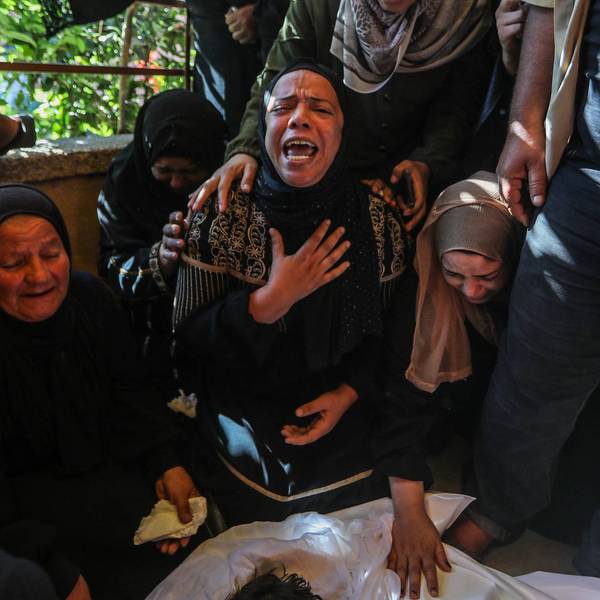
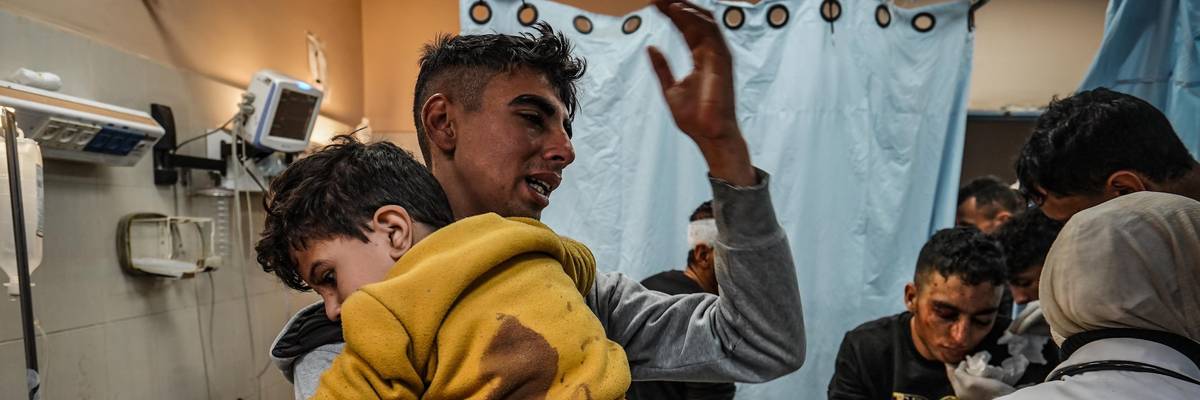
Injured Palestinians, including children, are brought to Nasser Hospital to receive medical treatment following Israeli attacks in Khan Younis, Gaza on January 22, 2024.
Israeli Forces 'Responsible,' Gaza Officials Say as Oxygen Cutoffs Kill Five Patients
The power outage at southern Gaza's largest hospital came hours after Israeli special forces raided the facility.
Several oxygen-dependent patients at southern Gaza's largest hospital died Friday due to a power outage at the facility, which Israeli forces raided and shelled 24 hours earlier as thousands of people who were sheltering at the complex scrambled to flee.
Gaza's Ministry of Health wrote on social media that at least five patients have died at Nasser Hospital in Khan Younis "as a result of a power outage" and the shutoff of electric generators, which medical facilities across the Palestinian enclave have relied on to keep their operations running amid Israel's massive bombing campaign, ground assault, and blockade.
Israel has only allowed limited fuel into Gaza, forcing many of the territory's hospitals to shut down.
Gaza officials did not specifically explain what caused the power outage at Nasser but said they "hold the Israeli occupation responsible for the lives of patients and crews considering that the complex is now under its full control." The health ministry also appealed to the international community to "intervene to save patients and staff" at Nasser "before it's too late."
The Associated Press noted that Gaza's health ministry "had earlier warned that six patients in the ICU and three infants in incubators were in danger because fuel for generators was on the verge of running out."
The Friday statement came hours after Israeli special forces stormed Nasser Hospital, claiming—without providing evidence—that Hamas was using the facility grounds for "military activity" and potentially holding hostages there.
A spokesperson for the Israel Defense Forces (IDF) said that no hostages were found during the Nasser raid on Thursday, which caused panic and chaos at the facility that around 10,000 displaced people turned to for shelter. Some who tried to flee ahead of the raid were shot dead by Israeli snipers, and at least one person was killed by an Israeli attack on Nasser's orthopedic department on Thursday.
The IDF claimed in a statement posted to social media that, during the Nasser raid, it "arrested over 20 terrorists who took part" in the October 7 attacks. The Israeli military also said it "located mortars, grenades, and other weapons" at the hospital, which has been under siege for more than a week, preventing critical supplies such as food and fuel from reaching the complex.
One of the individuals reportedly arrested by Israeli forces on Thursday was Haytham Ahmed, a doctor at Nasser Hospital.
Emina Ćerimović, a researcher at Human Rights Watch, expressed concern over Ahmed's detention, saying that "just yesterday, we were speaking about the situation in Nasser."
Very concerned to hear about the arrest of Dr. Haytham Ahmed, who provided valuable insight for an upcoming @hrw report on children w. disabilities in Gaza.
Just yesterday, we were speaking about the situation in Nasser hospital. https://t.co/pwkn1YmYis
— Emina Ćerimović (@EminaCerimovic) February 16, 2024
Hospitals are shielded under international humanitarian law and can only lose their protections when they are shown to have been used to commit an "act harmful to the enemy."
Kenneth Roth, former executive director of Human Rights Watch, argued early Friday that "no account of Israel's raid of Nasser Hospital (southern Gaza's largest) suggests Hamas was currently operating from there, let alone committing acts 'harmful to the enemy' as required for a hospital to lose protected status."
"Alleged past use isn't enough," Roth added.
Ravina Shamdasani, a spokesperson for the United Nations Human Rights Office, said in a statement Thursday that the U.N. is "deeply worried" by the IDF's Nasser raid.
"Israeli forces reportedly ordered the transfer of all patients, including those in intensive care and nursery units, to a different building, exposing patients to grave risks, including the risk of death for the most vulnerable," Shamdasani said. "There are unconfirmed reports of detention as well as targeting of those trying to leave the hospital."
"The raid appears to be part of a pattern of attacks by Israeli forces striking essential lifesaving civilian infrastructure in Gaza, especially hospitals," she added. "Our office has documented similar raids in Gaza City, North Gaza, Middle Gaza, and in Khan Younis, with serious consequences for the safety of patients, medical, and other staff, as well as civilians sheltering in these facilities."
We are at a crossroads
This country and this world are at a monumental crossroads. In a few short weeks, US voters will have an opportunity to beat back the forces of fascism and confront the billionaires who are rigging the economy, our media system, and our democracy, making it increasingly impossible for ordinary people to get by. We’re not just talking about the election. We’re talking about what must be done once these fascist elements are vanquished from power. We need a bolder set of solutions than what either major party has so far been willing to offer and a working-class movement ready to fight like hell for it. Trump didn't emerge from nowhere. The conditions that fueled MAGA authoritarianism were created by decades of radical neoliberal economic policies and a corrupt political system dominated by corporate interests. They slashed taxes on the super-rich, promising that the benefits would trickle down. They said giveaways to the corporate titans would make life more affordable for the rest of us. It was all bullshit. And when a bitter, betrayed populace searches for someone to blame, right-wing demagogues have little trouble finding scapegoats. People know when they're being lied to, but you won't hear any of this from the corporate media. Only independent journalism—powered and funded by people who believe in building a better world—can deliver truly trustworthy daily news. Our Fall Campaign is underway, and we need your help. To power our newsroom through the rest of the year, we need to raise $125,000 by midnight on October 31. So if you share our vision, please contribute whatever you can to sustain our work. |
Several oxygen-dependent patients at southern Gaza's largest hospital died Friday due to a power outage at the facility, which Israeli forces raided and shelled 24 hours earlier as thousands of people who were sheltering at the complex scrambled to flee.
Gaza's Ministry of Health wrote on social media that at least five patients have died at Nasser Hospital in Khan Younis "as a result of a power outage" and the shutoff of electric generators, which medical facilities across the Palestinian enclave have relied on to keep their operations running amid Israel's massive bombing campaign, ground assault, and blockade.
Israel has only allowed limited fuel into Gaza, forcing many of the territory's hospitals to shut down.
Gaza officials did not specifically explain what caused the power outage at Nasser but said they "hold the Israeli occupation responsible for the lives of patients and crews considering that the complex is now under its full control." The health ministry also appealed to the international community to "intervene to save patients and staff" at Nasser "before it's too late."
The Associated Press noted that Gaza's health ministry "had earlier warned that six patients in the ICU and three infants in incubators were in danger because fuel for generators was on the verge of running out."
The Friday statement came hours after Israeli special forces stormed Nasser Hospital, claiming—without providing evidence—that Hamas was using the facility grounds for "military activity" and potentially holding hostages there.
A spokesperson for the Israel Defense Forces (IDF) said that no hostages were found during the Nasser raid on Thursday, which caused panic and chaos at the facility that around 10,000 displaced people turned to for shelter. Some who tried to flee ahead of the raid were shot dead by Israeli snipers, and at least one person was killed by an Israeli attack on Nasser's orthopedic department on Thursday.
The IDF claimed in a statement posted to social media that, during the Nasser raid, it "arrested over 20 terrorists who took part" in the October 7 attacks. The Israeli military also said it "located mortars, grenades, and other weapons" at the hospital, which has been under siege for more than a week, preventing critical supplies such as food and fuel from reaching the complex.
One of the individuals reportedly arrested by Israeli forces on Thursday was Haytham Ahmed, a doctor at Nasser Hospital.
Emina Ćerimović, a researcher at Human Rights Watch, expressed concern over Ahmed's detention, saying that "just yesterday, we were speaking about the situation in Nasser."
Very concerned to hear about the arrest of Dr. Haytham Ahmed, who provided valuable insight for an upcoming @hrw report on children w. disabilities in Gaza.
Just yesterday, we were speaking about the situation in Nasser hospital. https://t.co/pwkn1YmYis
— Emina Ćerimović (@EminaCerimovic) February 16, 2024
Hospitals are shielded under international humanitarian law and can only lose their protections when they are shown to have been used to commit an "act harmful to the enemy."
Kenneth Roth, former executive director of Human Rights Watch, argued early Friday that "no account of Israel's raid of Nasser Hospital (southern Gaza's largest) suggests Hamas was currently operating from there, let alone committing acts 'harmful to the enemy' as required for a hospital to lose protected status."
"Alleged past use isn't enough," Roth added.
Ravina Shamdasani, a spokesperson for the United Nations Human Rights Office, said in a statement Thursday that the U.N. is "deeply worried" by the IDF's Nasser raid.
"Israeli forces reportedly ordered the transfer of all patients, including those in intensive care and nursery units, to a different building, exposing patients to grave risks, including the risk of death for the most vulnerable," Shamdasani said. "There are unconfirmed reports of detention as well as targeting of those trying to leave the hospital."
"The raid appears to be part of a pattern of attacks by Israeli forces striking essential lifesaving civilian infrastructure in Gaza, especially hospitals," she added. "Our office has documented similar raids in Gaza City, North Gaza, Middle Gaza, and in Khan Younis, with serious consequences for the safety of patients, medical, and other staff, as well as civilians sheltering in these facilities."
Several oxygen-dependent patients at southern Gaza's largest hospital died Friday due to a power outage at the facility, which Israeli forces raided and shelled 24 hours earlier as thousands of people who were sheltering at the complex scrambled to flee.
Gaza's Ministry of Health wrote on social media that at least five patients have died at Nasser Hospital in Khan Younis "as a result of a power outage" and the shutoff of electric generators, which medical facilities across the Palestinian enclave have relied on to keep their operations running amid Israel's massive bombing campaign, ground assault, and blockade.
Israel has only allowed limited fuel into Gaza, forcing many of the territory's hospitals to shut down.
Gaza officials did not specifically explain what caused the power outage at Nasser but said they "hold the Israeli occupation responsible for the lives of patients and crews considering that the complex is now under its full control." The health ministry also appealed to the international community to "intervene to save patients and staff" at Nasser "before it's too late."
The Associated Press noted that Gaza's health ministry "had earlier warned that six patients in the ICU and three infants in incubators were in danger because fuel for generators was on the verge of running out."
The Friday statement came hours after Israeli special forces stormed Nasser Hospital, claiming—without providing evidence—that Hamas was using the facility grounds for "military activity" and potentially holding hostages there.
A spokesperson for the Israel Defense Forces (IDF) said that no hostages were found during the Nasser raid on Thursday, which caused panic and chaos at the facility that around 10,000 displaced people turned to for shelter. Some who tried to flee ahead of the raid were shot dead by Israeli snipers, and at least one person was killed by an Israeli attack on Nasser's orthopedic department on Thursday.
The IDF claimed in a statement posted to social media that, during the Nasser raid, it "arrested over 20 terrorists who took part" in the October 7 attacks. The Israeli military also said it "located mortars, grenades, and other weapons" at the hospital, which has been under siege for more than a week, preventing critical supplies such as food and fuel from reaching the complex.
One of the individuals reportedly arrested by Israeli forces on Thursday was Haytham Ahmed, a doctor at Nasser Hospital.
Emina Ćerimović, a researcher at Human Rights Watch, expressed concern over Ahmed's detention, saying that "just yesterday, we were speaking about the situation in Nasser."
Very concerned to hear about the arrest of Dr. Haytham Ahmed, who provided valuable insight for an upcoming @hrw report on children w. disabilities in Gaza.
Just yesterday, we were speaking about the situation in Nasser hospital. https://t.co/pwkn1YmYis
— Emina Ćerimović (@EminaCerimovic) February 16, 2024
Hospitals are shielded under international humanitarian law and can only lose their protections when they are shown to have been used to commit an "act harmful to the enemy."
Kenneth Roth, former executive director of Human Rights Watch, argued early Friday that "no account of Israel's raid of Nasser Hospital (southern Gaza's largest) suggests Hamas was currently operating from there, let alone committing acts 'harmful to the enemy' as required for a hospital to lose protected status."
"Alleged past use isn't enough," Roth added.
Ravina Shamdasani, a spokesperson for the United Nations Human Rights Office, said in a statement Thursday that the U.N. is "deeply worried" by the IDF's Nasser raid.
"Israeli forces reportedly ordered the transfer of all patients, including those in intensive care and nursery units, to a different building, exposing patients to grave risks, including the risk of death for the most vulnerable," Shamdasani said. "There are unconfirmed reports of detention as well as targeting of those trying to leave the hospital."
"The raid appears to be part of a pattern of attacks by Israeli forces striking essential lifesaving civilian infrastructure in Gaza, especially hospitals," she added. "Our office has documented similar raids in Gaza City, North Gaza, Middle Gaza, and in Khan Younis, with serious consequences for the safety of patients, medical, and other staff, as well as civilians sheltering in these facilities."