SUBSCRIBE TO OUR FREE NEWSLETTER
Daily news & progressive opinion—funded by the people, not the corporations—delivered straight to your inbox.
5
#000000
#FFFFFF
To donate by check, phone, or other method, see our More Ways to Give page.
Daily news & progressive opinion—funded by the people, not the corporations—delivered straight to your inbox.
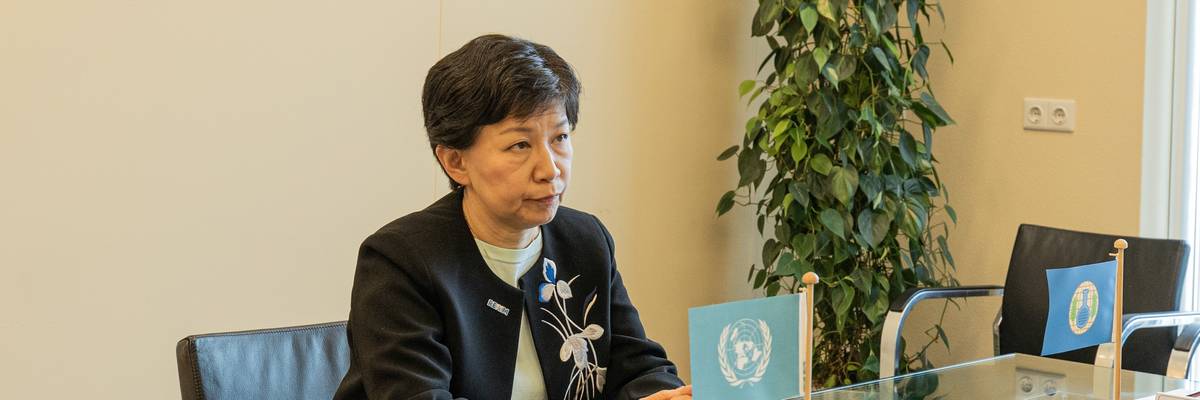
United Nations High Representative for Disarmament Affairs Izumi Nakamitsu attends a February 16, 2023 meeting with the head of the Organization for the Prohibition of Chemical Weapons.
"Though we are living in a moment of increased confrontation and militarization, one fundamental truth remains unchanged: The only way to eliminate nuclear risk is to eliminate nuclear weapons."
The head of the United Nations disarmament division warned Thursday of the need for urgent global action to eliminate atomic weapons, especially during the current heightened tensions between the United States and Russia—the world's leading nuclear powers—over the latter's thermonuclear threats during its invasion of Ukraine.
Addressing attendees of the International Campaign to Abolish Nuclear Weapons' "ICAN Act On It" Forum in Oslo, Norway via a pre-recorded video message, United Nations High Representative for Disarmament Affairs Izumi Nakamitsu linked the concept of "humanitarian disarmament" with international agreements including the Convention on Cluster Munitions, the Anti-Personnel Landmine Ban Convention, and the Treaty for the Prohibition of Nuclear Weapons (TPNW).
"It is clear that a desire to avoid the unspeakable human suffering caused by the use of nuclear weapons is a driving force for nuclear disarmament efforts," Nakamitsu said. "Such efforts are needed now more than ever."
"Since the invasion of Ukraine by the Russian Federation just over one year ago, we have witnessed an increase in dangerous nuclear rhetoric," she noted. "There has been a further breakdown of trust among the two states with the world's largest nuclear arsenals. In the past weeks, we have seen the suspension of inspections under the last remaining treaty limiting the size of these arsenals."
"Nuclear risk is at the highest level since the depth of the Cold War," said Nakamitsu, who highlighted "five key measures that can be taken" to "reverse current dangerous trends":
"Though we are living in a moment of increased confrontation and militarization, one fundamental truth remains unchanged: The only way to eliminate nuclear risk is to eliminate nuclear weapons," Nakamitsu concluded. "This remains the highest disarmament priority of the United Nations and we will continue to work with all member states and all other stakeholders to that end."
Dear Common Dreams reader, It’s been nearly 30 years since I co-founded Common Dreams with my late wife, Lina Newhouser. We had the radical notion that journalism should serve the public good, not corporate profits. It was clear to us from the outset what it would take to build such a project. No paid advertisements. No corporate sponsors. No millionaire publisher telling us what to think or do. Many people said we wouldn't last a year, but we proved those doubters wrong. Together with a tremendous team of journalists and dedicated staff, we built an independent media outlet free from the constraints of profits and corporate control. Our mission has always been simple: To inform. To inspire. To ignite change for the common good. Building Common Dreams was not easy. Our survival was never guaranteed. When you take on the most powerful forces—Wall Street greed, fossil fuel industry destruction, Big Tech lobbyists, and uber-rich oligarchs who have spent billions upon billions rigging the economy and democracy in their favor—the only bulwark you have is supporters who believe in your work. But here’s the urgent message from me today. It's never been this bad out there. And it's never been this hard to keep us going. At the very moment Common Dreams is most needed, the threats we face are intensifying. We need your support now more than ever. We don't accept corporate advertising and never will. We don't have a paywall because we don't think people should be blocked from critical news based on their ability to pay. Everything we do is funded by the donations of readers like you. When everyone does the little they can afford, we are strong. But if that support retreats or dries up, so do we. Will you donate now to make sure Common Dreams not only survives but thrives? —Craig Brown, Co-founder |
The head of the United Nations disarmament division warned Thursday of the need for urgent global action to eliminate atomic weapons, especially during the current heightened tensions between the United States and Russia—the world's leading nuclear powers—over the latter's thermonuclear threats during its invasion of Ukraine.
Addressing attendees of the International Campaign to Abolish Nuclear Weapons' "ICAN Act On It" Forum in Oslo, Norway via a pre-recorded video message, United Nations High Representative for Disarmament Affairs Izumi Nakamitsu linked the concept of "humanitarian disarmament" with international agreements including the Convention on Cluster Munitions, the Anti-Personnel Landmine Ban Convention, and the Treaty for the Prohibition of Nuclear Weapons (TPNW).
"It is clear that a desire to avoid the unspeakable human suffering caused by the use of nuclear weapons is a driving force for nuclear disarmament efforts," Nakamitsu said. "Such efforts are needed now more than ever."
"Since the invasion of Ukraine by the Russian Federation just over one year ago, we have witnessed an increase in dangerous nuclear rhetoric," she noted. "There has been a further breakdown of trust among the two states with the world's largest nuclear arsenals. In the past weeks, we have seen the suspension of inspections under the last remaining treaty limiting the size of these arsenals."
"Nuclear risk is at the highest level since the depth of the Cold War," said Nakamitsu, who highlighted "five key measures that can be taken" to "reverse current dangerous trends":
"Though we are living in a moment of increased confrontation and militarization, one fundamental truth remains unchanged: The only way to eliminate nuclear risk is to eliminate nuclear weapons," Nakamitsu concluded. "This remains the highest disarmament priority of the United Nations and we will continue to work with all member states and all other stakeholders to that end."
The head of the United Nations disarmament division warned Thursday of the need for urgent global action to eliminate atomic weapons, especially during the current heightened tensions between the United States and Russia—the world's leading nuclear powers—over the latter's thermonuclear threats during its invasion of Ukraine.
Addressing attendees of the International Campaign to Abolish Nuclear Weapons' "ICAN Act On It" Forum in Oslo, Norway via a pre-recorded video message, United Nations High Representative for Disarmament Affairs Izumi Nakamitsu linked the concept of "humanitarian disarmament" with international agreements including the Convention on Cluster Munitions, the Anti-Personnel Landmine Ban Convention, and the Treaty for the Prohibition of Nuclear Weapons (TPNW).
"It is clear that a desire to avoid the unspeakable human suffering caused by the use of nuclear weapons is a driving force for nuclear disarmament efforts," Nakamitsu said. "Such efforts are needed now more than ever."
"Since the invasion of Ukraine by the Russian Federation just over one year ago, we have witnessed an increase in dangerous nuclear rhetoric," she noted. "There has been a further breakdown of trust among the two states with the world's largest nuclear arsenals. In the past weeks, we have seen the suspension of inspections under the last remaining treaty limiting the size of these arsenals."
"Nuclear risk is at the highest level since the depth of the Cold War," said Nakamitsu, who highlighted "five key measures that can be taken" to "reverse current dangerous trends":
"Though we are living in a moment of increased confrontation and militarization, one fundamental truth remains unchanged: The only way to eliminate nuclear risk is to eliminate nuclear weapons," Nakamitsu concluded. "This remains the highest disarmament priority of the United Nations and we will continue to work with all member states and all other stakeholders to that end."